


Beijing Subway
| Beijing Subway | |||||||
|---|---|---|---|---|---|---|---|
 Logo of Beijing Subway | |||||||
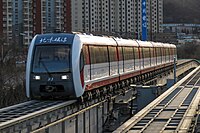
.jpg) A line 13 train leaving Huoying station | |||||||
| Overview | |||||||
| Native name | |||||||
| Chinese name | |||||||
| Simplified Chinese | 北京地铁 | ||||||
| Traditional Chinese | 北京地鐵 | ||||||
| |||||||
| Owner | Beijing Municipal Government | ||||||
| Locale | Beijing & Langfang, Hebei | ||||||
| Transit type | Rapid transit | ||||||
| Number of lines | 27 | ||||||
| Number of stations | 490[1] | ||||||
| Daily ridership | 10.544 million (2018 daily avg.)[2] 13.7538 million (12 July 2019 record)[3] | ||||||
| Annual ridership | 3.8484 billion (2018)[2] | ||||||
| Website | bjsubway.com mtr.bj.cn bjmoa.cn | ||||||
| Operation | |||||||
| Began operation | 15 January 1971 | ||||||
| Operator(s) |
| ||||||
| Character | Underground, at grade and elevated | ||||||
| Number of vehicles | 6,173 Revenue Railcars (2019)[4] | ||||||
| Technical | |||||||
| System length | 836 km (519 mi)[1] | ||||||
| Track gauge | 1,435 mm (4 ft 8+1⁄2 in) standard gauge | ||||||
| Electrification |
| ||||||
| |||||||

The Beijing Subway is the rapid transit system of Beijing Municipality that consists of 27 lines including 22 rapid transit lines, two airport rail links, one maglev line and 2 light rail lines, and 490 stations.[1] The rail network extends 836 km (519 mi)[1] across 12 urban and suburban districts of Beijing and into one district of Langfang in neighboring Hebei province. With 3.8484 billion trips delivered in 2018,[2] an average of 10.544 million trips per day,[2] the Beijing Subway is the world's busiest metro system. Single-day ridership set a record of 13.7538 million on July 12, 2019.[3] Being 836 kilometres (519 mi) in system length, the Beijing Subway is the longest metro system by route length, surpassing the Shanghai Metro in December 2023.
The Beijing Subway opened in 1971 and is the oldest metro system in mainland China and on the mainland of East Asia. Before the system began its rapid expansion in 2002, the subway had only two lines. The existing network still cannot adequately meet the city's mass transit needs. Beijing Subway's extensive expansion plans call for 998.5 km (620.4 mi)[5] of lines serving a projected 18.5 million trips every day when Phase 2 Construction Plan finished (around 2025).[6][7][8] The most recent expansion came into effect on December 30, 2023, with the openings of extensions to Line 11, Line 16, and Line 17.
Fares[edit]
Fare schedules[edit]
Single-ride fare
The Beijing Subway charges single-ride fare according to trip distance for all lines except the two airport express lines.
- For all lines except the two airport express lines, fares start at ¥3 for a trip up to 6 km in distance, with ¥1 added for the next 6 km, for every 10 km thereafter until the trip distance reaches 32 km, and for every 20 km beyond the first 32 km.[9] A 40 km trip would cost ¥7.
- The Capital Airport Express has a fixed fare of ¥25 per ride.[10]
- The Daxing Airport Express is the only line to maintain class-based fares with ordinary class fare varying with distance from ¥10 to ¥35 and business class fare fixed at ¥50 per ride.[11]
Same-station transfers are free on all subway lines except the two Airport Express lines, the Xijiao Line and the Yizhuang T1 Line, which require the purchase of a new fare when transferring to or from those lines.
Fare free riders
Children below 1.3 metres (51 in) in height ride for free when accompanied by a paying adult.[12] Senior citizens over the age of 65, individuals with physical disabilities, retired revolutionary cadres, police and army veterans who had been wounded in action, military personnel and People's Armed Police can ride the subway for free.[13]
Unlimited-rides fare
Since January 20, 2019, riders can purchase unlimited rides fare tickets using the Yitongxing (亿通行) APP on smartphones, which generates a QR code with effective periods of one to seven days.
| Fare | Trip distance |
|---|---|
| ¥3 | <6 km |
| ¥4 | 6–12 km |
| ¥5 | 12–22 km |
| ¥6 | 22–32 km |
| ¥7 | 32–52 km |
| ¥8 | 52–72 km |
| ¥9 | 72–92 km |
| ¥10 | 92–112 km |
| Period | Price |
|---|---|
| 1 day | ¥20 |
| 2 days | ¥30 |
| 3 days | ¥40 |
| 5 days | ¥70 |
| 7 days | ¥90 |
Previous fare schedules
On December 28, 2014, the Beijing Subway switched from a fixed-fare schedule to the current distance-based fare schedule for all lines except the Capital Airport Express.[9][11] Prior to the December 28, 2014 fare increase, passengers paid a flat rate of RMB(¥) 2.00 (including unlimited fare-free transfers) for all lines except the Capital Airport Express, which cost ¥25,[14] The flat fare was the lowest among metro systems in China.[15] Before the flat fare schedule was introduced on October 7, 2007, fares ranged from ¥3 to ¥7, depending on the line and number of transfers.
Fare collection[edit]
Each station has two to fifteen ticket vending machines.[16] Ticket vending machines on all lines can add credit to Yikatong cards.[17] Single-ride tickets take the form of an RFID-enabled flexible plastic card.
| Discounts for Yikatong card users | ||
|---|---|---|
| Monthly expenditure |
Net expenditure after credit rebate |
Net discount |
| ¥50 | ¥50 | 0% |
| ¥100 | ¥100 | 0% |
| ¥150 | ¥140 | 6.67% |
| ¥200 | ¥165 | 17.5% |
| ¥250 | ¥190 | 24% |
| ¥300 | ¥215 | 28.3% |
| ¥350 | ¥240 | 31.4% |
| ¥400 | ¥265 | 33.75% |
| ¥450 | ¥315 | 30% |
| ¥500 | ¥365 | 27% |
Passengers must insert the ticket or scan the card at the gate both before entering and exiting the station. The subway's fare collection gates accept single-ride tickets and the Yikatong fare card. Passengers can purchase tickets and add credit to Yikatong card at ticket counters or vending machines in every station. The Yikatong, also known as Beijing Municipal Administration & Communication Card (BMAC), is an integrated circuit card that stores credit for the subway, urban and suburban buses and e-money for other purchases.[18] The Yikatong card itself must be purchased at the ticket counter. To enter a station, the Yikatong card must have a minimum balance of ¥3.00.[19] Upon exiting the system, single-ride tickets are inserted into the turnstile, which are reused by the system.

To prevent fraud, passengers are required to complete their journeys within four hours upon entering the subway.[13] If the four-hour limit is exceeded, a surcharge of ¥3 is imposed.[20] Each Yikatong card is allowed to be overdrawn once. The overdrawn amount is deducted when credits are added to the card.[21]
Yikatong card users who spend more than ¥100 on subway fare in a calendar month will receive credits to their card the following month.[9] After reaching ¥100 of spending in one calendar month, 20% of any further spending up to ¥150 will be credited. When spending exceeds ¥150, 50% of any further spending up to ¥250 will be credited.[9] Once expenditures exceed ¥400, further spending won't earn any more credits.[9] The credits are designed to ease commuters' burdens of fare increases.[9]
Beginning in June 2017, single-journey tickets could be purchased via a phone app.[22] A May 2018 upgrade allowed entrance via scanning a QR code from the same app.[23]
Since the COVID-19 pandemic, a name and Chinese Resident Identity Card number must be entered when buying single-ride tickets for contact tracing purposes. This measure has been criticized for increasing the time spent buying tickets.[24] This is no longer the case as of December 2022.
Lines in operation[edit]
Beijing Subway lines generally follow the checkerboard layout of the city. Most lines through the urban core (outlined by the Line 10 loop) run parallel or perpendicular to each other and intersect at right angles.


.jpg)

.jpg)
.jpg)


Lines through the urban core[edit]
The urban core of Beijing is roughly outlined by the Line 10 loop, which runs underneath or just beyond the 3rd Ring Road. Each of the following lines provides extensive service within the Line 10 loop. All have connections to seven or more lines. Lines 1, 4, 5, 6, 8, and 19 also run through the Line 2 loop, marking the old Ming-Qing era city of Beijing.
- Line 1: straight east–west line underneath Chang'an Avenue, bisecting the city through Tiananmen Square. Line 1 connects major commercial centres, Xidan, Wangfujing, Dongdan and the Beijing CBD.
- Line 2: the inner rectangular loop line that traces the Ming-era inner city wall which once surrounded the inner city, with stops at 11 of the wall's former gates (ending in men), now busy intersections, as well as the Beijing railway station.[e]
- Line 4: mainly north–south line running to the west of city centre with stops at the Summer Palace, Old Summer Palace, Peking and Renmin Universities, Zhongguancun, National Library, Beijing Zoo, Xidan, Taoranting and Beijing South railway station.
- Line 5: straight north–south line running to the east of the city centre. Line 5 passes the Temple of Earth, Yonghe Temple and the Temple of Heaven.
- Line 6: east–west line running parallel and to the north of Line 1, passing through the city centre north of Beihai Park. At 53.4 km, Line 6 is the second longest Beijing Subway line after Line 10, and runs from Shijingshan District in the west to the Beijing City Sub-Center in Tongzhou District, terminating at Lucheng just beyond the eastern 6th Ring Road.
- Line 7: east–west line running parallel and to the south of Line 1, from Beijing West railway station to Universal Resort. Line 7 serves the old neighborhoods of southern Beijing with stops at Zhushikou, Caishikou and Ciqikou.
- Line 8: north–south line following the Beijing's central axis from Changping District through Huilongguan, the Olympic Green, Shichahai and Nanluoguxiang, where the line veers east of the Forbidden City and Tiananmen Square with stops at the National Art Museum and Wangfujing before returning to the central axis at Qianmen and continuing due south through Zhushikou and Yongdingmen to Heyi before turning southwest to Yinghai in Daxing District.
- Line 9: north–south line running to the west of Line 4 from the National Library through the Military Museum and Beijing West railway station to Guogongzhuang in the southwestern suburbs.
- Line 10, the outer loop line running beneath or just beyond the Third Ring Road. Apart from the Line 2 loop, which is entirely enclosed within the Line 10 loop, every other line through the urban core intersects with Line 10. In the north, Line 10 traces Beijing's Yuan-era city wall. In the east, Line 10 passes through the Beijing CBD.
- Line 14: inverted-L shaped line that connects the southwest, southeast and northeast parts of the city. From Zhangguozhuang in the southwest, Line 14 runs due west and enters the Line 10 loop at Xiju and passing through the Beijing South Railway Station, Yongdingmenwai, Puhuangyu, Fangzhuang and leaves the Line 10 loop at Shilihe before turning north at Beijing University of Technology and running south - north outside the Line 10 loop through the Beijing CBD, Chaoyang Park and Jiuxianqiao to Wangjing in the northeast.
- Line 16: line from the northwest suburbs of Haidian District north of the Baiwang Mountain that runs mostly north - south upon entering Line 10 into National Library and Yuyuantan Dongmen (Yuyuantan Park East Gate), then continuing south through Muxidi and Daguanying, before entering Fengtai railway station. It then turns west through Fengtai Nanlu before ending at Wanpingcheng in Fengtai District.
- Line 19: north–south line from Mudanyuan to Xingong with stops inside the Line 2 loop at Ping'anli and Taipingqiao near Beijing Financial Street.
Lines serving outlying suburbs[edit]
Each of the following lines provides service predominantly to one or more of the suburbs beyond the 5th Ring Road. Lines 15, S1 along with the Changping, Daxing, Yanfang lines extend beyond the 6th Ring Road.
- Line 11 currently runs from Moshikou to Xinshougang (Shougang Park) in Shijingshan District.
- Line 13 arcs across suburbs north of the city and transports commuters to Xizhimen and Dongzhimen, at the northwest and northeast corners of Line 2.
- Line 15 east–west line which runs between the northern 4th and 5th Ring Road from the east of Tsinghua University, through the Olympic Green and Wangjing, turning northeast to suburban Shunyi District.
- Line 17 currently runs from Shilihe to Jiahuihu in its south section, mainly serving Tongzhou District, whilst the north section currently runs from Future Science City North to Workers' Stadium, mainly serving Changping District and northern Chaoyang District.
- Batong line extends Line 1 eastward from Sihui to suburban Tongzhou District.
- Changping line starts at Xitucheng in Haidian District, passing through Liudaokou and Qinghe Xiaoyingqiao before intersecting with Line 13 at Qinghe railway station and Xi'erqi, and then running north through suburban Changping District. The line then passes the Life Science Park, Shahe Univ. Park, and the Ming Tombs.
- Daxing line extends Line 4 south to suburban Daxing District.
- Fangshan line goes from Dongguantounan in Fengtai District to Yancundong in Fangshan District in the southwestern suburbs.
- Yanfang line extends the Fangshan line further into western Fangshan District.
- Yizhuang line extends from Line 5's southern terminus to the Yizhuang Economic & Technological Development Zone in the southeastern suburbs.
- Capital Airport Express connects the Beijing Capital International Airport, 27 km (17 mi) northeast of the city, with Line 5 at Beixinqiao, Line 10 at Sanyuanqiao and Lines 2 and 13 at Dongzhimen.
- Daxing Airport Express connects the Beijing Daxing International Airport, 46 km (29 mi) south of the city, with Line 10 at Caoqiao.
- Line S1, a low-speed maglev line connecting suburban Mentougou District with Line 6 in Shijingshan District.
- Xijiao line, a light rail line that branches off Line 10 at Bagou and extends west to Fragrant Hills.
- Yizhuang T1 line, a light rail line runs from Quzhuang in Daxing District to Dinghaiyuan in Tongzhou District.
-
 Tian'anmen East station of Line 1
 -
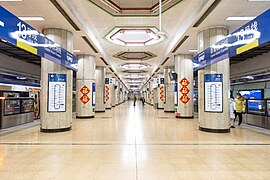 Dongzhimen station of Line 2
 -
 Beijing Zoo station of Line 4
 -
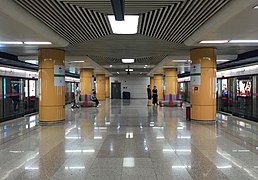 Dengshikou station of Line 5
 -
 Xihuangcun station of Line 6
 -
 Langxinzhuang station of Line 7
 -
 Jinyu Hutong station of Line 8
 -
 Fengtai Dongdajie station of Line 9
 -
 Anzhenmen station of Line 10
 -
 Beixin'an station of Line 11
 -
 Longze station of Line 13
 -
 Dongguantou station of Line 14
 -
 Maquanying station of Line 15
 -
 Ganjiakou station of Line 16
 -
 Jiahuihu station of Line 17
 -
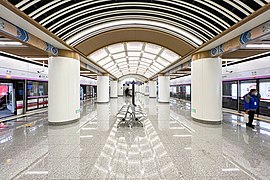 Niujie station of Line 19
 -
 Yizhuang Railway Station of Yizhuang Line
 -
 Huaxiang Dongqiao station of Fangshan Line
 -
 Qiaohuying station of Line S1
 -
 Beishaowa station of Changping Line
.jpg)
.jpg)
.jpg)
.jpg)
.jpg)
.jpg)
.jpg)
_20130813.jpg)
.jpg)

.jpg)

.jpg)
.jpg)
.jpg)


.jpg)

Future expansion[edit]
Phase II[edit]
According to the Phase 2 construction plan approved by the NDRC in 2015, the length of Beijing Subway will reach 998.5 km (620.4 mi)[35] when the Phase 2 construction finished.[35] By then, public transit will comprise 60% of all trips. Of those, the subway will comprise 62%.[35] The adjustment of the Phase 2 construction plan was approved by the NDRC on December 5, 2019.[36] Which altered and expanded some projects in the Phase 2 construction plan. Including adjusting alignments of Line 22 and Line 28 and additional projects such as the Daxing Airport Line north extension, the west section of Line 11 and transforming Line 13 into two lines, 13A and 13B.[37]

| Future Expansion (Phase 2) | |||||||||||
|---|---|---|---|---|---|---|---|---|---|---|---|
| Planned opening |
Line | Phase & Section | Terminals (District) |
Route Description | Construction since |
Length (km) |
Stations | Status | Refs | ||
| 2024 | 1 | Renovation on Fushouling station | Pingguoyuan (Shijingshan) |
Fushouling (Shijingshan) |
2020 | 1.6 | 2 | Under construction | [38] | ||
| 3 | Phase I | Dongsi Shitiao (Dongcheng) |
Dongbabei (Chaoyang) |
2017 | 15.6 | 10 | [39][40] | ||||
| 12 | Sijiqingqiao (Haidian) |
Dongbabei (Chaoyang) |
Following the North Third Ring Road | 2015 | 29.6 | 20 | [41][42] | ||||
| 2025 | 17 | Middle section of Phase I | Workers' Stadium (Chaoyang) |
Shilihe (Chaoyang) |
2015 | 7.6 | 4 | ||||
| 22 (Pinggu) | Dongdaqiao (Chaoyang) |
Pinggu (Pinggu) |
2021 | 81.2 | 21 | [43] | |||||
| 13A | Line 13 split project | Chegongzhuang (Xicheng) |
Tiantongyuandong (Changping) |
2021[44] | 31.2 (19.8 new) | 18 | [45][44] | ||||
| 13B | Dongzhimen (Dongcheng) |
Malianwa (Haidian) |
2021[44] | 32.2 (9.2 new) | 15 | ||||||
| Daxing Airport | North extension | Lize Shangwuqu (Fengtai) |
Caoqiao (Fengtai) |
2020 | 3.5 | 1 | [46] | ||||
| 2026 | 6 | South ext. of Phase II | Lucheng (Tongzhou) |
Dongxiaoyingnan (Tongzhou) |
2022 | 2.1 | 1 | [47][48] | |||
| 2029 | 28 (CBD line) | Dongdaqiao (Chaoyang) |
Guangqudonglu (Chaoyang) |
Runs through the Central Business District | 2021[49] | 8.9[50] | 9 | [50][49] | |||
| Total | 213.5 | 101 | |||||||||
Phase III (2022–2027)[edit]
According to the information released in July 2022, the "Beijing Rail Transit Phase III Construction Plan" includes 11 construction projects: Line 1 Branch, Line 7 Phase 3, Line 11 Phase 2, Line 15 Phase 2, Line 17 Phase 2 (Branch), Line 19 Phase 2, Line 20 Phase 1, Fangshan line (Line 25) Phase 3 (also known as Lijin Line), Line M101 Phase 1, Line S6 (New Town Link Line) Phase 1, and the connecting line between Yizhuang line, Line 5 and Line 10.[51]
| Future Expansion (Phase 3) | ||||||
|---|---|---|---|---|---|---|
| Line | Terminals | Planned Opening | Length in km |
Station | Source | |
| 1 Branch |
Bajiao Amusement Park | Qinglonghudong | 2027 | 19.9 | 9 | [51] |
| 7 Phase 3 |
Beijing West railway station | Wanshousi | 6.4 | 4 | ||
| 11 Phase 2 |
Xinshougang (Shougang Park) | Yangqiao | 23.8 | 17 | ||
| 15 Phase 2 |
Fengbo | Nancai | 3.5 | 1 | ||
| 17 Branch |
Tiantongyuandong | Beiqijia | 8.9 | 2 | ||
| 19 North |
Mudanyuan | Shengminggu | 17.6 | 6 | ||
| 19 North Branch |
Shangqingqiaonan | Qinghe railway station | 6.8 | 1 | ||
| 19 South |
Xingong | Haizijiao | 12.6 | 6 | ||
| 19 South Branch |
New Media Industry Base | Biomedical Base West | 17.4 | 7 | ||
| 20 Phase 1 |
Guanzhuangluxikou | Linhe | 19 | 4 | ||
| Fangshan Phase 3 |
Dongguantounan | Lingjing Hutong | 10.9 | 8 | ||
| M101 Phase 1 |
Shangwuyuan | Zhangjiawandong | 2027 | 18.1 | 14 | |
| S6 Phase 1 |
Terminal 3 | Daxing Xincheng | 64.4 | 9 | ||
| Yizhuang - 5 - 10 (Connecting line) |
Connecting Xiaocun, Chengshousi, and Songjiazhuang. | 1.1 | 0 | |||
| Total | 230.4 | 88 | ||||
Owner and operators[edit]
The Beijing Subway is owned by the Beijing Municipal People's Government through the Beijing Infrastructure Investment Co., LTD, (北京市基础设施投资有限公司 or BIIC), a wholly owned subsidiary of the Beijing State-owned Assets Supervision and Administration Commission (北京市人民政府国有资产监督管理委员会 or Beijing SASAC), the municipal government's asset holding entity.
The Beijing Subway was originally developed and controlled by the Central Government. The subway's construction and planning was headed by a special committee of the State Council. In February 1970, Premier Zhou Enlai handed management of the subway to the People's Liberation Army, which formed the PLA Rail Engineering Corp Beijing Subway Management Bureau.[52] In November 1975, by order of the State Council and Central Military Commission the bureau was placed under the authority of Beijing Municipal Transportation Department.
On April 20, 1981, the bureau became the Beijing Subway Company, which was a subsidiary of the Beijing Public Transportation Company.[53]
In July 2001, the Beijing Municipal Government reorganized the subway company into the Beijing Subway Group Company Ltd., a wholly city-owned holding company, which assumed ownership of all of the subway's assets.[53] In November 2003, the assets of the Beijing Subway Group Company were transferred to the newly created BIIC.
The Beijing Subway has five operators:
- The main operator is the wholly state-owned Beijing Mass Transit Railway Operation Corp. (北京市地铁运营有限公司 or Beijing Subway OpCo), which was formed in the reorganization of the original Beijing Subway Group Company in 2001, and operates 15 lines: Lines 1, 2, 5–10, 13, 15, Batong line, Changping line, Fangshan line, Yizhuang line and S1 line.[54]
- The Beijing MTR Corp. (北京京港地铁有限公司 or Beijing MTR), a public–private joint venture formed in 2005 by and among Beijing Capital Group, a state company under Beijing SASAC (with 49% equity ownership), MTR Corporation of Hong Kong (49%), and BIIC (2%),[55] and operates four lines: Lines 4, 14, 16 and Line 17 and Daxing line.[56][57]
- The Beijing Metro Operation Administration Corp., Ltd. [zh][58] (北京市轨道交通运营管理有限公司 or BJMOA[59]), a subsidiary of Beijing Metro Construction Administration Corporation Ltd. (北京市轨道交通建设管理有限公司 or BJMCA) also under Beijing SASAC, became the third company to obtain operation rights for the Beijing Subway in 2015. The BJMOA operates the Yanfang line, Daxing Airport Express, and Line 19.[60][61][62] Its corporate parent, BJMCA, is a general contractor for Beijing Subway construction.[63]
- The Beijing Public Transit Tramway Co., Ltd. (北京公交有轨电车有限公司), formed in 2017, is a wholly owned subsidiary of Beijing Public Transport Corporation (北京公共交通控股(集团)有限公司 or BPTC) that operates the Xijiao line.[64] Its corporate parent, BPTC, is the city's main public bus operator.
- The Beijing City Metro Ltd. [zh] (北京京城地铁有限公司), also branded as "Capital Metro" (京城地铁) in their official logo,[65] operates the Capital Airport Express.[66] Beijing City Metro Ltd. is a joint venture established on February 15, 2016, between Beijing Subway OpCo (51%) and BII Railway Transportation Technology Holdings Company Limited (49%)(京投轨道交通科技控股有限公司), a Hong Kong listed company (1522.HK) controlled by BIIC.[67] On March 27, 2017, Beijing City Metro Ltd. acquired a 30-year right to operate the Capital Airport Express and sections of the Dongzhimen subway station.[68]
Rolling stock[edit]
All subway train sets run on 1,435 millimetres (56.5 in) standard gauge rail, except the maglev trains on Line S1, which run on a maglev track.[69] Beijing Subway operates Type B trains on most lines. However, due to increasing congestion on the network, high capacity Type A trains are increasingly being used. Additionally, Type D trains are being used in express subway lines.
Until 2003 nearly all trains were manufactured by the Changchun Railway Vehicles Company Ltd., now a subsidiary of the China CNR Corporation.[70] The newest Line 1 trains and those on Lines 4, 8, Batong, Changping and Daxing are made by Qingdao Sifang Locomotive & Rolling Stock Co., a subsidiary of China South Locomotive and Rolling Stock Industry Corp.[71][72] Line S1's maglev trains were produced by CRRC Tangshan.
The Beijing Subway Rolling Stock Equipment Co. Ltd., a wholly owned subsidiary of the Beijing Mass Transit Railway Operation Corp. Ltd., provides local assemblage, maintenance and repair services.
-
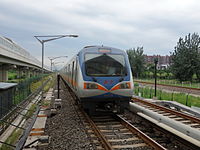 Most Beijing Subway rolling stock, such as this DKZ5 Line 13 train, run on 1,435 millimetres (56.5 in) standard gauge track, drawing 750V direct current (DC) electrical power from the third rail. Line 13, like most lines, use six-car Type-B train sets.
 -
 Lines 14 and 16 trains run on standard gauge track and draw 1500V DC power from overhead electrical lines. The DKZ53 train on Line 14 pictured above uses Type-A cars, which unlike the more common Type-B cars, are 3.1 meters longer and 20 cm wider, have 10 sets of doors instead of 8 sets of doors, greater passenger capacity and higher top speed.
 -
 The four-car train sets of the Capital Airport Express have linear motors of instead of rotary motors. Capital Airport Express trains draw 750V DC power from the third rail, and are propelled using the aluminum strip, a "fourth rail", between the main track. Capital Airport Express trains sets are lighter than subway cars with rotary motors and can reach a top speed of 110 km/h (68 mph).
 -
-
 The light rail transit trams on the Xijiao (Western Suburban) line run on standard gauge track and draw power 750V alternating current (AC) electrical power from overhead lines. The Xijiao line uses five-car trams and can reach a top speed of 70 km/h (43 mph).

.JPG)

.jpg)
.jpg)

Automated lines[edit]
There will be 6 fully automated lines at the level of GoA4, including 4 lines in operation (the Yanfang line, Line 17 and Line 19 and the Daxing Airport Express) and 2 lines under construction (Line 3 and Line 12), using domestically developed communications-based train control systems.[73]
History[edit]

1953–1965: origins[edit]
The subway was proposed in September 1953 by the city's planning committee and experts from the Soviet Union.[74] After the end of the Korean War, Chinese leaders turned their attention to domestic reconstruction. They were keen to expand Beijing's mass transit capacity but also valued the subway as an asset for civil defense. They studied the use of the Moscow Metro to protect civilians, move troops and headquarter military command posts during the Battle of Moscow, and planned the Beijing Subway for both civilian and military use.[74]
At that time, the Chinese lacked expertise in building subways and drew heavily on Soviet and East German technical assistance. In 1954, a delegation of Soviet engineers, including some who had built the Moscow Metro, was invited to plan the subway in Beijing.[74] From 1953 to 1960, several thousand Chinese university students were sent to the Soviet Union to study subway construction.[74] An early plan unveiled in 1957 called for one ring route and six other lines with 114 stations and 172 km (107 mi) of track.[74] Two routes vied for the first to be built. One ran east–west from Wukesong to Hongmiao, underneath Changan Avenue. The other ran north–south from the Summer Palace to Zhongshan Park, via Xizhimen and Xisi. The former was chosen due to more favorable geological foundation and greater number of government bureaus served. The second route would not be built until construction on Line 4 began forty years later.
The original proposal called for deep subway tunnels that can better serve military functions.[75] Between Gongzhufen and Muxidi, shafts as deep as 120 m (390 ft) were being dug.[75] The world's deepest subway station at the time in the Kyiv Metro was only 100 m (330 ft) deep.[75] But Beijing's high water table and high pressure head of ground water which complicated construction and posed risk of leakage, and along with the inconvenience of transporting passengers long distances from the surface, led the authorities to abandon the deep tunnel plan in May 1960 in favor of cut-and-cover shallow tunnels some 20 m (66 ft) below the surface.[75]
The deterioration of relations between China and Soviet Union disrupted subway planning. Soviet experts began to leave in 1960, and were completely withdrawn by 1963.[76] In 1961, the entire project was halted temporarily due to severe hardships caused by the Great Leap Forward. Eventually, planning work resumed. The route of the initial line was shifted westward to create an underground conduit to move personnel from the heart of the capital to the Western Hills. On February 4, 1965, Chairman Mao Zedong personally approved the project.[77]
1965–1981: the slow beginning[edit]


Construction began on July 1, 1965, at a groundbreaking ceremony attended by several national leaders including Zhu De, Deng Xiaoping, and Beijing mayor Peng Zhen.[78] The most controversial outcome of the initial subway line was the demolition of the Beijing's historic inner city wall to make way for the subway. Construction plans for the subway from Fuxingmen to the Beijing Railway Station called for the removal of the wall, as well as the gates and archery towers at Hepingmen, Qianmen, and Chongwenmen. Leading architect Liang Sicheng argued for protecting the wall as a landmark of the ancient capital. Chairman Mao favored demolishing the wall over demolishing homes. In the end, Premier Zhou Enlai managed to preserve several walls and gates, such as the Qianmen gate and its arrow tower by slightly altering the course of the subway.[79]


The initial line was completed and began trial operations in time to mark the 20th anniversary of the founding of the People's Republic on October 1, 1969.[77][80] It ran 21 km (13 mi) from Gucheng to the Beijing Railway Station and had 16 stations.[77] This line forms parts of present-day Lines 1 and 2. It was the first subway to be built in China, and predates the metros of Hong Kong, Seoul, Singapore, San Francisco, and Washington, D.C., but technical problems would plague the project for the next decade.
.jpg)


Initially, the subway hosted guest visits.[77] On November 11, 1969, an electrical fire killed three people, injured over 100 and destroyed two cars.[77] Premier Zhou Enlai placed the subway under the control of the People's Liberation Army in early 1970, but reliability problems persisted.[77]
On January 15, 1971, the initial line began operation on a trial basis between the Beijing railway station and Gongzhufen.[81] Single ride fare was set at ¥0.10 and only members of the public with credential letters from their work units could purchase tickets.[81] The line was 10.7 km (6.6 mi) in length, had 10 stations and operated more than 60 train trips per day with a minimum wait time of 14 minutes.[81] On August 15, the initial line was extended to Yuquan Lu and had 13 stations over 15.6 km (9.7 mi).[81] On November 7, the line was extended again, to Gucheng Lu, and had 16 stations over 22.87 km (14.21 mi).[81] The number of trains per day rose to 100. Overall, the line delivered 8.28 million rides in 1971, averaging 28,000 riders per day.[81]
From 1971 to 1975, the subway was shut down for 398 days for political reasons.[f] On December 27, 1972, the riders no longer needed to present credential letters to purchase tickets.[81] In 1972, the subway delivered 15 million rides and averaged 41,000 riders per day.[81] In 1973, the line was extended to Pingguoyuan and reached 23.6 km (14.7 mi) in length with 17 stations and 132 train trips per day.[81] The line delivered 11 million rides in 1973, averaging 54,000 riders per day.[81]
Despite its return to civilian control in 1976, the subway remained prone to closures due to fires, flooding, and accidents. Annual ridership grew from 22.2 million in 1976 and 28.4 million in 1977 to 30.9 million in 1978, and 55.2 million in 1980.[81]
1981–2000: two lines for two decades[edit]
On April 20, 1981, the Beijing Subway Company, then a subsidiary of the Beijing Public Transportation Company, was organized to take over subway operations.[83] On September 15, 1981, the initial line passed its final inspections, and was handed over to the Beijing Subway Company, ending a decade of trial operations.[83] It had 19 stations and ran 27.6 kilometres (17.1 miles) from Fushouling in the Western Hills to the Beijing railway station.[83] Investment in the project totaled ¥706 million. Annual ridership rose from 64.7 million in 1981 and 72.5 million in 1982 to 82 million in 1983.[83]

On September 20, 1984, a second line was opened to the public.[83] This horseshoe-shaped line was created from the eastern half of the initial line and corresponds to the southern half of the present-day Line 2.[83] It ran 16.1 km (10.0 mi) from Fuxingmen to Jianguomen with 16 stations.[83] Ridership reached 105 million in 1985.[83]

On December 28, 1987, the two existing lines were reconfigured into Lines 1, which ran from Pingguoyuan to Fuxingmen and Line 2, in its current loop, tracing the Ming city wall.[83] Fares doubled to ¥0.20 for single-line rides and ¥0.30 for rides with transfers.[83] Ridership reached 307 million in 1988.[83] The subway was closed from June 3–4, 1989 during the suppression of the Tiananmen Square demonstrations. In 1990, the subway carried more than one million riders per day for the first time, as total ridership reached 381 million.[83] After a fare hike to ¥0.50 in 1991, annual ridership declined slightly to 371 million.
On January 26, 1991, planning began on the eastward extension of Line 1 under Chang'an Avenue from Fuxingmen.[84] The project was funded by a 19.2 billion yen low-interest development assistance loan from Japan.[84] Construction began on the eastern extension on June 24, 1992, and the Xidan station opened on December 12, 1992.[84] The remaining extension to Sihuidong was completed on September 28, 1999.[85] National leaders Wen Jiabao, Jia Qinglin, Yu Zhengsheng and mayor Liu Qi were on hand to mark the occasion.[85] The full-length of Line 1 became operational on June 28, 2000.[86]
Despite little track expansion in the early 1990s, ridership grew rapidly to reach a record high of 558 million in 1995, but fell to 444 million the next year when fares rose from ¥0.50 to ¥2.00. After fares rose again to ¥3.00 in 2000, annual ridership fell to 434 million from 481 million in 1999.[86]
2001–2008: planning for the Olympics[edit]
In the summer of 2001, the city won the bid to host the 2008 Summer Olympics and accelerated plans to expand the subway. From 2002 to 2008, the city planned to invest ¥63.8 billion (US$7.69 billion) in subway projects and build an ambitious "three ring, four horizontal, five vertical and seven radial" subway network.[87] Work on Line 5 had already begun on September 25, 2000.[88] Land clearing for Lines 4 and 10 began in November 2003 and construction commenced by the end of the year.[89] Most new subway construction projects were funded by loans from the Big Four state banks. Line 4 was funded by the Beijing MTR Corporation, a joint-venture with the Hong Kong MTR.[90] To achieve plans for 19 lines and 561 km (349 mi) by 2015, the city planned to invest a total of ¥200 billion ($29.2 billion).[91]
-

-
 Line 13 station at Longze. Line 13 opened in two parts in 2002 and 2003.
 -
 A model SFX01 Batong line train at Shuangqiao. The Batong line opened in Dec. 2003


The next additions to the subway were surface commuter lines that linked to the north and east of the city. Line 13, a half loop that links the northern suburbs, first opened on the western half from Huilongguan to Xizhimen on September 28, 2002 and the entire line became operational on January 28, 2003.[92] Batong line, built as an extension to Line 1 to Tongzhou District, was opened as a separate line on December 27, 2003.[93] Work on these two lines had begun respectively in December 1999 and 2000.[94] Ridership hit 607 million in 2004.
Line 5 came into operation on October 7, 2007. It was the city's first north–south line, extending from Songjiazhuang in the south to Tiantongyuan in the north. On the same day, subway fares were reduced from between ¥3 and ¥7 per trip, depending on the line and number of transfers, to a single flat fare of ¥2 with unlimited transfers. The lower fare policy caused the Beijing Subway to run a deficit of ¥600 million in 2007, which was expected to widen to ¥1 billion in 2008.[91] The Beijing municipal government covered these deficits to encourage mass transit use, and reduce traffic congestion and air pollution. On a total of 655 million rides delivered in 2007, the government's subsidy averaged ¥0.92 per ride.[95]
-
 Elevated Line 5 station and platform at Tiantongyuan. Line 5 opened on Oct. 7, 2007.
 -
 Beitucheng station for Lines 8 and 10, which along with the Capital Airport Express, opened on July 19, 2008.
 -
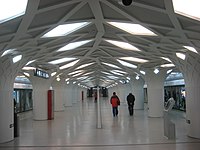 Each of the four original stations on the Olympic Branch Line (Line 8) has a unique interior decor style. (Pictured: Forest Park South Gate)

.jpg)

As part of the urban re-development for the 2008 Olympics, the subway system was significantly expanded.[96]: 137 In the summer of 2008, in anticipation of the Summer Olympic Games, three new lines—Line 10 (Phase 1), Line 8 (Phase 1) and the Capital Airport Express—opened on July 19.[97] The use of paper tickets, hand checked by clerks for 38 years, was discontinued and replaced by electronic tickets that are scanned by automatic fare collection machines upon entry and exit of the subway. Stations are outfitted with touch screen vending machines that sell single-ride tickets and multiple-ride Yikatong fare cards. The subway operated throughout the night from Aug. 8-9, 2008 to accommodate the Opening Ceremonies of the Olympic Games, and is extending evening operations of all lines by one to three hours (to 1-2 a.m.) through the duration of the Games.[98] The subway set a daily ridership record of 4.92 million on August 22, 2008, the day of the Games' closing ceremony.[99] In 2008, total ridership rose by 75% to 1.2 billion.[100]
2008–present: rapid expansion[edit]
After the Chinese government announced a ¥4 trillion economic stimulus package in November 2008, the Beijing urban planning commission further expedited subway building plans, especially for elevated lines to suburban districts that are cheaper to build. In December 2008, the commission moved completion dates of the Yizhuang and Daxing Lines to 2010 from 2012, finalized the route of the Fangshan Line, and unveiled the Changping and Xijiao Lines.[101]
-
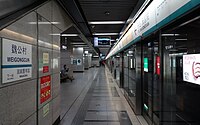 All stations built since 2007 have platform doors, including the Weigongcun station on Line 4, which opened September 28, 2009.
 -
 Entrance D to Xisi station on Line 4. Each station entrance has an entrance label
 -
 Tracks north of Xihongmen Station on the Daxing Line
 -
 Elevated viaduct on the Fangshan Line


Line 4 started operation on September 28, 2009, bringing subway service to much of western Beijing.[102] It is managed by the MTR Corporation through a joint venture with the city. In 2009, the subway delivered 1.457 billion rides,[103] 19.24% of mass transit trips in Beijing.[104]
-
 The Xi'erqi interchange for Lines 13 and Changping
 -
 Shahe station on the Changping line
 -
 Changyang station on the Fangshan line
 -
 Yizhuang Culture Park station on the Yizhuang Line


In 2010, Beijing's worsening traffic congestion prompted city planners to move the construction of several lines from the 13th Five Year Plan to the 12th Five Year Plan. This meant Lines 8 (Phase III), Line 3, Line 12, Line 16, the Yanfang line, as well as additional lines to Changping District and Tiantongyuan were to begin construction before 2015.[105] Previously, Lines 3, 12 and 16 were being planned for the more distant future.[106][107] On December 30, 2010, five suburban lines: Lines 15 (Phase I from Wangjingxi to Houshayu except Wangjing East station), Changping, Fangshan (except Guogongzhuang station), Yizhuang (except Yizhuang railway station), and Daxing, commenced operation.[108] The addition of 108 km (67 mi) of track, a nearly 50% increase, made the subway the fourth longest metro in the world. One year later, on December 31, 2011, the subway surpassed the New York City Subway to become the third longest metro in revenue track length with the extension of Line 8 north from the Forest Park South Gate to Huilongguan Dongdajie, the opening of Line 9 in southwest Beijing from Beijing West railway station to Guogongzhuang (except Fengtai Dongdajie, which opened on October 12, 2012), the extension of the Fangshan Line to Guogongzhuang, and the extension of Line 15 from Houshayu to Fengbo in central Shunyi.[109] In the same year, the Beijing government unveiled an ambitious expansion plan envisioning the subway network to reach a track density of 0.51 km per km2 (0.82 mi per sq. mi.) inside the Fifth Ring Road where residents would on average have to walk 1 km (0.62 mi) to the nearest subway station.[110] Ridership reached 2.18 billion in 2011.
-
 Nanluoguxiang station on Line 6 blends into the traditional courtyard neighborhood of central Beijing.
 -
 Line 8's concourse in Guloudajie station with drum-shaped lights inspired by nearby Drum Tower.
 -
 Interior décor of Beihai North station evokes the white stupa of Beihai Park.


In February 2012, the city government confirmed that Lines Line 3, Line 12, Line 17, and Line 19 were under planning as part of Phase II expansion.[111] Retroactively implying that the original three ring, four horizontal, five vertical and seven radial plan was part of Phase I expansion. Line 17 was planned to run north–south, parallel and to the east of Line 5, from Future Science Park North to Yizhuang Zhanqianqu South.[112] Line 19 was planned to run north–south, from Mudanyuan to Xin'gong.[113]

On December 30, 2012, Line 6 (Phase I from Haidian Wuluju to Caofang), the extension of Line 8 from Beitucheng south to Gulou Dajie (except Andeli Beijie), the remainder of Line 9 (except Military Museum station) and the remainder of the Line 10 loop (except the Xiju-Shoujingmao section and Jiaomen East station) entered service. The addition of 69.8 km (43 mi) of track increased the network length to 442 km (275 mi) and allowed the subway to overtake the Shanghai Metro, for several months, as the world's longest metro.[114] The subway delivered 2.46 billion rides in 2012.[115]
On May 5, 2013, the Line 10 loop was completed with the opening of the Xiju-Shoujingmao section and the Jiaomen East Station.[116] The 57 km (35 mi) loop line became the longest underground subway loop in the world.[116] On the same day, the first section of Line 14 from Zhangguozhuang to Xiju also entered operation, ahead of the opening of the Ninth China International Garden Expo in Fengtai District.[116] The subway's total length reached 456 km (283 mi).[116] On December 28, 2013, two sections were added to Line 8, which extended the line north to Zhuxinzhuang and south to Nanluoguxiang.[117] In 2013, the subway delivered 3.209 billion rides, an increase of 30% from the year before.[118]
On December 28, 2014, the subway network expanded by 62.2 km (38.6 mi) to 18 lines and 527 km (327 mi) with the opening of Line 7, the eastern extension of line 6 (from Caofang to Lucheng), the eastern section of line 14 (from Jintai Lu to Shangezhuang), and the western extension of line 15 (from Wangjingxi to Qinghua Donglu Xikou).[119][120] At the same time, the ¥2 flat-rate fare was replaced with a variable-rate fare (a minimum of ¥3), to cover operation costs.[121] In 2014, the subway delivered 3.387 billion rides, an increase of 5.68% from the year before.[122] Average daily and weekday ridership also set new highs of 9.2786 million and 10.0876 million, respectively.[123]
From 2007 to 2014, the cost of subway construction in Beijing rose sharply from ¥0.571 billion per km to ¥1.007 billion per km.[124][125] The cost includes land acquisition, compensation to relocate residents and firms, actual construction costs and equipment purchase. In 2014, city budgeted ¥15.5 billion for subway construction, and the remainder of subway building costs was financed by the Beijing Infrastructure Investment Co. LTD, a city-owned investment firm.[124]
In 2014, Beijing planning authorities assessed mass transit monorail lines for areas of the city in which subway construction or operation is difficult.[126] Straddle beam monorail trains have lower transport capacity and operating speed (60 km/h or 37 mph) than conventional subways, but are quieter to operate, have smaller turning radius and better climbing capability, and cost only one-third to one-half of subways to build.[126][127] According to the initial environmental assessment report by the Chinese Academy of Rail Sciences, the Yuquanlu Line was planned to have 21 stations over 25 km (16 mi) in western Beijing.[128] The line was to begin construction in 2014 and would take two years to complete.[126] The Dongsihuan Line (named for the Eastern Fourth Ring Road it was to follow) was planned to have 21 stations over 33.7 km (20.9 mi).[129][127]
In early 2015, plans for both monorail lines were shelved indefinitely, due to low capacity and resident opposition.[130] The Yuquanlu Line remains on the city's future transportation plan, and it will be built as a conventional underground subway line. The Dongsihuan Line was replaced by the East extension of Line 7.[131]
On December 26, 2015, the subway network expanded to 554 km (344 mi) with the opening of the section of Line 14 from Beijing South railway station to Jintai Lu (11 stations; 16.6 km (10.3 mi)), Phase II of the Changping line from Nanshao to Changping Xishankou (5 stations; 10.6 km or 6.6 mi), Andelibeijie station on Line 8, and Datunlu East station on Line 15.[132] Ridership in 2015 fell by 4% to 3.25 billion due to a fare increase from a flat fare back to a distance based fare.[122]
-
 Line 8 construction site at Yongdingmenwai in March 2018, next to Beijing's central north-south axis.
 -
 Enclosed construction site of Line 3 at Dongsishitiao along the 2nd Ring Road in December 2017.
 -
 Viaduct of the S1 Line near Shichang under construction in March 2017.
 -
 West Gate of Summer Palace on the Xijiao light rail line under construction in May 2017.
.jpg)
.jpg)
.jpg)
.jpg)
With the near completion of the three ring, four horizontal, five vertical and seven radial subway network, work began on Phase II expansion projects. These new extensions and lines will be operational in 2019~2021.[133] On December 9, 2016, construction started on 126 km (78 mi) of new line with the southern extension of Batong Line, the southern extension of Changping line, the Pinggu line, phase one of the New Airport line, and Line 3 Phase I breaking ground.[134] The northern section of Line 16 opened on December 31, 2016. Ridership reached a new high of 3.66 billion.[135] On December 30, 2017, a one-station extension of Fangshan Line (Suzhuang – Yancun East), Yanfang line (Yancun Dong - Yanshan), Xijiao line (Bagou - Fragrant Hills) and S1 line (Shichang – Jin'anqiao) were opened. On December 30, 2018, the western extension of Line 6 (Jin'anqiao – Haidian Wuluju), the South section of Line 8 (Zhushikou – Yinghai), a one-station extension on Line 8 North section (Nanluoguxiang – National Art Museum), a one-station extension on Yizhuang line (Ciqu – Yizhuang Railway Station) were opened. On September 26, 2019, the Daxing Airport Express (Phase 1) (Caoqiao - Daxing Airport)was opened.[136] On December 28, 2019, the eastern extension of Line 7 (Jiaohuachang-Huazhuang) and the southern extension of Batong line (Tuqiao-Huazhuang) were opened.[137]
-
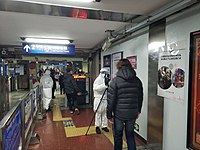 Subway staff in protective clothing check the temperature of a passenger with thermographic camera on January 27, 2020.
 -
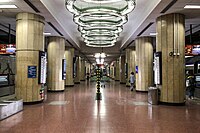 Subway ridership fell sharply during the COVID-19 pandemic. The Line 2 platform of Dongsi Shitiao station was almost vacant during the Friday evening rush hour on March 20, 2020
 -
 Passengers wear masks and maintain social distancing on a Line 4 train on March 23, 2020.

.jpg)
.jpg)
On January 24, 2020, the day after a lockdown was declared in the city of Wuhan to contain the outbreak of COVID-19 in China, the Beijing Subway began testing body temperature of passengers at the 55 subway stations including the three main railway stations and capital Airport.[138] Temperature checks expanded to all subway stations by January 27.[139]
On April 4, 2020, at 10:00am, Beijing Subway trains joined in China's national mourning of lives lost in the COVID-19 pandemic, by stopping for three minutes and sounding their horns three times, as conductors and passengers stood in silence.[140] To control the spread of COVID-19, certain Line 6 trains were outfitted with smart surveillance cameras that can detect passengers not wearing masks.[141]

In May 2020, the Beijing Subway began to pilot a new style of wayfinding on Line 13 and Airport Express. However, since then the new designs were not rolled out to other lines or even new lines that opened afterward.[142]
On December 31, 2020, the middle section of Line 16 (Xi Yuan-Ganjia Kou), the northern section of the Fangshan line (Guogongzhuang-Dongguantou Nan(S)), and the Yizhuang T1 line tram were opened.[143]
On August 26, 2021, Line 7 and Batong line extended to Universal Resort station.[144] On August 29, 2021, through operation of Line 1 and Batong line started.[26] On December 31, 2021, the initial sections of Line 11(Jin'anqiao - Shougang Park), Line 17 (Shilihe - Jiahuihu), Line 19(Mudanyuan - Xingong); extensions of Capital Airport Express(Dongzhimen - Beixinqiao), Changping line(Xierqi - Qinghe Railway Station), Line S1(Jin'anqiao - Pingguoyuan), Line 16(Ganjiakou - Yuyantan Park East Gate); and the central sections of Line 8(Zhushikou - National Art Museum) and Line 14(Beijing South Railway Station - Xiju) were opened.[145] With the completion of the central sections of Line 8 and 14 along with the final section of Line S1 marks the completion of the three ring, four horizontal, five vertical and seven radial subway network plan (retroactively named Phase I expansion).
On July 30, 2022, stations Beitaipngzhuang, Ping'anli, Taipingqiao, Jingfengmen of Line 19 were opened.[146] On December 31, 2022, the extension of Line 16 (Yuyantan Park East Gate - Yushuzhuang) was opened.[147]
On January 18, 2023, in the morning and evening peak hours of the workday, the cross-line operation of Fangshan Line and Line 9 began.[148] On February 4, 2023, the extension of Changping Line (Qinghe Railway Station - Xitucheng) was opened.[149]
Ridership[edit]
 | Graphs are unavailable due to technical issues. There is more info on Phabricator and on MediaWiki.org. |
|
|
|
| |||||||||||||||||||||||||||||||||||||||||||||||||||||||||||||||||||||||||||||||||||||||||||||||||||||||||||||||||||||||||||||||||||||||||||||||||||||||||||||||||||||
| Source: 北京地铁大事记回顾 1965-2006 • 北京市2010年暨"十一五"期间国民经济和社会发展统计公报 • 北京市2011年国民经济和社会发展统计公报 • 北京市2012年国民经济和社会发展统计公报 • 北京市2013年国民经济和社会发展统计公报 • [150] • 北京市2015年暨"十二五"时期国民经济和社会发展统计公报 • [135] • [151] • [2] | ||||||||||||||||||||||||||||||||||||||||||||||||||||||||||||||||||||||||||||||||||||||||||||||||||||||||||||||||||||||||||||||||||||||||||||||||||||||||||||||||||||||||
Facilities[edit]
Accessibility[edit]
.jpg)

Right: A foldable wheelchair lift inside Exit A of the Dongdan station. Most stations built after 2007 have elevators. Older stations have been outfitted with wheelchair lifts. Tactile paving is found throughout stations.
.jpg)
Each station is equipped with ramps, lifts, or elevators to facilitate wheelchair access.[152][153] Newer model train cars now provide space to accommodate wheelchairs.[154] Automated audio announcements for incoming trains are available in all lines. On all lines, station names are announced in Mandarin Chinese and English. Under subway regulations, riders with mobility limitations may obtain assistance from subway staff to enter and exit stations and trains, and visually impaired riders may bring assistance devices and guide dogs into the subway.[155]
Cellular network coverage[edit]
Mobile phones can currently be used throughout the network. In 2014, Beijing Subway started upgrading cellular networks in the Beijing subway to 4G.[156] In 2016, the entire subway network has 4G coverage.[157] Since 2019, 5G coverage is being rolled out across the network.[158][159]
Commercial facilities[edit]
In the 1990s a number of fast food and convenience stores operated in the Beijing Subway.[160] In 2002, fourteen Wumart convenience stores opened in various Line 2 stations.[161]
After witnessing the Daegu subway fire in February 2003, the Beijing Subway gradually removed the 80 newsstands and fast food restaurants across 39 stations in Line 1 and Line 2.[162] The popular underground mall at Xidan station was closed. This is in contrast other systems in China which added more station commerce as they started to rapidly expand their networks.[162] Since the implementation of this policy new lines did not have any station commerce upon opening.
Passengers consistently complained that the lack of station commerce in the Beijing Subway is inconvenient. In the early 2010s, Beijing Subway started reversing some of these policies. Vending machines selling drinks and snacks has gradually introduced inside stations since 2013. Later machines with of common items such as flowers, earphones, masks, etc. were also introduced.[160] In 2013, China Resources Vanguard and FamilyMart expressed interest in opening convenience stores in the Beijing Subway but this never materialized.[163]
.jpg)
The survey report on passenger satisfaction in subway services since 2018 shows that more than 70% of passengers want convenience stores in subway stations, especially for various hot and cold drinks, ready-to-eat food, and bento meals.[160] In December 2020, "the deployment of 130 convenient service facilities at subway stations" was listed as a key project for the Beijing municipal government.[164] On 25 July 2021, Beijing Subway selected three stations, Hepingli Beijie station of Line 5, Qingnian Lu station of Line 6, and Caishikou station of Line 7, to carry out a pilot program of opening convenience stores.[165] Since December 2021, a rapid rollout of station commerce began on a large scale across the network with a variety of commercial establishments such as bookstores, pharmacies, flower shops and specialty vendors being constructed inside stations.[166]
Information hotline and app[edit]
The Beijing Subway telephone hotline was initiated on the eve of the 2008 Summer Olympic Games to provide traveler information, receive complaints and suggestions, and file lost and found reports.[167] The hotline combined the nine public service telephones of various subway departments.[168] On December 29, 2013, the hotline number was switched from (010)-6834-5678 to (010)-96165 for abbreviated dialing.[169] In December 2014, the hotline began offering fare information, as the subway switched to distance-based fare.[10] The hotline has staffed service from 5 am to midnight and has automated service during unstaffed hours.[167]
The Beijing Subway has an official mobile application and a number of third-party apps.
English station names[edit]
According to the related rules released in 2006, all the place names, common names and proper names of subway stations and bus stops should use uppercase Hanyu Pinyin. For example, Nanlishi Lu Station should be written as NANLISHILU Station. However, names of venues can use English translation, such as Military Museum.
According to the translation standard released in December 2017, station names of rail transit and public transport have to follow the laws.
Since December 2018, Beijing Subway has changed the format of names of the new subway stations every year. On the subway map of December 2018, the station names used Roman script, and it gave consideration to English writing habit and pronunciation. The format changed to verbatim in December 2019, where the positions (East, South, West and North) were written in Hanyu Pinyin and an English abbreviation was added to them.
.jpg)
Since 31 December 2021, Beijing Subway has started using new station name format. The Pinyin "Zhan" is used instead of English word "Station" on the light box at the subway entrance. This caused a strong disagreement.[170] Citizens criticized it, making comments like "Chinese do not need to read and foreigners cannot read it". Some of the landmark named stations uses Chinese name, Hanyu Pinyin and English translation. Station names ending with positions no longer add English abbreviation. Some of the stations that used English translation names (such as Shahe Univ. Park, Life Science Park and Liangxiang Univ. Town) changed to Hanyu Pinyin only (The new station names are Shahe Gaojiaoyuan, Shengming Kexueyuan and Liangxiang Daxuecheng).
System upgrades[edit]
Capacity[edit]

With new lines drawing more riders to the network, the subway has experienced severe overcrowding, especially during the rush hour.[171] Since 2015, significant sections of Lines 1, 4 – Daxing, 5, 10,[172] 13, Batong and Changping are officially over capacity during rush hour.[173][174] By 2019, Lines 1, 2, 4, 5, 6 and 10 all have daily weekday ridership's of over 1 million passengers a day each.[175] In short term response, the subway upgraded electrical, signal and yard equipment to increase the frequency of trains to add additional capacity. Peak headways have been reduced to 1 min. 43 sec. on Line 4;[176] 1 min. 45 sec. on Lines 1/Batong,[177] 5,[178] 9,[177] and 10;[179] 2 min. on Lines 2,[180] 6,[178] 13[178] and Changping;[181] 2 min. and 35 sec. on Line 15;[178][181] 3 min. 30 sec. on Line 8;[182] and 15 min. on the Airport Express.[183] The Beijing Subway is investigating the feasibility of reducing headways of Line 10 down to 1 min 40 seconds.[184]
Lines 13 and Batong have converted 4-car to 6-car trains.[185][186] Lines 6[187] and 7 have longer platforms that can accommodate 8-car type B trains,[188] while lines 14, 16, 17 and 19 use higher capacity wide-body type A trains (all mentioned except Line 14 use eight-car trains).[citation needed] New lines that cross the city center such as Line 3 and Line 12, now under construction, will also adopt high capacity 8-car type A trains with a 70 percent increase in capacity over older lines using 6 car type B.[187][189] When completed these lines are expected to greatly relieve overcrowding in the existing network.

Despite these efforts, during the morning rush hour, conductors at line terminals and other busy stations must routinely restrict the number of passengers who can board each train to prevent the train from becoming too crowded for passengers waiting at other stations down the line.[190] Some of these stations have built queuing lines outside the stations to manage the flow of waiting passengers.[191] As of August 31, 2011, 25 stations mainly on Lines 1, 5, 13, and Batong have imposed such restrictions.[192] By January 7, 2013, 41 stations on Lines 1, 2, 5, 13, Batong, and Changping had instituted passenger flow restrictions during the morning rush hour.[193] The number of stations with passenger flow restrictions reached 110 in January 2019, affecting all lines except Lines 15, 16, Fangshan, Yanfang and S1.[194] Lines 4, 5, 10 and 13 strategically run several empty train runs during rush hour bound for specific stations help clear busy station queues.[178] Counter peak flow express trains started operating on Line 15, Changping and Batong to minimize line runtimes and allow the existing fleet size to serve more passengers during peak periods.[178] Additionally, investigations are being carried out on Line 15 and Yizhuang for upgrading to 120 km/h operations.[195]
Transfers[edit]

Interchange stations that permit transfers across two or more subway lines receive heavy traffic passenger flow. The older interchange stations are known for lengthy transfer corridors and slow transfers during peak hours. The average transfer distance at older interchange stations is 128 m (420 ft)[196] The transfer between Lines 2 and 13 at Xizhimen once required 15 minutes to complete during rush hours.[197] In 2011, this station was rebuilt to reduce the transfer distance to about 170 m (560 ft) long.[198][199] There are plans to rebuild other interchange stations such as Dongzhimen.[196]
In newer interchange stations, which are designed to permit more efficient transfers, the average transfer distance is 63 m (207 ft).[196] Many of the newer interchange stations including Guogongzhuang (Lines 9 and Fangshan), Nanluoguxiang (Lines 8 and 6), Zhuxinzhuang (Changping and Line 8), Beijing West railway station (Lines 9 and 7), National Library (Lines 9 and 4), Yancun East (Fangshan Line and Yanfang Line) feature cross platform transfers.[200] Nevertheless, longer transfer corridors must still be used when the alignment of the lines do not permit cross-platform transfer.[201] The transfer corridors between Lines 1 and 9 at the Military Museum, which opened on December 23, 2013, are 160 m (520 ft) in one direction and just under 300 m (980 ft) in the other.[202]
Safety[edit]
Security check[edit]

To ensure public safety during the 2008 Summer Olympic and Paralympic Games, the subway initiated a three-month heightened security program from June 29 to September 20, 2008. Riders were subject to searches of their persons and belongings at all stations by security inspectors using metal detectors, X-ray machines and sniffer dogs. Items banned from public transportation such as "guns, ammunition, knives, explosives, flammable and radioactive materials, and toxic chemicals" were subject to confiscation.[203] The security program was reinstituted during the 2009 New Year Holiday[204] and has since been made permanent through regulations enacted in February 2009.[205]
Accidents and incidents[edit]
The subway was plagued by numerous accidents in its early years, including a fire in 1969 that killed six people and injured over 200.[206] But its operations have improved dramatically and there have been few reported accidents in recent years. Most of the reported fatalities on the subway are the result of suicides.[207] Authorities have responded by installing doors on platforms of newer lines.
- On October 8, 2003, the collapse of steel beams at the construction site of Line 5's Chongwenmen station killed three workers and injured one.[208]
- On March 29, 2007, the construction site at the Suzhoujie station on Line 10 collapsed, burying six workers.
- On June 6, 2008, prior to the opening of Line 10, a worker was crushed to death inside an escalator in Zhichunlu station when an intern turned on the moving staircase.[209]
- On July 14, 2010, two workers were killed and eight were injured at the construction site of Line 15's Shunyi station when the steel support structure collapsed on them.[210]
- On September 17, 2010, Line 9 tunnels under construction beneath Yuyuantan Lake were flooded, killing one worker.[211] A city official who oversaw waterworks contracts at the site was convicted of corruption and given a death sentence with reprieve.[211]
- On June 1, 2011, one worker was killed when a section of Line 6 under construction in Xicheng District near Ping'anli collapsed.[212]
- On July 5, 2011, an escalator collapsed at Beijing Zoo Station, killing one 13-year-old boy and injuring 28.[213]
- On July 19, 2012, a man was fatally shot at Hujialou station by a sniper from the Beijing Special Weapons and Tactics Unit after taking a subway worker hostage.[214]
- On May 4, 2013, a train derailed when it overran a section of track on Line 4. The section was not open to the public and was undergoing testing. There were no injuries.[215]
- On November 6, 2014, a woman was killed when she tried to board the train at Huixinxijie Nankou station on Beijing Subway's Line 5. She became trapped between the train door and the platform edge door and was crushed to death by the departing train. The accident happened on the second day of APEC China 2014 meetings in the city during which the municipal government has banned cars from the roads on alternate days to ease congestion and reduce pollution during the summit – measures which the capital's transport authorities have estimated would lead to an extra one million passengers on the subway every day.[216]
- On March 26, 2015, a Yizhuang line train was testing when it derailed around Taihu Depot [zh]. No passengers were on board and the driver faced leg injuries.[217][218][219]
- On January 1, 2018, a Xijiao line train derailed around Fragrant Hills station. There were no injuries.[220] Fragrant Hills station was temporarily closed until 1 March 2018.[221]
- On December 14, 2023, two trains on the Changping line collided between Xi'erqi station and Life Science Park station, causing one of the carriages to break apart and injuring over 500 passengers on board.[222][223][224]
Subway culture[edit]
Logo[edit]

The subway's logo, a capital letter "G" encircling a capital letter "D" with the letter "B" silhouetted inside the letter D, was designed by Zhang Lide, a subway employee, and officially designated in April 1984.[225] The letters B, G, and D form the pinyin abbreviation for "北京高速电车" (pinyin: Běijīng gāosù diànchē; lit. 'Beijing high-speed electric carriage').
Subway Culture Park[edit]

The Beijing Subway Culture Park, located near Xihongmen in Daxing District, opened in 2010 to commemorate the 40-year history of the Beijing Subway.[226] The 19 ha (47 acres) park was built using dirt and debris removed from the construction of the Daxing line and contains old rolling stock, sculpture, and informational displays.[226] Admission to the park is free.
Beijing Suburban Railway[edit]
The Beijing Suburban Railway, a suburban commuter train service, is managed separately from the Beijing Subway. The two systems, although complementary, are not related to each other operationally. Beijing Suburban Railway is operated by the China Railway Beijing Group.
There are 4 suburban railway lines currently in operation: Line S2, Sub-Central line, Huairou–Miyun line and Tongmi line.
Network Map[edit]

See also[edit]
.jpg)
Notes[edit]
- ^ Through operation of Line 1 and Batong line started on August 29, 2021.[26]
- ^ The construnction finished in 1969 but was not open to public until 1971
- ^ a b c d e f g The following stations haven't been opened and not included in the station count: Pingguoyuan on Line 1; Tongyunmen on Line 6; Dahongmen on Line 8; Taoranqiao, Hongmiao and Gaojiayuan on Line 14; Lize Shangwuqu on Line 16; Wangjingxi on Line 17 North section; Zhufangbei and Jimenqiao on Changping line
- ^ a b With the opening of the Daxing Line on December 30, 2010 the Beijing MTR Corporation operates service on Lines 4 and Daxing as follows:[27][28]
** A service that covers both lines, from Anheqiaobei, the northern terminus of Line 4, to Tiangongyuan, the southern terminus of the Daxing Line.
** A service that covers Line 4 plus one stop on the Daxing Line, from Anheqiaobei to Xingong, the northernmost stop on the Daxing Line. Travelers wishing to proceed further south on the Daxing Line have to switch to a south-bound full-route train. - ^ There is no subway stop at the 12th gate, Deshengmen, between Jishuitan and Gulou Dajie.
- ^ From August 12, 1973, to June 30, 1974, and in January 1975, the subway was closed due to defense mobilization.[82] It was closed from September 13 to November 6, 1971, in the aftermath of the Lin Biao incident and on September 18, 1976, after the death of Chairman Mao.[82]
References[edit]
- ^ a b c d e f g "地铁19号线剩余4站明日试运营!新宫至牡丹园只需半小时". July 29, 2022. Archived from the original on July 29, 2022.
至此,本市城市轨道交通运营总里程783公里、车站463座
- ^ a b c d e "2018年统计报告". Archived from the original on April 4, 2020. Retrieved April 9, 2019.
- ^ a b "北京轨道交通全路网日客运量再创新高 超1375万人次". July 13, 2019.
- ^ "北京市2019年国民经济和社会发展统计公报".
- ^ 未来五年再建12条地铁. September 29, 2015. Archived from the original on March 12, 2016. Retrieved October 2, 2015.
- ^ Li Song (李松). "Beijing's subway is going full bore - China - Chinadaily.com.cn". www.chinadaily.com.cn. Retrieved January 19, 2017.
- ^ 北京2020年轨道交通线路预计将达1000公里左右. www.chinanews.com.cn (in Simplified Chinese). December 30, 2010.
- ^ Xin, Dingding (July 31, 2012). "Experts fear subway costs could go off the rails". China Daily.
- ^ a b c d e f Beijing to Increase Public Transportation Fare Prices Next, CRI 2014-11-27
- ^ a b 北京地铁票价今起可上网查询 客户端15日起可查 (in Simplified Chinese). Xinhua News. December 10, 2014. Archived from the original on December 29, 2014.
- ^ a b "北京大兴国际机场线票价方案正式启用 最低10元". September 15, 2019. Archived from the original on October 11, 2019.
- ^ Lin Ye (林野) (December 17, 2014). 北京地铁各站公布最新里程票价儿童免票身高提高 (in Simplified Chinese). The Beijing News.
- ^ a b 北京地铁告别 '两元时代' 车票设四小时时限 [Beijing Subway says farewell to the "2 yuan era"; tickets now set to a four-hour limit] (in Simplified Chinese). December 28, 2014.
- ^ "Beijing airport express rail on trial run," China Daily July 15, 2008
- ^ 杭州地铁拟定票价 "贵"为全国前三 市民喊吃不消. Xinhuanet Zhejiang (in Simplified Chinese). Qianjiang Evening News. 20 July 2012. Archived from the original on 23 July 2012. Retrieved 1 May 2013.
- ^ CityWeekend: The Official Beijingology Subway AFC Cheat Sheet (Part 3) Archived December 6, 2008, at the Wayback Machine/
- ^ The AFC machines are supplied by the following companies: Thales (Lines 1, 2 and Batong), Samsung SDS (Lines 4, 8 and 10), Founder, OMRON (Line 5), Nippon Signal (Lines 13 & Airport Express)
- ^ "Beijing MTR website". Mtr.bj.cn. Archived from the original on September 11, 2010. Retrieved January 5, 2011.
- ^ 北京28日起公交上下车均刷卡 余额不足3元禁坐地铁 (in Simplified Chinese). December 20, 2014. Archived from the original on December 29, 2014. Retrieved December 29, 2014.
- ^ 北京地铁票首设4小时时限 中途换卡将遭10倍罚款 (in Simplified Chinese). December 4, 2014.
- ^ 北京地铁调价后"大考" 公交增车超"APEC标准 (in Simplified Chinese). 29 December 2014. Archived from the original on 29 December 2014. Retrieved 29 December 2014.
- ^ Dong, Liu. "Beijing subway jumps on board mobile payment system". China Daily. Retrieved May 31, 2018.
- ^ Liu, Charles (March 27, 2018). "Pay Beijing Metro Fares With Mobile Phone QR Codes Beginning in May". The Beijinger. Retrieved May 31, 2018.
- ^ "输入身份信息耗时 自助购票机排大队 地铁买票身份验证环节请改进_北京日报网". news.bjd.com.cn. Retrieved February 21, 2023.
- ^ See "History" section of this article.
- ^ a b "四惠四惠东站无须换乘了!北京地铁1号线、八通线本周日跨线运营". Beijing Daily. August 25, 2021. Archived from the original on August 25, 2021. Retrieved August 25, 2021.
- ^ 北京京港地铁有限公司. Mtr.bj.cn. December 29, 2010. Archived from the original on January 1, 2011. Retrieved January 5, 2011.
- ^ "Beijing MTR Corporation Limited". Mtr.bj.cn. September 27, 2010. Archived from the original on October 9, 2011. Retrieved January 5, 2011.
- ^ "北京:四年内副中心陆续开4条地铁-新华网". Archived from the original on December 29, 2018.
- ^ a b "三段地铁线路即将开通". December 28, 2023. Archived from the original on December 29, 2023.
- ^ a b "北京今日开通9条地铁线(段) 3条主干线贯通南北". December 31, 2021.
- ^ "北京首条中低速磁浮交通线路S1线年底部分开通-新华网". Archived from the original on December 29, 2018.
- ^ "北京市朝阳区国民经济和社会发展第十四个五年规划和二〇三五年远景目标纲要". March 18, 2021. Archived from the original on March 20, 2021.
- ^ 北京市城市规划设计研究院 郑猛. "浅析北京TOD的发展及几点思考". Archived from the original on January 21, 2021. Retrieved September 1, 2020.
- ^ a b c 国家发展改革委关于北京市城市轨道交通第二期建设规划(2015~2021年)的批复. 中华人民共和国国家发展和改革委员会 [National Development and Reform Commission]. September 29, 2015. Retrieved October 2, 2015.
- ^ 国家发展改革委关于调整北京市城市轨道交通第二期建设规划方案的批复. 中华人民共和国国家发展和改革委员会 [National Development and Reform Commission]. December 5, 2019. Archived from the original on December 20, 2019. Retrieved January 2, 2020.
- ^ "关于调整北京市城市轨道交通第二期建设规划方案的批复(发改基础〔2019〕1904号)_政府信息公开_政务公开-国家发展改革委". zfxxgk.ndrc.gov.cn. Retrieved January 27, 2022.
- ^ "今年石景山区将建设多条轨道交通,一号线福寿岭站预计年内竣工". January 5, 2023. Archived from the original on January 5, 2023.
- ^ "北京市重大项目建设指挥办公室". Archived from the original on February 17, 2019. Retrieved March 13, 2019.
- ^ "北京地铁3号线一期工程首站封顶". Xinhuanet. Archived from the original on December 17, 2020. Retrieved November 12, 2020.
- ^ "建议加快推进3,12,16,17号线进度". November 16, 2021.
- ^ "请问北京地铁12号线何时开通". June 10, 2021.
- ^ "北京地铁平谷线城市副中心5座车站明年实现开工". December 15, 2020. Archived from the original on December 31, 2020. Retrieved December 15, 2020.
- ^ a b c "轨道交通13号线扩能提升工程启动建设2座车站进场施工". August 9, 2021. Archived from the original on October 23, 2021.
- ^ "北京轨道交通13号线扩能提升工程环境影响报告书" (PDF). October 21, 2021. Archived from the original (PDF) on October 23, 2021.
- ^ "北京地铁11号线西段、大兴机场线北延年内开工". September 25, 2019.
- ^ "6号线南延段启动建设 计划于2025年底建成通车". August 31, 2022.
- ^ "北京地铁6号线二期(南延段)工程环境影响报告书(征求意见稿).pdf" (PDF). Archived from the original (PDF) on May 31, 2022. Retrieved September 10, 2022.
- ^ a b "北京地铁28号线首站启动建设". July 27, 2021.
- ^ a b "地铁28号线可行性研究报告批复,纳入今年北京市政府重点工程". September 10, 2020. Archived from the original on September 11, 2020. Retrieved November 16, 2021.
- ^ a b "附件1:北京市轨道交通第三期建设规划(2022-2027年)环境影响报告书(征求意见稿).pdf" (PDF). Archived (PDF) from the original on July 8, 2022. Retrieved July 8, 2022.
- ^ "地铁公司1965-1970年" (in Chinese). Archived from the original on February 6, 2010. Retrieved March 27, 2010.
- ^ a b "地铁公司1981-1990年" (in Chinese). Archived from the original on February 6, 2010. Retrieved March 27, 2010.
- ^ the Beijing Subway website [1] reported that the total 2015 passenger ridership on the 15 lines under its control was 2.832 billion. Total network ridership including the three Beijing MTR lines were not provided.
- ^ website of Beijing MTR Corporation Limited Archived 6 January 2016 at the Wayback Machine
- ^ "确定了!北京地铁17号线,京港地铁公司运营". December 30, 2019. Archived from the original on July 26, 2020. Retrieved December 31, 2019.
- ^ "Brief of BJMTR". Beijing MTR website. Archived from the original on January 6, 2016. Retrieved July 6, 2019.
- ^ "北京市轨道交通运营管理有限公司". Retrieved August 12, 2019.
- ^ "大兴机场线文创产品首次亮相2019北京城轨展". August 1, 2019.
- ^ "喜讯!北京轨道运营公司获得北京地铁19号线运营权 (BJMOA Obtains Operation Rights for Beijing Subway Line 19)".
继国庆节前成功高水平开通运营北京大兴国际机场线后,又收到成交通知书,经市政府批准,公司被确定为北京地铁19号线的运营商 (Following the successful opening of the Daxing Airport Express before the National Day, a transaction notification was received. With the approval of the municipal government, the BJMOA company was identified as the operator of Line 19)
- ^ "公司介绍". November 27, 2019.
目前,负责运营北京市轨道交通燕房线、北京大兴国际机场线 (Currently operates Yanfang line and Daxing Airport Express of Beijing Subway)
- ^ "特许经营主体为北京城市铁建轨道交通投资发展有限公司,特许经营期三十年。运营商为"4大8小"联合体中运营专业公司:北京市轨道交通运营管理有限公司(北京轨道运营)".
- ^ (Chinese) 北京市轨道交通建设管理有限公司 公司介绍 accessed 2019-08-11
- ^ (Chinese) 北京公交有轨电车有限公司 Accessed 2019-08-11
- ^ "京城地铁 : 欢迎使用 京城地铁". Retrieved August 12, 2019.
- ^ "Beijing Metro" BII Railway Transportation Technology Holdings Company Limited website
- ^ "Company profile" BII Railway Transportation Technology Holdings Company Limited website Accessed 2019-07-06
- ^ "Rail transit operation" BII Railway Transportation Technology Holdings Company Limited website Accessed 2019-07-06
- ^ 北京磁悬浮S1线西段通过环评 不会造成电磁污染 (in Simplified Chinese). 京华时报. August 4, 2010. Archived from the original on February 9, 2019. Retrieved February 8, 2019.
- ^ The M-series train that appeared on Lines 2 and 13 were made by Japan's Tokyu Car Corporation "东急" Accessed Mar. 28, 2010
- ^ 中国南车中标北京地铁大兴线、八号线. Ccmetro.com (in Simplified Chinese). 30 July 2009. Archived from the original on 8 July 2011. Retrieved 29 March 2010.
- ^ 北京地铁再添"青岛造" 最高运营时速100公里 (in Simplified Chinese). Xinhua News Shandong. 31 December 2009. Archived from the original on 18 July 2011. Retrieved 29 March 2010.
- ^ "北京6条地铁线将实现无人驾驶 首先将用于燕房线--北京频道--人民网". Archived from the original on November 19, 2015. Retrieved March 3, 2019.
- ^ a b c d e 北京地铁诞生记:周总理称筹建地铁是为备战 (in Simplified Chinese). Beijing Daily. September 28, 2007. Archived from the original on January 16, 2009.
- ^ a b c d 经过半个世纪 我国城市轨道交通运营里程超4900公里 (in Simplified Chinese). People's Daily. October 12, 2019.
- ^ News.xinhuanet.com Id. Part 2
- ^ a b c d e f 1965 -- 1970年 地铁大事记 (in Simplified Chinese). Beijing Subway. 24 April 2009. Archived from the original on 29 April 2014. Retrieved 29 April 2014.
- ^ The ceremony was not publicized at the time because the project was classified for its national security implications.
- ^ 北京地铁诞生记:周总理称筹建地铁是为备战 (in Simplified Chinese). Beijing Daily. September 28, 2008. Archived from the original on January 14, 2009.
- ^ The initial line, originally slated for completion by 1968, was delayed by the onset of the Cultural Revolution. The original director of the project, General Yang Yong and much of the city government were purged in 1967. [2] "杨勇小传(5)" in "毛泽东瞩目的著名将帅(二)" (2003)
- ^ a b c d e f g h i j k 1971 -- 1980年 地铁大事记 (in Simplified Chinese). Beijing Subway. 24 April 2009. Archived from the original on 29 April 2014. Retrieved 29 April 2014.
- ^ a b 地铁公司1971 -- 1980年 (in Simplified Chinese). Beijing Subway. Archived from the original on December 3, 2007. Retrieved July 21, 2008.
- ^ a b c d e f g h i j k l 1981 -- 1990年 地铁大事记 (in Simplified Chinese). Beijing Subway. 24 April 2009. Archived from the original on 29 April 2014. Retrieved 29 April 2014.
- ^ a b c 地铁公司1991 -- 2000年 (in Simplified Chinese). Beijing Subway. 24 April 2009. Archived from the original on 31 October 2010. Retrieved 31 May 2010. P1:1991-1993
- ^ a b 地铁公司1991 -- 2000年 (in Simplified Chinese). Beijing Subway. 24 April 2009. Archived from the original on 7 July 2011. Retrieved 31 May 2010. P2: 1994-1997
- ^ a b 地铁公司1991 -- 2000年 (in Simplified Chinese). Beijing Subway. 24 April 2009. Archived from the original on 7 July 2011. Retrieved 31 May 2010. P3:1998-2000
- ^ 北京十条地铁同时建 将实现三环四横五纵七放射_网易奥运. 2008.163.com. 163.com. Archived from the original on February 10, 2018. Retrieved February 10, 2018.
- ^ 1991 – 2000年 地铁大事记 (in Simplified Chinese). Archived from the original on December 4, 2008. Retrieved July 21, 2008.
- ^ 北京地铁四号、十号线年底开工 征地拆迁已启动"] Nov. 14, 2003 (in Simplified Chinese).
- ^ "H.K. subway operator seeks Beijing projects". International Herald Tribune. March 29, 2009. Retrieved January 5, 2011.
- ^ a b 到2015年北京地铁建设静态投资将达2000亿元 (in Simplified Chinese). 第一财经日报. 29 October 2008. Archived from the original on 18 July 2011. Retrieved 25 January 2009.
- ^ 2001 – 2004年 地铁大事记 (in Simplified Chinese). Archived from the original on 3 December 2007. Retrieved 21 July 2008.
- ^ Id.
- ^ 1991 – 2000年 地铁大事记 (in Simplified Chinese). Archived from the original on December 4, 2008. Retrieved July 21, 2008.
- ^ 2007年北京地铁运送乘客6.55亿人次 (in Simplified Chinese). 中广网. January 2, 2008.
- ^ Hu, Richard (2023). Reinventing the Chinese City. New York: Columbia University Press. ISBN 978-0-231-21101-7.
- ^ "Beijing opens three new subways ahead of Olympics" China Daily July 19, 2008
- ^ 北京地铁今起至23日延长运营时间. Bjsubway.com. August 13, 2008. Archived from the original on August 17, 2008.
- ^ Beijing subway system busy during Olympics Xinhua Aug. 27, 2008
- ^ 北京地铁2008年运送乘客突破12亿人次 (in Simplified Chinese). Beijing Subway. Archived from the original on March 25, 2009. Retrieved January 3, 2009.
- ^ Zhang Nan; Meng Huan (11 December 2008). 西郊线通往香山两年内有望开通 (in Simplified Chinese). Beijing Evening News. Archived from the original on 7 June 2011. Retrieved 7 January 2009.
- ^ Line 4 was originally scheduled to be completed by the end of 2007 see (Chinese) Gzuda.gov.cn Archived 2011-07-07 at the Wayback Machine "北京地铁4号和10号线获审批2007年底投入运营" September 4, 2004; & Bh.buaa.edu.cn; 北京地铁4号线特许经营案例 Xinhuanet.com "北京地铁4号线今日开通 站内设施服务全接触"
- ^ Including 1.372 billion passengers of eight lines operated by Beijing Subway Operating Company, and 52.60 million passengers of Line 4 operated by Beijing MTR Corporation (Chinese)北京地铁公司为轨道交通大发展做好充分准备. Archived from the original on January 10, 2010. Retrieved January 1, 2010.; "北京地铁4号线元旦期间运送乘客超过180万人次" Jan. 1, 2010
- ^ 谁的地铁,谁做主? (in Simplified Chinese). 财经文摘. March 23, 2010.
- ^ 北京10条地铁五年内开建 远郊进市区1小时(图) (in Simplified Chinese). Sohu. December 31, 2010.
- ^ 北京地铁15号线有望年内开工 (in Simplified Chinese). 北京商报. October 9, 2008. Archived from the original on October 12, 2008. Retrieved October 12, 2008.
- ^ 北京地铁西郊线确定设五站 (in Simplified Chinese). The Beijing News. January 15, 2009. Archived from the original on September 24, 2015. Retrieved January 28, 2009.
- ^ "Chinadaily US Edition".
- ^ Xu Wei, "Beijing launches three new subway sections" China Daily 2012-01-01
- ^ 本市5年建成"1—1—2"交通圈" (in Simplified Chinese). Beijing Municipal People's Government. January 21, 2011. Archived from the original on June 4, 2013. Retrieved August 24, 2012.
- ^ 北京市城市轨道交通第二期建设规划(2015~2021 年) (PDF). National Development and Reform Commission (NDRC).
- ^ "编制轨道交通新一轮建设规划". Beijing Evening News. February 27, 2019. Archived from the original on March 28, 2019.
- ^ 北京地铁19号线将设10座车站8座能换乘 年内开建 (in Simplified Chinese). Beijing Daily. August 27, 2015.
- ^ "Beijing Subway largest in the world". Voice of Russia. December 30, 2012. Archived from the original on January 21, 2013. Retrieved January 2, 2013.
- ^ 北京市2012年国民经济和社会发展统计公报. Beijing Stats. February 7, 2013. Archived from the original on October 3, 2013. Retrieved February 18, 2013.
- ^ a b c d 北京地铁10号线一圈57公里 创地下铁之最. xinhuanet.com (in Simplified Chinese). May 6, 2013. Archived from the original on September 26, 2013.
- ^ 京地铁8号线南北新线周六开通 中国美术馆站暂缓开通. Xinhua News (in Simplified Chinese). Beijing Evening News. December 25, 2013. Archived from the original on January 5, 2014.
- ^ Du Yan (杜燕) (January 2, 2014). 北京地铁一年运客超32亿人次 同比增长近30%. 中国新闻网. Retrieved January 2, 2014.
- ^ 北京:4条地铁新线开通 轨道线路总里程达527公里. Xinhua News. December 28, 2014. Archived from the original on December 28, 2014. Retrieved December 28, 2014.
- ^ 北京地铁4条新线全景图公布(图) (in Simplified Chinese). December 26, 2014.
- ^ 北京地铁平价时代终结 将按里程收费(双语). September 25, 2014.
- ^ a b 北京市2014年国民经济和社会发展统计公报. 北京市统计局 [Beijing Municipal Bureau of Statistics]. 12 February 2014. Archived from the original on 12 March 2016. Retrieved 12 February 2015.
- ^ 北京市2015年暨"十二五"时期国民经济和社会发展统计公报. 北京市统计局 [Beijing Municipal Bureau of Statistics]. 15 February 2016. Retrieved 18 February 2015.
- ^ a b Wei Fangchao (魏方超) (April 10, 2015). 北京地铁建设投入已达2500亿 每公里成本超10亿 (in Simplified Chinese). 中国网.
- ^ 发改委:北京地铁每公里造价已超过10亿元 (in Simplified Chinese). 中国新闻网. June 30, 2015.
- ^ a b c 北京首条"空中小火车"拟今年开工. The Beijing News 2014-02-24.
- ^ a b 北京建空中东四环:跨座式单轨 造价为地铁1/3. 法制晚报. February 24, 2012.
- ^ 北京轨道交通玉泉路线工程环境影响评价公众参与第一次公示 - 中国铁道科学研究院新闻中心通知公告正文. January 7, 2014.
- ^ "总体总包项目". Archived from the original on March 13, 2021.
- ^ Beijing canceled air train monorail line construction program Archived May 18, 2015, at the Wayback Machine 2015-02-03
- ^ "单轨东四环线方案搁浅 7号线将东延至环球影城" [Monorail Dongsihuan Line proposal shelved, Line 7 to be extended east to Universal Beijing Resort]. August 25, 2015. Archived from the original on August 31, 2021.
- ^ Ding Jing (丁静) (December 26, 2015). 北京地铁14号线中段、昌平线二期开通试运营 (in Simplified Chinese). Xinhua News. Archived from the original on January 5, 2016.
- ^ 首次披露 北京地铁未来5-10年这样建……. news.sina.com.cn. January 26, 2018. Retrieved February 10, 2018.
- ^ Jin, Zhang. "Beijing starts building five more subway lines". CRIenglish.com. China Radio International. Retrieved December 14, 2016.[dead link]
- ^ a b 体验北京地铁:没有"最挤"只有更挤 小窍门多. January 20, 2017. Retrieved January 25, 2017.
- ^ "地铁大兴机场线明起运营,6条机场大巴线路同步开通". September 25, 2019.
- ^ "北京:两条地铁新线本周六试运营". December 26, 2019. Archived from the original on December 26, 2019.
- ^ "北京道路省际客运今起全部停运" 北京青年报 2020-01-26
- ^ (Chinese) "北京地铁将全路网推行测温 体温超37.3°C就需隔离" 人民网 2020-01-27
- ^ (Chinese) "全国哀悼日北京地铁运行列车停车鸣笛三次 乘客肃立哀悼" 新京报 2020-04-04
- ^ Beijing's 'intelligent' metro line able to identify unmasked passengers Xinhua 2020-04-09
- ^ "地铁首都机场线启用新导向标识 _光明网". travel.gmw.cn. Retrieved January 30, 2022.
- ^ "明日起,地铁房山线北延、16号线中段和有轨电车T1线开通试运营!". December 30, 2020.
- ^ "定了!北京环球度假区各交通站口明天同步开通". August 25, 2021. Archived from the original on August 25, 2021.
- ^ "官宣!北京9段新地铁今天开通!线路图、新站抢先看". December 31, 2021. Retrieved December 31, 2021.
- ^ "地铁19号线剩余4站明日试运营!新宫至牡丹园只需半小时".
- ^ "北京地铁16号线南段明日开通并与北段、中段贯通!".
- ^ "今日起房山线9号线部分列车在工作日高峰期间实现跨线运行".
- ^ ""学院派地铁"昌平线南延通车!西二旗到西土城仅18分钟".
- ^ "北京市基础设施投资有限公司 > 网站首页".
- ^ "2017年统计报告 - 数据统计 - 轨道交通". Archived from the original on May 2, 2019. Retrieved April 28, 2018.
- ^ Beijing promises integrated subway service for disabled xinhua Aug. 27, 2008
- ^ All stations on Line 5 have elevators. Some of the older stations on Lines 1 and 2 have escalators that descend from the station entrances to the ticket counters one level below ground level but do not extend to the platform two levels below. In the summer of 2008, mechanical wheelchair lifts were installed next to staircases in these stations.北京地铁安装轮椅升降平台(组图) [Beijing Subway installs wheelchair lifts]. Hexun News. Xinhua News. June 20, 2008.
- ^ "New Beijing Subway Line 5 is passenger-friendly", Beijing2008 Archived 2008-08-01 at the Wayback Machine Sept. 30, 2007
- ^ 北京市人民代表大会常务委员会公告第7号 《北京市轨道交通运营安全条例》(2014年11月28日通过,2015年5月1日施行 )第38条 [Beijing Municipal People's Congress Standing Committee Report No. 7, Beijing Municipal Rail Transportation Safe Operations Ordnance (Enacted 2014-11-28, Effective 2015-05-01) Art. 38] (in Simplified Chinese). Beijing People's Government. Archived from the original on November 13, 2017. Retrieved November 12, 2017.
- ^ "北京:多条地铁线实现4G全覆盖--IT--人民网". it.people.com.cn. Retrieved January 28, 2022.
- ^ "北京地铁线基本实现4G网络覆盖_财经_腾讯网". finance.qq.com. Retrieved January 28, 2022.
- ^ "北京市已开通5G基站5.64万个 网络良好覆盖率超九成-新华网". www.xinhuanet.com. Retrieved January 28, 2022.
- ^ "China now has 5G on the subway and it's super fast". South China Morning Post. May 17, 2019. Retrieved January 28, 2022.
- ^ a b c "三座地铁车站引入便利店-新华网". www.bj.xinhuanet.com. Archived from the original on August 4, 2021. Retrieved January 28, 2022.
- ^ "北京的地铁站、加油站即将开设物美便利店". www.chinanews.com.cn. Retrieved January 28, 2022.
- ^ a b "北京地铁将再次迎来商铺时代_央广网". finance.cnr.cn. Retrieved January 28, 2022.
- ^ "华润确认进军北京地铁 全时便利店紧随其后_央广网". finance.cnr.cn. Retrieved January 28, 2022.
- ^ 北京日报客户端 (December 25, 2020). "北京2021年31件重要民生实事项目确定 您关心的都在列". news.sina.com.cn. Retrieved January 28, 2022.
- ^ "北京地铁站内首批便利店开业!现场实拍探究竟_京报网". news.bjd.com.cn. Retrieved January 28, 2022.
- ^ "北京地铁再开便利店,便利店"荒漠"开花了 | 界面新闻". m.jiemian.com. Retrieved January 28, 2022.
- ^ a b 北京地铁热线25日开通 解答8类问题 [Beijing Subway telephone hotline opens on the 25th, intending to answer 8 types of question] (in Simplified Chinese). Beijing Daily. 24 July 2008. Archived from the original on 7 April 2014. Retrieved 5 April 2014.
- ^ 北京地铁开通服务热线可查询地铁公交换乘信息 [Beijing Subway opens service hotline to look up Subway to Bus transfers] (in Simplified Chinese). July 24, 2008.
- ^ 8号新线通了 地铁热线改成96165 (in Simplified Chinese). Beijing Youth Daily. 29 December 2013. Archived from the original on 7 April 2014. Retrieved 5 April 2014.
- ^ "网友反映北京地铁将"站"译为Zhan不妥,官方:统一译法". www.thepaper.cn. Retrieved February 10, 2022.
- ^ 申通地铁集团董事长学习北京地铁应对客流之法 (in Simplified Chinese). Xinmin Evening News. March 9, 2010.
- ^ 明起北京地铁10号线发车间隔将缩短10秒. news.sohu.com. July 20, 2015.
- ^ 我市轨道交通网络化运营效果凸显. 北京市交通委员会. 7 February 2013. Archived from the original on 9 January 2014. Retrieved 15 September 2013.
- ^ 北京地铁1号线、5号线、10号线年底最快两分钟一趟-新华网. news.xinhuanet.com. Retrieved December 31, 2017.
- ^ 孙福亮, 马毅林. "纵观北京地铁十年客流变化(2010-2019)". Weixin Official Accounts Platform. Retrieved May 24, 2021.
- ^ 近10年增长2倍 日客运量超1000万人次 -- 北京轨道交通建设凸显"北京速度"-新华网. www.xinhuanet.com. Archived from the original on January 1, 2018. Retrieved December 31, 2017.
- ^ a b "北京地铁1号线车辆间隔跑进1分45秒是怎么做到的_列车". www.sohu.com. Retrieved June 15, 2022.
- ^ a b c d e f "四条地铁线开行大站快车". Beijing Evening News. March 31, 2020. Archived from the original on April 4, 2020.
- ^ "10号线加入"双超"家族 最小运行间隔缩至1分45秒". WeChat Official Accounts Platform. Retrieved April 24, 2020.
- ^ 地铁2号线发车间隔将缩短为2分钟. Beijing Subway. April 16, 2009. Retrieved June 14, 2013.
- ^ a b "北京地铁5、6、13、15号线采取超常超强措施 降低高峰期列车满载率_央广网". m.cnr.cn. Retrieved January 19, 2024.
- ^ 下周一起北京地铁8号线早高峰列车间隔缩短15秒] 2014-12-26 (in Simplified Chinese).
- ^ 三条新线将开 北京地铁奥运最高日客流将达587万 (in Simplified Chinese). Xinhua News. July 17, 2008. Archived from the original on January 13, 2009.
- ^ "打造"高效型地铁"10条地铁线路跑进2分钟_公告提示_首都之窗_北京市人民政府门户网站". www.beijing.gov.cn. Retrieved May 24, 2021.
- ^ 13号线加挂两节车厢 (in Simplified Chinese). Beijing Youth Daily. Archived from the original on 27 May 2011. Retrieved 16 August 2008. July 21, 2008
- ^ 北京地铁2号线全部更换空调车 (in Simplified Chinese). The Beijing News. 8 August 2008. Archived from the original on 10 December 2008. Retrieved 16 August 2008. Aug. 8, 2008
- ^ a b 北京四条新地铁线30日开通 首末车时间确定. Xinhua News. 26 December 2012. Archived from the original on 31 December 2012. Retrieved 27 December 2012.
- ^ 4条地铁线将装屏蔽门 (in Simplified Chinese). 法制晚报. 20 January 2010. Archived from the original on 21 July 2011. Retrieved 20 January 2010.
- ^ 北京地铁17号线两站率先开工 一车站将建最长站台-新华网. news.xinhuanet.com. Archived from the original on October 31, 2016. Retrieved October 31, 2016.
- ^ 北京地铁重点车站为应对大客流早晚高峰将限流" 新京报] Nov. 11, 2007 (in Simplified Chinese).[permanent dead link]
- ^ (Video) 北京八通线公布早高峰拥挤度与限流挂钩 (in Simplified Chinese). 中国新闻网. September 5, 2011.
- ^ 北京25个地铁站高峰常态限流. ifeng.com, Ifeng news (in Simplified Chinese). August 31, 2011. Archived from the original on January 7, 2018. Retrieved September 10, 2011.
- ^ 北京41地铁站公布常态限流时间 将精确到分钟 (in Simplified Chinese). The Beijing News. January 7, 2013. Archived from the original on January 7, 2016.
- ^ "北京地铁4号线、大兴线工作日早高峰将限流-千龙网·中国首都网". beijing.qianlong.com. Retrieved January 25, 2019.
- ^ "企业动态_北京市人民政府国有资产监督管理委员会". gzw.beijing.gov.cn. Retrieved May 24, 2021.
- ^ a b c 国贸东直门等四大换乘站拟择机改造 换乘不超5分钟 (in Simplified Chinese). Beijing Municipal People's Government. 7 July 2012. Archived from the original on 11 July 2012. Retrieved 9 July 2012.
- ^ 北京:地铁西直门站换13号线不再绕大圈 (in Simplified Chinese). CCTV News. August 28, 2009.
- ^ "北京地铁西直门站9月24日启用新换乘通道" (in Simplified Chinese). Beijing Times. September 23, 2011. Retrieved November 3, 2023.
- ^ 24日地铁西直门站地下换乘通道正式启用 换乘方式变化大 (in Simplified Chinese). Beijing Subway. September 22, 2011. Archived from the original on July 7, 2012. Retrieved August 28, 2012.
- ^ 南锣鼓巷地铁站可双向同台换乘. baic.gov.cn (in Simplified Chinese). May 17, 2012. Archived from the original on November 27, 2012.
- ^ 公主坟地铁站新建四个换乘厅 换乘不超过100米 (in Simplified Chinese). Beijing Municipal People's Government. March 28, 2012. Archived from the original on May 1, 2012. Retrieved August 28, 2012.
- ^ 北京地铁"最复杂换乘站"开通:用时最少7分钟 (in Simplified Chinese). Beijing Morning News. December 23, 2013.
- ^ "Beijing starts passenger security checks in all subway stations",Chinaview.com.cn June 29, 2008
- ^ 元旦期间地铁客流将达840万 恢复"逢包必检" (in Simplified Chinese). 千龙网. December 30, 2008. Archived from the original on January 7, 2009. Retrieved January 7, 2009.
- ^ "北京:拒不接受地铁安全检查将被处理" (in Simplified Chinese). Beijing Times. March 18, 2009. Archived from the original on March 3, 2016. Retrieved January 2, 2010.
- ^ "Backgrounder: Major metro accidents in China". Archived from the original on February 21, 2014.
- ^ For example, 北京地铁一号线一男子跳轨事故最新情况. July 17, 2009. Archived from the original on July 20, 2009. and 北京地铁一号线因乘客跳下站台晚点 已恢复运营. February 14, 2014.
- ^ 北京地铁五号线"10•8"事故 (in Simplified Chinese). November 14, 2018. Archived from the original on December 8, 2010. Retrieved July 15, 2010.
- ^ 北京地铁实习生误操作 一维修工电梯内被挤死 (in Simplified Chinese). 法制晚报. 21 June 2009. Archived from the original on 7 July 2011. Retrieved 15 July 2010.
- ^ "Two killed in Beijing subway construction site accident" Xinhua 2010-07-14
- ^ a b 北京地铁透水事故涉事官员贪贿近6千万被判死缓 (in Simplified Chinese). Legal Daily. January 30, 2014.
- ^ 北京地铁6号线工地发生塌方 一工人被埋身亡. 163.com news (in Simplified Chinese). June 1, 2011.
- ^ "Xinhuan News - One dead, 28 injured in Beijing subway escalator accident" 2011-07-05
- ^ "Beijing Subway Hostage Taker Shot: Armed Standoff At Hujialou Station Ends In Bloodshed". Huffington Post. July 25, 2012.
- ^ "Beijing subway train derails during testing of new section of tracks". South China Morning Post. May 3, 2014.
- ^ http://www.scmp.com/news/china/article/1634392/beijing-subway-passengers-tried-raise-alarm-accident-victim-was-dragged "South China Morning Post — Beijing subway passengers tried to raise alarm before accident victim was dragged to her death"
- ^ "Trial train of Beijing subway derails, no casualties found". Sina News. March 25, 2015. Retrieved August 31, 2020.
- ^ "Subway train derails during test run in Beijing". South China Morning Post. March 25, 2015. Retrieved December 9, 2020.
- ^ "Subway train on Yizhuang Line derails". people.cn. Retrieved December 9, 2020.
- ^ "Multiple Malfunctions Mar Opening of Beijing's New Streetcar Line". Thebeijingner. January 3, 2018. Retrieved December 9, 2020.
- ^ "西郊线香山站恢复双向运营". Beijing Youth Daily. Archived from the original on March 8, 2018. Retrieved December 9, 2020.
- ^ "北京地铁:初步了解昌平线为车辆故障,工作人员正组织紧急救援和疏散". 中央网. December 14, 2023. Retrieved December 14, 2023.
- ^ "北京地铁:北京地铁昌平线突发故障?最新回应". 绍兴网. December 14, 2023. Retrieved December 14, 2023.
- ^ "昌平线列车最后两节与前车在西二旗至生命科学园区段发生分离情况,有乘客受伤". 新浪微博. 北京地铁. December 14, 2023. Retrieved December 14, 2023.
- ^ 中国地铁标志花样迭出 地铁建设如火如荼 (in Simplified Chinese). 中国建筑新闻网. June 1, 2012. Archived from the original on June 26, 2013. Retrieved June 4, 2012.
- ^ a b Li Zhiyong (October 28, 2010). 北京建成首座地铁主题文化公园 [Beijing constructs first subway-themed culture park] (in Simplified Chinese). Xinhua News. Archived from the original on October 3, 2013. Retrieved October 3, 2013.
External links[edit]

- Official Beijing Subway website. Detailed information only for the lines operated by Beijing Subway.
- Official Beijing MTR Website Archived January 19, 2016, at the Wayback Machine (Chinese). For the 5 lines operated by MTR Beijing.
- Official Beijing MTR Website Archived January 12, 2016, at the Wayback Machine (English)
- Official Beijing Metro Operation Administration (BJMOA) Website For Line 19, Yanfang line, Daxing Airport Express operated by Beijing Metro Operation Administration (BJMOA).
- Beijing Subway Information on UrbanRail.net
Public transportation in Beijing Metropolitan Area (BJ) | |||||||
|---|---|---|---|---|---|---|---|
  Beijing Subway Beijing Subway |
| ||||||
 Trams in Beijing Trams in Beijing |
| ||||||
 CR S-train CR S-train(Beijing Suburban Railway) |
| ||||||
| CR C/G-train (intercity railways) |
| ||||||
| Other CR railways |
| ||||||
| Other urban transit |
| ||||||
| Transportation hubs |
| ||||||

|
|  | |||||||||||||||||||||||||||||||||||||
|---|---|---|---|---|---|---|---|---|---|---|---|---|---|---|---|---|---|---|---|---|---|---|---|---|---|---|---|---|---|---|---|---|---|---|---|---|---|---|---|
|
| ||||||||||||||||||||||||||||||||||||||
|
| ||||||||||||||||||||||||||||||||||||||
| APM |
| ||||||||||||||||||||||||||||||||||||||
|
| ||||||||||||||||||||||||||||||||||||||
| BRT |
| ||||||||||||||||||||||||||||||||||||||
| Autonomous Rail Rapid Transit (ART) |
| ||||||||||||||||||||||||||||||||||||||
* in / related to the special administrative regions
| |||||||||||||||||||||||||||||||||||||||

Rapid transit in Asia | |
|---|---|
 Bangladesh Bangladesh | |
 China (PRC) China (PRC) |
|
 India India | |
 Indonesia Indonesia | |
 Iran Iran | |
 Japan Japan | |
 Kazakhstan Kazakhstan | |
 North Korea North Korea | |
 Malaysia Malaysia | |
 Pakistan Pakistan | |
 Philippines Philippines | |
 Qatar Qatar | |
 Russia Russia | |
 Saudi Arabia Saudi Arabia | |
 Singapore Singapore | |
 South Korea South Korea | |
 Taiwan (ROC) Taiwan (ROC) | |
 Thailand Thailand | |
 Turkey Turkey | |
 United Arab Emirates United Arab Emirates | |
 Uzbekistan Uzbekistan | |
 Vietnam Vietnam | |
* Under construction. | |


| Administration |
|  | ||||||
|---|---|---|---|---|---|---|---|---|
| Economy | ||||||||
| Education | ||||||||
| Transportation |
| |||||||
| Visitor attractions | ||||||||
| Municipal agencies |
| |||||||


