


Charm quark

 | |
| Composition | Elementary particle |
|---|---|
| Statistics | Fermion |
| Family | Quark |
| Generation | Second |
| Interactions | strong, electromagnetic, weak, gravity |
| Symbol | c |
| Antiparticle | Charm antiquark ( c ) |
| Theorized |
|
| Discovered |
|
| Mass | 1.27±0.02 GeV/c2 |
| Electric charge | +2/3 e |
| Color charge | Yes |
| Spin | 1/2 ħ |
| Weak isospin | LH: +1/2, RH: 0 |
| Weak hypercharge | LH: +1/3, RH: +4/3 |
| Standard Model of particle physics |
|---|
 |
The charm quark, charmed quark, or c quark is an elementary particle found in composite subatomic particles called hadrons such as the J/psi meson and the charmed baryons created in particle accelerator collisions. Several bosons, including the W and Z bosons and the Higgs boson, can decay into charm quarks. All charm quarks carry charm, a quantum number. This second generation particle is the third-most-massive quark with a mass of 1.27±0.02 GeV/c2 as measured in 2022 and a charge of +2/3 e.
In 1964, James Bjorken and Sheldon Glashow theorized on the charm quark, and in 1970, Glashow, John Iliopoulos, also theorized on by others.[1][2][3] In 1974, it was separately discovered through the J/psi meson at Brookhaven National Laboratory and the Stanford Linear Accelerator Center. In the next few years, several charmed particles, including the D meson and the charmed strange mesons, were found.
In the 21st century, a baryon containing two charmed quarks has been found. There is recent evidence intrinsic charm quarks exist in the proton, and the coupling of the charm quark and the Higgs boson has been studied. Recent evidence also indicates CP violation in the decay of the D0 meson, which contains the charm quark.
Naming[edit]
According to Sheldon Glashow, the charm quark received its name because of the "symmetry it brought to the subnuclear world".[4][5] Glashow also justified the name as "a magical device to avert evil" because adding the charm quark would prohibit unwanted and unseen decays in the three-quark theory at the time.[4] The charm quark is also called the "charmed quark" in both academic and non-academic contexts.[6][7][8] The symbol of the charm quark is "c".[9]
History[edit]
Background[edit]
In 1961, Murray Gell-Mann introduced the Eightfold Way as a pattern to group baryons and mesons.[10] In 1964, Gell-Mann and George Zweig independently proposed all hadrons are composed of elementary constituents, which Gell-Mann called "quarks".[11] Initially, only the up quark, the down quark, and the strange quark were proposed.[12] These quarks would produce all of the particles in the Eightfold Way.[13] Gell-Mann and Kazuhiko Nishijima established strangeness, a quantum number, in 1953 to describe processes involving strange particles such as
Σ
and
Λ
.[14]
Theoretical prediction[edit]

K0
into two muons by involving the charm quark (c) in the process.
In 1964, James Bjorken and Sheldon Glashow theorized "charm" as a new quantum number.[15] At the time, there were four known leptons—the electron, the muon, and each of their neutrinos—but Gell-Mann initially proposed only three quarks.[5] Bjorken and Glashow thus hoped to establish parallels between the leptons and the quarks with their theory.[16] According to Glashow, the conjecture came from "aesthetic arguments".[4]
In 1970, Glashow, John Iliopoulos, and Luciano Maiani proposed a new quark that differed from the three then-known quarks by the charm quantum number.[17][18] They further predicted the existence of "charmed particles" and offered suggestions on how to experimentally produce them.[19] They also suggested the charmed quark could provide a mechanism—the GIM mechanism—to facilitate the unification of the weak and electromagnetic forces.[20]
At the Conference on Experimental Meson Spectroscopy (EMS) in April 1974, Glashow delivered his paper titled "Charm: An Invention Awaits Discovery". Glashow asserted because neutral currents were likely to exist, a fourth quark was "sorely needed" to explain the rarity of the decays of certain kaons.[21] He also made several predictions on the properties of charm quarks.[22] He wagered, by the next EMS conference in 1976:
There are just three possibilities:
In July 1974, at the 17th International Conference on High Energy Physics (ICHEP), Iliopoulos said:
I have won already several bottles of wine by betting for the neutral currents and I am ready to bet now a whole case that if the weak interaction sessions of this Conference were dominated by the discovery of the neutral currents, the entire next Conference will be dominated by the discovery of the charmed particles.[24]
Applying the principle of naturalness to the kaon mass splitting between the K0
L and K0
S states, the mass of the charm quark was estimated by Mary K. Gaillard and Benjamin W. Lee in 1974 to be less than 5 GeV/c2.[25][26]
Discovery[edit]
Glashow predicted the down quark of a proton could absorb a
W+
and become a charm quark. Then, the proton would be transformed into a charmed baryon before it decays into several particles, including a lambda baryon. In late May 1974, Robert Palmer and Nicholas P. Samios found an event generating a lambda baryon from their bubble chamber at Brookhaven National Laboratory.[27] It took months for Palmer to be convinced the lambda baryon came from a charmed particle.[28] The magnet of the bubble chamber failed in October 1974 and they did not encounter the same event.[21] The two scientists published their observations in early 1975.[29][30] Michael Riordan commented that this event was "ambiguous" and "encouraging but not convincing evidence".[31]
J/psi meson (1974)[edit]
In 1974, Samuel C. C. Ting was searching for charmed particles at Brookhaven National Laboratory (BNL).[32] His team was using an electron-pair detector.[33] By the end of August, they found a peak at 3.1 GeV/c2 and the signal's width was less than 5 MeV.[34] The team was eventually convinced they had observed a massive particle and named it "J". Ting considered announcing his discovery in October 1974 but he postponed the announcement due to his concern on the μ/π ratio.[35]
At the Stanford Linear Accelerator Center (SLAC), Burton Richter's team performed experiments on 9–10 November 1974. They also found a high probability of interaction at 3.1 GeV/c2. They called the particle "psi".[36] On 11 November 1974, Richter met Ting at the SLAC,[37] and they announced their discovery.[38]
Theorists immediately began to analyze the new particle.[39] It was shown to have a lifetime on the scale of 10−20 seconds, suggesting special characteristics.[36][40] Thomas Appelquist and David Politzer suggested the particle was composed of a charm quark and a charm antiquark with their spin aligned in parallel. The two called this configuration "charmonium".[39] Charmonium would have two forms: "orthocharmonium", where the spins of the two quarks are parallel, and "paracharmonium", where the spins align oppositely.[41] Murray Gell-Mann also believed in the idea of charmonium.[42] Some other theorists, such as Richard Feynman, initially thought the new particle consisted of an up quark with a charm antiquark.[39]
On 15 November 1974, Ting and Richter issued a press release about their discovery.[43] On 21 November at the SLAC, SPEAR found a resonance of the J/psi particle at 3.7 GeV/c2 as Martin Breidenbach and Terence Goldman had predicted.[43] This particle was called ψ′ ("psi-prime").[44] In late November, Appelquist and Politzer published their paper theorizing charmonium. Glashow and Alvaro De Rujula also published a paper called "Is Bound Charm Found?", in which they used the charm quark and asymptotic freedom to explain the properties of the J/psi meson.[45]
Eventually, on 2 December 1974, Physical Review Letters (PRL) published the discovery papers of J and psi, by Ting[46] and Richter[47] respectively.[45] The discovery of the psi-prime was published the following week.[45] Then, on 6 January 1975, PRL published nine theoretical papers on the J/psi particle; according to Michael Riordan, five of them "promoted the charm hypothesis and its variations".[30] In 1976, Ting and Richter shared the Nobel Prize in Physics for their discovery "of a heavy elementary particle of the new kind".[48]
In August 1976, in The New York Times, Glashow recalled his wager and commented, "John [Iliopoulos]'s wine and my hat had been saved in the nick of time".[4] At the next EMS conference, spectroscopists ate Mexican candy hats supplied by the organizers.[49][50] Frank Close wrote a Nature article titled "Iliopoulos won his bet" in the same year, saying the 18th ICHEP was "indeed dominated by that very discovery".[20] No-one paid off their bets to Iliopoulos.[51][38]
Other charmed particles (1975–1977)[edit]
In April 1975, E. G. Cazzoli et al., including Palmer and Samios, published their earlier ambiguous evidence for the charmed baryon.[29] By the time of the Lepton–Photon Symposium in August 1975, eight new heavy particles had been discovered.[52] These particles, however, have zero total charm.[53] Starting from the fourth quarter of that year, physicists began to look for particles with a net, or "naked", charm.[54]
On 3 May 1976 at SLAC, Gerson Goldhaber and François Pierre identified a 1.87 GeV/c2 peak, which suggested the presence of a neutral charmed D meson according to Glashow's prediction. On 5 May, Goldhaber and Pierre published a joint memorandum about their discovery of the "naked charm".[55] By the time of the 18th International Conference on High Energy Physics, more charmed particles had been discovered. Riordan said "solid evidence for charm surfaced in session after session" at the conference, confirming the existence of the charm quark.[56][57] The charmed strange meson was discovered in 1977.[58][59]
Later and current research[edit]
In 2002, the SELEX Collaboration at Fermilab published the first observation of the doubly charmed baryon
Ξ+
cc ("double charmed xi+").[60] It is a three-quark particle containing two charm quarks. The team found doubly charmed baryons with an up quark are more massive and has a higher rate of production than those with a down quark.[61]
In 2007, the BaBar and Belle collaborations each reported evidence for the mixing of two neutral charmed mesons,
D0
and
D0
.[62][63][64] The evidence confirmed the mixing rate is small, as is predicted by the standard model.[65] Neither studies found evidence for CP violation between the decays of the two charmed particles.[62][63]
In 2022, the NNPDF Collaboration found evidence for the existence of intrinsic charm quarks in the proton.[66][67] In the same year, physicists also conducted a direct search for Higgs boson decays into charm quarks using the ATLAS detector of the Large Hadron Collider.[68] They have determined the Higgs–charm coupling is weaker than the Higgs–bottom coupling.[69] On 7 July 2022, the LHCb experiment announced they had found evidence of direct CP violation in the decay of the D0 meson into pions.[70]
Characteristics[edit]
The charm quark is a second-generation up-type quark.[6][64] It carries charm, a quantum number.[71] According to the 2022 Particle Physics Review, the charmed quark has a mass of 1.27±0.02 GeV/c2,[b] a charge of +2/3 e, and a charm of +1.[9] The charm quark is more massive than the strange quark: the ratio between the masses of the two is about 11.76+0.05
−0.10.[9]
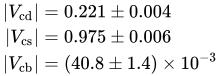
The CKM matrix describes the weak interaction of quarks.[73] As of 2022, the values of the CKM matrix relating to the charm quark are:[74]

Charm quarks can exist in either "open charm particles", which contain one or several charm quarks, or as charmonium states, which are bound states of a charm quark and a charm antiquark.[64] There are several charmed mesons, including
D±
and
D0
.[75] Charmed baryons include
Λ
c,
Σ
c,
Ξ
c,
Ω
c, with various charges and resonances.[76]
Production and decay[edit]
Particles containing charm quarks can be produced via electron–positron collisions or in hadron collisions.[77] Using different energies, electron–positron colliders can produce psi or upsilon mesons.[78] Hadron colliders produce particles that contain charm quarks at a higher cross section.[c][81] The W boson can also decay into hadrons containing the charm quark or the charm antiquark.[82] The Z boson can decay into charmonium through charm quark fragmentation.[83] The Higgs boson can also decay to
J/ψ
or
η
c through the same mechanism. The decay rate of the Higgs boson into charmonium is "governed by the charm-quark Yukawa coupling".[84]
The charm quark can decay into other quarks via weak decays.[64] The charm quark also annihilates with the charm antiquark during the decays of ground-state charmonium mesons.[64]
References[edit]
Notes[edit]
- ^ According to Riordan, the word "outlanders" means "other kinds of physicists who did neutrino scattering or measured electron–positron collisions in storage rings."[23]
- ^ The Particle Physics Review uses the unit GeV instead of GeV/c2.[9] This is because particle physics uses natural units, in which the speed of light is set to be one.[72] The Review also notes this mass corresponds to the "running" mass in the Minimal subtraction scheme (MS scheme).[9]
- ^ According to Mark Thomson, a cross section in particle physics is a measure of quantum mechanical probability for the interaction.[79] It is the ratio between the interaction rate per target particle and the incident particle flux.[80]
Citations[edit]
- ^ Amati et al. 1964.
- ^ Maki & Ohnuki 1964.
- ^ Hara 1964.
- ^ a b c d Glashow 1976.
- ^ a b Riordan 1987, p. 210.
- ^ a b Harari 1977, p. 6.
- ^ Riordan 1992, p. 1292.
- ^ Levine 2017.
- ^ a b c d e Workman et al. 2022, p. 32.
- ^ Griffiths 2008, p. 35.
- ^ Griffiths 2008, p. 37.
- ^ Griffiths 2008, p. 39.
- ^ Griffiths 2008, p. 41.
- ^ Griffiths 2008, p. 34.
- ^ Bjorken & Glashow 1964, p. 255.
- ^ Griffiths 2008, pp. 44–45.
- ^ Glashow, Iliopoulos & Maiani 1970, p. 1287.
- ^ Appelquist, Barnett & Lane 1978, p. 390.
- ^ Glashow, Iliopoulos & Maiani 1970, p. 1290–1291.
- ^ a b Close 1976, p. 537.
- ^ a b Riordan 1987, p. 297.
- ^ a b Rosner 1998, p. 14.
- ^ Riordan 1987, p. 295.
- ^ Iliopoulos 1974, p. 100.
- ^ Giudice, Gian Francesco. "Naturally speaking: the naturalness criterion and physics at the LHC". Perspectives on LHC physics (2008): 155–178.
- ^ Gaillard & Lee 1974.
- ^ Riordan 1987, pp. 295–297.
- ^ Riordan 1987, pp. 296.
- ^ a b Cazzoli et al. 1975.
- ^ a b Riordan 1987, p. 306.
- ^ Riordan 1987, p. 306, "It was encouraging, but not convincing, evidence [...] this one was ambiguous".
- ^ Riordan 1987, pp. 297–298.
- ^ Ting 1977, p. 239.
- ^ Ting 1977, p. 243.
- ^ Ting 1977, p. 244.
- ^ a b Southworth 1976, p. 385.
- ^ Southworth 1976, pp. 385–386.
- ^ a b Rosner 1998, p. 16.
- ^ a b c Riordan 1987, p. 300.
- ^ Riordan 1987, p. 300.
- ^ Riordan 1987, p. 304.
- ^ Riordan 1987, p. 300, "Murray ... thinks that the charm–anticharm vector meson is more likely".
- ^ a b Riordan 1987, p. 301.
- ^ Riordan 1987, p. 303.
- ^ a b c Riordan 1987, p. 305.
- ^ Aubert et al. 1974.
- ^ Augustin et al. 1974.
- ^ Southworth 1976, p. 383.
- ^ Riordan 1987, p. 321.
- ^ Rosner 1998, p. 18.
- ^ Riordan 1987, pp. 319–320.
- ^ Riordan 1987, pp. 310–311.
- ^ Riordan 1987, p. 312.
- ^ Riordan 1987, p. 317.
- ^ Riordan 1987, p. 318.
- ^ Riordan 1987, p. 319, "Solid evidence for charm surfaced in session after session. There was no longer any doubt".
- ^ Griffiths 2008, p. 47, "With these discoveries, the interpretation ... was established beyond reasonable doubt. More important, the quark model itself was put back on its feet".
- ^ Brandelik et al. 1977.
- ^ Griffiths 2008, p. 47.
- ^ Mattson et al. 2002.
- ^ Yap 2002.
- ^ a b Aubert et al. 2007.
- ^ a b Starič et al. 2007.
- ^ a b c d e Gersabeck 2014, p. 2.
- ^ Aubert et al. 2007, p. 4.
- ^ The NNPDF Collaboration 2022.
- ^ Thompson & Howe 2022.
- ^ Aad et al. 2022.
- ^ ATLAS experiment 2022.
- ^ LHCb experiment 2022, "This is the first evidence of direct CP violation in an individual charm–hadron decay (D0 → π– π+), with a significance of 3.8σ".
- ^ Appelquist, Barnett & Lane 1978, p. 388.
- ^ Thomson 2013, p. 31.
- ^ Thomson 2013, p. 368.
- ^ Workman et al. 2022, pp. 262–263.
- ^ Workman et al. 2022, pp. 43–45.
- ^ Workman et al. 2022, pp. 100–4.
- ^ Gersabeck 2014, pp. 3–4.
- ^ Gersabeck 2014, p. 3.
- ^ Thomson 2013, p. 26.
- ^ Thomson 2013, p. 69.
- ^ Gersabeck 2014, p. 4.
- ^ Thomson 2013, p. 412.
- ^ Braaten, Cheung & Yuan 1993.
- ^ Han et al. 2022.
Bibliography[edit]
News articles[edit]
- ATLAS experiment (2 May 2022). "Higgs-boson charm coupling weaker than bottom". CERN Courier. Retrieved 2023-06-03.
- Glashow, Sheldon L. (July 18, 1976). "The hunting of the quark". The New York Times.
- Levine, Alaina G. (November 2017). "This Month in Physics History". APS News. Vol. 26, no. 10. American Physical Society. Retrieved 2023-06-01.
- LHCb experiment (7 July 2022). "LHCb digs deeper in CP-violating charm decays". CERN Courier. Retrieved 2023-07-27.
- Southworth, Brian, ed. (November 1976). "1976 Nobel Prize for Physics" (PDF). CERN Courier. Vol. 16, no. 11. Geneva, Switzerland: CERN. pp. 383–88.
- Yap, Diana Michele (2002-06-10). "Hunting the Doubly Charmed Baryon". Wired. Retrieved 2023-06-06.
Journal articles[edit]
- Aad, G.; et al. (ATLAS Collaboration) (2022). "Direct constraint on the Higgs–charm coupling from a search for Higgs boson decays into charm quarks with the ATLAS detector". The European Physical Journal C. 82 (717): 717. arXiv:2201.11428. Bibcode:2022EPJC...82..717A. doi:10.1140/epjc/s10052-022-10588-3. S2CID 251688816.
- Amati, D.; Bacry, H.; Nuyts, J.; Prentki, J. (December 1964). "SU 4 and strong interactions". Il Nuovo Cimento. 34 (6): 1732–1750. Bibcode:1964NCim...34.1732A. doi:10.1007/BF02750568. S2CID 118803104.
- Appelquist, Thomas; Barnett, R. Michael; Lane, Kenneth (December 1978). "Charm and Beyond" (PDF). Annual Review of Nuclear and Particle Science. 28: 387–499. Bibcode:1978ARNPS..28..387A. doi:10.1146/annurev.ns.28.120178.002131. OSTI 1446842.
- Aubert, B.; et al. (BaBar Collaboration) (2003). "Observation of a Narrow Meson State Decaying to at a Mass of 2.32 GeV/c2". Physical Review Letters. 90 (24): 242001. arXiv:hep-ex/0304021. doi:10.1103/PhysRevLett.90.242001. PMID 12857188. S2CID 248411543. 242001.
- Aubert, B.; et al. (BaBar Collaboration) (2007). "Evidence for Mixing". Physical Review Letters. 98 (21): 211802. doi:10.1103/PhysRevLett.98.211802. hdl:2445/140150. PMID 17677764. 211802.
- Aubert, J. J.; et al. (1974). "Experimental Observation of a Heavy Particle J". Physical Review Letters. 33 (23): 1404. Bibcode:1974PhRvL..33.1404A. doi:10.1103/PhysRevLett.33.1404.
- Augustin, J.-E.; et al. (1974). "Discovery of a Narrow Resonance in e+e− Annihilation". Physical Review Letters. 33 (23): 1406. Bibcode:1974PhRvL..33.1406A. doi:10.1103/PhysRevLett.33.1406.
- Besson, D.; et al. (CLEO Collaboration) (2003). "Observation of a narrow resonance of mass 2.46 GeV/c2, decaying to and confirmation of the (2317) state". Physical Review D. 68 (3): 032002. arXiv:hep-ex/0305100. doi:10.1103/PhysRevD.68.032002. (Erratum: Bibcode:2007PhRvD..75k9908B, doi:10.1103/PhysRevD.75.119908)
- Bjorken, B. J.; Glashow, S. L. (1964). "Elementary particles and SU(4)". Physics Letters. 11 (3): 255–257. Bibcode:1964PhL....11..255B. doi:10.1016/0031-9163(64)90433-0.
- Braaten, Eric; Cheung, Kingman; Yuan, Tzu Chiang (1993). "Z0 decay into charmonium via charm quark fragmentation". Physical Review D. 48 (9): 4230–4235. arXiv:hep-ph/9302307. Bibcode:1993PhRvD..48.4230B. doi:10.1103/PhysRevD.48.4230. PMID 10016703. S2CID 14348242.
- Brandelik, R.; et al. (DASP Collaboration) (1977). "On the origin of inclusive electron events in e+e− annihilation between 3.6 and 5.2 GeV". Physics Letters B. 70 (1): 125–31. Bibcode:1977PhLB...70..125B. doi:10.1016/0370-2693(77)90360-4.
- Cazzoli, E. G.; et al. (1975). "Evidence for ΔS = −ΔQ Currents or Charmed-Baryon Production by Neutrinos". Physical Review Letters. 34 (17): 1125–28. doi:10.1103/PhysRevLett.34.1125.
- Close, F. E. (1976). "Iliopoulos wins his bet" (PDF). Nature. 262 (5569): 537–38. Bibcode:1976Natur.262..537C. doi:10.1038/262537a0. S2CID 8569677.
- Gaillard, M.K.; Lee, B.W. (1974). "Rare decay modes of the mesons in gauge theories". Phys. Rev. D. 10 (3): 897–916. Bibcode:1974PhRvD..10..897G. doi:10.1103/PhysRevD.10.897.
- Gersabeck, Marco (2012). "Brief Review of Charm Physics". Modern Physics Letters A. 27 (26). arXiv:1207.2195. Bibcode:2012MPLA...2730026G. doi:10.1142/S0217732312300261. S2CID 119284941. 1230026.
- Glashow, S. L.; Iliopoulos, J.; Maiani, L. (1970). "Weak Interactions with Lepton–Hadron Symmetry". Physical Review D. 2 (7): 1285–1292. Bibcode:1970PhRvD...2.1285G. doi:10.1103/PhysRevD.2.1285.
- Goldhaber, G.; et al. (1976). "Observation in e+e− Annihilation of a Narrow State at 1865 MeV/c2 Decaying to Kπ and Kπππ". Physical Review Letters. 37 (5): 255–59. Bibcode:1976PhRvL..37..255G. doi:10.1103/PhysRevLett.37.255.
- Han, Tao; et al. (August 2022). "Higgs boson decay to charmonia via c-quark fragmentation". Journal of High Energy Physics. 2022 (73): 73. arXiv:2202.08273. Bibcode:2022JHEP...08..073H. doi:10.1007/JHEP08(2022)073. S2CID 246904813.
- Hara, Yasuo (11 May 1964). "Unitary Triplets and the Eightfold Way". Physical Review. 134 (3B): B701–B704. Bibcode:1964PhRv..134..701H. doi:10.1103/PhysRev.134.B701.
- Liu, Z.; et al. (Belle Collaboration) (2013). "Study of e+e− → π+π−J/ψ and Observation of a Charged Charmoniumlike State at Belle". Physical Review Letters. 110 (25): 252002. arXiv:1304.0121. doi:10.1103/PhysRevLett.110.252002. PMID 23829730. S2CID 28918792. 252002.
- Maki, Z.; Ohnuki, Y. (1 July 1964). "Quartet Scheme for Elementary Particles". Progress of Theoretical Physics. 32 (1): 144–158. Bibcode:1964PThPh..32..144M. doi:10.1143/PTP.32.144.
- Mattson, M.; et al. (SELEX Collaboration) (September 2002). "First Observation of the Doubly Charmed Baryon Ξ+cc". Physical Review Letters. 89 (11): 112001. arXiv:hep-ex/0208014. Bibcode:2002PhRvL..89k2001M. doi:10.1103/PhysRevLett.89.112001. hdl:11449/66973. PMID 12225136. S2CID 16737596.
- The NNPDF Collaboration (2022). "Evidence for intrinsic charm quarks in the proton". Nature. 608 (7923): 483–487. arXiv:2208.08372. Bibcode:2022Natur.608..483N. doi:10.1038/s41586-022-04998-2. PMC 9385499. PMID 35978125.
- Peruzzi, I.; et al. (1976). "Observation of a Narrow Charged State at 1876 MeV/c2 Decaying to an Exotic Combination of Kππ". Physical Review Letters. 37 (10): 569–71. Bibcode:1976PhRvL..37..569P. doi:10.1103/PhysRevLett.37.569.
- Riordan, Michael (1992). "The Discovery of Quarks". Science. 256 (5061): 1287–93. Bibcode:1992Sci...256.1287R. doi:10.1126/science.256.5061.1287. JSTOR 2877300. PMID 17736758. S2CID 34363851. Retrieved 2023-06-01.
- Starič, M.; et al. (Belle Collaboration) (2007). "Evidence for Mixing". Physical Review Letters. 98 (21): 211803. doi:10.1103/PhysRevLett.98.211803. PMID 17677765. S2CID 30918611. 211803.
- Thompson, Benjamin; Howe, Nick Petrić (2022-08-17). "Do protons have intrinsic charm? New evidence suggests yes". Nature. doi:10.1038/d41586-022-02237-2. PMID 35978168. S2CID 251645562. Retrieved 2022-06-03.
- Ting, Samuel C. C. (April 1977). "The discovery of the J particle: A personal recollection" (PDF). Reviews of Modern Physics. 49 (2): 235–49. Bibcode:1977RvMP...49..235T. doi:10.1103/RevModPhys.49.235.
- Workman, R. L.; et al. (Particle Data Group) (2022). "Review of Particle Physics". Progress of Theoretical and Experimental Physics. 2022 (8). doi:10.1093/ptep/ptac097. hdl:20.500.11850/571164. 083C01.


Conferences[edit]
- Harari, Haim (April 29–30, 1977). Three Generations of Quarks and Leptons (PDF). V International Conference on Experimental Meson Spectroscopy. Boston, Mass. SLAC-PUB-1974.
- Iliopoulos, J. (July 1–10, 1974). Progress in Gauge Theories. XVII International Conference on High Energy Physics. Vol. III. London: Ecole Normale Superieure. pp. 89–116. PTENS-74-4.
- Gersabeck, Marco (28–31 October 2014). Introduction to Charm Physics. Flavorful Ways to New Physics. Freudenstadt - Lauterbad, Germany. arXiv:1503.00032.
- Rosner, Jonathan L. (1998). The Arrival of Charm. Heavy Quarks at Fixed Targets. AIP Conference Proceedings. Vol. 459, no. 1 (published 1999). pp. 9–27. arXiv:hep-ph/9811359. doi:10.1063/1.57782. Retrieved 2023-06-02.
Books[edit]
- Griffiths, David (2008). Introduction to Elementary Particles. Wiley-VCH. ISBN 978-3-527-40601-2.
- Riordan, Michael (1987). The Hunting of the Quark: A True Story of Modern Physics. Simon & Schuster. ISBN 978-0-671-50466-3.
- Thomson, Mark (2013). Modern Particle Physics. Cambridge University Press. ISBN 978-1-107-03426-6.
Further reading[edit]
- R. Nave. "Quarks". HyperPhysics. Georgia State University, Department of Physics and Astronomy. Retrieved 2008-06-29.
- A. Pickering (1984). Constructing Quarks. University of Chicago Press. pp. 114–125. ISBN 978-0-226-66799-7.
| Elementary |
| ||||||||||||||||||||||||
|---|---|---|---|---|---|---|---|---|---|---|---|---|---|---|---|---|---|---|---|---|---|---|---|---|---|
| Composite |
| ||||||||||||||||||||||||
| Quasiparticles | |||||||||||||||||||||||||
| Lists | |||||||||||||||||||||||||
| Related | |||||||||||||||||||||||||

| Authority control databases: National |
|---|
