


Dallas–Fort Worth metroplex
Dallas–Fort Worth–Arlington | ||
|---|---|---|
From top: Dallas, Fort Worth, Arlington, showcasing Downtown Dallas and Downtown Fort Worth, and the Arlington Entertainment District | ||
 Map of Dallas–Fort Worth, TX–OK CSA
| ||
| Country |  United States United States | |
| State |  Texas Texas | |
| Principal cities[1] | ||
| Area | ||
| • Urban | 1,746.90 sq mi (4,524.44 km2) | |
| • Metro | 8,675 sq mi (22,468 km2) | |
| Highest elevation | 1,368 ft (417 m) | |
| Population | ||
| • Conurbation | 7,637,387 (4th) | |
| • Urban | 5,732,354 (6th) | |
| • Urban density | 3,281.45/sq mi (1,266.98/km2) | |
| • Metro density | 880.4/sq mi (339.9/km2) | |
| • MSA | 7,637,387 (4th) | |
| • CSA | 8,121,108 (7th) | |
| GDP | ||
| • MSA | $688.928 billion (2022) | |
| Time zone | UTC-6 (CST) | |
| • Summer (DST) | UTC-5 (CDT) | |
| Area codes | 214, 254, 430, 469, 682, 817, 903, 940, 945, 972 | |


.jpg)
The Dallas–Fort Worth metroplex, officially designated Dallas–Fort Worth–Arlington by the U.S. Office of Management and Budget,[a] is the most populous metropolitan statistical area in the U.S. state of Texas and the Southern United States, encompassing 11 counties. Its historically dominant core cities are Dallas and Fort Worth.[5] It is the economic and cultural hub of North Texas. Residents of the area also refer to it as DFW (airport code), or the Metroplex. The Dallas–Fort Worth–Arlington metropolitan statistical area's population was 7,637,387 according to the U.S. Census Bureau's 2020 census,[6] making it the fourth-largest metropolitan area in the U.S. and the fifteenth-largest in the Americas. In 2016, the Dallas–Fort Worth metroplex had the highest annual population growth in the United States.[7] By 2023, the U.S. Census Bureau estimated that the Dallas-Fort Worth metropolitan area's population had increased to 8,100,037, with the highest numerical growth of any metropolitan area in the United States.[8]
The metropolitan region's economy, also referred to as Silicon Prairie, is primarily based on banking, commerce, insurance, telecommunications, technology, energy, healthcare, medical research, transportation and logistics. As of 2022, Dallas–Fort Worth is home to 23 Fortune 500 companies, the 4th-largest concentration of Fortune 500 companies in the United States behind New York City (62), Chicago (35), and Houston (24).[9] In 2016, the metropolitan economy surpassed Houston to become the fourth-largest in the U.S. The Dallas–Fort Worth metroplex boasted a GDP of just over $620.6 billion in 2020.[10] If the Metroplex were a sovereign state, it would have the twentieth largest economy in the world as of 2019. In 2015, the conurbated metropolitan area would rank the ninth-largest economy if it were a U.S. state.[11] In 2020, Dallas–Fort Worth was recognized as the 36th best metropolitan area for STEM professionals in the U.S.[12]
The Dallas–Fort Worth metroplex comprises the highest concentration of colleges and universities in Texas. The UT Southwestern Medical Center is home to six Nobel Laureates and was ranked No. 1 in the world among healthcare institutions in biomedical sciences.[13][14] The Metroplex is also the second most popular metropolis for megachurches in Texas (trailing the Greater Houston metropolitan area),[15] ranked the largest Christian metropolitan statistical area in the U.S.,[16][17][18] and has one of the largest LGBT communities in Texas since 2005.[19][20][21][22]
Etymology[edit]
A portmanteau of metropolis and complex, the term metroplex is credited to Harve Chapman, an executive vice president with Dallas-based Tracy-Locke, one of three advertising agencies that worked with the North Texas Commission (NTC) on strategies to market the region.[23] The NTC copyrighted the term "Southwest Metroplex" in 1972 as a replacement for the previously-ubiquitous "North Texas",[24] which studies had shown lacked identifiability outside the state. In fact, only 38 percent of a survey group identified Dallas and Fort Worth as part of "North Texas", with the Texas Panhandle also a perceived correct answer, being the northernmost region of Texas.[25]
Geography[edit]
The United States Census Bureau determined the Metroplex encompasses 9,286 square miles (24,100 km2) of total area; 8,991 sq mi (23,290 km2) is land, and 295 sq mi (760 km2) is covered by water. The conurbated metropolitan area is larger in area than the U.S. states of Rhode Island and Connecticut combined,[26] and larger than New Jersey.[26] If the metropolitan area were a sovereign state, it would rank the 162nd largest state by total area after Lebanon. The U.S. Office of Management and Budget combines the Dallas–Fort Worth metroplex with the Sherman–Denison metropolitan area and seven micropolitan statistical areas to form the Dallas–Fort Worth TX–OK combined statistical area.
The Dallas–Fort Worth metroplex overlooks mostly prairie land with a few rolling hills dotted by human-made lakes cut by streams, creeks and rivers surrounded by forested land. The Dallas–Fort Worth metroplex is situated in the Texas blackland prairies region,[27] so named for its fertile black soil found especially in the rural areas of Collin, Dallas, Ellis, Hunt, Kaufman, and Rockwall counties.
Many areas of Denton, Johnson, Parker, Tarrant, and Wise counties are located in the Fort Worth Prairie region of North Texas,[28] which has less fertile and more rocky soil than that of the Texas blackland prairie; most of the rural land on the Fort Worth Prairie is ranch land. A large onshore natural gas field, the Barnett Shale, lies underneath this area; Denton, Tarrant and Wise counties feature many natural gas wells. Continuing land use change results in scattered crop fields surrounded by residential or commercial development. South of Dallas and Fort Worth is a line of rugged hills that goes north to south about 15 miles (24 km) that looks similar to the Texas Hill Country 200 miles (320 km) to the south.
Metropolitan divisions and counties[edit]

The Dallas–Fort Worth–Arlington metropolitan statistical area is formed by a combination of two separate metropolitan statistical divisions. The Dallas–Plano–Irving MDA and Fort Worth–Arlington–Grapevine MDA come together to form one full metropolitan area or conurbation.[29][1]
Dallas–Plano–Irving metropolitan division[edit]
- Collin County
- Dallas County
- Denton County
- Ellis County
- Hunt County
- Kaufman County
- Rockwall County[30][31]
Fort Worth–Arlington–Grapevine metropolitan division[edit]
Climate[edit]
Dallas–Fort Worth has a humid subtropical climate (Köppen climate classification: Cfa).
It is also continental, characterized by a relatively wide annual temperature range for the latitude. The Dallas–Fort Worth metroplex is located at the lower end of Tornado Alley, and can experience extreme weather.[33]
In the Metroplex, summers are very hot and humid, although low humidity characteristics of desert locations can appear at any time of the year. July and August are typically the hottest months, with an average high of 96.0 °F (36 °C) and an average low of 76.7 °F (25 °C). Heat indexes regularly surpass 105 °F (41 °C) at the height of summer. The all-time record high is 113 °F (45 °C), set on June 26 and 27, 1980 during the Heat Wave of 1980 at nearby Dallas/Fort Worth International Airport.[34][35]
Winters in the area are cool to mild, with occasional cold spells. The average date of first frost is November 12, and the average date of last frost is March 12.[36] January is typically the coldest month, with an average daytime high of 56.8 °F (14 °C) and an average nighttime low of 37.3 °F (3 °C). The normal daily average temperature in January is 47.0 °F (8 °C) but sharp swings in temperature can occur, as strong cold fronts known as "Blue Northers" pass through the Metroplex, forcing daytime highs below the 50 °F (10 °C) mark for several days at a time and often between days with high temperatures above 80 °F (27 °C). Snow accumulation is seen in the city in about 70% of winter seasons, and snowfall generally occurs 1–2 days out of the year for a seasonal average of 1.5 inches (4 cm). Some areas in the region, however, receive more than that, while other areas receive negligible snowfall or none at all.[37] The all-time record low temperature within the city is −3 °F (−19 °C), set on January 18, 1930, however the temperature at Dallas/Fort Worth International Airport reached −2 °F (−19 °C) on February 16, 2021, during Winter Storm Uri.
| Month | Jan | Feb | Mar | Apr | May | Jun | Jul | Aug | Sep | Oct | Nov | Dec | Year |
|---|---|---|---|---|---|---|---|---|---|---|---|---|---|
| Record high °F (°C) | 88 (31) |
95 (35) |
97 (36) |
100 (38) |
103 (39) |
112 (44) |
112 (44) |
111 (44) |
110 (43) |
100 (38) |
92 (33) |
89 (32) |
112 (44) |
| Mean maximum °F (°C) | 76.7 (24.8) |
80.5 (26.9) |
85.9 (29.9) |
89.0 (31.7) |
95.0 (35.0) |
98.9 (37.2) |
103.6 (39.8) |
104.1 (40.1) |
99.1 (37.3) |
92.5 (33.6) |
82.9 (28.3) |
77.9 (25.5) |
105.5 (40.8) |
| Mean daily maximum °F (°C) | 57.7 (14.3) |
62.0 (16.7) |
69.9 (21.1) |
77.4 (25.2) |
84.9 (29.4) |
92.7 (33.7) |
96.9 (36.1) |
97.1 (36.2) |
90.0 (32.2) |
79.5 (26.4) |
67.8 (19.9) |
59.2 (15.1) |
77.9 (25.5) |
| Daily mean °F (°C) | 47.8 (8.8) |
52.0 (11.1) |
59.6 (15.3) |
67.1 (19.5) |
75.4 (24.1) |
83.3 (28.5) |
87.3 (30.7) |
87.3 (30.7) |
80.1 (26.7) |
69.1 (20.6) |
57.8 (14.3) |
49.5 (9.7) |
68.0 (20.0) |
| Mean daily minimum °F (°C) | 37.9 (3.3) |
41.9 (5.5) |
49.4 (9.7) |
56.8 (13.8) |
66.0 (18.9) |
73.8 (23.2) |
77.7 (25.4) |
77.4 (25.2) |
70.1 (21.2) |
58.7 (14.8) |
47.8 (8.8) |
39.8 (4.3) |
58.1 (14.5) |
| Mean minimum °F (°C) | 22.5 (−5.3) |
26.5 (−3.1) |
31.1 (−0.5) |
41.3 (5.2) |
52.0 (11.1) |
64.2 (17.9) |
70.8 (21.6) |
69.4 (20.8) |
56.8 (13.8) |
42.0 (5.6) |
31.2 (−0.4) |
25.1 (−3.8) |
19.1 (−7.2) |
| Record low °F (°C) | −3 (−19) |
2 (−17) |
11 (−12) |
30 (−1) |
39 (4) |
53 (12) |
56 (13) |
57 (14) |
36 (2) |
26 (−3) |
17 (−8) |
1 (−17) |
−3 (−19) |
| Average precipitation inches (mm) | 2.59 (66) |
2.78 (71) |
3.45 (88) |
3.15 (80) |
4.57 (116) |
3.83 (97) |
2.54 (65) |
2.31 (59) |
3.10 (79) |
4.79 (122) |
2.93 (74) |
3.23 (82) |
39.33 (999) |
| Average snowfall inches (cm) | 0.1 (0.25) |
0.9 (2.3) |
0.3 (0.76) |
0.0 (0.0) |
0.0 (0.0) |
0.0 (0.0) |
0.0 (0.0) |
0.0 (0.0) |
0.0 (0.0) |
0.0 (0.0) |
0.1 (0.25) |
0.3 (0.76) |
1.7 (4.3) |
| Average precipitation days (≥ 0.01 in) | 7.0 | 6.9 | 8.1 | 7.3 | 9.4 | 7.3 | 4.9 | 5.1 | 5.6 | 7.2 | 6.5 | 6.9 | 82.2 |
| Average snowy days (≥ 0.1 in) | 0.4 | 0.5 | 0.2 | 0.0 | 0.0 | 0.0 | 0.0 | 0.0 | 0.0 | 0.0 | 0.1 | 0.3 | 1.5 |
| Average relative humidity (%) | 67.5 | 66.4 | 63.7 | 65.3 | 69.7 | 65.8 | 60.0 | 60.5 | 66.5 | 65.7 | 67.4 | 67.5 | 65.4 |
| Average dew point °F (°C) | 31.3 (−0.4) |
35.2 (1.8) |
42.6 (5.9) |
52.0 (11.1) |
61.0 (16.1) |
66.6 (19.2) |
67.6 (19.8) |
66.7 (19.3) |
63.3 (17.4) |
53.2 (11.8) |
43.7 (6.5) |
34.7 (1.5) |
51.5 (10.8) |
| Mean monthly sunshine hours | 183.5 | 178.3 | 227.7 | 236.0 | 258.4 | 297.8 | 332.4 | 304.5 | 246.2 | 228.1 | 183.8 | 173.0 | 2,849.7 |
| Percent possible sunshine | 58 | 58 | 61 | 61 | 60 | 69 | 76 | 74 | 66 | 65 | 59 | 56 | 64 |
| Average ultraviolet index | 3 | 5 | 7 | 9 | 10 | 10 | 10 | 10 | 8 | 6 | 4 | 3 | 7 |
| Source 1: NOAA (sun, relative humidity, and dew point 1961–1990 at DFW Airport)[d][39][40][41][42] | |||||||||||||
| Source 2: Weather Atlas (Average UV index)[43] | |||||||||||||
| Climate data for Fort Worth, Texas | |||||||||||||
|---|---|---|---|---|---|---|---|---|---|---|---|---|---|
| Month | Jan | Feb | Mar | Apr | May | Jun | Jul | Aug | Sep | Oct | Nov | Dec | Year |
| Record high °F (°C) | 80 (27) |
79 (26) |
87 (31) |
92 (33) |
97 (36) |
113 (45) |
110 (43) |
113 (45) |
111 (44) |
103 (39) |
95 (35) |
83 (28) |
113 (45) |
| Mean daily maximum °F (°C) | 54.1 (12.3) |
60.1 (15.6) |
68.3 (20.2) |
75.9 (24.4) |
83.2 (28.4) |
91.1 (32.8) |
95.4 (35.2) |
94.8 (34.9) |
87.7 (30.9) |
77.9 (25.5) |
65.1 (18.4) |
56.5 (13.6) |
75.8 (24.3) |
| Daily mean °F (°C) | 44.1 (6.7) |
49.4 (9.7) |
57.4 (14.1) |
65.0 (18.3) |
73.1 (22.8) |
80.9 (27.2) |
85.0 (29.4) |
84.4 (29.1) |
77.5 (25.3) |
67.2 (19.6) |
55.1 (12.8) |
46.7 (8.2) |
65.5 (18.6) |
| Mean daily minimum °F (°C) | 34.0 (1.1) |
38.7 (3.7) |
46.4 (8.0) |
54.0 (12.2) |
63.0 (17.2) |
70.7 (21.5) |
74.6 (23.7) |
74.0 (23.3) |
67.2 (19.6) |
56.4 (13.6) |
45.1 (7.3) |
36.8 (2.7) |
55.1 (12.8) |
| Record low °F (°C) | −7 (−22) |
−8 (−22) |
−2 (−19) |
21 (−6) |
32 (0) |
43 (6) |
52 (11) |
59 (15) |
31 (−1) |
24 (−4) |
−3 (−19) |
−5 (−21) |
−8 (−22) |
| Average precipitation inches (mm) | 1.89 (48) |
2.37 (60) |
3.06 (78) |
3.20 (81) |
5.15 (131) |
3.23 (82) |
2.12 (54) |
2.03 (52) |
2.42 (61) |
4.11 (104) |
2.57 (65) |
2.57 (65) |
34.72 (882) |
| Average precipitation days | 7.2 | 6.1 | 7.5 | 7.2 | 9.3 | 7.2 | 4.7 | 4.5 | 5.8 | 7.1 | 6.7 | 6.5 | 79.8 |
| Mean monthly sunshine hours | 186.0 | 169.5 | 217.0 | 240.0 | 248.0 | 300.0 | 341.0 | 310.0 | 240.0 | 217.0 | 180.0 | 186.0 | 2,834.5 |
| Percent possible sunshine | 60 | 55 | 58 | 62 | 57 | 71 | 79 | 77 | 67 | 64 | 60 | 60 | 64 |
| Average ultraviolet index | 3 | 5 | 7 | 9 | 10 | 11 | 10 | 10 | 8 | 6 | 4 | 3 | 7 |
| Source 1: National Climatic Data Center[44] | |||||||||||||
| Source 2: Weather Atlas[45] (sunshine data, UV index) | |||||||||||||
Principal communities[edit]
.jpg)
The following are cities and towns categorized based on the latest population estimates from the North Central Texas Council of Governments (as of July 1, 2022).[46] No population estimates are released for census-designated places (CDPs), which are marked with an asterisk (*). These places are categorized based on their 2020 census population.[47]
Places with more than 100,000 inhabitants[edit]

Places designated "principal cities" by the U.S. Office of Management and Budget are italicized.[48]
1,000,000+
- Dallas (1,299,544)
500,000–999,999
- Fort Worth (956,709)
200,000–499,999
- Arlington (394,602)
- Plano (289,547)
- Irving (254,715)
- Garland (240,854)
- Frisco (219,587)
- McKinney (207,507)
- Grand Prairie (201,843)
100,000–199,999
- Denton (150,353)
- Mesquite (147,899)
- Carrollton (133,820)
- Lewisville (131,215)
- Richardson (118,802)
- Allen (111,551)
Places with 10,000 to 99,999 inhabitants[edit]
- Addison
- Anna
- Azle
- Balch Springs
- Bedford
- Benbrook
- Burleson
- Cedar Hill
- Celina
- Cleburne
- Colleyville
- Coppell
- Corinth
- Crowley
- DeSoto
- Duncanville
- Ennis
- Euless
- Fairview
- Farmers Branch
- Fate
- Flower Mound
- Forest Hill
- Forney
- Glenn Heights
- Granbury
- Grapevine
- Greenville
- Haltom City
- Heath
- Highland Village
- Hurst
- Keller
- Lancaster
- Little Elm
- Mansfield
- Melissa
- Midlothian
- Mineral Wells (partial)
- Murphy
- North Richland Hills
- Princeton
- Prosper
- Red Oak
- Rendon*
- Rockwall
- Rowlett
- Royse City
- Sachse
- Saginaw
- Seagoville
- Southlake
- Terrell
- The Colony
- Trophy Club
- University Park
- Watauga
- Waxahachie
- Weatherford
- White Settlement
- Wylie
Places with fewer than 10,000 inhabitants[edit]
- Aledo
- Alma
- Alvarado
- Alvord
- Annetta North
- Annetta South
- Annetta
- Argyle
- Aubrey
- Aurora
- Bardwell
- Bartonville
- Blue Mound
- Blue Ridge
- Boyd
- Briar*
- Briaroaks
- Bridgeport
- Caddo Mills
- Campbell
- Celeste
- Chico
- Cockrell Hill
- Combine
- Commerce
- Cool
- Cooper
- Copper Canyon
- Corral City
- Cottonwood
- Covington
- Crandall
- Cresson (partial)
- Cross Roads
- Cross Timber
- Dalworthington Gardens
- Decatur
- DeCordova
- Dennis
- DISH
- Double Oak
- Eagle Mountain*
- Edgecliff Village
- Everman
- Farmersville
- Ferris
- Garrett
- Glen Rose
- Godley
- Grandview
- Grays Prairie
- Gun Barrel City
- Hackberry
- Haslet
- Hawk Cove
- Hebron
- Hickory Creek
- Highland Park
- Hudson Oaks
- Hutchins
- Italy
- Itasca
- Josephine
- Joshua
- Justin
- Kaufman
- Keene
- Kemp
- Kennedale
- Knollwood
- Krugerville
- Krum
- Lake Bridgeport
- Lake Dallas
- Lake Worth
- Lakeside
- Lakewood Village
- Lavon
- Leonard
- Lincoln Park
- Lone Oak
- Lowry Crossing
- Lucas
- Mabank (partial)
- Maypearl
- McLendon-Chisholm
- Milford
- Millsap
- Mobile City
- Nevada
- New Fairview
- New Hope
- Newark
- Neylandville
- Northlake
- Oak Grove
- Oak Leaf
- Oak Point
- Oak Ridge
- Ovilla
- Palmer
- Pantego
- Paradise
- Parker
- Pecan Acres*
- Pecan Hill
- Pelican Bay
- Pilot Point
- Ponder
- Post Oak Bend City
- Providence Village
- Quinlan
- Reno
- Rhome
- Richland Hills
- Rio Vista
- River Oaks
- Roanoke
- Rosser
- Runaway Bay
- Saint Paul
- Sanctuary
- Sanger
- Sansom Park
- Scurry
- Shady Shores
- Springtown
- Sunnyvale
- Talty
- Union Valley
- Van Alstyne (partial)
- Venus
- West Tawakoni
- Westlake
- Weston
- Westover Hills
- Westworth Village
- Willow Park
- Wilmer
- Wolfe City
Unincorporated places[edit]
Demographics[edit]
| Census | Pop. | Note | %± |
|---|---|---|---|
| 1980 | 2,974,805 | — | |
| 1990 | 3,885,415 | 30.6% | |
| 2000 | 5,221,801 | 34.4% | |
| 2010 | 6,426,214 | 23.1% | |
| 2020 | 7,637,387 | 18.8% | |
| 2023 (est.) | 8,100,037 | 6.1% | |
| U.S. Decennial Census | |||
| County | 2023 estimate[49] | 2020 census | Change | Area | Density | ||
|---|---|---|---|---|---|---|---|
| Dallas County | 2,606,358 | 2,613,539 | −0.27% | 2,613,539 | −0.49% | 871.28 sq mi (2,256.6 km2) | 2,985/sq mi (1,153/km2) |
| Tarrant County | 2,182,947 | 2,110,640 | +3.43% | 2,110,640 | +2.08% | 863.61 sq mi (2,236.7 km2) | 2,495/sq mi (963/km2) |
| Collin County | 1,195,359 | 1,064,465 | +12.30% | 1,064,465 | +8.85% | 841.22 sq mi (2,178.7 km2) | 1,377/sq mi (532/km2) |
| Denton County | 1,007,703 | 906,422 | +11.17% | 906,422 | +7.82% | 878.43 sq mi (2,275.1 km2) | 1,113/sq mi (430/km2) |
| Ellis County | 222,829 | 192,455 | +15.78% | 192,455 | +10.25% | 935.49 sq mi (2,422.9 km2) | 227/sq mi (88/km2) |
| Johnson County | 202,906 | 179,927 | +12.77% | 179,927 | +8.66% | 724.69 sq mi (1,876.9 km2) | 270/sq mi (104/km2) |
| Kaufman County | 185,690 | 145,310 | +27.79% | 145,310 | +18.62% | 780.70 sq mi (2,022.0 km2) | 221/sq mi (85/km2) |
| Parker County | 173,494 | 148,222 | +17.05% | 148,222 | +11.88% | 903.48 sq mi (2,340.0 km2) | 184/sq mi (71/km2) |
| Rockwall County | 131,307 | 107,819 | +21.78% | 107,819 | +14.27% | 127.04 sq mi (329.0 km2) | 970/sq mi (374/km2) |
| Hunt County | 113,347 | 99,956 | +13.40% | 99,956 | +8.33% | 840.32 sq mi (2,176.4 km2) | 129/sq mi (50/km2) |
| Wise County | 78,097 | 68,632 | +13.79% | 68,632 | +9.13% | 904.42 sq mi (2,342.4 km2) | 83/sq mi (32/km2) |
| Total | 8,100,037 | 7,637,387 | +6.06% | 7,637,387 | +4.01% | 8,670.68 sq mi (22,457.0 km2) | 916/sq mi (354/km2) |
Numerically, the Metroplex is the fastest growing metropolitan area in the U.S.[50] At the 2020 U.S. census 7,637,387 people lived in the area,[6] up from 6,371,773 in 2010,[51] and 2,974,805 in 1970. In 2020, the Dallas–Fort Worth metroplex's racial composition was 42% non-Hispanic white, 16% Black or African American, 8% Asian, 3-4% two or more races, and 29% Hispanic or Latino American of any race.[52] According to information gathered from the North Texas Commission, the Metroplex's racial and ethnic makeup was 46% non-Hispanic white, 15% Black or African American, 7% Asian American, and 3% from other races in 2017. Ethnically, Hispanics and Latinos of any race made up 29% of the metropolitan population.[53] From 2010 to 2017, Hispanics and Latinos increased an estimated 38.9% followed by Blacks and African Americans.[53]
In 2015, an estimated 101,588 foreign-born residents moved to the Metroplex. Of the immigrant population, 44.1% were from Latin America, 35.8% Asia, 7.1% Europe, and 13.1% Africa. In 2010, 77,702 foreign nationals immigrated; approximately 50.6% came from Latin America, 33.0% from Asia, 7.3% Europe, and 9.1% Africa.[53] During the 2020 American Community Survey, an estimated 18.5% of its population were foreign-born, with 56% from Latin America, 30% Asia, 8% Africa, 4% Europe, and 1% elsewhere from North America.[54]
The median household income in Dallas–Fort Worth was higher than the state average in 2017, and its unemployment and poverty rate was lower.[53] The median income for males was $51,498 and $44,207 for females. In 2019, the per capita income of DFW was $72,265. In 2010, the median income for a household in the metropolitan area was $48,062, and the median income for a family was $55,263. Males had a median income of $39,581 versus $27,446 for females. The per capita income for the Metroplex altogether was $21,839.
The Dallas–Fort Worth metroplex's religious population are predominantly Christian and the largest metro area that identify with the religion in the United States (78%).[18][16] Methodist, Baptist, Presbyterian, and Catholic churches are prominent in many cities and towns in the metropolitan region. The Methodist and Baptist communities anchor two of the area's major private universities (Southern Methodist University and Dallas Baptist University). Non-Christian faiths including Islam, Judaism, Hinduism, Sikhism, Buddhism, and contemporary paganism collectively form a little over 4% of the religious population.[55]
Combined statistical area[edit]
The Dallas–Fort Worth, TX–OK combined statistical area is made up of 20 counties in North Central Texas and one county in South Central Oklahoma. The statistical area includes two metropolitan areas and seven micropolitan areas. The CSA definition encompasses 14,628 sq mi (37,890 km2) of area, of which 14,126 sq mi (36,590 km2) is land and 502 sq mi (1,300 km2) is water. The population density was 485 people per square mile according to estimates from the U.S. Census Bureau.[56]
Metropolitan statistical areas (MSAs)[edit]
- Dallas–Fort Worth–Arlington (Collin, Dallas, Denton, Ellis, Hunt, Johnson, Kaufman, Parker, Rockwall, Tarrant, and Wise counties)
- Sherman-Denison (Grayson County); population 143,131 (2022 estimate)[57]
Micropolitan statistical areas (μSAs)[edit]
- Athens (Henderson County); population 84,511 (2022 estimate)[57]
- Bonham (Fannin County) (delineated and added in 2015); population 37,125 (2022 estimate)[57]
- Corsicana (Navarro County); population 54,636 (2022 estimate)[57]
- Durant, OK (Bryan County, Oklahoma); population 48,182 (2022 estimate)[57]
- Gainesville (Cooke County); population 43,050 (2022 estimate)[57]
- Granbury (Hood County) (delineated and added in 2018); population 66,373 (2022 estimate)[57]
- Mineral Wells (Palo Pinto County); population 29,239 (2022 estimate)[57]
Demographics[edit]
At the 2000 U.S. census,[51] there were 5,487,956 people, 2,006,665 households, and 1,392,540 families residing within the CSA. The racial makeup of the CSA was 70.41% White, 13.34% Black or African American, 0.59% Native American, 3.58% Asian, 0.08% Pacific Islander, 9.62% from other races, and 2.39% from two or more races. Hispanics or Latinos of any race were 20.83% of the population. The median income for a household in the CSA was $43,836, and the median income for a family was $50,898. Males had a median income of $37,002 versus $25,553 for females. The per capita income for the CSA was $20,460.
At the 2020 census, the DFW CSA had a population of 8,121,108 (though a July 1, 2015 estimate placed the population at 7,504,362).[58] In 2018 it had an estimated 7,994,963 residents.[56] The American Community Survey determined 18% of the population was foreign-born. The median household income was $67,589 and the per capita income was $34,455. An estimated 11.5% lived below the poverty line. The median age of the DFW CSA was 35.3.
Urban areas within[edit]

At the core of the Dallas–Fort Worth combined statistical area (CSA) lies the Dallas–Fort Worth–Arlington, TX urban area, the sixth-most populous in the United States.[3] Within the boundaries of the CSA the Census Bureau defines 31 other urban areas as well, some of which form the core of their own metro or micro statistical areas separate from the Dallas–Fort Worth metropolitan statistical area. Urban areas situated primarily outside the Dallas–Fort Worth metropolitan statistical area but within the CSA are identified with a cross (†) in the table below.
| Urban area | Population (2020 census) |
Land area (sq mi) |
Land area (km2) |
Density (population / sq mi) |
Density (population / km2) |
|---|---|---|---|---|---|
| Dallas–Fort Worth–Arlington, TX | 5,732,354 | 1,746.90 | 4,524.44 | 3,281.45 | 1,266.98 |
| McKinney–Frisco, TX | 504,803 | 151.64 | 392.75 | 3,328.93 | 1,285.31 |
| Denton–Lewisville, TX | 429,461 | 150.48 | 389.74 | 2,853.94 | 1,101.91 |
| Sherman–Denison, TX † | 66,691 | 38.49 | 99.70 | 1,732.52 | 668.93 |
| Weatherford, TX | 48,112 | 38.69 | 100.20 | 1,243.60 | 480.16 |
| Cleburne, TX | 43,901 | 24.51 | 63.48 | 1,791.10 | 691.55 |
| Forney, TX | 41,112 | 19.68 | 50.97 | 2,089.25 | 806.66 |
| Melissa–Anna, TX | 34,516 | 16.95 | 43.89 | 2,036.73 | 786.39 |
| Midlothian, TX | 30,908 | 24.72 | 64.03 | 1,250.30 | 482.75 |
| Granbury, TX † | 29,706 | 21.87 | 56.63 | 1,358.53 | 524.53 |
| Greenville, TX | 27,054 | 17.30 | 44.81 | 1,563.59 | 603.70 |
| Corsicana, TX † | 24,380 | 15.52 | 40.20 | 1,570.65 | 606.43 |
| Ennis, TX | 19,763 | 12.42 | 32.16 | 1,591.54 | 614.50 |
| Durant, OK † | 19,324 | 12.01 | 31.10 | 1,609.52 | 621.44 |
| Gun Barrel City, TX † | 18,309 | 18.41 | 47.67 | 994.74 | 384.07 |
| Princeton, TX | 18,184 | 8.24 | 21.33 | 2,207.88 | 852.47 |
| Terrell, TX | 16,581 | 12.30 | 31.86 | 1,347.74 | 520.37 |
| Gainesville, TX † | 16,544 | 9.56 | 24.75 | 1,731.38 | 668.49 |
| Mineral Wells, TX † | 14,211 | 8.86 | 22.94 | 1,604.73 | 619.59 |
| Denton Southwest, TX | 14,105 | 7.06 | 18.29 | 1,997.20 | 771.12 |
| Royse City, TX | 13,922 | 6.13 | 15.89 | 2,269.52 | 876.27 |
| Athens, TX † | 12,050 | 9.32 | 24.14 | 1,292.92 | 499.20 |
| Heartland, TX | 9,841 | 2.77 | 7.17 | 3,556.92 | 1,373.33 |
| Commerce, TX | 8,320 | 3.34 | 8.66 | 2,489.33 | 961.14 |
| Sanger, TX | 8,279 | 4.39 | 11.37 | 1,885.57 | 728.02 |
| Bonham, TX † | 7,799 | 5.03 | 13.02 | 1,550.96 | 598.83 |
| Pecan Plantation, TX † | 6,831 | 8.12 | 21.04 | 841.04 | 324.73 |
| Decatur, TX | 6,486 | 6.20 | 16.05 | 1,046.54 | 404.07 |
| Kaufman, TX | 6,127 | 3.07 | 7.94 | 1,997.39 | 771.20 |
| Krum, TX | 5,876 | 3.27 | 8.47 | 1,796.71 | 693.71 |
| Aubrey, TX | 5,116 | 2.74 | 7.10 | 1,867.03 | 720.86 |
| Alvarado, TX | 5,034 | 3.04 | 7.88 | 1,653.89 | 638.57 |
Economy[edit]

The cities of Dallas and Fort Worth are the two central cities of the Metroplex, with Arlington being a third economically important city; it is a center for sporting events, tourism and manufacturing. Most other incorporated cities in the Metroplex are "bedroom communities" serving largely as residential and small-business centers, though there are several key employers in these regions. Due to the large number of smaller, less well-known cities, Metroplex residents commonly divide the region roughly in half along Texas Interstate 35, which runs north–south, splitting into two 'branches' (I-35E in Dallas and I-35W in Fort Worth) through the Metroplex. They refer to places as being on the "Dallas side" or the "Fort Worth side", or in "the Arlington area", which is almost directly south of the airport; cities in the Arlington area form the Mid-Cities. It is nominally between the two major east–west interstates in the region (I-20, passing to the south of both downtowns, and I-30, connecting Dallas and Fort Worth city centers).

Business management and operations play a central role in the area's economy. Dallas and its suburbs have the third-largest concentration of corporate headquarters in the United States. Moreover, it is the only metro area in the country home to three of the top-ten largest Fortune 500 companies by revenue. The area continues to draw corporate relocation from across the nation, and especially from California. From late 2018 to early 2019, both McKesson and Charles Schwab announced they would be relocating from San Francisco to the DFW area.[59] Later in 2019, San Francisco-based Uber announced a massive corporate expansion just east of downtown Dallas.
Banking and finance play a key role in the area's economy. DFW recently surpassed Chicago to become the second-largest financial services hub in the nation, eclipsed only by New York.[60] Bank of America, JP Morgan Chase, Liberty Mutual, Goldman Sachs, State Farm, TD Ameritrade, Charles Schwab, and Fidelity Investments maintain significant operations in the area. The Metroplex also contains the largest Information Technology industry base in the state (often referred to as Silicon Prairie or the Telecom Corridor, especially when referring to US-75 through Richardson, Plano and Allen just north of Dallas itself). This area has a large number of corporate IT projects and the presence of numerous electronics, computing and telecommunication firms such as Microsoft, Texas Instruments, HP Enterprise Services, Dell Services, Samsung, Nokia, Cisco, Fujitsu, i2, Frontier, Alcatel, Ericsson, CA, Google, T-Mobile US, and Verizon. AT&T, the second largest telecommunications company in the world, is headquartered at the Whitacre Tower in downtown Dallas. ExxonMobil and McKesson, respectively the 2nd and 7th largest Fortune 500 companies by revenue, are headquartered in Irving, Texas. Fluor, the largest engineering & construction company in the Fortune 500, is also headquartered in Irving.[61] In October 2016, Jacobs Engineering, a Fortune 500 company and one of the world's largest engineering companies, relocated from Pasadena, California to Dallas.[62] Toyota USA, in 2016, relocated its corporate headquarters to Plano, Texas. Southwest Airlines is headquartered in Dallas. The airline has more than 53,000 employees as of October 2016 and operates more than 3,900 departures a day during peak travel season.
On the other side of the Metroplex, the Texas farming and ranching industry is based in Fort Worth, though the area's economy is diverse. American Airlines, the largest airline in the world, recently completed their new $350M corporate HQ complex in Fort Worth.[63] American Airlines is also the largest employer in the Metroplex.[64] Several major defense manufacturers, including Lockheed Martin, Bell Helicopter Textron, and Raytheon, maintain significant operations in the Metroplex, primarily on the "Fort Worth side." They are concentrated along State Highway 170 near I-35W, commonly called the "Alliance Corridor" due to its proximity to the Fort Worth Alliance regional airport.
Changes in house prices for the Metroplex are publicly tracked on a regular basis using the Case–Shiller index; the statistic is published by Standard & Poor's and is also a component of S&P's 20-city composite index of the value of the U.S. residential real estate market.
Sports[edit]
The Metroplex is one of the 13 U.S. metropolitan areas that has a team in each of the four major professional sports leagues. Major professional sports first came to the area in 1952, when the Dallas Texans competed in the National Football League for one season.[65] In 1960, major professional sports returned when the Dallas Cowboys began competing in the National Football League and the Dallas Texans began competing in the American Football League.[66][67] The Dallas Texans later relocated to Kansas City and became the Chiefs.[68] In 1972, Major League Baseball's Washington Senators moved to Arlington to become the Texas Rangers,[69] named after the statewide law enforcement agency. The National Basketball Association expanded into North Texas in 1980 when the Dallas Mavericks were added to the league.[70] The fourth sport was added in 1993 when the Minnesota North Stars of the National Hockey League moved to Dallas, becoming the Dallas Stars.[71]
The Major League Soccer team FC Dallas is based in Frisco, and the Dallas Wings of the WNBA play in Arlington. The area is also home to many minor-league professional teams, and four colleges that compete in NCAA Division I athletics. A NASCAR Cup Series race is hosted annually at Texas Motor Speedway, the AAA Texas 500, and two PGA Tour events are held annually in the Metroplex, the AT&T Byron Nelson and the Colonial National Invitation Tournament. The Metroplex has hosted many premiere sports events on both an annual and one-time basis.[72][73]
Major professional sports teams[edit]
| Club | Sport | Founded | League | Venue |
|---|---|---|---|---|
 Dallas Cowboys |
American Football | 1960 | NFL | AT&T Stadium |
 Texas Rangers |
Baseball | 1972^ | MLB | Globe Life Field |
 Dallas Mavericks |
Basketball | 1980 | NBA | American Airlines Center |
 Dallas Stars |
Ice Hockey | 1993^ | NHL | American Airlines Center |
 FC Dallas |
Soccer | 1996 | MLS | Toyota Stadium |
 Dallas Wings |
Basketball | 2015^ | WNBA | College Park Center |
Panther City Lacrosse Club |
Lacrosse | 2020 | NLL | Dickies Arena |
Texas Super Kings |
Cricket | 2023 | MLC | Grand Prairie Stadium |
^- Indicates year team relocated to the area
Other notable professional and amateur teams[edit]
^- Indicates year team relocated to the area
Division I college athletics[edit]
.jpg)
_football_game,_Navy_Midshipmen_running_back,_Shun_White,_attempts_a_to_run_against_UNT%27s_defense.jpg)


.jpg)

The headquarters for both the Big 12 and American Athletic Conference are located in Irving, Conference USA headquarters are in Dallas, the Southland Conference headquarters are in Frisco, and the Western Athletic Conference is headquartered in Arlington.
Sports events hosted[edit]
Note: Venues are listed with their current names, not necessarily those in use when an event took place.
The AT&T Stadium in Arlington is set to host the most matches during the 2026 FIFA World Cup.[74][75]
Education[edit]
Notable colleges and universities[edit]
| School | Enrollment | Location | Mascot | Athletic affiliation (conference) |
University system |
|---|---|---|---|---|---|
.jpg) University of North Texas |
44,532 | Denton | Mean Green | NCAA Division I FBS (American Athletic Conference) |
University of North Texas System |
 University of Texas at Arlington |
42,496 | Arlington | Mavericks | NCAA Division I (WAC) Non–Football |
University of Texas System |
 University of Texas at Dallas |
31,570[76] | Richardson | Comets | NCAA Division III (American Southwest) Non–Football |
University of Texas System |
 Texas Woman's University |
15,472 | Denton | Pioneers | NCAA Division II (Lone Star) Women's sports only |
Independent |
 Texas A&M University–Commerce |
12,385 | Commerce | Lions | NCAA Division I FCS (Southland) |
Texas A&M University System |
 University of North Texas at Dallas |
3,030 | Dallas | Trailblazers | NAIA (Sooner) Non–Football |
University of North Texas System |
 UT Southwestern |
2,235 | Dallas | N/A | N/A | University of Texas System |
| School | Enrollment | Location | Mascot | Athletic affiliation (conference) |
|---|---|---|---|---|
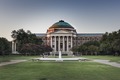 Southern Methodist University |
11,643 | University Park | Mustangs | NCAA Division I FBS (American; ACC in 2024) |
 Texas Christian University |
10,394 | Fort Worth | Horned Frogs | NCAA Division I FBS (Big 12) |
 Dallas Baptist University |
5,445 | Dallas | Patriots | NCAA Division II (Lone Star) Non–Football, compete in the Missouri Valley Conference at the Division I level for baseball |
.jpg) Texas Wesleyan University |
3,378 | Fort Worth | Rams | NAIA (Sooner) |
 University of Dallas |
2,387 | Irving | Crusaders | NCAA Division III (SCAC) Non–Football, compete in Texas Rugby Union at the Division II level for Rugby |
 Southwestern Assemblies of God University |
2,012 | Waxahachie | Lions | NAIA NCCAA (Sooner and Central States Football League) |
 Paul Quinn College |
600 | Dallas | Tigers | NAIA (Red River) Non–Football |
Politics[edit]
| Year | Republican | Democratic |
|---|---|---|
| 2020 | 48.5% 1,495,550 | 49.8% 1,535,525 |
| 2016 | 50.7% 1,218,897 | 44.4% 1,066,312 |
| 2012 | 56.4% 1,205,855 | 42.2% 900,749 |
| 2008 | 54.6% 1,188,570 | 44.6% 969,541 |
| 2004 | 61.5% 1,188,915 | 37.9% 732,160 |
| 2000 | 60.8% 971,927 | 36.7% 587,163 |
The Republican Party has historically been dominant in the Dallas–Fort Worth area, including in presidential elections, although recently since 2016, Democrats have been making inroads in the suburbs.[citation needed] The DFW Area is considered a bellwether polity in recent history.[citation needed] Factors causing this shift include an influx of Democratic-voting younger professionals and families from Democratic states, as well as a more diverse population (with increasing numbers of African-Americans along with recent immigrants and their children).[citation needed] Democratic voters dominate a majority of areas in the large cities of Dallas, Grand Prairie, and Arlington (especially areas east of Interstate 35W).[79][80] Republicans dominate North Dallas, western Fort Worth, along with most suburbs and exurbs of the Metroplex.
Media[edit]
The cities of Dallas and Fort Worth have their own newspapers, The Dallas Morning News and the Fort Worth Star-Telegram, respectively. Historically, the two papers had readership primarily in their own counties. As the two cities' suburbs have grown together in recent years (and especially since the demise of the Dallas Times Herald in 1991), many sites sell both papers. This pattern of crossover has been repeated in other print media, radio, and television.
Since the 1970s all of the television stations and most of the FM radio stations have chosen to transmit from Cedar Hill so as to serve the entire market, and are programmed likewise. There has been a rise in "80–90 move-ins", whereby stations have been moved from distant markets, in some cases as far away as Oklahoma, and relicensed to anonymous small towns in the Metroplex to serve as additional DFW stations. According to RadioTime, the market had 38 AM stations, 58 FM stations (many of them class Cs), and 18 full-power television stations. Per another study the area has a total of 62 FM stations and 40 AM stations as of 2020.[81]
Dallas–Fort Worth is the fifth-largest television market in the United States, behind only New York City, Los Angeles, Chicago, and Philadelphia. Two of the Metroplex's AM radio stations, 820 WBAP and 1080 KRLD, are 50,000-watt stations with coverage of much of the North American continent and beyond during nighttime hours. The South Asian population (Indian Sub-continent) has increased considerably in the DFW metroplex. They have the FM 104.9 radio channel and 700 AM radio.[82] Recently Sony TV, a subsidiary of Sony TV Asia, launched its FTA (free to Air OTA) channel on 44.2 station in DFW. It was one of the two locations they chose in the United States, the other being New York City, where there is also a large South Asian demographic.
TV stations[edit]
The following are full-powered stations serving the Dallas–Fort Worth television market. Network owned-and-operated stations are highlighted in bold.
| Channel | Call sign (branding) |
Primary network affiliation | Subchannel(s) | City of license | Owner |
|---|---|---|---|---|---|
| 2.1 | KDTN | Daystar | None | Denton | Word of God Fellowship (Community Television Educators of DFW, Inc.) |
| 4.1 | KDFW (FOX 4) |
FOX | None | Dallas | Fox Television Stations (NW Communications of Texas, Inc.) |
| 5.1 | KXAS-TV (NBC 5) |
NBC | 5.2 Cozi TV | Fort Worth | NBCUniversal Owned Television Stations (Station Venture Operations, LP) |
| 8.1 | WFAA (WFAA-TV Channel 8) |
ABC | 8.2 AccuWx 8.3 True Crime Network 8.4 Quest |
Dallas | Tegna Media (WFAA-TV, Inc.) |
| 11.1 | KTVT (CBS 11) |
CBS | 11.2 Start TV | Fort Worth | Paramount Global (CBS Stations Group of Texas, Inc.) |
| 13.1 | KERA-TV (KERA) |
PBS | 13.2 KERA Kids 13.3 Create |
Dallas | North Texas Public Broadcasting |
| 18.1 | KPFW-LD | Hope Channel broadcasting | None | Dallas | DTV America Corporation |
| 20.1 | KBOP-LD | Infomercial | 20.2 Infomercial 20.3 3ABN (Spanish) 20.4 3ABN |
Dallas | Randolph W. Weigner (D.T.V., LLC.) |
| 21.1 | KTXA (TXA 21) |
Independent | 21.2 CBS News Dallas–Fort Worth | Fort Worth | Paramount Global (Television Station KTXA Inc.) |
| 22 | KNAV-LD | Hot TV Network | None (low-power analog) |
Dallas | Tuck Properties |
| 23.1 | KUVN-DT (Univision 23) |
Univision | 23.2 Bounce TV 23.3 Escape 23.4 LAFF |
Garland | TelevisaUnivision (KUVN License Partnership, LP) |
| 25.1 | K07AAF-D | HSN | None | Corsicana | Ventana Television, Inc. |
| 26.1 | KODF-LD (KODF-TV) |
Guide US TV | 26.2 Soul of the South TV 26.3 Almavision 26.4 HSN2 |
Britton | Mako Communications, LLC |
| 27.1 | KDFI (My27) |
MyNetworkTV | 27.2 Movies! 27.3 Buzzr 27.4 Heroes and Icons 27.5 Light TV |
Dallas | Fox Television Stations (NW Communications of Texas, Inc.) |
| 28.1 | KHPK-LD | SonLife | 28.2 Guide US TV 28.3 Shop LC 28.4 Soul of the South TV |
DeSoto | Mako Communications, LLC |
| 29.1 | KMPX (Estrella TV KMPX 29) |
Estrella TV | 29.2 Inmigrante TV | Decatur | Liberman Broadcasting (Liberman Television of Dallas License LLC) |
| 31.1 | K07AAD-D | SonLife | 31.2 Hot TV Network 31.3 Hot TV Network 31.4 RTV |
Fort Worth | Mako Communications, LLC |
| 33.1 | KDAF (CW33) |
The CW | 33.2 Antenna TV 33.3 This TV 33.4 Charge |
Dallas | Nexstar Media Group (Tribune Media Company) |
| 34.1 | KJJM-LD (Access 34) |
HSN | 34.2 Shop LC 34.3 HSN2 34.4 Jewelry TV 34.5 Infomercial |
Dallas & Mesquite | Mako Communications, LLC |
| 39.1 | KXTX-TV (Telemundo 39) |
Telemundo | 39.2 TeleXitos | Dallas | NBCUniversal (NBC Telemundo License LLC) |
| 44.1 | KLEG-CD (Vmas) |
TVC+Latino | 44.3 Diya TV - America's first South Asian broadcast television network 44.4 SAB TV (Indian) |
Dallas | Dilip Viswanath |
| 46.1 | KUVN-CD (Univision 23) |
Univision | None (mirror broadcast of KUVN-DT) |
Garland | Univision Communications (KUVN License Partnership, LP) |
| 47.1 | KTXD-TV (Texas 47) |
Independent | 47.2 Comet 47.3 Charge 47.4 TBD 47.5 SonLife |
Greenville | London Broadcasting Company (KTXD License Company, LLC) |
| 49.1 | KSTR-DT (UniMás 49) |
UniMás | 49.2 GetTV 49.3 Grit |
Irving | TelevisaUnivision (UniMas Dallas, LLC) |
| 51.1 | KHFD-LD | The Walk TV | 51.2 Cornerstone Television 51.4 Global Christian Network |
Cedar Hill | Randall & Adrienne Weiss (EICB-TV West LLC) |
| 52.1 | KFWD | SonLife | 52.3 QVC Plus 52.4 Evine |
Fort Worth | NRJ Holdings LLC (NRJ TV DFW License Co, LLC) |
| 55.1 | KAZD (Spectrum News 1) |
Spectrum News 1 | 55.2 Decades 55.3 Azteca América |
Lake Dallas | Weigel Broadcasting |
| 58.1 | KDTX-TV | TBN | 58.2 Hillsong Channel 58.3 JUCE TV 58.4 Enlace 58.5 Smile |
Dallas | Trinity Broadcasting Network (Trinity Broadcasting of Texas, Inc.) |
| 68.1 | KPXD-TV (Ion Television) |
Ion Television | 68.2 Court TV 68.3 Grit 68.4 Laff 68.5 QVC 68.6 HSN |
Arlington | Ion Media Networks (Ion Media Dallas License, Inc.) |
Transportation[edit]
Air travel[edit]

The Dallas Fort Worth International Airport (IATA airport code: DFW), located between the cities of Dallas and Fort Worth, is the largest and busiest airport in the state of Texas. At 17,207 acres (6,963 ha) of total land area, DFW is also the second-largest airport in the country and the sixth-largest in the world. It is the third-busiest airport in the world in terms of aircraft movements and the world's seventh-busiest by passenger traffic, transporting 62.9 million passengers in FY 2014.[83] Based in Fort Worth, American Airlines' headquarters are adjacent to DFW. Recently having regained the title as the largest airline in the world in terms of both passengers transported and fleet size, American is a predominant leader in domestic routes and operations.[84]
The Dallas Love Field Airport (IATA airport code: DAL) is located in northwest Dallas. Based in Dallas, Southwest Airlines is headquartered next to Love Field.
Freeways[edit]

The Dallas–Fort Worth area has thousands of lane-miles of freeways and interstates. The Metroplex has the second-largest number of freeway-miles per capita in the nation, behind only the Kansas City metropolitan area. As in most major metropolitan areas in Texas, most interstates and freeways have access or frontage roads where most of the businesses are located; these access roads have slip ramps allowing traffic to transition between the freeway and access road. North–south interstates include I-35 and I-45. East–west routes include I-30 and I-20. I-35 splits into I-35E and I-35W from Denton to Hillsboro: I-35W goes through Fort Worth while I-35E goes through Dallas. (This is one of only two examples of an interstate splitting off into branches and then rejoining as one; the other such split is in Minneapolis-St. Paul where I-35E goes into St. Paul and I-35W goes through Minneapolis.) I-30 connects Dallas and Fort Worth, and I-45 connects Dallas to Houston. The "multiple-of-5" numbers used for the interstate designations are notable, as these numbers were designed to be used for major multi-state arteries of the U.S. Interstate Highway System. The North Texas region is the terminus for two of them, and I-45 is located only within Texas.
HOV lanes exist along I-35E, I-30, I-635, US 67, and US 75. I-20 bypasses both Dallas and Fort Worth to the south while its loop, I-820, goes around Fort Worth. I-635 splits to the north of I-20 and loops around east and north Dallas, ending at SH 121 north of Dallas Fort Worth International Airport. I-35E, Loop 12, and Spur 408 ultimately connect to I-20 southwest of Dallas, completing the west bypass loop around Dallas. A large number of construction projects are planned or are already underway in the region to alleviate congestion. Due largely to funding issues, many of the new projects involve building new tollways or adding tolled express lanes to existing highways, which are managed by the North Texas Tollway Authority. It was originally established to manage the Dallas North Tollway and oversees several other toll projects in the area.[citation needed]
Public transit[edit]

Public transit options continue to expand significantly throughout the Metroplex. However, it is limited in several outlying and rural suburbs. Dallas County and portions of Collin and Rockwall counties have bus service and light rail operated by Dallas Area Rapid Transit (DART), covering thirteen member cities. DART's rail network currently sprawls for 93 miles throughout the area. The Red Line extends north to Plano and southwest to Oak Cliff. The Blue Line reaches from Rowlett in the northeast to the University of North Texas at Dallas campus near I-20 in the south. The 28-mile Green Line, which opened in December 2010, connects Carrollton in the northwest through downtown Dallas to Pleasant Grove in the southeast. The Orange Line, which completed expansion in 2014, parallels the Red Line from Plano to downtown Dallas and the Green Line from downtown Dallas to Northwest Hwy before extending through the Las Colinas area of Irving to reach DFW International Airport.
Denton County has bus service limited to Denton, Highland Village, and Lewisville (with commuter service to downtown Dallas) provided by the Denton County Transportation Authority (DCTA). The A-train, a diesel commuter rail line, parallels I-35E to connect Denton, Highland Village, Lewisville, and Carrollton. Several smaller towns along this line, Corinth, Shady Shores, and Lake Dallas, voted to abstain from DCTA and do not have stations. There is an across-the-platform transfer in Carrollton to the DART Green Line. A-Train service began June 20, 2011.[85]
Tarrant County has bus services operated by Trinity Metro (formerly the Fort Worth Transportation Authority, popularly known as 'The T'), available only in Fort Worth. It additionally operates TEXRail commuter rail, which serves to connect downtown Fort Worth with DFW Airport and the DART Orange Line. The diesel commuter train that serves Fort Worth and its eastern suburbs is operated as the Trinity Railway Express; it connects downtown Fort Worth to downtown Dallas, where it links to the DART light rail system. A station near its midpoint, Centerport, also serves DFW Airport via a free airport shuttle bus. The TRE is jointly owned by FWTA and DART.[86] Amtrak serves two stations in the Metroplex—Dallas Union Station and Fort Worth Central Station. Both are served by the Texas Eagle route, which operates daily between Chicago and San Antonio (continuing on to Los Angeles three days a week), though only Fort Worth is served by the Fort Worth-Oklahoma City Heartland Flyer.
As of 2016 the Taiwanese airline EVA Air operates a shuttle bus service from George Bush Intercontinental Airport in Houston to Richardson, so that Dallas-based customers may fly on its services to and from Houston.[87]
See also[edit]


Notes[edit]
- ^ This has been rendered various different ways, with and without capitalization, with hyphens or slashes instead of dashes, and with or without spaces around those marks, and in abbreviated forms, sometimes without "Arlington", such as "Dallas–Fort Worth–Arlington MSA", "Dallas–Fort Worth Metropolitan Area", "Dallas–Fort Worth–Arlington Statistical Area", "Dallas–Fort Worth–Arlington Metro Area", "Dallas–Fort Worth Area", etc. The term is often rendered, especially in government documents, as "Dallas–Fort Worth–Arlington, TX Metropolitan Statistical Area", "Dallas–Fort Worth–Arlington, TX (MSA)", "Dallas–Fort Worth–Arlington, TX Metro Area", etc., using the US Postal Service code "TX" for Texas, and often without the syntactically expected comma after "TX". Other versions include the full word "Texas", and some give a shortened but redundant form such as "Dallas Area, Texas (Metro Area)". Other words are sometimes used, e.g. "Dallas–Fort Worth–Arlington Urbanized Area".
- ^ Mean monthly maxima and minima calculated based on data at said location from 1991 to 2020.
- ^ Official records for Dallas were kept at the Weather Bureau Office in downtown from 15 October 1913 to August 1940, and at Love Field since September 1940.[38]
- ^ Sunshine normals are based on only 24 years of data.
References[edit]
- ^ a b "OMB Bulletin No. 20-01: Revised Delineations of Metropolitan Statistical Areas, Micropolitan Statistical Areas, and Combined Statistical Areas, and Guidance on Uses of the Delineations of These Areas" (PDF). www.whitehouse.gov. Retrieved December 2, 2020.
- ^ "2020 Population and Housing State Data". United States Census Bureau, Population Division. August 12, 2021. Retrieved January 16, 2022.
- ^ a b "List of 2020 Census Urban Areas". United States Census Bureau. Retrieved January 7, 2023.
- ^ "Total Gross Domestic Product for Dallas-Fort Worth-Arlington, TX (MSA)". Federal Reserve Economic Data. Federal Reserve Bank of St. Louis.
- ^ "Metropolitan Areas, Core Cities & Principal Cities" (PDF). Demographia.com. Retrieved July 22, 2023.
- ^ a b Bureau, U.S. Census. "U.S. Census website". United States Census Bureau. Retrieved May 14, 2020.
- ^ "Dallas–Fort Worth–Arlington, TX MSA Population". U.S. Census Bureau. Archived from the original on March 24, 2017. Retrieved March 23, 2017.
- ^ "More Counties Saw Population Gains in 2023".
- ^ "Here are this year's Fortune 500 companies by region". The Dallas Morning News. Retrieved June 10, 2022.
- ^ Burns, David W. (September 27, 2019). "September 2019 U.S. Metro Economies Report". United States Conference of Mayors. Retrieved December 26, 2019.
- ^ "If the DFW economy were its own state, or a country, here's how it would rank". www.bizjournals.com. Retrieved August 18, 2020.
- ^ January 2020, AVNetwork Staff22 (January 22, 2020). "2020's Best & Worst Metro Areas for STEM Professionals According to WalletHub". systemscontractor. Retrieved June 19, 2020.
{{cite web}}: CS1 maint: numeric names: authors list (link) - ^ "Nobel Prizes | A Legacy of Research & Discovery | UT Southwestern Medical Center". utswmed.org. Retrieved June 19, 2020.
- ^ "Nature Index 2019 Biomedical Sciences | Supplements". Nature Index. Retrieved June 19, 2020.
- ^ Shellnutt, Kate (March 21, 2011). "Megachurches getting bigger; Lakewood quadruples in size since 2000". Houston Chronicle. Archived from the original on February 21, 2019. Retrieved June 19, 2020.
- ^ a b "Dallas Has the Most Christians". D Magazine. July 29, 2015. Retrieved June 19, 2020.
- ^ W.L. Tiltte. "Is Dallas the Most Christian City in the NATION?". D Magazine. Dallas. Retrieved September 16, 2020.
- ^ a b "Adults in the Dallas metro area - Religion in America: U.S. Religious Data, Demographics and Statistics". Pew Research Center's Religion & Public Life Project. Retrieved June 19, 2020.
- ^ "LGBT". LGBT. Retrieved June 19, 2020.
- ^ "Dallas LGBT Fact Sheet". www.smu.edu.
- ^ "Same-sex Couples and the Gay, Lesbian, Bisexual Population: New Estimates from the American Community Survey" (PDF). February 5, 2015. Archived (PDF) from the original on February 5, 2015. Retrieved June 29, 2020.
- ^ "'A historic win': North Texas leaders, LGBTQ organizations react to landmark Supreme Court discrimination ruling". wfaa.com. June 15, 2020. Retrieved June 29, 2020.
- ^ "The Sulphur Springs News-Telegram". The Sulphur Springs News-Telegram. Retrieved June 19, 2020.
- ^ North Texas Commission. "History". Archived from the original on October 4, 2013. Retrieved October 1, 2013.
- ^ North Texas Commission (January 1, 2002). ""Dallas/Fort Worth Metroplex" brand serves region well". Archived from the original on December 28, 2004. Retrieved June 27, 2006.
- ^ a b "If North Texas Were a State ..." North Texas Commission. February 25, 2016. Archived from the original on March 28, 2016. Retrieved May 19, 2020.
- ^ "TPWD:Blackland Prairie". tpwd.texas.gov. Retrieved May 19, 2020.
- ^ "Cross Timbers and Prairies Ecological Region". tpwd.texas.gov.
- ^ "U.S. Bureau of Labor and Statistics". www.bls.gov. Retrieved July 26, 2019.
- ^ a b "OMB Bulletin No. 18-04: Revised Delineations of Metropolitan Statistical Areas, Micropolitan Statistical Areas, and Combined Statistical Areas, and Guidance on Uses of the Delineations of These Areas" (PDF). United States Office of Management and Budget. September 14, 2018. Retrieved September 4, 2019.
- ^ "At the Heart of Texas: Dallas–Plano–Irving". www.dallasfed.org. Retrieved October 11, 2019.
- ^ "At the Heart of Texas: Fort Worth–Arlington". www.dallasfed.org. Retrieved October 11, 2019.
- ^ "Which counties in North Texas are most vulnerable to tornadoes? This new map will show you". Dallas News. June 25, 2019. Retrieved August 19, 2020.
- ^ "Dallas/Fort Worth – All-Time Maximum and Minimum Temperatures". National Weather Service Fort Worth. Retrieved December 5, 2011.
- ^ "NowData – NOAA Online Weather Data". National Oceanic and Atmospheric Administration. Retrieved November 30, 2012.
- ^ "DFW – Freeze Summary". National Weather Service. Retrieved November 2, 2018.
- ^ DFW Climate. Retrieved on March 26, 2006. Archived October 10, 2008, at the Wayback Machine
- ^ ThreadEx
- ^ "Station Name: TX DALLAS LOVE FLD". National Oceanic & Atmospheric Administration. Retrieved March 24, 2021.
- ^ "Summary of Monthly Normals 1991–2020". National Oceanic and Atmospheric Administration. Retrieved May 5, 2021.
- ^ "NOWData – NOAA Online Weather Data". National Oceanic & Atmospheric Administration. Retrieved March 24, 2021.
- ^ "WMO Climate Normals for FORT WORTH/GREATER SW INT'L A,TX 1961–1990". National Oceanic and Atmospheric Administration. Retrieved March 24, 2021.
- ^ "Dallas, Texas, USA - Monthly weather forecast and Climate data". Weather Atlas. Archived from the original on November 12, 2020. Retrieved May 5, 2021.
- ^ "NOW Data-NOAA Online Weather Data". National Oceanic and Atmospheric Administration. 2009. Retrieved August 2, 2009.
- ^ "Fort Worth, Texas, USA - Monthly weather forecast and Climate data". Weather Atlas. Retrieved June 14, 2019.
- ^ Population by City Archived May 20, 2018, at the Wayback Machine. North Central Texas Council of Governments, 2018. Retrieved 2018-05-19.
- ^ "2010 Census: Population of Texas Cities Arranged in Alphabetical Order". Austin: Texas State Library and Archives Commission. Retrieved September 5, 2012.
- ^ "OMB Census". Arlington: Arlington City Council. Retrieved November 12, 2012.
- ^ Bureau, US Census. "County Population Totals and Components of Change: 2020-2023". Census.gov. Retrieved March 27, 2024.
- ^ "Houston region saw second-largest population surge in U.S. In 2021-2022, census analysis finds". April 11, 2023.
- ^ a b "U.S. Census website". United States Census Bureau. Retrieved January 31, 2008.
- ^ "P2 Hispanic or Latino, and Not Hispanic or Latino by Race". Census.gov. Retrieved August 13, 2022.
- ^ a b c d "Demographic Diversity in Texas and the DFW Metro Area" (PDF). demographics.texas.gov. February 14, 2019. Retrieved June 19, 2020.
- ^ "Census profile: Dallas-Fort Worth-Arlington, TX Metro Area". Census Reporter. Retrieved June 2, 2022.
- ^ "Major U.S. metropolitan areas differ in their religious profiles". Pew Research Center. Retrieved June 19, 2020.
- ^ a b "Census profile: Dallas-Fort Worth, TX-OK CSA". Census Reporter. Retrieved June 19, 2020.
- ^ a b c d e f g h "Estimates of Resident Population Change and Rankings for Counties: July 1, 2018 to July 1, 2019". Retrieved March 26, 2020.
- ^ "Table 2. Annual Estimates of the Population of Combined Statistical Areas: April 1, 2010 to July 1, 2012". 2012 Population Estimates. United States Census Bureau, Population Division. March 2013. Archived from the original (CSV) on May 17, 2013. Retrieved April 19, 2013.
- ^ "Many Of DFW's Corporate Relocations In 2019 Were Poached From San Francisco". Bisnow. Retrieved February 16, 2020.
- ^ Kotkin, Joel. "Welcome To Y'all Street: The Cities Challenging New York For Financial Supremacy". Forbes. Retrieved February 16, 2020.
- ^ "Fortune 500". Fortune. Retrieved February 4, 2020.
- ^ Carlisle, Candace. "Global engineering firm to relocate headquarters from California to Dallas". Dallas Business Journal.
- ^ "American Airlines unveils new $350 million headquarters in Fort Worth". Dallas News. September 23, 2019. Retrieved February 16, 2020.
- ^ "Largest Employers in the Dallas Fort Worth Area". www.destinationdfw.com. August 19, 2013. Retrieved February 16, 2020.
- ^ "Right Place, Wrong Time: How the 1952 Dallas Texans Flamed Out After One Lackluster Season of Football". Texas Monthly. March 22, 2019. Retrieved October 29, 2020.
- ^ "How the Dallas Cowboys Were Born in 1960". www.dallascowboys.com. Retrieved October 29, 2020.
- ^ "Dallas Texans (Chiefs) Team History". Sports Team History. January 15, 2017. Retrieved October 29, 2020.
- ^ "Kansas City Chiefs Team History". Pro Football Hall of Fame Official Site. Retrieved October 29, 2020.
- ^ "Washington Senators II team ownership history – Society for American Baseball Research". Retrieved October 29, 2020.
- ^ Rathbun, Trevor (May 1, 2018). "This Day in Mavs History: The Dallas Mavericks are Born". Dallas Sports Fanatic. Retrieved October 29, 2020.
- ^ "The North Stars Move to Dallas". D Magazine. January 13, 2010. Retrieved October 29, 2020.
- ^ "The Cowboys will host another Super Bowl. But the date just got further away". Dallas News. May 23, 2018. Retrieved October 29, 2020.
- ^ "Cotton Bowl: History and everything else you need to know". NCAA.com. Retrieved October 29, 2020.
- ^ "AT&T Stadium will host 9 games in upcoming 2026 World Cup - CBS Texas". CBS News. February 5, 2024.
- ^ "FIFA unveils stellar line-up of FIFA World Cup 2026 Host Cities". FIFA. June 16, 2022. Archived from the original on June 16, 2022. Retrieved June 16, 2022.
- ^ "Fast Facts".
- ^ "Dave Leip's election atlas".
- ^ "Office of the Secretary of State".
- ^ "2016 election: Division in a key Texas Republican stronghold?". star-telegram. Retrieved November 23, 2016.
- ^ "Tarrant County: 2016 election results by precinct".
- ^ "Radio stations in Dallas, Texas - Radio Lineup". www.radiolineup.com. Retrieved October 29, 2020.
- ^ "Sony launches free-to-air SAB TV in the US". Rapid TV News. Retrieved February 8, 2022.
- ^ "DFW End Report Shows Record 62 Million Customers". Archived from the original on November 17, 2015. Retrieved November 16, 2015.
- ^ IATA. "Scheduled Passengers Carried". iata.org. Archived from the original on June 12, 2011. Retrieved February 17, 2012.
- ^ Peterson, Matt (June 20, 2011). "A-train railway begins rolling, carrying commuters from Denton to Carrollton". The Dallas Morning News. Archived from the original on July 1, 2011. Retrieved June 20, 2011.
- ^ "About – Trinity Railway Express (TRE)". Trinity Railway Express. Archived from the original on February 4, 2012. Retrieved April 22, 2013.
- ^ "Dallas – Houston – Dallas Free Shuttle Service Schedule Archived September 5, 2015, at the Wayback Machine." EVA Air. Retrieved on February 29, 2016.
External links[edit]
 Travel information from Wikivoyage
 Data from Wikidata


| Authority control databases: National |
|---|


- Dallas–Fort Worth metroplex
- Geography of Collin County, Texas
- Geography of Dallas County, Texas
- Geography of Denton County, Texas
- Geography of Ellis County, Texas
- Geography of Hunt County, Texas
- Geography of Johnson County, Texas
- Geography of Kaufman County, Texas
- Geography of Parker County, Texas
- Geography of Rockwall County, Texas
- Geography of Tarrant County, Texas
- Geography of Wise County, Texas
- Metropolitan areas of Texas
- Regions of Texas