


Grisaille
 | This article needs additional citations for verification. (November 2021) |


Grisaille (/ɡrɪˈzaɪ/ or /ɡrɪˈzeɪl/; French: grisaille, lit. 'greyed' French pronunciation: [ɡʁizaj], from gris 'grey') is a painting executed entirely in shades of grey or of another neutral greyish colour. It is particularly used in large decorative schemes in imitation of sculpture. Many grisailles include a slightly wider colour range.
A grisaille may be executed for its own sake, as an underpainting for an oil painting (in preparation for glazing layers of colour over it) or as a model from which an engraver may work (as was done by Rubens and his school).[1] Full colouring of a subject makes many demands of an artist, and working in grisaille was often chosen as it may be quicker and cheaper than traditional painting, although the effect was sometimes deliberately chosen for aesthetic reasons. Grisaille paintings resemble the drawings, normally in monochrome, that artists from the Renaissance on were trained to produce; as with drawings, grisaille can betray the hand of a less-talented assistant more easily than would a fully coloured painting.
History[edit]

Giotto used grisaille in the lower registers of his frescoes in the Scrovegni Chapel in Padua (c. 1304) and Robert Campin, Jan van Eyck and their successors painted grisaille figures on the outsides of the wings of triptychs, including the Ghent Altarpiece. Originally these were the sides on display for most of the time, as the doors were normally kept closed except on feast days or at the (paid) request of tourists. However, today these images are often invisible in museums when the triptych is displayed open and flat against a wall. In these cases, imitation of sculpture was intended, as sculpture was still more expensive than a painting, even one by an acknowledged master.
Limners often produced illuminated manuscripts in pen and wash with a very limited colour range, and many artists such as Jean Pucelle (active c. 1320–1350) and Matthew Paris specialised in such work, which had been especially common in England since Anglo-Saxon times. Renaissance artists such as Mantegna and Polidoro da Caravaggio often used grisaille to imitate the effect of a classical sculptured relief or Roman painting.
In the Low Countries, a continuous tradition of grisaille paintings can be traced from Early Netherlandish painting to Martin Heemskerck (1498–1574), Pieter Brueghel the Elder (Christ and the Woman Taken in Adultery, 1565) and Hendrik Goltzius, and through the copious output of Adriaen van de Venne, to the circle of Rembrandt and Jan van Goyen.
Portions of the ceiling frescoes of the Sistine Chapel are grisaille, as is the lower part of the great staircase decoration by Antonio Verrio (c. 1636 – 1707) at Hampton Court.
Modern examples[edit]
Grisaille, while less widespread in the 20th century, continues as an artistic technique. Pablo Picasso's painting Guernica (1937) is a prominent example.
Contemporary American painter Hugo Bastidas has become known for black-and-white paintings that imitate the effect of grisaille and often resemble black-and-white photographs. His medium- and large-scale paintings feature contrasting zones of high and low detail.[2][3]
With the 20th century's emphasis on direct (alla prima) painting, the grisaille technique lost favour with artists of the period. This historic method is still incorporated into the curriculum of some private ateliers.[citation needed]
Two modern adaptation of Grisaille are used in miniature painting, and they are called Slop Chop or Slap Chop and Zenithal Priming/Highlighting. Both have recently gained popularity due to the advent of contrast/speed paints, a type of acrylic paint standing somewhat in between acrylic ink and normal acrylic paint. After painting the Grisaille undercoated, the miniature is painted with contrast/speed paints to the desired colour scheme. As these paints are translucent, this emphasises the highlights while leaving the recesses dark, imitating natural shadows to scale.
For Slap Chop, models are primed in a dark base colour, usually black, and then dry brushed twice, once very heavily in a midtone (usually a grey) and then, with a much lighter touch, a light tone (the standard being titanium white). It has been noted that this approach is comparatively labour intensive.
This is where the technique of Zenithal has its advantages, as it is much faster. However, it is often recommended to use an airbrush to avoid "chalky" models, especially when using white primer, as rattle can paints have a tendency to dry midair under the wrong conditions, and is much harder to control. Thus Zenithal has the disadvantage of an initial investment several times larger than that for the Slap Chop technique, which only requires a few large, soft brushes and the correct paints. Zenithal, so called because it imitates a light source coming from the zenith above the miniature, is done by priming the model in a dark tone or midtone, then, at a 45° angle from the sides with a midtone in the first case, and from straight below with a dark tone in the latter, and finally, from the zenith, with a light tone.
Enamel and stained glass[edit]

The term is also applied to monochrome painting in other media such as those involving enamels, in which an effect similar to a relief in silver may be intended. Grisaille is also common in stained glass, as the need for sections in different colours is greatly reduced, such as York Minster's Five Sisters window. Portions of a window may be done in grisaille using, for example, silver stain or vitreous paint, while other sections are coloured glass.
Brunaille and verdaille[edit]


Monochrome work is sometimes executed in colours other than grey: a brunaille is a painting executed entirely or primarily in shades of brown, while a verdaille is the same for green. Such works are said to have been painted en brunaille or en verdaille, respectively.[4][5]
Brunaille and verdaille painting both have their roots in 12th century stained glass made for Cistercian monasteries, which prohibited the use of coloured art in 1134. The term "brunaille" was first used to refer to all-brown paintings in the 17th century.[5]
Gallery[edit]
-
 Molded tile, mid-19th century Iran, Brooklyn Museum
 -
 Master of Frankfurt, Saint Odile and Saint Cecilia, ca. 1503–1506, oil on panel, Historical Museum, Frankfurt
 -
 Giotto, Scrovegni Chapel, Infidelity
 -
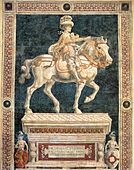 Andrea del Castagno, monument to Niccolò da Tolentino
 -

-
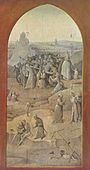 Triptych shutter outside panel by Hieronymus Bosch
 -
 2008 unveiling ceremony at The Kennedy Center of a Steinway Art Case piano painted in grisaille
 -
 Frans Francken II by Anthony van Dyck, one of a series of studies for portrait prints
 -

-
 Italian palace staircase, 18th century
 -
![Student copy in grisaille after Jacques-Louis David[6]](//upload.wikimedia.org/wikipedia/commons/thumb/6/68/David_patroclus_mimsstudios_grisaille.jpg/170px-David_patroclus_mimsstudios_grisaille.jpg) Student copy in grisaille after Jacques-Louis David[6]
Student copy in grisaille after Jacques-Louis David[6] -
![Painted Fire Screen by Jacques Vigoureux Duplessis, The Walters Art Museum. The pair of figures painted on the right side are in the grisaille style.[7]](//upload.wikimedia.org/wikipedia/commons/thumb/4/48/Jacques_Vigoureux_Duplessis_-_Painted_Fire_Screen_-_Walters_372479.jpg/170px-Jacques_Vigoureux_Duplessis_-_Painted_Fire_Screen_-_Walters_372479.jpg) Painted Fire Screen by Jacques Vigoureux Duplessis, The Walters Art Museum. The pair of figures painted on the right side are in the grisaille style.[7]
Painted Fire Screen by Jacques Vigoureux Duplessis, The Walters Art Museum. The pair of figures painted on the right side are in the grisaille style.[7] -
 Window of St. Peter: Stained glass (white glass, grisaille and silver sulfide) and lead, France, ca. 1500–1510
 -
 Odalisque in Grisaille, Jean Auguste Dominique Ingres and his workshop


_-_Foto_Giovanni_Dall%27Orto_20-May-2007.jpg)
![Student copy in grisaille after Jacques-Louis David[6]](/wiki/File:David_patroclus_mimsstudios_grisaille.jpg)
![Painted Fire Screen by Jacques Vigoureux Duplessis, The Walters Art Museum. The pair of figures painted on the right side are in the grisaille style.[7]](/wiki/File:Jacques_Vigoureux_Duplessis_-_Painted_Fire_Screen_-_Walters_372479.jpg)


See also[edit]
- Aizuri-e — ukiyo-e prints executed primarily or entirely in blue
- Monochrome painting — abstract art executed in a single color
- Pablo Picasso's Blue Period and Rose Period
- Sepia tone (photography)
- Zorn palette
- Valmer castle
References[edit]
- ^ Osborne, Harold, ed. (1970). The Oxford Companion to Art. Clarendon Press.
- ^ Dawson, Jessica. "Without Hue: A Rainbow of Grays". The Washington Post. Retrieved 16 February 2017.
- ^ Carvalho, Denise (April 2008). "Hugo Bastidas at Nohra Haime". Art in America: 169.
- ^ Christie’s, Sale 2437, Old Master Pictures, lot 51, Amsterdam, Christie’s, 8 November 1999
- ^ a b Christie’s, Sale 1380, Old Master Paintings, lot 49, New York, Christie’s, 17 June 2004
- ^ "Mims Studios School of Fine Art". Archived from the original on 5 August 2019. Retrieved 21 February 2009.
- ^ Old Masters Academy
External links[edit]

