


Lablab
| Lablab | |
|---|---|

| |
| Pod | |
Scientific classification 
| |
| Kingdom: | Plantae |
| Clade: | Tracheophytes |
| Clade: | Angiosperms |
| Clade: | Eudicots |
| Clade: | Rosids |
| Order: | Fabales |
| Family: | Fabaceae |
| Subfamily: | Faboideae |
| Genus: | Lablab Adans. (1763) |
| Species: | L. purpureus
|
| Binomial name | |
| Lablab purpureus | |
| Subspecies and varieties[1] | |
| |
| Synonyms[2] | |
| |
| Nutritional value per 100 g (3.5 oz) | |
|---|---|
| Energy | 209 kJ (50 kcal) |
9.2 g | |
0.27 g | |
2.95 g | |
| Vitamins | Quantity %DV† |
| Thiamine (B1) | 5% 0.056 mg |
| Riboflavin (B2) | 7% 0.088 mg |
| Niacin (B3) | 3% 0.48 mg |
| Folate (B9) | 12% 47 μg |
| Vitamin C | 6% 5.1 mg |
| Minerals | Quantity %DV† |
| Calcium | 3% 41 mg |
| Iron | 4% 0.76 mg |
| Magnesium | 10% 42 mg |
| Manganese | 9% 0.21 mg |
| Phosphorus | 4% 49 mg |
| Potassium | 9% 262 mg |
| Zinc | 3% 0.38 mg |
Link to USDA Database entry Cooked, boiled, drained, without salt | |
| †Percentages estimated using US recommendations for adults,[3] except for potassium, which is estimated based on expert recommendation from the National Academies.[4] | |
_Sweet,_1804.jpg)
Lablab purpureus is a species of bean in the family Fabaceae. It is native to sub-Saharan Africa and India and it is cultivated throughout the tropics for food.[1][5] English language common names include hyacinth bean,[6] lablab-bean[7] bonavist bean/pea, dolichos bean, seim or sem bean, lablab bean, Egyptian kidney bean, Indian bean, bataw and Australian pea.[8] Lablab is a monotypic genus.[5][9]
Description[edit]
The plant is variable due to extensive breeding in cultivation, but in general, they are annual or short-lived perennial vines. The wild species is perennial. The thick stems can reach 6 m (20 ft) in length. The leaves are made up of three pointed leaflets, each up to 15 cm (5.9 in) long. They may be hairy on the undersides. The inflorescence is made up of racemes of many flowers. Some cultivars have white flowers, and others may have purplish or blue.[5] The fruit is a legume pod variable in shape, size, and color. It is usually several centimeters long and bright purple to pale green.[10] It contains up to four seeds. Depending on the cultivar, the seeds are white, brown, red, or black, sometimes with a white hilum. Wild plants have mottled seeds. The seed is about a centimeter long.[5]
Subspecific classification[edit]
According to the British biologist and taxonomist Bernard Verdcourt,[11]
- there are two cultivated subspecies of Lablab purpureus (L.) Sweet:
- Lablab purpureus subsp. bengalensis (Jacq.) Verdc. (Syn.: Dolichos bengalensis Jacq., Dolichos lablab subsp. bengalensis (Jacq.) Rivals, Lablab niger subsp. bengalensis (Jacq.) Cuf.)
- Lablab purpureus subsp. purpureus
- in addition to one wild subspecies:
- Lablab purpureus subsp. uncinatus
- of which a special variant with lobed leaflets exists only in Namibia:
- Lablab purpureus var. rhomboïdeus (Schinz).
Uses[edit]
The hyacinth bean is an old domesticated pulse and multi-purpose crop.[12][13][14] L. purpureus has been cultivated in India as early as 2500 BC.[15]
Due to seed availability of one forage cultivar (cv. Rongai), it is often grown as forage for livestock[16] and as an ornamental plant.[17] In addition, it is cited both as a medicinal plant and a poisonous plant.[18][19]
The fruit and beans are edible if boiled well with several changes of the water.[19][20] Otherwise, they are toxic due to the presence of cyanogenic glycosides, glycosides that are converted to hydrogen cyanide when consumed. Signs of poisoning include weakness, vomiting, shortness of breath, twitching, stupor, and convulsions.[19] It has been shown that there is a wide range of cyanogenic potential among the varieties.[21]
The leaves are eaten raw or cooked like spinach.[14] The flowers can be eaten raw or steamed. The root can be boiled or baked for food. The seeds are used to make tofu and tempeh.[10]
Food in South Asia[edit]
In Bangladesh and West Bengal, the green pods along with the beans, known as sheem (শিম), are cooked as vegetables or cooked with fish as a curry.
In Gujarat, lablab is called surti papdi.[22]
In Kerala, it is known as amarakka, avara or amara payar (Malayalam: അമര പയർ).[23] The beans as well as the bean pods are used in cooking curries.[24] The bean pods are also used (along with spices) for preparing a stir-fried dish known as thoran.[25]
In Tamil Nadu, it is called avarai or avaraikkaay (Tamil: அவரைக்காய் / அவரை).[26] The entire bean is used in cooking dry curries[27] and in sauces/gravies such as sambar.[28] The seed alone is used in many recipes and is referred to as mochai (Tamil: மொச்சை / மொச்சைக்கொட்டை).[29]
In Maharashtra, dry preparations with green masala are often made out of these green beans (ghevda varieties; Shravan ghevda (French beans), bajirao ghevda, ghevda, walwar, pavta sheng) mostly at the end of monsoon season during fasting festivals of Shravan month.[citation needed]
In Karnataka, the hyacinth bean is made into curry (avarekalu saaru) (Kannada: ಅವರೆಕಾಳು ಸಾರು), salad (avarekaalu usli), added to upma (avrekaalu uppittu), and as a flavoring to Akki rotti. Sometimes the outer peel of the seed is removed and the inner soft part is used for a variety of dishes. This form is called hitakubele avarekalu, which means "pressed (hitaku) hyacinth bean," and a curry known as hitikida avarekaalu saaru is made out of the deskinned beans.[citation needed]
In Telangana and Andhra Pradesh, the bean pods are cut into small pieces and cooked as a spicy curry in the Pongal festival season. Sometimes the outer peel of the seed when tender and soaked overnight is removed and the inner soft part is used for a variety of dishes. This form is called pitakapappu hanupa/anapa, which means "pressed (pitaku) hyacinth bean, and a curry known as pitikina anapaginjala chaaru/pitaka pappu is made from the deskinned beans and eaten along with bajra bread.[citation needed]
Food in Southeast and East Asia[edit]
In Myanmar, lablab beans are used to make a braised Burmese curry hnat (ပဲကြီးနှပ်).[30] They are also crisp-fried and served in Burmese pickled tea leaf salad.
In Huế, Vietnam, hyacinth beans are the main ingredient of the dish chè đậu ván (Hyacinth Bean Sweet Soup).[31]
In China, the seeds are known as Bai Bian Dou. They are usually dried and baked before being used in traditional Chinese herbal remedies to strengthen the spleen, reduce heat and dampness, and promote appetite.[32]
Food tradition in East Africa[edit]
In Kenya, the bean, known as njahe or njahi,[33] is popular among several communities, especially the Kikuyu. Seasons were actually based on it, i.e., the Season of Njahe (Kīmera kīa njahī). It is thought to encourage lactation and has historically been the main dish for breastfeeding mothers.[34] Beans are boiled and mashed with ripe and/or semi-ripe bananas, giving the dish a sweet taste. Today the production is in decline in eastern Africa.[34][35] This is partly attributed to the fact that under colonial rule in Kenya, farmers were forced to give up their local bean in order to produce common beans (Phaseolus vulgaris) for export.[36]
Medicinal use[edit]
Taiwanese research found that a carbohydrate-binding protein (i.e. a legume lectin) from lablab beans effectively blocks the infections of influenza viruses and SARS-CoV-2.[37]
Gallery[edit]
-
 Foliage
 -
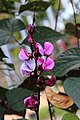 Flowers
 -
 Seeds
Seeds


Further reading[edit]
- Devaraj, V. Rangaiah (2016). "Hyacinth bean: A gem among legumes. State of the art in Lablab purpureus research" (PDF). Legume Perspectives. 13 (2016–07): 1–42.
- Fakhoury, A. M.; Woloshuk, C. P. (2001). "Inhibition of Growth of Aspergillus flavusand Fungal α-Amylases by a Lectin-Like Protein from Lablab purpureus". Molecular Plant-Microbe Interactions. 14 (8): 955–61. doi:10.1094/MPMI.2001.14.8.955. PMID 11497467.
- Hendricksen, R.; Minson, D. J. (2009). "The feed intake and grazing behaviour of cattle grazing a crop of Lablab purpureus cv. Rongai". The Journal of Agricultural Science. 95 (3): 547–54. doi:10.1017/S0021859600087955. S2CID 84231105.
- Hendricksen, RE; Poppi, DP; Minson, DJ (1981). "The voluntary intake, digestibility and retention time by cattle and sheep of stem and leaf fractions of a tropical legume (Lablab purpureus)". Australian Journal of Agricultural Research. 32 (2): 389–98. doi:10.1071/AR9810389.
- Humphry, E; Konduri, V; Lambrides, J; Magner, T; McIntyre, L; Aitken, B; Liu, J (2002). "Development of a mungbean (Vigna radiata) RFLP linkage map and its comparison with lablab (Lablab purpureus) reveals a high level of colinearity between the two genomes". Theoretical and Applied Genetics. 105 (1): 160–6. doi:10.1007/s00122-002-0909-1. PMID 12582573. S2CID 19420328.
- Liu, C. J. (1996). "Genetic diversity and relationships among Lablab purpureus genotypes evaluated using RAPD as markers". Euphytica. 90 (1): 115–9. doi:10.1007/BF00025167. S2CID 31881073.
- Maass, Brigitte L. (2006). "Changes in seed morphology, dormancy and germination from wild to cultivated germplasm of the hyacinth bean (Lablab purpureus (L.) Sweet)". Genetic Resources and Crop Evolution. 53 (6): 1127–35. doi:10.1007/s10722-005-2782-7. S2CID 27644011.
- Maass, Brigitte L.; Jamnadass, Ramni H.; Hanson, Jean; Pengelly, Bruce C. (2005). "Determining sources of diversity in cultivated and wild Lablab purpureus related to provenance of germplasm using amplified fragment length polymorphism (AFLP)". Genetic Resources and Crop Evolution. 52 (5): 683–95. doi:10.1007/s10722-003-6019-3. S2CID 44040763.
- Maass, Brigitte L.; Robotham, Oliver; Chapman, Marc A. (2017). "Evidence for two domestication events of hyacinth bean (Lablab purpureus (L.) Sweet): a comparative analysis of population genetic data" (PDF). Genetic Resources and Crop Evolution. 64 (6): 1221–30. doi:10.1007/s10722-016-0431-y. S2CID 10921988.
- Maass, Brigitte L.; Usongo, Macalister F. (2007). "Changes in seed characteristics during the domestication of the lablab bean (Lablab purpureus (L.) Sweet: Papilionoideae)". Australian Journal of Agricultural Research. 58 (1): 9–19. doi:10.1071/ar05059.
- Pengelly, Bruce C.; Maass, Brigitte L. (2001). "Lablab purpureus (L.) Sweet – diversity, potential use and determination of a core collection of this multi-purpose tropical legume". Genetic Resources and Crop Evolution. 48 (3): 261–72. doi:10.1023/A:1011286111384. S2CID 11125153.
- Trinick, M. J. (1980). "Relationships Amongst the Fast-growing Rhizobia of Lablab purpureus, Leucaena leucocephala, Mimosa spp., Acacia farnesiana and Sesbania grandiflora and their Affinities with Other Rhizobial Groups". Journal of Applied Bacteriology. 49 (1): 39–53. doi:10.1111/j.1365-2672.1980.tb01042.x.
- Vanlauwe, B.; Nwoke, O.C.; Diels, J.; Sanginga, N.; Carsky, R.J.; Deckers, J.; Merckx, R. (2000). "Utilization of rock phosphate by crops on a representative toposequence in the Northern Guinea savanna zone of Nigeria: Response by Mucuna pruriens, Lablab purpureus and maize". Soil Biology and Biochemistry. 32 (14): 2063–77. doi:10.1016/S0038-0717(00)00149-8.
References[edit]
- ^ a b Lablab purpureus (L.) Sweet. Plants of the World Online. Retrieved 3 September 2023.
- ^ Lablab purpureus at Multilingual taxonomic information from the University of Melbourne
- ^ United States Food and Drug Administration (2024). "Daily Value on the Nutrition and Supplement Facts Labels". Retrieved 2024-03-28.
- ^ National Academies of Sciences, Engineering, and Medicine; Health and Medicine Division; Food and Nutrition Board; Committee to Review the Dietary Reference Intakes for Sodium and Potassium (2019). Oria, Maria; Harrison, Meghan; Stallings, Virginia A. (eds.). Dietary Reference Intakes for Sodium and Potassium. The National Academies Collection: Reports funded by National Institutes of Health. Washington (DC): National Academies Press (US). ISBN 978-0-309-48834-1. PMID 30844154.
{{cite book}}: CS1 maint: multiple names: authors list (link) - ^ a b c d Lablab purpureus. Tropical Forages.
- ^ USDA, NRCS (n.d.). "Lablab purpureus". The PLANTS Database (plants.usda.gov). Greensboro, North Carolina: National Plant Data Team. Retrieved 22 January 2016.
- ^ BSBI List 2007 (xls). Botanical Society of Britain and Ireland. Archived from the original (xls) on 2015-06-26. Retrieved 2014-10-17.
- ^ Lablab purpureus L. (Sweet). University of Agricultural Sciences, Bangalore, India.
- ^ Lablab purpureus, general information. Archived 2020-07-15 at the Wayback Machine University of Agricultural Sciences, Bangalore, India.
- ^ a b Dolichos lablab. Floridata.
- ^ Verdcourt, Bernard (1970). "LablabAdans. In: Studies in the Leguminosae-Papilionoideae for the 'Flora of Tropical East Africa': III". Kew Bulletin. 24 (3): 409–11. JSTOR 4102845.
- ^ Smartt, John (1985). "Evolution of grain legumes. II. Old and new world pulses of lesser economic importance". Experimental Agriculture. 21 (3): 1–18. doi:10.1017/S0014479700012205. S2CID 84150245.
- ^ Shivashankar, G.; Kulkarni, R. S. (1992). van der Maesen (ed.). Plant Resources of South-East Asia, No. 1, Pulses. Wageningen, The Netherlands: Pudoc. pp. 48–50.
- ^ a b "PROTA (Plant Resources of Tropical Africa)". Archived from the original on 2016-01-10.
- ^ Pearman, Georgina (2005). Prance, Ghillean; Nesbitt, Mark (eds.). The Cultural History of Plants. Routledge. p. 144. ISBN 0415927463.
- ^ Lablab purpureus. Archived 2005-01-30 at the Wayback Machine Grassland Species Profiles. Food and Agriculture Organization.
- ^ Lablab purpureus. Missouri Botanical Garden.
- ^ Lablab purpureus. Plants for a Future. Archived December 13, 2006, at the Wayback Machine
- ^ a b c Dolichos lablab (Lablab purpureus). Archived 2007-04-10 at the Wayback Machine Poisonous Plants of North Carolina. North Carolina State University.
- ^ "Lablab bean/Indian Bean/Avarakkai". Local Seeds. Retrieved 2020-10-12.
- ^ *Guretzki, Sebastian; Papenbrock, Jutta (2014). "Characterization of Lablab purpureus Regarding drought tolerance, trypsin inhibitor activity and cyanogenic potential for selection in breeding programmes". Journal of Agronomy and Crop Science. 200 (1): 24–35. doi:10.1111/jac.12043.
- ^ Melvyn Reggie Thomas (Jan 12, 2017). "Olpad farmers revive farming of Surti papdi". The Times of India. Retrieved 2019-11-20.
- ^ Nair, Manu (2014-01-01). "papanasini: AMARA PAYAR ( അമര പയർ )". papanasini. Retrieved 2018-11-14.
- ^ "Amarapayar Curry (Snowpeas Curry)". Retrieved 2018-11-14.
- ^ "Amara Thoran". Nammude Ruchikal. Retrieved 2018-11-14.
- ^ "Vegetable names in Tamil and English". Learn Tamil Online. Retrieved 2020-07-17.
- ^ Amit, Dassana (2019-02-06). "avarakkai poriyal | avarakkai recipe". Dassana Amit Recipes. Retrieved 2020-07-17.
- ^ "Avarakkai Sambar | Broad Beans Sambar | Easy Sambar Recipe". Revi's Foodography. 2015-10-17. Retrieved 2020-07-17.
- ^ "Mochai Kottai Kootu Recipe-Field Beans Kootu". Padhuskitchen. 2019-01-10. Retrieved 2020-07-17.
- ^ "အိစိမ့်မွှေးပဲကြီးနှပ်". How to Cook (in Burmese). Archived from the original on 2021-01-10. Retrieved 2021-01-08.
- ^ Vietnamese Food Team. "Hyacinth Bean Sweet Soup Recipe (Chè Đậu Ván)". vietnamesefood.com. Vietnamese Food. Archived from the original on 2 September 2013. Retrieved 30 May 2015.
- ^ "Hyacinth bean (bai bian dou)". Acupuncture Today. February 2019. Retrieved 1 February 2019.
- ^ "The Njahi Wars: Behind Kenya's Controversial Black Bean". Serious Eats. Retrieved 2021-05-15.
- ^ a b Maundu, Patrick M.; Ngugi, G. W.; Kabuye, Christine H. S. (1999). Traditional food plants of Kenya. National Museums of Kenya, English Press, Nairobi, Kenya.
- ^ Maass, Brigitte L.; Knox, Maggie R.; Venkatesha, S. C.; Angessa, Tefera Tolera; Ramme, Stefan; Pengelly, Bruce C. (2010). "Lablab purpureus (L.) Sweet – a crop lost for Africa?". Tropical Plant Biology. 3 (3): 123–35. doi:10.1007/s12042-010-9046-1. PMC 2933844. PMID 20835399.
- ^ Robertson, Claire C. (1997). "Black, white, and red all over: Beans, women, and agricultural imperialism in twentieth-century Kenya". Agricultural History. 71 (3): 259–99.
- ^ Liu, Yo-Min; Shahed-Al-Mahmud, Md.; Chen, Xiaorui; Chen, Ting-Hua; Liao, Kuo-Shiang; Lo, Jennifer M.; Wu, Yi-Min; Ho, Meng-Chiao; Wu, Chung-Yi; Wong, Chi-Huey; Jan, Jia-Tsrong; Ma, Che (2020). "A carbohydrate-binding protein from the edible Lablab beans effectively blocks the infections of influenza viruses and SARS-CoV-2". Cell Reports. 32 (6). CellReports: 108016. doi:10.1016/j.celrep.2020.108016. PMC 7380208. PMID 32755598.
External links[edit]

(Hyacinth bean).
- Dolichos bean, Lablab purpureus (L.) Sweet by the University of Agricultural Sciences, Bangalore, India
- Avadhani, Ramesh (Spring 2006). "The Bangalore Beans". Mood Indico. Archived from the original on 2013-07-24. Retrieved 2007-01-08.
- JSTOR Global Plants: Lablab purpureus