


Joe DiMaggio
| Joe DiMaggio | |||||||||||||||
|---|---|---|---|---|---|---|---|---|---|---|---|---|---|---|---|
.jpg) DiMaggio with the New York Yankees in 1939 | |||||||||||||||
| Center fielder | |||||||||||||||
| Born: November 25, 1914 Martinez, California, U.S. | |||||||||||||||
| Died: March 8, 1999 (aged 84) Hollywood, Florida, U.S. | |||||||||||||||
Batted: Right Threw: Right | |||||||||||||||
| MLB debut | |||||||||||||||
| May 3, 1936, for the New York Yankees | |||||||||||||||
| Last MLB appearance | |||||||||||||||
| September 30, 1951, for the New York Yankees | |||||||||||||||
| MLB statistics | |||||||||||||||
| Batting average | .325 | ||||||||||||||
| Hits | 2,214 | ||||||||||||||
| Home runs | 361 | ||||||||||||||
| Runs batted in | 1,537 | ||||||||||||||
| Teams | |||||||||||||||
| As player
As coach | |||||||||||||||
| Career highlights and awards | |||||||||||||||
| |||||||||||||||
| Member of the National | |||||||||||||||
 Baseball Hall of Fame Baseball Hall of Fame | |||||||||||||||
| Induction | 1955 | ||||||||||||||
| Vote | 88.8% (fourth ballot) | ||||||||||||||
| |||||||||||||||
Joseph Paul DiMaggio (born Giuseppe Paolo DiMaggio; [dʒuˈzɛppe ˈpaːolo diˈmaddʒo]; November 25, 1914 – March 8, 1999), nicknamed "Joltin' Joe", "the Yankee Clipper" and "Joe D.", was an American baseball center fielder who played his entire 13-year career in Major League Baseball for the New York Yankees. Born to Italian immigrants in California, he is widely considered one of the greatest baseball players of all time and is best known for setting the record for the longest hitting streak in baseball (56 games from May 15 – July 16, 1941), which still stands today.[1]
DiMaggio was a three-time American League (AL) Most Valuable Player Award winner and an All-Star in each of his 13 seasons. During his tenure with the Yankees, the club won ten American League pennants and nine World Series championships. His nine career World Series rings are second only to fellow Yankee Yogi Berra, who won ten.
At the time of his retirement after the 1951 season, he ranked fifth in career home runs (361) and sixth in career slugging percentage (.579). He was inducted into the Baseball Hall of Fame in 1955 and was voted the sport's greatest living player in a poll taken during baseball's centennial year of 1969.[2] His brothers Vince (1912–1986) and Dom (1917–2009) also were major league center fielders. Outside of baseball, DiMaggio is also widely known for his marriage and life-long devotion to Marilyn Monroe.
Early life[edit]
DiMaggio was born on November 25, 1914, in Martinez, California,[3] the eighth of nine children born to Italian (Sicilian) immigrants Giuseppe and Rosalia DiMaggio, from Isola delle Femmine. His Italian birth name was Giuseppe Paolo DiMaggio. Rosalia named her son "Giuseppe" after his father in the hopes he would be her last child; "Paolo" was in honor of Giuseppe's favorite saint, Paul of Tarsus.
Giuseppe was a fisherman, as were generations of DiMaggios before him. Joe's brother Tom told Maury Allen that Rosalia's father wrote to her saying Giuseppe could earn a better living in California. Giuseppe and Rosalia decided that he would go to America for one year: if things were better, he would send for her; if not, he would return home. After being processed on Ellis Island, Giuseppe worked his way across the country, eventually settling near Rosalia's father in Pittsburg, on the east side of the San Francisco Bay Area. After four years, he had earned enough money to send for Rosalia and their daughter, who was born after he left. When Joe was a toddler, Giuseppe moved his family to the North Beach section of San Francisco.[4]: 18 Giuseppe hoped that his five sons would become fishermen.[5]
DiMaggio recalled that he would do anything to get out of cleaning his father's boat, as the smell of dead fish nauseated him. Giuseppe called him "lazy" and "good-for-nothing". At age ten, he took up baseball, playing third base at the North Beach playground near his home. After attending Hancock Elementary and Francisco Middle School, DiMaggio dropped out of Galileo High School and worked odd jobs.[6]

By 1931, DiMaggio was playing semi-pro ball. Nearing the end of the 1932 season, his brother Vince, playing for the San Francisco Seals of the Pacific Coast League (PCL), talked his manager into letting DiMaggio fill in at shortstop. He made his professional debut on October 1, 1932, playing the last three games. In less than two years, DiMaggio made the jump from the playground to the PCL, one notch below the majors.[4]: 34 In his full rookie year, from May 27 to July 25, 1933, he hit safely in 61 consecutive games, a PCL-record,[7] and second-longest in Minor League Baseball history.[8] "Baseball didn't really get into my blood until I knocked off that hitting streak," he said. "Getting a daily hit became more important to me than eating, drinking, or sleeping".
In 1934, DiMaggio suffered a potentially career-threatening knee injury when he tore ligaments of his right knee while stepping out of a jitney. Convinced the injury would heal, Yankees scout Bill Essick pestered his bosses to give DiMaggio another look. After he passed a physical, the team bought him for $50,000 and five players, with the Seals keeping him for the 1935 season.[9] DiMaggio batted .398 with 154 runs batted in (RBIs) and 34 home runs. The Seals won the 1935 PCL title, and he was named the league's Most Valuable Player.
Major league career[edit]

DiMaggio made his major league debut on May 3, 1936, batting ahead of Lou Gehrig in the lineup. The Yankees had not been to the World Series since 1932, but they won the next four World Series. Over the course of his 13-year Major League career, DiMaggio led the Yankees to nine World Series championships, where he trails only Yogi Berra (10) in that category.[10]
DiMaggio set a franchise record for rookies in 1936 by hitting 29 home runs. DiMaggio accomplished the feat in 138 games.[11] His record stood for over 80 years until it was shattered by Aaron Judge, who tallied 52 homers in 2017.[12]
In 1937, DiMaggio built upon his rookie season by leading the majors with 46 home runs, 151 runs scored, and 418 total bases. He also hit safely in 43 of 44 games from June 27 to August 12.[13] He finished second in American League MVP voting in a close race with Charlie Gehringer of the Detroit Tigers.
In 1939, DiMaggio was nicknamed the "Yankee Clipper" by Yankee's play-by-play announcer Arch McDonald, when he likened DiMaggio's speed and range in the outfield to the then-new Pan American airliner.[4]: 152 That year in August, DiMaggio recorded 53 RBIs, tying Hack Wilson's 1930 record for most in a single month.[14] He also won his first career batting title and MVP award, as well as leading the Yankees to their fourth consecutive World Series championship.[15]
DiMaggio was pictured with his son on the cover of the inaugural issue of SPORT magazine in September 1946.[16]
In 1947, DiMaggio won his third MVP award and his sixth World Series with the Yankees. That year, Boston Red Sox owner Tom Yawkey and Yankees GM Larry MacPhail verbally agreed to trade DiMaggio for Ted Williams, but the trade was canceled when MacPhail refused to include Yogi Berra.[17]
In the September 1949 issue of SPORT, Hank Greenberg said that DiMaggio covered so much ground in center field that the only way to get a hit against the Yankees was "to hit 'em where Joe wasn't." DiMaggio also stole home five times in his career.
On February 7, 1949, DiMaggio signed a contract worth $100,000 ($1,280,000 in current dollar terms) ($70,000 plus bonuses), and became the first baseball player to break $100,000 in earnings. By 1950, he was ranked the second-best center fielder by the Sporting News, after Larry Doby.[18] After a poor 1951 season, various injuries, and a scouting report by the Brooklyn Dodgers that was turned over to the New York Giants and leaked to the press, DiMaggio announced his retirement at age 37 on December 11, 1951.[19] When remarking on his retirement to the Sporting News on December 19, 1951, he said:

I feel like I have reached the stage where I can no longer produce for my club, my manager, and my teammates. I had a poor year, but even if I had hit .350, this would have been my last year. I was full of aches and pains and it had become a chore for me to play. When baseball is no longer fun, it's no longer a game, and so, I've played my last game.
Through May 2009, DiMaggio was tied with Mark McGwire for third place all-time in home runs over the first two calendar years in the major leagues (77), behind Phillies Hall of Famer Chuck Klein (83), and Milwaukee Brewers' Ryan Braun (79).[20] Through 2011, he was one of seven major leaguers to have had at least four 30-homer, 100-RBI seasons in their first five years, along with Chuck Klein, Ted Williams, Ralph Kiner, Mark Teixeira, Albert Pujols, and Ryan Braun.[21] DiMaggio holds the record for most seasons with more home runs than strikeouts (minimum 20 home runs), a feat he accomplished seven times, and five times consecutively from 1937 to 1941.[22] DiMaggio could have possibly exceeded 500 home runs and 2,000 RBIs had he not served in the military during World War II, causing him to miss the 1943, 1944, and 1945 seasons.[23]
DiMaggio might have had better power-hitting statistics had his home park not been Yankee Stadium. In "The House That Ruth Built", its nearby right field favored the Babe's left-handed power. For right-handed hitters, its deep left and center fields made home runs almost impossible. Mickey Mantle recalled that he and Whitey Ford witnessed many DiMaggio blasts that would have been home runs anywhere other than Yankee Stadium (Ruth himself fell victim to that problem, as he also hit many long flyouts to center). Bill James calculated that DiMaggio lost more home runs due to his home park than any other player in history. Left-center field went as far back as 457 ft [139 m], whereas left-center rarely reaches 380 ft [116 m] in today's ballparks. Al Gionfriddo's famous catch in the 1947 World Series, which was close to the 415-foot mark [126 m] in left-center, would have been a home run in the Yankees' current ballpark. DiMaggio hit 148 home runs in 3,360 at-bats at home versus 213 home runs in 3,461 at-bats on the road. His slugging percentage at home was .546, and on the road, it was .610. Statistician Bill Jenkinson commented on these figures:

For example, Joe DiMaggio was acutely handicapped by playing at Yankee Stadium. Every time he batted in his home field during his entire career, he did so knowing that it was physically impossible for him to hit a home run to the half of the field directly in front of him. If you look at a baseball field from foul line to foul line, it has a 90-degree radius. From the power alley in the left-center field (430 in Joe's time) to the fence in the deep right-center field (407 ft), it is 45 degrees. And Joe DiMaggio never hit a single home run over the fences at Yankee Stadium in that 45-degree graveyard. It was just too far. Joe was plenty strong; he routinely hit balls in the 425-foot range. But that just wasn't good enough in the cavernous Yankee Stadium. Like Ruth, he benefited from a few easy homers each season due to the short foul line distances. But he lost many more than he gained by constantly hitting long flyouts toward center field. Whereas most sluggers perform better on their home fields, DiMaggio hit only 41 percent of his career home runs in the Bronx. He hit 148 homers at Yankee Stadium. If he had hit the same exact pattern of batted balls with a typical modern stadium as his home, he would have belted about 225 homers during his home-field career.
DiMaggio became eligible for the Baseball Hall of Fame in 1953 but he was not elected until 1955. The Hall of Fame rules on the post-retirement induction waiting period had been revised in the interim, extending the waiting period from one to five years, but DiMaggio and Ted Lyons were exempted from the rule. DiMaggio told Baseball Digest in 1963 that the Brooklyn Dodgers had offered him their managerial job in 1953, but he turned it down. After being out of baseball since his retirement as an active player, DiMaggio joined the newly relocated Oakland Athletics as a vice president in 1968 and 1969 and a coach in just the first of those two seasons. The appointment allowed him to qualify for MLB's maximum pension allowance of which he had fallen two years short upon his retirement. During his only campaign as a coach, he helped improve the talents of players such as Reggie Jackson, Sal Bando, and Joe Rudi who became part of the team's nucleus when it won three consecutive World Series from 1972 to 1974.[24]
After he resigned from the Athletics, DiMaggio was named the acting manager for the East team in the East-West Major League Baseball Classic which was held in honor of the late Martin Luther King Jr., raising charity money for King's causes.[25]
1941 hitting streak[edit]
DiMaggio's streak is the most extraordinary thing that ever happened in American sports.
— Stephen Jay Gould[26]

DiMaggio's most famous achievement is his MLB record-breaking 56-game hitting streak in 1941. The streak began on May 15, a couple of weeks before the death of Lou Gehrig—who had been DiMaggio's teammate from 1936 to 1939—when DiMaggio went one-for-four against Chicago White Sox pitcher Eddie Smith.[27] Major newspapers began to write about DiMaggio's streak early on, but as he approached George Sisler's modern-era record of 41 games, it became a national phenomenon. Initially, DiMaggio showed little interest in breaking Sisler's record, saying: "I'm not thinking a whole lot about it... I'll either break it or I won't."[28] As he approached Sisler's record, DiMaggio showed more interest, saying, "At the start, I didn't think much about it... but naturally I'd like to get the record since I am this close."[29] On June 29, 1941, DiMaggio doubled in the first game of a doubleheader against the Washington Senators at Griffith Stadium to tie Sisler's record and then singled in the nightcap to extend his streak to 42.[30][31]
A Yankee Stadium crowd of 52,832 fans watched DiMaggio tie the all-time hitting streak record (44 games, Wee Willie Keeler in 1897) on July 1.[32] The next day against the Boston Red Sox, he homered into Yankee Stadium's left-field stands to extend his streak to 45, setting a new record. DiMaggio recorded 67 hits in 179 at-bats during the first 45 games of his streak, while Keeler recorded 88 hits in 201 at-bats.[33] DiMaggio continued hitting after breaking Keeler's record, reaching 50 straight games on July 11 against the St. Louis Browns.[34] On July 17 at Cleveland's Municipal Stadium, DiMaggio's streak was finally snapped at 56 games, thanks in part to two backhand stops by Indians third baseman Ken Keltner.[35] DiMaggio batted .408 during the streak with 15 home runs and 55 RBI.[36] The day after the streak ended DiMaggio started another streak that lasted 16 games, therefore hitting safely in 72 of 73 games.[37][38] The closest anyone has come to equaling DiMaggio is Pete Rose, who hit safely in 44 straight games in 1978.[39][40] During the streak, DiMaggio played in seven doubleheaders. The Yankees' record during the streak was 41–13–2.
Some consider DiMaggio's streak a uniquely outstanding and unbreakable record and a statistical near-impossibility. Nobel Prize-winning physicist and sabermetrician Edward Mills Purcell calculated that, to have the likelihood of a hitting streak of 50 games occurring in the history of baseball up to the late 1980s be greater than 50%, fifty-two .350 lifetime hitters would have to have existed instead of the actual three (Ty Cobb, Rogers Hornsby, and Shoeless Joe Jackson). His Harvard colleague Stephen Jay Gould, citing Purcell's work, called DiMaggio's 56-game achievement "the most extraordinary thing that ever happened in American sports".[26] Samuel Arbesman and Steven Strogatz of Cornell University disagree. They conducted 10,000 computer simulations of Major League Baseball from 1871 to 2005, 42% of which produced streaks as long or longer, with record streaks ranging from 39 to 109 games and typical record streaks between 50 and 64 games.[1]
World War II[edit]
DiMaggio enlisted in the United States Army Air Forces on February 17, 1943, rising to the rank of sergeant. He was stationed at Santa Ana, California, Hawaii, and Atlantic City, New Jersey, as a physical education instructor.[41] He was released on a medical discharge in September 1945, due to chronic stomach ulcers.[42] Other than being paid $21 a month, DiMaggio's service was as comfortable as a soldier's life could be. He spent most of his military career playing for baseball teams and in exhibition games against fellow Major Leaguers and minor league players, and superiors gave him special privileges due to his prewar fame. DiMaggio ate so well from an athlete-only diet that he gained 10 pounds, and while in Hawaii he and other players mostly tanned on the beach and drank. Embarrassed by his lifestyle, DiMaggio requested that he be given a combat assignment but was turned down.[23]
Parents as "enemy aliens"[edit]
Giuseppe and Rosalia DiMaggio, both from Isola delle Femmine, were among the thousands of German, Japanese, and Italian immigrants classified as "enemy aliens" by the government after the attack on Pearl Harbor. Each was required to carry photo ID booklets at all times and was not allowed to travel outside a five-mile radius from their home without a permit. Giuseppe was barred from San Francisco Bay, where he had fished for decades, and his boat was seized. Rosalia became an American citizen in 1945, followed by Giuseppe in 1946.[42]
Marriages[edit]
Dorothy Arnold[edit]
In January 1937, DiMaggio met actress Dorothy Arnold on the set of Manhattan Merry-Go-Round, in which he had a minor role, and she was an extra. He announced their engagement on April 25, 1939, just before the Yankees were to meet the Philadelphia Athletics (The Yankees won that game 8 to 4, belting out 13 hits, including three by DiMaggio and the only two-hit performance that year by the ailing Lou Gehrig.)[43] They married at Saints Peter and Paul Church, San Francisco on November 19, 1939, as 20,000 well-wishers jammed the streets. Their son, Joseph Paul DiMaggio Jr. (1941–1999), was born at Doctors' Hospital in Staten Island.[44] The couple divorced in 1944, while he was on leave from the Yankees during World War II.
Marilyn Monroe[edit]

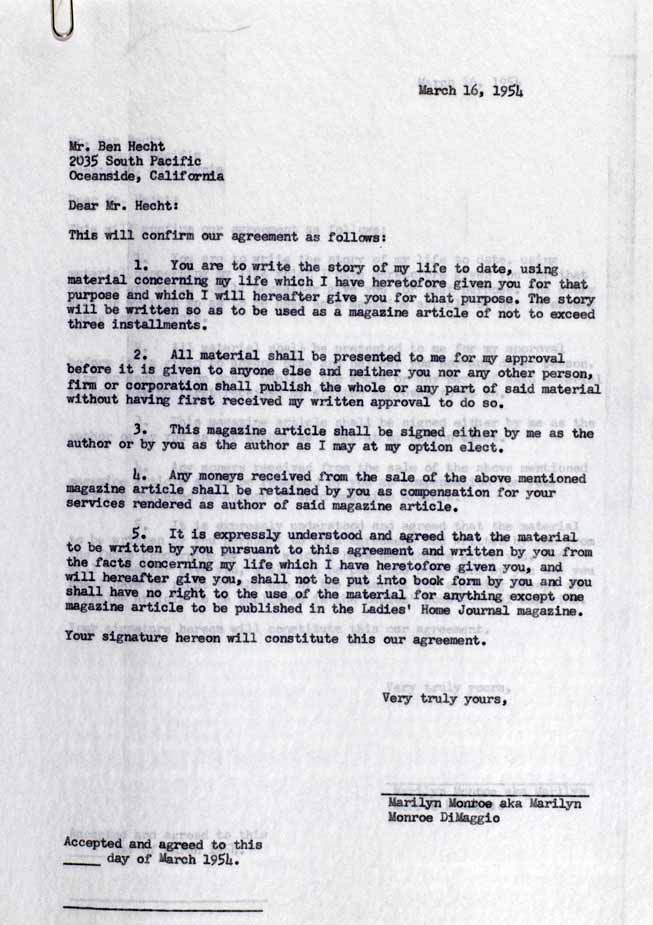
According to her autobiography My Story, ghostwritten by Ben Hecht,[45] Marilyn Monroe originally did not want to meet DiMaggio, fearing he was a stereotypically arrogant athlete. They eloped at San Francisco City Hall on January 14, 1954. Although she suffered from endometriosis,[46] Monroe and DiMaggio each expressed to reporters their desire to start a family.
The union was troubled from the start by DiMaggio's jealousy and controlling attitude; he was also physically abusive.[47] A violent fight between the couple occurred immediately after the skirt-blowing scene in The Seven Year Itch that was filmed on September 14, 1954, in front of Manhattan's Trans-Lux 52nd Street Theater.[48] Then 20th Century Fox's East Coast correspondent Bill Kobrin told the Palm Springs Desert Sun that it was director Billy Wilder's idea to turn the shoot into a media circus. The couple then had a "yelling battle" in the theater lobby.[49] After returning from New York City to Hollywood in October 1954, Monroe filed for divorce from DiMaggio after only nine months of marriage.[50] DiMaggio underwent therapy, stopped drinking alcohol, and expanded his interests beyond baseball.[51]
On August 1, 1956, an International News wire photo of DiMaggio with Lee Meriwether gave rise to speculation that they were engaged, but DiMaggio biographer Richard Ben Cramer wrote that it was a rumor started by columnist Walter Winchell. Monroe biographer Donald Spoto claimed that DiMaggio was "very close to marrying" 1957 Miss America Marian McKnight, who won the crown with a Marilyn Monroe act, but McKnight denied it.[52] He was also linked to Liz Renay, Cleo Moore, Rita Gam, Marlene Dietrich, and Gloria DeHaven during this period, and years later to Elizabeth Ray and Morgan Fairchild, but he never publicly confirmed any involvement with any woman.

DiMaggio reentered Monroe's life as her marriage to Arthur Miller was ending. On February 10, 1961, he secured her release from Payne Whitney Psychiatric Clinic in Manhattan. She joined him in Florida where he was a batting coach for the Yankees. Their "just friends" claim did not stop remarriage rumors from flying. Reporters staked out her Manhattan apartment building. Bob Hope "dedicated" Best Song nominee "The Second Time Around" to them at the 33rd Academy Awards.
According to Maury Allen's biography, DiMaggio was alarmed at how Monroe had fallen in with people he felt were detrimental to her well-being. Val Monette, the owner of a military post-exchange supply company, told Allen that DiMaggio left his employ on August 1, 1962, because he had decided to ask Monroe to remarry him.
Four days later, on August 5, Monroe was found dead in her Brentwood, Los Angeles home after housekeeper Eunice Murray telephoned Monroe's psychiatrist, Ralph Greenson. DiMaggio's son had spoken to Monroe on the phone the night of her death and said she seemed fine.[53] Her death was deemed a probable suicide by "Coroner to the Stars" Thomas Noguchi. It has also been the subject of conspiracy theories.
Devastated, DiMaggio claimed Monroe's body and arranged for her funeral at Westwood Village Memorial Park Cemetery. He barred Hollywood's elite and members of the Kennedy family from attending the funeral, including President John F. Kennedy. He had a half-dozen red roses delivered to her crypt three times a week for 20 years.[54] He refused to talk about her publicly or otherwise exploit their relationship. He never married again. According to DiMaggio's attorney Morris Engelberg, DiMaggio's last words were "I'll finally get to see Marilyn."[55] However, Joe's brother Dominic challenged Engelberg's version of Joe's final moments and his motives.[56][57]
Advertising[edit]

In the 1970s, DiMaggio became a spokesman for Mr. Coffee, and was the face of the electric drip coffee makers for over 20 years. Vincent Marotta, the CEO of North American Systems, which manufactured Mr. Coffee at the time, recruited DiMaggio for the advertising campaign.[58] DiMaggio's spots were successful with consumers. In a 2007 interview with The Columbus Dispatch, Marotta joked that "millions of kids grew up thinking Joe DiMaggio was a famous appliance salesman."[58] Despite the commercials, DiMaggio rarely drank coffee due to ulcers;[58] and when he did drink coffee, he preferred Sanka instant coffee rather than coffee brewed by Mr. Coffee machines.[58]
In 1972, DiMaggio became a spokesman for the Bowery Savings Bank. Except for a five-year hiatus in the 1980s, he regularly made commercials for them until 1992.[59] In 1986, he became a spokesperson for Florida's Cross Keys Village, an active retirement community.[60]
Television programs[edit]
Beginning in April 1952, DiMaggio had 10-minute programs on Channel 11 in New York City before and after each Yankees' home game. Episodes included interviews with guests and DiMaggio's comments about baseball. The team owned the program, with DiMaggio under contract to the Yankees. He also did Joe DiMaggio's Dugout on Channel 4 in New York City, a weekly filmed program unrelated to the pre-and post-game shows. It featured instructional sessions and quizzes for young people.[61]
Death[edit]

DiMaggio was a heavy smoker for much of his adult life.[62] He was admitted to Memorial Regional Hospital in Hollywood, Florida, on October 12, 1998, for lung cancer surgery and remained there for 99 days.[63] He returned to his home in Hollywood, Florida, on January 19, 1999, where he died on March 8 at age 84.
DiMaggio's funeral was held on March 11, 1999, at Saints Peter and Paul Church in San Francisco,[64] and he was interred three months later at Holy Cross Cemetery in Colma, California.[65] His son also died that year, on August 6, at age 57.[66]
Legacy[edit]
At his death, The New York Times called DiMaggio's 1941 56-game hitting streak "perhaps the most enduring record in sports."[54]
In an article in 1976 in Esquire magazine, sportswriter Harry Stein published an "All Time All-Star Argument Starter," consisting of five ethnic baseball teams. Joe DiMaggio was the center fielder on Stein's Italian team.[67]
According to American geneticist Mary-Claire King, in the spring of 1981 DiMaggio babysat her daughter at the San Francisco airport so King could drop her mother off to her flight to Chicago. According to King, if it were not for DiMaggio's kindness, she would have almost certainly missed her own flight that was taking her and her daughter to Washington, D.C., a trip that eventually resulted in King's getting her first major grant from the National Institutes of Health and the discovery of the breast and ovarian cancer-causing gene, BRCA1.[68]
On September 17, 1992, the doors were opened at Joe DiMaggio Children's Hospital at Memorial Regional Hospital in Hollywood, Florida, for which he raised over $4 million.[54]

On April 13, 1998, DiMaggio was given the Sports Legend Award at the 13th annual American Sportscasters Association Hall of Fame Awards Dinner in New York City. Henry Kissinger, former Secretary of State and a longtime fan of DiMaggio, made the presentation to the Yankee great. The event was one of DiMaggio's last public appearances before taking ill.
Yankee Stadium's fifth monument was dedicated to DiMaggio on April 25, 1999, and the West Side Highway was officially renamed The Joe DiMaggio Highway in his honor. The Yankees wore DiMaggio's number 5 on the left sleeves of their uniforms for the 1999 season. He is ranked No. 11 on The Sporting News' list of the 100 Greatest Baseball Players, and he was elected by fans to the Major League Baseball All-Century Team. In addition to his number 5 being retired by the New York Yankees, DiMaggio's number was also retired by the Florida Marlins, who retired it in honor of their first team president, Carl Barger, who died five months before the team took the field for the first time in 1993. DiMaggio had been his favorite player.
In 2000 after some negotiations,[69] the heirs of Joe DiMaggio's estate, two granddaughters and their four children, welcomed the renaming of San Francisco's North Beach playground, the place where Joe DiMaggio first took up baseball as a boy, as the Joe DiMaggio North Beach Playground.[70]
In 2001, Major League Baseball introduced an online daily fantasy game called "Beat the Streak" which required players to pick one or two MLB players to get a hit in a game that day. The goal was to pick correctly 57 times in a row to beat DiMaggio's record streak. As of August 2021[update], the prize money for beating the streak was $5.6 million; more than 4.5 million players had combined to make over 100 million attempts but none had reached even 52 consecutive hits in the game's history.[71]
In May 2006, the adopted daughters of DiMaggio's son held an auction of DiMaggio's personal items. Highlights included the ball he hit in breaking Wee Willie Keeler's hitting-streak record ($63,250); his 2,000th career hit ball ($29,900); his 1947 Most Valuable Player Award ($281,750); the uniform worn in the 1951 World Series ($195,500); his Hall of Fame ring ($69,000); a photograph Marilyn autographed "I love you Joe" ($80,500); her passport ($115,000); and their marriage certificate ($23,000). Lot 758, DiMaggio's white 1991 Mercedes 420 SEL sedan, which was a gift from the New York Yankees commemorating the 50th anniversary of DiMaggio's 1941 season, sold for $18,000. The event netted a total of $4.1 million.

On August 8, 2011, the United States Postal Service announced that an image of DiMaggio would appear on a stamp for the first time. It was issued as part of the "Major League Baseball All-Star Stamp Series," which came out in July 2012.[72]
DiMaggio insisted on being introduced as the "Greatest Living Ballplayer" at events, including Yankee Old-Timers Day, and he once punched Billy Crystal in the stomach for not introducing him as such.[73]
In 2013, the Bob Feller Act of Valor Award honored DiMaggio as one of 37 Baseball Hall of Fame members for his service in the United States Army Air Force during World War II.[74]
The Joe DiMaggio Fields in his hometown of Martinez, California are named after him.
Career statistics[edit]
| Category | G | AB | R | H | 2B | 3B | HR | RBI | BB | SO | AVG | OBP | SLG | OPS | FLD% | Ref. |
|---|---|---|---|---|---|---|---|---|---|---|---|---|---|---|---|---|
| Total | 1,736 | 6,821 | 1,390 | 2,214 | 389 | 131 | 361 | 1,537 | 790 | 369 | .325 | .398 | .579 | .977 | .978 | [1] |
DiMaggio played in 10 World Series, winning 9. His only loss was in the 1942 World Series. He batted .271 (54-199), with 27 runs scored, 8 home runs, and 30 RBI in 51 post-season games.
In popular culture[edit]
 |


An American icon, DiMaggio's popularity during his career was such that he was referenced in film, television, literature, art, and music both during his career and decades after he retired.
Art[edit]
- Pierre Bellocq: Canvas of Stars mural for Gallagher's Steak House (2006)[75]
- Robert Casilla: The Continuity of Greatness[76]
- Devon Dikeou: Marilyn Monroe Wanted to Be Buried in Pucci installation (2008)[77]
- Harvey Dinnerstein: The Wide Swing (1979) sold at auction for $95,000[78]
- Curt Flood: painting of DiMaggio sold at auction for $9,500[79]
- Bart Forbes: illustration of DiMaggio for the July 1999 Boys' Life[80]
- Zenos Frudakis: bronze sculpture of DiMaggio for the Joe DiMaggio Children's Hospital[81]
- Bill Gallo: caricature of DiMaggio and Ted Williams sold at auction for $750[82]
- Red Grooms: Joltin' Joe Takes a Swing installation (1985–1988)[83]
- Stephen Holland: Joe DiMaggio (2005)
- Armand LaMontagne: 1991 giclee of DiMaggio sold at auction for $325[84]
- Tommy McDonald: paintings of DiMaggio sold at auction for $4,000,[85] and $2,300[78]
- Willard Mullin: 1936 drawing of DiMaggio sold at auction for $2,600[82]
- LeRoy Neiman: Joe DiMaggio, New York Yankees (1969), Joe DiMaggio, San Francisco Seals (1989), and The DiMaggio Cut (1998)
- Bruce Stark: caricature of DiMaggio and Mickey Mantle sold at auction for $700[86]
- Mark Ulriksen: illustration of DiMaggio for the cover of the April 12, 1999 The New Yorker[non-primary source needed]
Cartoons/Comics/Graphic Novels[edit]

- Boobs in the Woods: Daffy yells at Porky: "Steal home, DiMaggio! It means the game! Attaboy, DiMaggio! Hit the dirt! Slide, DiMaggio! Slide!" Porky then breaks the Fourth wall and says: "Why am I sliding for? I'm not DiMaggio".
- DC Comics' 100 Bullets by Brian Azzarello and Eduardo Risso:
- Harvey Comics' Babe Ruth Sports Comics (August 1949)[89]
- Parents' Magazine's True Comics #71 (May 1948)[90]
- Revolutionary Comics' Baseball Legends: Joe DiMaggio (July 1992)[91]
Literature[edit]
- "Buck Wischnewski" is based on him in Alvah Bessie's 1966 novel The Symbol[non-primary source needed]
- "The Ex-Athlete" is based on him in Joyce Carol Oates's 2000 novel Blonde.[92]
- "The Silent Season of a Hero" by Gay Talese, is a celebrated 1966 piece for Esquire magazine[non-primary source needed]
- In Ernest Hemingway's 1952 novel, The Old Man and the Sea, Santiago is a fan of DiMaggio.[93]
Music[edit]
- Asia: "Joe DiMaggio's Glove"[94][non-primary source needed]
- Billy Bragg and Woody Guthrie: "DiMaggio Done It Again"[non-primary source needed]
- Les Brown & His Band of Renown's "Joltin' Joe DiMaggio"[95]
- Kinky Friedman: "Marilyn and Joe"[non-primary source needed]
- Mike Plume: "DiMaggio"[non-primary source needed]
- Abie Rotenberg: "The Great Joe DiMaggio's Card"[non-primary source needed]
- Simon & Garfunkel: "Mrs. Robinson"[96]
- Billy Joel: "We Didn't Start the Fire"[97]
- Vulfpeck: "1 for 1, Dimaggio"[non-primary source needed]
- Bon Jovi: "Captain Crash and the Beauty Queen from Mars"
- Madonna: "Vogue"
- Tim Curry: "I Do the Rock"[98]
- John Fogerty: "Centerfield"
Movies[edit]
- 61*, played by Michael Nouri
- The Goddess: "Dutch Seymour" is based on DiMaggio[non-primary source needed]
- Insignificance: "The Ballplayer" is based on DiMaggio[non-primary source needed]
- Blonde, played by Bobby Cannavale[99]
- Manhattan Merry-Go-Round (film), Joe DiMaggio played himself
TV movies[edit]
- Marilyn & Me, portrayed by Sal Landi
- Marilyn: The Untold Story, portrayed by Frank Converse
- Norma Jean & Marilyn, portrayed by Peter Dobson
- The Rat Pack, portrayed by John Diehl
- The Secret Life of Marilyn Monroe, portrayed by Jeffrey Dean Morgan
Theater[edit]
- Insignificance (1982) by Terry Johnson: The Ballplayer is based on DiMaggio[non-primary source needed]
- Marilyn: An American Fable (1983): DiMaggio is a character
- Arthur and Joe (2012) by Allan Havis: DiMaggio is a character[100]
- Bronx Bombers (2013) by Eric Simonson: DiMaggio is a character[101]
Television[edit]
- The Bronx Is Burning, played by Christopher McDonald
- Blonde: "The Baseball Player" is based on DiMaggio [non-primary source needed]
- Frasier, "Room Full of Heroes": Martin dresses as DiMaggio, his boyhood hero
- M*A*S*H:
- "Showtime": Jackie Flash mentions DiMaggio during a routine
- "Pressure Points": Potter mentions DiMaggio while talking to Freedman
- "Bombshells": Hawkeye tries to convince a 20th Century-Fox Switchboard operator that he's DiMaggio's "friend" Ted Williams
- Seinfeld, "The Note": Kramer tries to convince the gang that he saw DiMaggio at Dinky Donuts
See also[edit]
- List of Major League Baseball career batting average leaders
- List of Major League Baseball career hits leaders
- List of Major League Baseball career home run leaders
- List of Major League Baseball career on-base percentage leaders
- List of Major League Baseball career OPS leaders
- List of Major League Baseball career runs batted in leaders
- List of Major League Baseball career slugging percentage leaders
- List of Major League Baseball career total bases leaders
- List of Major League Baseball career triples leaders
- List of Major League Baseball players to hit for the cycle
- List of Major League Baseball players who spent their entire career with one franchise
References[edit]
- ^ a b Arbesman, Samuel; Strogatz, Steven (March 30, 2008). "A Journey to Baseball's Alternate Universe". The New York Times. Archived from the original on June 30, 2017. Retrieved February 9, 2017.
- ^ Callahan, Gerry (July 19, 1999). "Hank Or Ted Or Willie Or...:Who's the best living ballplayer now that Joe DiMaggio's gone?". Sports Illustrated. Archived from the original on February 3, 2014. Retrieved September 16, 2009.
- ^ "Joe DiMaggio Jr.; Son of Yankees Baseball Legend Led Troubled Life". Los Angeles Times. August 8, 1999. Archived from the original on August 19, 2019. Retrieved February 14, 2020.
- ^ a b c Richard Ben Cramer (2000). Joe DiMaggio: The Hero's Life. Simon & Schuster. ISBN 0684853914.
- ^ Schwartz, Larry. "Joltin' Joe was a hit for all reason". ESPN. Archived from the original on February 5, 2009. Retrieved March 12, 2009.
- ^ Nelson, Murry R. (2013). American Sports: A History of Icons, Idols, and Ideas [4 Volumes]: A History of Icons, Idols, and Ideas. ABC-CLIO. p. 347. ISBN 9780313397530. Retrieved March 21, 2017.
- ^ Nemec, David; Flatow, Scott (2008). Great Baseball Feats, Facts and Figures. A Signet Book (2008 ed.). New York: Penguin Group. p. 210. ISBN 978-0-451-22363-0.
- ^ Kramer, Daniel (August 12, 2016). "Mejia's epic streak ends, then extends to 50: Official scorer changes controversial error call after game to keep run alive for Indians prospect". MLB.com. Archived from the original on February 2, 2018. Retrieved August 14, 2016.
- ^ "Yankees Timeline". New York Yankees. Archived from the original on September 6, 2015. Retrieved September 21, 2015.
- ^ Kennedy, Kostya, "The Streak", Sports Illustrated, March 14, 2011, pp. 60–67 (Excerpted from 56: Joe DiMaggio and the Last Magic Number in Sports, 2011, Sports Illustrated Books).
- ^ Marchand, Andrew (July 8, 2017). "Aaron Judge passes Joe DiMaggio for most Yankee rookie home runs". ESPN. Archived from the original on July 9, 2017. Retrieved July 8, 2017.
- ^ "Judge honored by Yanks for rookie HR record". MLB.com. Archived from the original on July 21, 2019. Retrieved July 21, 2019.
- ^ "Joe DiMaggio 1937 Batting Game Logs". Baseball-Reference.com. Retrieved January 7, 2022.
- ^ Adler, David (May 24, 2020). "The 27 greatest offensive runs in MLB history". MLB.com. Retrieved January 7, 2022.
- ^ "DiMaggio Voted Most Valuable Player in American League". The New York Times. October 25, 1939. p. 31.
- ^ "SPORT magazine, September 1946". Archived from the original on April 14, 2010. Retrieved July 21, 2019.
- ^ "The List: Baseball's biggest rumors". ESPN.com. p. 2. Archived from the original on February 26, 2011..
- ^ Hunt, Donald (April 5, 2012). "Baseball Great Doby Receives Postage Stamp". PhillyTrib.com. Archived from the original on April 9, 2012. Retrieved July 14, 2012.
- ^ John Drebinger (December 12, 1951). "DiMaggio Retires as Player but Expects to Remain in Yankee Organization". New York Times. p. 63.
- ^ Sandler, Jeremy, "NL Weekly: The Notebook", National Post, May 27, 2009, accessed 5/28/09.[dead link]
- ^ "Fascinating facts from Friday's games". Major League Baseball. Archived from the original on November 7, 2012. Retrieved September 21, 2015.
- ^ "More Homers than Strikeouts in a Season by Baseball Reference". baseball-reference.com. Archived from the original on October 6, 2014. Retrieved September 19, 2014.
- ^ a b Bullock, Steven R. (2004). Playing for Their Nation: Baseball and the American Military during World War II. University of Nebraska Press. pp. 100–102, 127. ISBN 0-8032-1337-9.
- ^ Castrovince, Anthony. "How DiMaggio wound up in an A's uniform," MLB.com, Tuesday, December 21, 2021. Retrieved December 22, 2021
- ^ Verducci, Tom (January 18, 2021). "The Greatest (Forgotten) Game Ever Played: MLB's 1970 Exhibition to Honor MLK". Sports Illustrated.
- ^ a b Gould, Stephen Jay (August 18, 1988). "The Streak of Streaks". The New York Review of Books. Archived from the original on February 15, 2020. Retrieved February 15, 2020.
- ^ "Joe DiMaggio Hitting Streak by Baseball Almanac". baseball-almanac.com. Archived from the original on August 22, 2011. Retrieved August 14, 2011.
- ^ "Joe DiMaggio 7 Games away from Batting Record". St. Petersburg Times. June 22, 1941. Archived from the original on September 8, 2019. Retrieved August 14, 2011.
- ^ "Joe DiMaggio Taking Interest in Hit Streak". Meriden Record. June 27, 1941. Retrieved August 14, 2011.
- ^ Talbot, Gayle (June 30, 1941). "Yankees Keep Pace with Joe in Homer Derby". The Miami News. Retrieved August 14, 2011.[permanent dead link]
- ^ "Retrosheet Boxscore: New York Yankees 9, Washington Senators 4 (1)". retrosheet.org. Archived from the original on September 4, 2015. Retrieved August 14, 2011.
- ^ Daley, Arthur (July 2, 1941). "Yankee Star Hits 44th Game in Row". The New York Times. Archived from the original on July 23, 2018. Retrieved August 14, 2011.
- ^ Bailey, Judson (July 3, 1941). "DiMaggio's Home Run Tops Keeler's Record". Ottawa Citizen. Archived from the original on June 29, 2016. Retrieved August 14, 2011.
- ^ Boni, Bill (July 12, 1941). "DiMaggio Runs Hitting Streak to 50 Straight". Times Daily. Archived from the original on June 30, 2016. Retrieved August 14, 2011.
- ^ Hauck, Larry (July 18, 1941). "Two Ordinary Hurlers End DiMaggio's Streak". The Calgary Herald. Retrieved August 14, 2011.
- ^ "Joe DiMaggio Hitting Streak by Baseball Almanac". Baseball Almanac. Archived from the original on August 22, 2011. Retrieved August 7, 2011.
- ^ Martin, Cam (July 13, 2011). "Does Ted Williams Own A More Impressive Streak Than Joe DiMaggio?". ThePostGame.com. Archived from the original on August 10, 2011. Retrieved August 14, 2011.
- ^ Baseball's Top 100: The Game's Greatest Records, p.5, Kerry Banks, 2010, Greystone Books, Vancouver, BC, ISBN 978-1-55365-507-7
- ^ Stark, Jayson (May 15, 2011). "Baseball's unbreakable record". ESPN. Archived from the original on September 8, 2019. Retrieved February 15, 2020.
- ^ "DiMaggio's hit streak still appears unbreakable". sports.yahoo.com. May 11, 2011. Archived from the original on June 23, 2011. Retrieved August 14, 2011.
- ^ Leonard, Tom (August 3, 2010). "Joe DiMaggio made a poor soldier, military records show". Archived from the original on February 26, 2019. Retrieved July 21, 2019 – via www.telegraph.co.uk.
- ^ a b The New York Daily News (1999). Joe DiMaggio: an American icon. Sports Publishing LLC. pp. 83, 96, 100. ISBN 1-58261-037-1. Archived from the original on January 3, 2014. Retrieved February 21, 2016.
- ^ "A's Are Held to Eight Hits". The Montreal Gazette. April 26, 1939. p. 18 – via Google News Archive.
- ^ "Joe DiMaggio 1914–1999". San Francisco Examiner. March 9, 1999. Archived from the original on April 1, 2005. Retrieved August 4, 2009.
- ^ "'My Story' Contract" (March 16, 1954) Archived December 24, 2017, at the Wayback Machine cursumperficio.net June 6, 2017
- ^ Fraser, IS (2008). "Recognising, understanding, and managing endometriosis". J Hum Reprod Sci. 1 (2): 56–64. doi:10.4103/0974-1208.44112. PMC 2700667. PMID 19562047.
- ^ Spoto 2001, pp. 208, 222–223, 262–267, 292; Churchwell 2004, pp. 243–245; Banner 2012, pp. 204, 219–221.
- ^ Donahue, Anne T. (September 15, 2014). "'That silly little dress': the story behind Marilyn Monroe's iconic scene". The Guardian. Archived from the original on August 6, 2019. Retrieved July 21, 2019 – via www.theguardian.com.
- ^ Goolsby, Denise (June 26, 2006). "Meet Marilyn Monroe photographer Saturday". The Desert Sun. Archived from the original on December 13, 2007. Retrieved August 25, 2008.
- ^ Summers 1985, pp. 103–105; Spoto 2001, pp. 290–295; Banner 2012, pp. 224–225.
- ^ Harrod, Horatia (August 3, 2012). "50 things you didn't know about Marilyn Monroe". The Sydney Morning Herald. Archived from the original on February 15, 2020. Retrieved February 14, 2020.
- ^ "South Carolina's first Miss America, Marian McKnight". The Hartsville Messenger. May 20, 2005. Archived from the original on May 29, 2006.
- ^ Huber, Robert (June 1999). "Joe DiMaggio Would Appreciate It Very Much If You'd Leave Him the Hell Alone". Esquire.
- ^ a b c Durso, Joseph (March 9, 1999). "Joe DiMaggio, Yankee Clipper, Dies at 84". The New York Times. Archived from the original on February 3, 2012. Retrieved May 25, 2009.
- ^ "Report: DiMaggio's Final Words". ABC News. Archived from the original on November 12, 2013. Retrieved September 8, 2014.
- ^ O'Keeffe, Michael (August 11, 2000). "Joe D's Brother Takes Swing". New York Daily News. Archived from the original on February 15, 2020. Retrieved February 14, 2020.
- ^ Madden, Bill; Cyphers, Luke; O'Keeffe, Michael (April 25, 1999). "Joe D & Morris: The Final Days How Lawyer Crony Isolated the Dying DiMaggio". New York Daily News. Archived from the original on February 15, 2020. Retrieved February 14, 2020.
- ^ a b c d Fox, Margalit (August 3, 2015). "Vincent Marotta Sr., a Creator of Mr. Coffee, Dies at 91". The New York Times. Archived from the original on December 19, 2016. Retrieved August 31, 2015.
- ^ Elliott, Stuart (April 8, 1992). "THE MEDIA BUSINESS; With Joe DiMaggio Leaving, It Just Won't Be the Bowery". The New York Times. Archived from the original on January 5, 2017. Retrieved February 9, 2017.
- ^ "The Palm Beach Post from West Palm Beach, Florida on March 16, 1986 · Page 119". Newspapers.com. March 16, 1986. Retrieved September 26, 2020.
- ^ Adams, Val (May 11, 1952). "The 'Yankee Clipper' at the Mike: Joe DiMaggio Discusses His Various Video Activities". The New York Times. p. X 11. Retrieved February 2, 2022.
- ^ Wine, Steven (March 9, 1999). "JOE DIMAGGIO 1914–1999: Goodbye, Joe". Kitsap Sun. Bremerton, Washington. Associated Press. Archived from the original on August 4, 2019. Retrieved February 14, 2020.
- ^ Berkow, Ira (November 25, 1998). "Sports of The Times; DiMaggio, Failing, Is 84 Today". The New York Times. Archived from the original on August 26, 2014. Retrieved May 25, 2009.
- ^ "Yankee Clipper eulogized". ESPN SportsCentury. Associated Press. Archived from the original on July 25, 2008. Retrieved September 21, 2008.
- ^ "Fit for the Clipper / DiMaggio's tomb a work of grace, precision". Sfgate. June 16, 1999.
- ^ "The Obit for Joe DiMaggio Jr (Joe DiMaggio's Only Son Dies)". The Deadball Era. Associated Press. August 7, 1999. Archived from the original on October 20, 2010. Retrieved February 11, 2009.
- ^ Stein, Harry (July 1, 1976). "All-Time All-Star Argument Starter". Esquire.
- ^ King, Mary-Claire (September 15, 2017). "The Week My Husband Left And My House Was Burgled I Secured A Grant To Begin The Project That Became BRCA1". HuffPost. Archived from the original on September 17, 2017. Retrieved September 17, 2017.
- ^ "DIMAGGIO, LLC. v. City & County of San Francisco, 187 F. Supp. 2d 1359 (S.D. Fla. 2000)". law.justia.com. June 29, 2000. Retrieved January 22, 2022.
...the Court finds it lacks personal jurisdiction over San Francisco in this matter. Unlike the game of baseball, personal jurisdiction in federal court is not a fielder's choice.
- ^ Glionna, John (October 11, 2000). "San Francisco Park Will Be Named for DiMaggio After All". Los Angeles Times. Retrieved January 22, 2022.
- ^ Waldstein, David (August 15, 2021). "They Tried to Beat DiMaggio. Like Everyone Else, They Failed". The New York Times. Retrieved August 23, 2021.
- ^ Ember, Sydney (August 8, 2011). "One More Honor for Joe D: Finally, a Stamp". the New York Times. Archived from the original on September 22, 2011. Retrieved August 14, 2011.
- ^ Crystal, Billy (2013). Still Foolin' 'Em: Where I've Been, Where I'm Going, and Where the Hell Are My Keys?. New York: Henry Holt and Company. p. 167. ISBN 978-0-8050-9823-5. Retrieved February 15, 2020.
- ^ "WWII HOF Players". Bob Feller Act of Valor Award. Archived from the original on October 8, 2021. Retrieved August 21, 2021.
- ^ "Canvas of Stars – Peb's New Mural" dogwoodstable.com Archived July 10, 2011, at the Wayback Machine May 28, 2010.
- ^ "Portfolio of Works" Robert Casilla Fine Art Archived August 26, 2011, at the Wayback Machine April 6, 2011.
- ^ "New York-Based Installation Artist Explores 1960s Fame, Fashion and Iconography" TheDesign Center at Philadelphia University May 27, 2010. Archived December 2, 2008, at the Wayback Machine
- ^ a b "Items For The Auction of May 19th & 20th, 2006" HuntAuctions.com Archived July 12, 2011, at the Wayback Machine February 28, 2010.
- ^ "Items For The Auction of May 19th & 20th, 2006" HuntAuctions.com February 25, 2010.
- ^ "'He Was The Best'. Baseball Fans Wonder if There Will Ever be Another Like the Classy Joe DiMaggio" by Robert E. Hood Boys' Life (July 1999); retrieved February 2, 2020
- ^ "Sculptures: Joe DiMaggio" zenosfrudakis.com Archived July 18, 2011, at the Wayback Machine May 28, 2010.
- ^ a b "Items For The Auction of May 19th & 20th, 2006" HuntAuctions.com Archived July 12, 2011, at the Wayback Machine February 28, 2010.
- ^ Adelson, Fred B. (June 4, 2000). "Sculptors: A Giant and Company". The New York Times. Archived from the original on September 8, 2019. Retrieved February 14, 2020.
- ^ "Items For The Auction of May 19th & 20th, 2006" HuntAuctions.com Archived July 12, 2011, at the Wayback Machine February 28, 2010.
- ^ "Items For The Auction of May 19th & 20th, 2006" HuntAuctions.com Archived July 12, 2011, at the Wayback Machine February 25, 2010.
- ^ "Items For The Auction of May 19th & 20th, 2006" HuntAuctions.com Archived July 12, 2011, at the Wayback Machine February 28, 2010.
- ^ "100 Bullets: The Counterfifth Detective" comicvine.com Archived August 7, 2011, at the Wayback Machine May 28, 2010.
- ^ "100 Bullets: Idol Chatter" comicvine.com Archived August 7, 2011, at the Wayback Machine May 28, 2010.
- ^ "Babe Ruth Sports Comics" comicvine.com Archived October 8, 2012, at the Wayback Machine May 28, 2010.
- ^ "Reading Room Index to the Comic Art Collection, 'True Comics'" Michigan State University Libraries Archived June 15, 2010, at the Wayback Machine May 28, 2010.
- ^ "DiMaggio, Joe Baseball Legends Comic July 5, 1992" adsportscardsetc.com May 28, 2010. Archived November 11, 2012, at the Wayback Machine
- ^ Connnolly, Cressida (April 9, 2000). "Blind leading the blonde". The Guardian. Retrieved November 24, 2020.
- ^ Barnes, Bart (March 8, 1999). "Joltin' Joe Has Gone Away". The Washington Post. Retrieved August 9, 2020.
- ^ ""Gravitas" Press Release". originalasia.com. Archived from the original on September 6, 2015. Retrieved September 21, 2015.
- ^ Joltin' Joe Dimaggio, Retrieved June 11, 2010 on YouTube
- ^ Simon, Paul (March 9, 1999). "The Silent Superstar". The New York Times. Archived from the original on February 15, 2016. Retrieved February 9, 2017.
- ^ Marvar, Alexandra (September 26, 2019). "Billy Joel's 'We Didn't Start the Fire': Where are they now?". Los Angeles Times. Retrieved November 23, 2020.
- ^ "I Do the Rock". Genius. Retrieved July 16, 2021.
- ^ "'Blonde': 10 of the Marilyn Monroe Biopic's Stars and Their Real-Life Inspirations". The Hollywood Reporter. September 28, 2022. Retrieved August 6, 2023.
- ^ "Playwrights Process at Cygnet" charleneandbrendaintheblogosphere.blogspot.com Archived April 16, 2014, at the Wayback Machine. Retrieved October 1, 2013.
- ^ "The Week Ahead" Playbill Archived September 21, 2013, at the Wayback Machine. Retrieved September 16, 2013
Works cited[edit]
- Banner, Lois (2012). Marilyn: The Passion and the Paradox. Bloomsbury. ISBN 978-1-4088-3133-5.
- Churchwell, Sarah (2004). The Many Lives of Marilyn Monroe. Granta Books. ISBN 978-0-312-42565-4.
- Spoto, Donald (2001). Marilyn Monroe: The Biography. Cooper Square Press. ISBN 978-0-8154-1183-3.
- Summers, Anthony (1985). Goddess: The Secret Lives of Marilyn Monroe. Victor Gollancz Ltd. ISBN 978-0-575-03641-3.
Further reading[edit]
- Cramer, Richard Ben (2000). Joe DiMaggio: The Hero's Life. Simon & Schuster. ISBN 0684853914.
- Kahn, Roger (1986). Joe and Marilyn: A Memory of Love. Avon Books. ISBN 978-0380704620.
- Charyn, Jerome (2011). Joe DiMaggio: The Long Vigil. Yale University Press. ISBN 978-0300123289.
- Kennedy, Kostya (2011). 56: Joe DiMaggio and the Last Magic Number in Sports. Sports Illustrated Books. ISBN 978-1603201773.
- O'Toole, Andrew (2015). Strangers in the Bronx: DiMaggio, Mantle, and the Changing of the Yankee Guard. Triumph Books. ISBN 978-1629370279.
- Positano, Rock; Positano, John (2017). Dinner with DiMaggio: Memories of An American Hero. Simon & Schuster. ISBN 978-1501156847.
- Monroe, Marilyn; Hecht, Ben (1974). My Story. Stein and Day. ISBN 9780812817072.
External links[edit]
 Definitions from Wiktionary
 Media from Commons
 News from Wikinews
 Quotations from Wikiquote
 Texts from Wikisource
 Textbooks from Wikibooks
 Resources from Wikiversity


- Career statistics and player information from MLB, or ESPN, or Baseball Reference, or Fangraphs, or Baseball Reference (Minors), or Retrosheet
- Official website
- Joe DiMaggio at the Baseball Hall of Fame
- Joe DiMaggio at the SABR Baseball Biography Project
- Joe DiMaggio at IMDb
- Joe DiMaggio at Find a Grave


| International | |
|---|---|
| National | |
| Academics | |
| Artists | |
| Other | |


- 1914 births
- 1999 deaths
- American League All-Stars
- American League batting champions
- American League home run champions
- American League Most Valuable Player Award winners
- American League RBI champions
- American people of Italian descent
- Baseball players from San Francisco
- Burials at Holy Cross Cemetery (Colma, California)
- Catholics from California
- Major League Baseball broadcasters
- Major League Baseball center fielders
- Major League Baseball hitting coaches
- Major League Baseball players with retired numbers
- Marilyn Monroe
- National Baseball Hall of Fame inductees
- New York Yankees announcers
- New York Yankees players
- Oakland Athletics coaches
- People of Sicilian descent
- Pacific Coast League MVP award winners
- Presidential Medal of Freedom recipients
- San Francisco Seals (baseball) players
- United States Army Air Forces soldiers
- United States Army Air Forces personnel of World War II
- Baseball players from Martinez, California
- Tobacco-related deaths