


Jules Joseph Lefebvre
 | You can help expand this article with text translated from the corresponding article in French. (June 2020) Click [show] for important translation instructions.
|
Jules Joseph Lefebvre | |
|---|---|
 A photo of Lefebvre taken no later than 1903 | |
| Born | 14 March 1836[1] Tournan-en-Brie, Seine-et-Marne, France |
| Died | 24 February 1911 (aged 74)[1][2] Paris, France |
| Other names | Jules Lefebvre[2] |
| Occupation | Painter |

Jules Joseph Lefebvre (French: [ʒyl ʒɔzɛf ləfɛvʁ]; 14 March 1836 – 24 February 1911) was a French painter, educator and theorist.
Early life[edit]
Lefebvre was born in Tournan-en-Brie, Seine-et-Marne, on 14 March 1836.[1] He entered the École nationale supérieure des Beaux-Arts in 1852 and was a pupil of Léon Cogniet.
Career[edit]
He won the prestigious Prix de Rome with his The Death of Priam in 1861. Between 1855 and 1898, he exhibited 72 portraits in the Paris Salon. Many of his paintings are single figures of beautiful women. Among the portraits of his considered the best were those of M. L. Reynaud and the Prince Imperial (1874).[3] In 1891, he became a member of the French Académie des Beaux-Arts.
He was professor at the Académie Julian in Paris.[4] Lefebvre is chiefly important as an excellent and sympathetic teacher who numbered many Americans among his 1500 or more pupils. Among his famous students were Fernand Khnopff, Kenyon Cox,[3] Félix Vallotton, Ernst Friedrich von Liphart,[5] Georges Rochegrosse,[6] the Scottish-born landscape painter William Hart, Walter Lofthouse Dean, and Edmund C. Tarbell, who became an American Impressionist painter.[7] Another pupil was the miniaturist Alice Beckington[8] as was Laura Leroux-Revault, the daugher of his friend Louis Hector Leroux.[9] Jules Benoit-Lévy entered his workshop at the École nationale supérieure des Beaux-Arts.[10]


Lefebvre died in Paris on 24 February 1911 and was buried in the Montmartre Cemetery with a bas-relief depiction of his painting La Vérité on his grave.[1][2]
Significant milestones[edit]
- 1853 Student at the École des Beaux-Arts
- 1859 Second place Prix de Rome
- 1861 His Death of Priam wins the Prix de Rome
- 1870 Académie Julian[4] professor
- 1870 Légion d'honneur, Officer, named Commander from 1898
- 1891 Member of the Académie des Beaux-Arts
Selected works[edit]
- 1861 The Death of Priam (won the Prix de Rome), École nationale supérieure des Beaux-Arts, Paris
- 1861 Diva Vittoria Colonna
- 1863 Boy Painting a Tragic Mask
- 1864 Roman Charity
- 1865 Portrait d'Antonio, modèle italien
- 1866 Cornelia, Mother of the Gracchi
- 1868 Reclining Nude, Musée d'Orsay
- 1869 Le Réveil de Diane
- 1869 Portrait of Alexandre Dumas
- 1870 La Vérité (The Truth), Musée d'Orsay
- 1870s Jeune femme à la mandoline (Girl with a Mandolin)
- 1870 Portrait du Prince Impérial
- 1872 Pandora

Graziella, 1878 (depicting the protagonist of Alphonse de Lamartine's novel Graziella) - 1872 La Cigale, National Gallery of Victoria (Exhibited Salon, Paris, 1872, no. 970; collection of Milton Latham (1827–82), San Francisco, before 1878; by whom sold, New York, 1879; collection of Daniel Catlin, St Louis, Missouri, 1879–1893; by whom gifted to the St Louis Museum of Fine Arts, 1893–1945; deaccessioned and sold, c. 1945; collection of Julian Sterling, Melbourne, by 1984–2005; from whom purchased for the Felton Bequest, 2005.)
- 1874 Odalisque
- 1874 Slave Carrying Fruit (Ghent Museum)
- 1874 Portrait of Eugène Louis Napoléon Bonaparte
- 1875 Chloé, Young and Jackson Hotel, Melbourne
- 1876 Mary Magdalene in the Cave, Hermitage Museum, Saint Petersburg
- 1877 Pandora
- 1878 Mignon, Metropolitan Museum of Art, New York
- 1878 Graziella, Metropolitan Museum of Art, New York
- 1879 Diana
- 1879 Diana Surprised, Museo Nacional de Bellas Artes, Buenos Aires
- 1880 Portrait of Julia Foster Ward, Museum of Fine Arts, St. Petersburg, FL
- 1880 Housemaid, Pera Museum, Istanbul
- 1881 La Fiametta from Giovanni Boccaccio
- 1881, Ondine, Museum of Fine Arts, Budapest[11]
- 1882 Pandora (II)
- 1882 Japonaise (A Japanese woman)
- 1883 Psyché
- 1884 The Feathered Fan
- 1884 Portrait of Edna Barger, private collection
- 1890 Lady Godiva
- 1890 Ophelia
- 1892 A Daughter of Eve
- 1892 Judith
- 1896 Portrait of a Lady (II)
- 1898 Amor beim Schärfen seiner Pfeile (Love sharpening its arrows)
- 1901 Alexander Agassiz
- 1901 Yvonne (formerly Musée du Luxembourg), Portrait of Lefebvre's daughter

-
 Clémence Isaure
 -
 Diana Surprised, 1879
 -
 Lady Godiva, 1891
 -
 La Vérité, 1870
 -
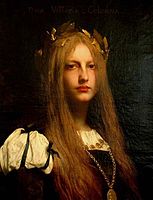 Vittoria Colonna, 1861
 -
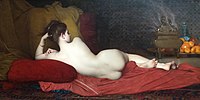 Odalisque, 1874
 -
 Psyché, 1883.
 -
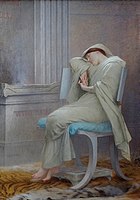 Sleeping vestal virgin, 1902
 -
 Sappho 1884


Undated works[edit]
- Clémence Isaure
- La Fiancée
- Woman with an Orange
- Nymph with Morning Glory Flowers
- Fleurs des Champs
- L'Amour Blessé (Wounded Love)
- Mediterranean Beauty
- Portrait of a Lady
- Portrait of a Woman
- Young Woman with Morning Glories in Her Hair
See also[edit]
- Samantha Littlefield Huntley, one of his students
- Angèle Delasalle, a student at Académie Julian
References[edit]
- ^ a b c d "Art Renewal Center Museum™ Artist Information for Jules Joseph Lefebvre". Art Renewal Center.
- ^ a b c "A One-Picture Painter". Evening News. No. 13, 776. New South Wales, Australia. 3 August 1911. p. 6. Retrieved 6 March 2017 – via National Library of Australia.
- ^ a b Oxford Art Online, "Lefebvre, Jules"
- ^ a b Collier, Peter; Lethbridge, Robert (1994). Artistic Relations: Literature and the Visual Arts in Nineteenth-century France. London: Yale University Press. p. 50. ISBN 9780300060096.
- ^ Baron Ernst Friedrich von Liphart, Late 19th Century – 19th Century – Russian Artists – Biographies – RusArtNet.com
- ^ Waller, S. (ed.), Foreign Artists and Communities in Modern Paris, 1870–1914: Strangers in Paradise, Routledge, 2017, p. 119
- ^ Kathleen Luhrs, American Paintings in the Metropolitan Museum of Art, 1980: "... on to Paris and studied for a year at the Académie Julian under Gustave Boulanger and Jules Lefebvre."
- ^ Carrie Rebora Barratt; Lori Zabar (1 January 2010). American Portrait Miniatures in the Metropolitan Museum of Art. Metropolitan Museum of Art. pp. 244–. ISBN 978-1-58839-357-9.
- ^ "ULAN Full Record Display (Getty Research)". www.getty.edu. Retrieved 2024-04-10.
- ^ "Benoit-Lévy, Jules (1866–1925), Painter, draughtsman, illustrator" Archived 2019-10-15 at the Wayback Machine, Benezit Dictionary of Artists
- ^ Kovacs, Anna Zsófia (2015–2016). "L'Ondine de Jules Lefebvre : un nu académique français dans les collections du musée des Beaux-Arts". Bulletin du musée hongrois des Beaux-Arts. 120–121: 147–164.
External links[edit]

- TheARTwerx – Lefebvre Gallery: Comprehensive archive of 141 images
- Jules-Joseph-Lefebvre.org: 42 images by Jules Joseph Lefebvre
- Art Renewal Centre – Lefebvre Gallery
- Jules Joseph Lefebvre, paintingiant.com
| International | |
|---|---|
| National | |
| Artists | |
| People | |
| Other | |


.jpg)


- 1836 births
- 1911 deaths
- People from Tournan-en-Brie
- 19th-century French painters
- French male painters
- 20th-century French painters
- 20th-century French male artists
- Academic art
- Academic staff of the Académie Julian
- Prix de Rome for painting
- Commanders of the Legion of Honour
- Officiers of the Ordre des Palmes Académiques
- Burials at Montmartre Cemetery
- 19th-century French male artists