


O'Hare International Airport
Chicago O'Hare International Airport | |||||||||||||||||||||||||||||||||||||||
|---|---|---|---|---|---|---|---|---|---|---|---|---|---|---|---|---|---|---|---|---|---|---|---|---|---|---|---|---|---|---|---|---|---|---|---|---|---|---|---|
 | |||||||||||||||||||||||||||||||||||||||
.jpg) | |||||||||||||||||||||||||||||||||||||||
| Summary | |||||||||||||||||||||||||||||||||||||||
| Airport type | Public | ||||||||||||||||||||||||||||||||||||||
| Owner/Operator | Chicago Department of Aviation | ||||||||||||||||||||||||||||||||||||||
| Serves | Chicago metropolitan area | ||||||||||||||||||||||||||||||||||||||
| Location | O'Hare, Chicago, Illinois, U.S. | ||||||||||||||||||||||||||||||||||||||
| Opened | February 1944[1] | ||||||||||||||||||||||||||||||||||||||
| Hub for | |||||||||||||||||||||||||||||||||||||||
| Focus city for | Polar Air Cargo | ||||||||||||||||||||||||||||||||||||||
| Operating base for |
| ||||||||||||||||||||||||||||||||||||||
| Elevation AMSL | 668 ft / 204 m | ||||||||||||||||||||||||||||||||||||||
| Coordinates | 41°58′43″N 87°54′17″W / 41.97861°N 87.90472°W | ||||||||||||||||||||||||||||||||||||||
| Website | flychicago | ||||||||||||||||||||||||||||||||||||||
| Maps | |||||||||||||||||||||||||||||||||||||||
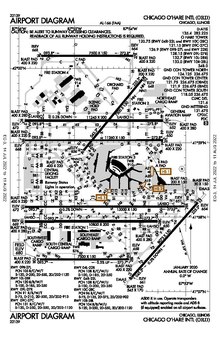 FAA airport diagram | |||||||||||||||||||||||||||||||||||||||
 | |||||||||||||||||||||||||||||||||||||||
| Runways | |||||||||||||||||||||||||||||||||||||||
| |||||||||||||||||||||||||||||||||||||||
| Helipads | |||||||||||||||||||||||||||||||||||||||
| |||||||||||||||||||||||||||||||||||||||
| Statistics (2023) | |||||||||||||||||||||||||||||||||||||||
| |||||||||||||||||||||||||||||||||||||||
Source: O'Hare International Airport[3] | |||||||||||||||||||||||||||||||||||||||
Chicago O'Hare International Airport (IATA: ORD, ICAO: KORD, FAA LID: ORD), sometimes referred to as Chicago O'Hare, or simply O'Hare, is a major international airport serving Chicago, Illinois, located on the city's Northwest Side, approximately 17 miles (27 km) northwest of the Loop business district. Operated by the Chicago Department of Aviation[4] and covering 7,627 acres (3,087 ha),[5][6] O'Hare has non-stop flights to 214 destinations in North America, South America, the Caribbean, Europe, Africa, Asia, the Middle East, Oceania, and the North Atlantic region as of November 2022.[7][8] As of 2023, O'Hare is considered the world's most connected airport.[9]
Designed to be the successor to Chicago's Midway International Airport, itself once nicknamed the "busiest square mile in the world," O'Hare began as an airfield serving a Douglas manufacturing plant for C-54 military transports during World War II. It was renamed Orchard Field Airport in the mid-1940s and assigned the IATA code ORD. In 1949, it was renamed after aviator Edward "Butch" O'Hare, the U.S. Navy's first Medal of Honor recipient during that war.[10][11] As the first major airport planned after World War II, O'Hare's innovative design pioneered concepts such as concourses, direct highway access to the terminal, jet bridges, and underground refueling systems.[12]
O'Hare became famous during the jet age, holding the distinction as the world's busiest airport by passenger traffic from 1963 to 1998. It still ranks as one the busiest airports in the world, according to the Airports Council International rankings.[13][14] In 2019, O'Hare had 919,704 aircraft movements, averaging 2,520 per day, the most of any airport in the world in part because of a large number of regional flights.[15] On the ground, road access to the airport is offered by airport shuttle, bus, the Chicago "L", or taxis. Interstate 190 (Kennedy Expressway) goes directly into the airport. O'Hare is a hub for American Airlines and United Airlines (which is headquartered in Willis Tower),[16][17] as well as an operating base for Spirit Airlines.[18][19]
History[edit]
Establishment and defense efforts[edit]

Soon after the opening of Chicago Municipal Airport in 1926, the City of Chicago realized more airport capacity would be needed. The city government investigated various sites in the 1930s but made little progress before America's entry into World War II.[10]
O'Hare began as a manufacturing plant for Douglas C-54 Skymasters during World War II. The site was known as Orchard Place, previously a small German-American farming community. The 2 million square feet (190,000 m2) plant, in the northeast corner of what is now the airport, needed easy access to the workforce of the nation's second-largest city, as well as its railroads and location far from enemy threat. 655 C-54s were built at the plant, more than half of all produced. The airfield, from which the C-54s flew out, was known as Douglas Airport; initially, it had four 5,500-foot (1,700 m) runways.[10] Less known is the fact that it was the location of the Army Air Force's 803rd Specialized Depot,[20] a unit charged with storing many captured enemy aircraft; a few representatives of this collection would eventually be transferred to the Smithsonian Institution's National Air and Space Museum.[21][22]
Douglas Company's contract ended with the war's conclusion. Douglas considered building airliners at Orchard but chose to concentrate civil production at its headquarters in Santa Monica, California.[10] With the departure of Douglas, the complex took the name Orchard Field Airport, and was assigned the IATA code ORD.[23]
The United States Air Force used the field extensively during the Korean War; the airport then had no scheduled airline service. Although not its primary base in the area, the Air Force used O'Hare as a fighter base; it was home to the 62nd Fighter-Interceptor Squadron flying North American F-86 Sabres from 1950 to 1959.[24] By 1960, the need for O'Hare as an active duty fighter base was diminishing, just as commercial business was picking up at the airport. The Air Force removed active-duty units from O'Hare and turned the station over to Continental Air Command, enabling them to base reserve and Air National Guard units there.[25] As a result of a 1993 agreement between the City and the Department of Defense, the reserve base was closed on April 1, 1997, ending its career as the home of the 928th Airlift Wing and of the 126th Air Refueling Wing in 1999. At that time, the remaining 357-acre (144 ha) site came under the ownership of the Chicago Department of Aviation.[26]
Early commercial development[edit]
In 1945, Chicago mayor Edward Kelly established a board to choose the site of a new airport to meet future demand. After considering various proposals, the board decided upon the Orchard Field site and acquired most of the federal government property in March 1946. The military retained a small parcel of property on the site and the right to use 25% of the airfield's operating capacity for free.[10]
Ralph H. Burke devised an airport master plan based on the pioneering idea of what he called "split finger terminals", allowing a terminal building to be attached to "airline wings" (concourses), each providing space for gates and planes. (Pre-war airport designs had favored ever-larger single terminals, exemplified by Berlin's Tempelhof.) Burke's design also included underground refueling, direct highway access to the front of terminals, and direct rail access from downtown, all of which are utilized at airports worldwide today.[27] O'Hare was the site of the world's first jet bridge in 1958,[28][29] and successfully adapted slip form paving, developed for the nation's new Interstate highway system, for seamless concrete runways.
In 1949, the City renamed the facility O'Hare Airport to honor Edward "Butch" O'Hare, the U.S. Navy's first flying ace and Medal of Honor recipient in World War II.[30] Its IATA code (ORD) remained unchanged, however, resulting in O'Hare being one of the few IATA codes bearing no connection to the airport's name or metropolitan area.[23]
Arrival of passenger service and subsequent growth[edit]
Scheduled passenger service began in 1955,[31] but growth was slow at first. Although Chicago had invested over $25 million in O'Hare, Midway remained the world's busiest airport and airlines were reluctant to move until highway access and other improvements were completed.[32] The April 1957 Official Airline Guide listed 36 weekday departures from O'Hare, while Midway had 414. Improvements began to attract the airlines: O'Hare's first international terminal opened in August 1958, and by April 1959 the airport had expanded to 7,200 acres (2,900 ha) with new hangars, terminals, parking and other facilities. The expressway link to downtown Chicago, now known as the Kennedy Expressway, was completed in 1960.[31] And new Terminals 2 and 3, designed by C. F. Murphy and Associates, opened on January 1, 1962.[33]
The biggest factor driving airlines to relocate their operations from Midway to O'Hare was the jet airliner; the first scheduled jet at O'Hare was an American 707 from New York to Chicago to San Francisco on March 22, 1959.[34] One-mile-square (2.6-kilometer-square) Midway had no space for the runways that 707s and DC-8s required. Airlines had been reluctant to move to O'Hare, but they naturally did not want to split their operations: in July 1962, the last fixed-wing scheduled airline flight in Chicago moved from Midway to O'Hare. Until United returned in July 1964, Midway's only scheduled airline was Chicago Helicopter Airways. The arrival of Midway's traffic quickly made O'Hare the world's busiest airport, serving 10 million passengers annually. Within two years, that number would double, with Chicagoans boasting that more people passed through O'Hare in 12 months than Ellis Island had processed in its entire existence. O'Hare remained the world's busiest airport until it was eclipsed by Hartsfield-Jackson Atlanta International Airport in 1998.
O'Hare had four runways in 1955;[35] 8,000 foot (2,400 m) runway 14R/32L opened in 1956 and was extended to 11,600 feet (3,500 m) a few years later, allowing nonstops to Europe. Runway 9R/27L (now 10L/28R) opened in 1968 and runway 4R/22L in 1971.
Post-deregulation developments[edit]

In the 1980s, after passage of US airline deregulation, the first major change at O'Hare occurred when TWA left Chicago for St. Louis as its main mid-continent hub.[36] Although TWA had a large hangar complex at O'Hare and had started Constellation nonstops to Paris in 1958, by the time of deregulation its operation was losing $25 million a year under competition from United and American.[37] Northwest likewise ceded O'Hare to the competition and shifted to a Minneapolis/St. Paul and Detroit-centered network by the early 1990s after acquiring Republic Airlines in 1986.[38] Delta maintained an O'Hare hub for some time, even commissioning a new Concourse L in 1983.[39] Ultimately, Delta found competing from an inferior position at O'Hare too expensive and closed its Chicago hub in the 1990s, concentrating its upper Midwest operations at Cincinnati.
.jpg)
The dominant hubs established at O'Hare in the 1980s by United and American continue to operate today. United developed a new two-concourse Terminal 1 (dubbed "The Terminal for Tomorrow"), designed by Helmut Jahn. It was built between 1985 and 1987 on the site of the original Terminal 1; the structure, which includes 50 gates, is best known for its curved glass forms and the connecting underground tunnel between Concourses B and C.[40] The tunnel is illuminated with a neon installation titled Sky's the Limit (1987) by Canadian artist Michael Hayden, which plays an airy, slow-tempo version of Rhapsody in Blue.[41] American renovated and expanded its existing facilities in Terminal 3 from 1987 to 1990; those renovations feature a flag-lined entrance hall to Concourses H/K.[42]
The demolition of the original Terminal 1 in 1984 to make way for Jahn's design forced a "temporary" relocation of international flights into facilities called "Terminal 4" on the ground floor of the airport's central parking garage. International passengers were then bused to and from their aircraft. Relocation finally ended with the completion of the 21-gate International Terminal in 1993 (now called Terminal 5); it contains all customs facilities. Its location, on the site of the original cargo area and east of the terminal core, necessitated the construction of a peoplemover, which connected the terminal core with the new terminal as well as remote rental and parking lots.[39]
Following deregulation and the buildup of the American and United hubs, O'Hare faced increasing delays from the late 1980s onward due to its inefficient runway layout; the airfield had remained unchanged since the addition of its last new runway (4R/22L) in 1971.[43] O'Hare's three pairs of angled runways were meant to allow takeoffs into the wind, but they came at a cost: the various intersecting runways were both dangerous and inefficient. Official reports at the end of the 1990s ranked O'Hare as one of the worst-performing airports in the United States based on the percentage of delayed flights.[44] In 2001, the Chicago Department of Aviation committed to an O'Hare Modernization Plan (OMP). Initially estimated at $6.6 billion, the OMP was to be paid by bonds issued against the increase in the federal passenger facility charge enacted that year and federal airport improvement funds.[45] The modernization plan was approved by the FAA in October 2005 and involved a complete reconfiguration of the airfield. The OMP included the construction of four new runways, lengthening two existing runways, and decommissioning three old runways to provide O'Hare with six parallel runways and two crosswind runways.[46]
The OMP was the subject of legal battles, both with suburbs who feared the new layout's noise implications as well as with survivors of persons interred in a cemetery the city proposed to relocate; some of the cases were not resolved until 2011.[47] These issues, plus the reduction in traffic as a result of the 2008 financial crisis, delayed the OMP's completion; construction of the sixth and final parallel runway (9C/27C) began in 2016.[48] Its completion in 2020, along with an extension of runway 9R/27L completed in 2021, concluded the OMP.[49]
Expansion[edit]

In 2018, the city and airlines committed to Phase I of a new Terminal Area Plan dubbed O'Hare 21. The plan was to build two all-new satellite concourses to the southwest of Concourse C, and to expand Terminals 2 and 5 with additional gates, lounges, and updates to operations all over the airport. (Terminal 5 has ten new gates in addition to its newly expanded facilities, plus two additional gates to each accommodate an Airbus A380.)[50] The expansion will enable same-terminal transfers between international and domestic flights, faster connections, improved facilities and technology for TSA and customs inspections and much larger landside amenities such as shopping and restaurants. A principal feature of the plan is the reorganization of the terminal core into an "alliance hub," the first in North America; airside connections and layout will be optimized around airline alliances. This will be made possible by the construction of the O'Hare Global Terminal (OGT) where Terminal 2 currently stands. The OGT and two new satellite concourses will allow for expansion for both American's and United's international operations as well as easy interchange with their respective Oneworld (American) and Star Alliance (United) partner carriers, eliminating the need to transfer to Terminal 5.
This project will add over 3 million square feet (280,000 m2) to the airport's terminals, add a new customs processing center in the OGT, reconstruct gates and concourses (new concourses will be a minimum of 150 feet (46 m) wide), increase the gate count from 185 to 235, and provide 25% more ramp space at every gate throughout the airport to accommodate larger aircraft.[51] After an international design competition that featured public voting on five final architectural proposals, the Studio ORD group, led by architect Jeanne Gang (in collaboration with SCB, Corgan, Milhouse, and STL Architect), was selected to design the OGT,[52][53] while Skidmore, Owings & Merrill LLP will design Satellites 1 and 2.[54] By terms of the agreement, total costs of $8.5 billion for the project are to be borne by bonds issued by the city, which will be retired by airport usage fees paid by the airlines. O'Hare 21 is scheduled for completion of the two satellite terminals in 2028, and overall completion in 2030.[55][56][needs update]
As of 2023, the project's cost had ballooned far over budget leading both American Airlines and United Airlines to call for the global terminal project to be cancelled or scaled back.[57]
Facilities[edit]


Terminals[edit]
O'Hare has four numbered passenger terminals with nine lettered concourses and a total of 213 gates.[58]
- Terminal 1 is used for United Airlines, Lufthansa and All Nippon Airways flights. It contains 52 gates on two concourses, lettered B–C.[58]
- Terminal 2 is used for most United Express and some mainline United flights, as well as all Air Canada, Alaska Airlines, and JetBlue flights. It contains 41 gates on two concourses, lettered E–F.[58]
- Terminal 3 is used for American Airlines, Aer Lingus, Iberia, Japan Airlines and Spirit Airlines flights. It contains 80 gates on four concourses, lettered G, H, K, and L.[58]
- Terminal 5 (there is no Terminal 4) is used for Delta Air Lines, Frontier Airlines and Southwest Airlines flights, as well as all international airlines save for those that depart from Terminals 1–3.[59][60] Terminal 5 is also used for non-pre–cleared international arrivals, as it currently contains the airport's sole U.S. Customs and Border Protection facility.[61] It contains 35 non-sequential gates on a single concourse with the highest number being 40, lettered M. (Note that Terminal 5 is very long, so be prepared for a 20 minute walk.)
Terminals 1–3 are interconnected airside via a walkway.[62] Terminal 5 is separated from the other terminals by a set of taxiways that cross over the airport's access road, requiring most passengers to exit security, ride a shuttle bus or take the Airport Transit System and then re–clear security. An additional shuttle bus provides an airside connection from Terminals 1 and 3 to Terminal 5, operating every 15 minutes from 11:30 am to 9:30 pm.[62]
Runways[edit]
O'Hare has two sets of parallel runways, one on either side of the terminal complex. Each airfield has three parallel east–west runways (9L/27R, 9C/27C, and 9R/27L on the north side; 10L/28R, 10C/28C, and 10R/28L on the south side) and a crosswind runway oriented northeast–southwest (4L/22R on the north, 4R/22L on the south). The north crosswind runway, 4L/22R, sees limited usage due to intersecting 9R/27L and 9C/27C;[63] however, runway 22L is often used for takeoffs during what is called "west flow" on the main runways. The airfield is managed by three FAA air traffic control towers. O'Hare has a voluntary nighttime (22:00–07:00) noise abatement program.[64]
In 2015, runway 32R/14L was permanently closed after 72 years of service, in favor of the new runway 10R/28L.[65]
Currently, O'Hare has the most runways of any civilian airport in the world, totaling eight.[66]
Hotel[edit]
The Hilton Chicago O'Hare is between the terminal core and parking garage and is currently the only hotel on airport property. It is owned by the Chicago Department of Aviation and operated under an agreement with Hilton Hotels, who extended their agreement with the city by ten years in 2018.[67]
Ground transportation[edit]
The Airport Transit System shuttles passengers between the terminal core (Terminals 1–3), Terminal 5, and the O'Hare Multi-Modal Facility (MMF).[68] The system, which re-opened on November 3, 2021, resumed round-the-clock service starting at 5 a.m. on Monday, April 18, 2022,[69] after a nearly six-year renovation.[70] Meanwhile, free shuttle buses also continue to run 24/7 and contribute to congestion, boarding on the upper (departures) level of all terminals. The Bus Shuttle center, located on the ground level of the parking garage between Terminals 1–3 and directly opposite the Hilton Hotel, provides a temporary boarding location for local hotel shuttles and regional public transport buses.[71] The O'Hare Multi-Modal Facility is the home of all on-airport car rental firms as well as some extended parking.[72] In addition, the Chicago-area commuter rail system, Metra, has a transfer station of its North Central Service (NCS) located at the northeast corner of the MMF; however, the NCS currently operates an occasional schedule on weekdays only.[73]
The CTA Blue Line's north terminus is at O'Hare  and provides direct service to downtown via the Milwaukee–Dearborn subway in the Loop and continuing to west suburban Forest Park. Trains depart at intervals ranging from every four to thirty minutes, 24 hours a day.[74] The station is located on the lower level of the parking garage, and can be accessed directly from Terminals 1–3 via tunnel and from Terminal 5 via shuttle bus.
Pace, Peoria Charter, Van Galder Bus Company, and Wisconsin Coach Lines operate bus service to O'Hare, stopping at the MMF.
O'Hare is directly served by Interstate 190, which offers interchanges with Mannheim Road (U.S. 12 and 45), the Tri-State Tollway (Interstate 294), and Interstate 90. I-90 continues as the Kennedy Expressway into downtown Chicago and becomes the Jane Addams Memorial Tollway northwest to Rockford and the Wisconsin state line.
Cargo facilities[edit]
There are presently two main cargo areas at O'Hare. The South Cargo Area was relocated in the 1980s from the airport's first air cargo facilities, located east of the terminal core, where Terminal 5 now stands. Many of the structures in this new cargo area then had to be rebuilt, again, to allow for the OMP and specifically runway 10R/28L; as a result, what is now called the South Cargo Area is located between 10R/28L and 10C/28C. This large collection of facilities, in three sections (Southwest, South Central, and Southeast), was established mainly by traditional airline-based air cargo; Air France Cargo, American, JAL Cargo, KLM, Lufthansa Cargo, Northwest and United all built purpose-built, freestanding cargo facilities,[75] although some of these are now leased out to dedicated cargo firms. In addition, the area contains two separate facilities for shipper FedEx and one for UPS.[75]
The Northeast Cargo Area (NEC) is a conversion of the former military base (the Douglas plant area) at the northeast corner of the airport property. It is a new facility designed to increase O'Hare's cargo capacity by 50%. Two buildings currently make up the NEC: a 540,000 square feet (50,000 m2) building completed in 2016,[76] and a 240,000 square feet (22,000 m2) building that was completed in 2017.[77] A third structure will complete the NEC with another 150,000 square feet (14,000 m2) of warehouse space.[78]
The current capability of the cargo areas provide 2 million square feet (190,000 m2) of airside cargo space with parking for 40 wide-body freighters matched with over 2 million square feet (190,000 m2) of landside warehousing capability. O'Hare shipped over 1,700,000 tonnes (1,900,000 short tons) in 2018, fifth among airports in the U.S.[79]
Other facilities[edit]
In 2011, O'Hare became the first major airport to build an apiary on its property; every summer, it hosts as many as 75 hives and a million bees. The bees are maintained by 30 to 40 ex-offenders with little to no work experience and few marketable skills; they are primarily recruited from Chicago's North Lawndale neighborhood. They are taught beekeeping but also benefit from the bees' labor, turning it into bottled fresh honey, soaps, lip balms, candles and moisturizers marketed under the beelove product line.[80][81] More than 500 persons have completed the program, transferring to jobs in manufacturing, food processing, customer service, and hospitality; the repeat-offender rate is reported to be less than 10%.[82]
The CDA's Airport Airfield Operations section is based out of the 150' tall prototype tower architect I.M. Pei designed for the FAA in the 1960s -1970s.
Airlines and destinations[edit]
Passenger[edit]
^1 : Ethiopian Airlines flight from Addis Ababa to O'Hare stops at Rome–Fiumicino,[161] but the flight from O'Hare to Addis Ababa is non-stop.
Cargo[edit]
Statistics[edit]
Top destinations[edit]
| Rank | Airport | Passengers | Carriers |
|---|---|---|---|
| 1 |  Los Angeles, California Los Angeles, California
|
1,138,000 | American, Spirit, United |
| 2 |  New York–LaGuardia, New York New York–LaGuardia, New York
|
1,102,000 | American, Delta, United |
| 3 |  Denver, Colorado Denver, Colorado
|
998,000 | American, Southwest, United |
| 4 |  Orlando, Florida Orlando, Florida
|
876,000 | American, Frontier, Southwest, Spirit, United |
| 5 | San Francisco, California
|
873,000 | Alaska, American, United |
| 6 |  Phoenix–Sky Harbor, Arizona Phoenix–Sky Harbor, Arizona
|
861,000 | American, Southwest, Spirit, United |
| 7 |  Dallas/Fort Worth, Texas Dallas/Fort Worth, Texas
|
843,000 | American, Spirit, United |
| 8 |  Atlanta, Georgia Atlanta, Georgia
|
823,000 | American, Delta, Frontier, Spirit, United |
| 9 |  Las Vegas, Nevada Las Vegas, Nevada
|
808,000 | American, Frontier, Southwest, Spirit, United |
| 10 |  Newark, New Jersey Newark, New Jersey
|
765,000 | American, United |
| Rank | Airport | Passengers | Carriers |
|---|---|---|---|
| 1 |  London–Heathrow, United Kingdom London–Heathrow, United Kingdom
|
1,008,885 | American, British Airways, United |
| 2 |  Cancún, Mexico Cancún, Mexico
|
862,563 | American, Frontier, Southwest, Spirit, United |
| 3 |  Toronto–Pearson, Canada Toronto–Pearson, Canada
|
704,364 | Air Canada, American, Flair, Swoop, United, WestJet |
| 4 | Mexico City, Mexico
|
667,260 | Aeroméxico, United, Viva Aerobus, Volaris |
| 5 |  Frankfurt, Germany Frankfurt, Germany
|
586,239 | Lufthansa, United |
| 6 |  Paris, France Paris, France
|
438,682 | Air France, American, United |
| 7 |  Dublin, Ireland Dublin, Ireland
|
411,649 | Aer Lingus, American, United |
| 8 |  Tokyo, Japan Tokyo, Japan
|
396,394 | ANA, Japan Airlines, United |
| 9 |  Istanbul, Turkey Istanbul, Turkey
|
386,478 | Turkish |
| 10 | Munich, Germany
|
378,187 | Lufthansa, United |
[edit]
| Rank | Airline | Passengers | Percent of market share |
|---|---|---|---|
| 1 | United Airlines | 23,788,000 | 40.58% |
| 2 | American Airlines | 13,342,000 | 22.76% |
| 3 | SkyWest Airlines | 5,447,000 | 9.29% |
| 4 | Envoy Air | 2,773,000 | 4.73% |
| 5 | Delta Airlines | 2,538,000 | 4.42% |
| Other | 10,479,000 | 18.27% |
Annual traffic[edit]
 | Graphs are unavailable due to technical issues. There is more info on Phabricator and on MediaWiki.org. |
| Year | Passenger volume | Change over previous year | Aircraft operations | Cargo tonnage |
|---|---|---|---|---|
| 2000 | 72,144,244 |  0.64% 0.64% |
908,989 | 1,640,524 |
| 2001 | 67,448,064 | 6.51% |
911,917 | 1,413,834 |
| 2002 | 66,565,952 | 1.31% |
922,817 | 1,436,386 |
| 2003 | 69,508,672 |  4.40% 4.40% |
928,691 | 1,601,736 |
| 2004 | 75,533,822 | 8.67% |
992,427 | 1,685,808 |
| 2005 | 76,581,146 | 1.38% |
972,248 | 1,701,446 |
| 2006 | 76,282,212 | 0.30% |
958,643 | 1,718,011 |
| 2007 | 76,182,025 | 0.15% |
926,973 | 1,690,742 |
| 2008 | 70,819,015 | 7.03% |
881,566 | 1,480,847 |
| 2009 | 64,397,782 | 9.07% |
827,899 | 1,198,426 |
| 2010 | 67,026,191 | 3.83% |
882,617 | 1,577,048 |
| 2011 | 66,790,996 | 0.35% |
878,798 | 1,505,218 |
| 2012 | 66,834,931 | 0.04% |
878,108 | 1,443,569 |
| 2013 | 66,909,638 | 0.12% |
883,287 | 1,434,377 |
| 2014 | 70,075,204 | 4.45% |
881,933 | 1,578,330 |
| 2015 | 76,949,336 | 9.81% |
875,136 | 1,742,501 |
| 2016 | 77,960,588 | 1.31% |
867,635 | 1,726,362 |
| 2017 | 79,828,183 | 2.40% |
867,049 | 1,950,137 |
| 2018 | 83,339,186[188] | 4.40% |
903,747 | 1,868,880 |
| 2019 | 84,649,115 | 1.69% |
919,704 | 1,788,001 |
| 2020 | 30,860,251 | 63.54% |
538,211 | 2,052,025 |
| 2021 | 54,020,399 | 75.06% |
684,201 | 2,536,576 |
| 2022 | 68,340,619 | 26.50% |
711,561 | 2,235,709 |
| 2023 | 73,894,226 | 8.13% |
720,582 | 1,906,463 |
On-time performance (domestic major U.S. carriers only)[edit]
| Year | Percent of on-
time departures |
Percent of on-
time arrivals |
Average departure
delay (min) |
Average arrival
delay (min) |
Percent of
cancelled flights |
|---|---|---|---|---|---|
| 2017 | 79% | 81% | 69.43 | 77.38 | 1.40% |
| 2018 | 77% | 77% | 69.15 | 77.91 | 2.14% |
| 2019 | 75% | 75% | 73.69 | 86.01 | 3.11% |
| 2020 | 84% | 85% | 65.36 | 78.36 | 6.18% |
| 2021 | 81% | 82% | 70.40 | 82.42 | 1.93% |
| 2022 | 78% | 79% | 70.26 | 80.29 | 2.75% |
Major accidents and incidents[edit]
The following is a list of major crashes or incidents that occurred to planes at O'Hare, on approach, or just after takeoff from the airport:[189]
- On September 17, 1961, Northwest Orient Airlines Flight 706, a Lockheed L-188 Electra, crashed upon takeoff, killing all 37 on board.[190]
- On August 16, 1965, United Airlines Flight 389, a Boeing 727, crashed 30 miles (48 km) east of O'Hare while on approach, killing all 30 on board.[191]
- On December 27, 1968, North Central Airlines Flight 458, a Convair CV-580, crashed into a hangar at O'Hare, killing 27 on board and one on the ground.[192]
- On December 20, 1972, North Central Airlines Flight 575, a Douglas DC-9, crashed upon takeoff after colliding with Delta Airlines Flight 954, a Convair CV-880 which was taxiing across the active runway; 10 passengers on the DC-9 were killed.[193]
- On May 25, 1979, American Airlines Flight 191, a McDonnell Douglas DC-10 on a Memorial Day weekend flight to Los Angeles International Airport, had its left engine detach while taking off from runway 32R, then stalled and crashed into a field some 4,600 feet (1,400 m) away. 273 died, including two on the ground, in the deadliest single-aircraft crash in United States history, and the worst aviation disaster in U.S. history prior to the September 11, 2001 attacks.[194][195]
- On March 19, 1982, a United States Air Force KC-135 Stratotanker crashed upon approach to O'Hare 40 miles (64 km) northwest of the city (near Woodstock), killing 27 people on board.[196]
- On February 9, 1998, American Airlines Flight 1340, a Boeing 727, crashed upon landing from Kansas City, injuring 22 passengers.[197]
- On October 28, 2016, American Airlines Flight 383 aborted takeoff on runway 28R after a fire broke out in the right engine of the Boeing 767-300ER; 20 passengers and one flight attendant were injured.[198]
- On April 9, 2017, a passenger was forced off of a Republic-operated United Express flight in Chicago bound for Louisville. The passenger was escorted off the flight by Chicago Department of Aviation officers after he refused to give up his seat to an airline employee. He attempted to run back onto the aircraft but was removed. A video posted on social media showing him being injured and dragged off the plane led to a public outcry.
See also[edit]
- List of the world's busiest airports, for a complete list of the busiest airports in the world
- List of airports in Illinois
- Chicago Union Station
References[edit]
- ^ "Chicago O'Hare International Airport". AirNav, LLC. Archived from the original on October 29, 2016. Retrieved October 28, 2016.
- ^ "Frontier Airlines to Re-Open Pilot Base in Chicago". Frontier Newsroom. November 21, 2023. Retrieved November 22, 2023.
- ^ "Year to Date Operations-Passengers, Cargo Summary December 2023" (PDF). flychicago.com. Retrieved March 6, 2024.
- ^ "About the CDA". City of Chicago Department of Aviation. Archived from the original on May 4, 2018. Retrieved May 3, 2018.
- ^ FAA Airport Form 5010 for ORD PDF, effective January 25, 2024.
- ^ "ORD airport data at skyvector.com". skyvector.com. Retrieved August 25, 2022.
- ^ "Non-stop Service". Chicago Department of Aviation. Archived from the original on March 26, 2019. Retrieved March 26, 2019.
- ^ "O'Hare to offer first direct Chicago-to-Africa flights". Chicago Tribune. Chicago: Tribune Publishing. Associated Press. Archived from the original on April 1, 2018. Retrieved April 1, 2018.
- ^ "Chicago O'Hare Airport named 'World's Best-Connected Airport' on 2022 Megahub Connectivity Index". ABC News. Chicago: ABC Owned Television Stations. September 21, 2022. Retrieved October 4, 2022.
- ^ a b c d e Petchmo, Ian. "The Fascinating History Chicago's O'Hare International Airport: 1920–1960". airwaysmag.com. Airways International Inc. Archived from the original on November 7, 2017. Retrieved April 7, 2018.
- ^ "O'Hare History". Chicago: Chicago Department of Transportation. Retrieved July 18, 2022.
- ^ Burley, Paul. "Ralph H. Burke: Early Innovator of Chicago O'Hare International Airport". Chicago: Northwestern University. Archived from the original on May 11, 2018. Retrieved May 10, 2018.
{{cite journal}}: Cite journal requires|journal=(help) - ^ "O'Hare Ranks as World's Fourth-Busiest Airport, According to New Report". NBC News. Chicago: NBC Owned Television Stations. April 11, 2022. Retrieved April 19, 2022.
- ^ Josephs, Leslie (April 15, 2024). "World's busiest airports show surge in international travel. Here are the rankings". CNBC. Retrieved April 15, 2024.
- ^ Hetter, Katia. "This is the world's busiest airport". CNN Travel. Atlanta: Warner Bros. Discovery. Archived from the original on November 19, 2019. Retrieved November 26, 2019.
- ^ Mutzbaugh, Ben. "The fleet and hubs of United Airlines, by the numbers". USA Today. Washington: Gannett. Archived from the original on February 12, 2018. Retrieved January 29, 2018.
- ^ "Chicago, IL: O'Hare (ORD)". Washington: Bureau of Transportation Statistics. Archived from the original on October 6, 2014. Retrieved September 1, 2015.
- ^ Harden, Mark (September 30, 2014). "Frontier Airlines making Chicago's O'Hare a focus". Chicago Business Journal. Chicago: American City Business Journals. Archived from the original on October 3, 2014. Retrieved September 30, 2014.
- ^ Bhaskara, Vinay (October 1, 2014). "Spirit Airlines Adds Two New Routes at Chicago O'Hare". Airways News. Archived from the original on October 3, 2014. Retrieved October 1, 2014.
- ^ "The Early Years: Major Commands" (PDF). Air Force Association. Archived (PDF) from the original on April 12, 2019. Retrieved August 31, 2018.
- ^ "Messerschmitt Me 262 A-1a Schwalbe (Swallow)". Smithsonian: National Air & Space Museum. Smithsonian Institution. Archived from the original on June 12, 2018. Retrieved May 24, 2018.
- ^ "Junkers Ju 388 L-1". Smithsonian: National Air & Space Museum. Smithsonian Institution. Archived from the original on June 12, 2018. Retrieved May 24, 2018.
- ^ a b "The Wacky Logic Behind Airport Codes". ABC.com. Archived from the original on August 17, 2017. Retrieved August 7, 2017.
- ^ "62 Fighter Squadron (AETC)". Air Force Historical Research Agency. United States Air Force. Archived from the original on July 1, 2018. Retrieved May 11, 2018.
- ^ "ABSTRACT". airforcehistoryindex.org. US Air Force. Archived from the original on July 24, 2011. Retrieved March 16, 2018.
- ^ "1,000 Bid Farewell To O'hare's Air Force Reserve Base". chicagotribune.com. tronc. March 24, 1997. Archived from the original on April 1, 2018. Retrieved April 1, 2018.
- ^ Burley, Paul. "Ralph H. Burke: Early Innovator of Chicago O'Hare International Airport". library.northwestern.edu. Northwestern University. Archived from the original on December 30, 2019. Retrieved December 30, 2019.
- ^ "Briefings... (pg. 58)". Flying Magazine. No. Vol, 62, No. 6. Ziff-Davis Publishing Co. Google. June 1, 1958. Archived from the original on April 17, 2021. Retrieved August 13, 2018.
{{cite news}}:|issue=has extra text (help) - ^ "Airport's Mobile Covered Bridge". Life Magazine. Vol. 44, no. 16. Time-Life Publishing. April 21, 1958.
- ^ "YESTERDAY'S CITY – Part III". polishnews.com. MH Magazine. January 16, 2013. Archived from the original on April 7, 2018. Retrieved April 7, 2018.
- ^ a b "O'Hare History". Fly Chicago. Chicago Department of Aviation. Archived from the original on September 24, 2015. Retrieved September 1, 2015.
- ^ "Airports for the Jet Age: The U.S. Is Far from Ready". Time Magazine. October 21, 1957. Archived from the original on July 19, 2012. Retrieved July 15, 2012.
- ^ "Break Ground at O'Hare for Terminal Unit". Chicago Daily Tribune. April 2, 1959. Retrieved July 2, 2012.
- ^ Chicago Tribune March 22, 1959, part 1 p3, March 23 part 3 p19
- ^ #18 Illinois airport directory. Dept. of Transportation, Division of Aeronautics. 1956 – via HathiTrust.
- ^ "TWA Routes". Airways News. January 1, 1987. Archived from the original on March 20, 2012. Retrieved July 15, 2012.
- ^ "THE AIRLINE BATTLE AT O'HARE". The New York Times. November 4, 1983. Archived from the original on April 1, 2018. Retrieved April 1, 2018.
- ^ "North America Nonstop Routes". Airways News. 1994. Archived from the original on March 20, 2012. Retrieved July 15, 2012.
- ^ a b Petchmo, Ian. "The Fascinating History Chicago's O'Hare International Airport: 1960–2000". airwaysmag.com. Airways International, Inc. Archived from the original on April 7, 2018. Retrieved April 7, 2018.
- ^ Washburn, Gary (August 4, 1987). "United's Flashy Terminal Ready For Takeoff". Chicago Tribune. Archived from the original on March 15, 2013. Retrieved July 2, 2012.
- ^ Chicago O'Hare International Airport Archived June 28, 2020, at the Wayback Machine. Reported Lost&Found. Retrieved June 24, 2020
- ^ McGovern-Petersen, Laurie (2004). "Chicago O'Hare International Airport". In Sinkevitch, Alice (ed.). AIA Guide to Chicago (2nd ed.). Orlando, Florida: Harcourt. p. 278. ISBN 0-15-602908-1. Retrieved February 8, 2013.
- ^ Flightguide Vol. II,Revision 5/71, Airguide Publications/Monty Navarre, Monterrey CA
- ^ "Chicago, IL: Chicago O'Hare International (ORD)". Bureau of Transportation Statistics. Archived from the original on March 12, 2012. Retrieved November 3, 2010.
- ^ "Lessons Learned From the Chicago O'Hare Modernization Program" (PDF). enotrans.com. Eno Center for Transportation. Archived (PDF) from the original on May 1, 2021. Retrieved April 6, 2018.
- ^ Hinz, Greg (September 25, 2019). "Here's how O'Hare's $8.5 billion makeover is moving along". Crain's Chicago Business. Crain Communications, Inc. Archived from the original on September 26, 2019. Retrieved September 26, 2019.
- ^ Petchmo, Ian. "The Fascinating History Chicago's O'Hare International Airport: 2000 to Present". www.airwaysmag.com. Airways International, Inc. Archived from the original on May 10, 2018. Retrieved May 10, 2018.
- ^ "Runway realignment at O'Hare (map)". chicagotribune.com. Chicago Tribune. July 20, 2015. Archived from the original on April 1, 2018. Retrieved March 31, 2018.
- ^ Wessell, Todd (September 10, 2021). "$6 Billion, 16-Year O'Hare Modernization Project Ends Construction". Journal & Topics. Archived from the original on November 9, 2021. Retrieved November 9, 2021.
- ^ Spielman, Fran. "City Council approves $8.5 billion O'Hare expansion plan by 40-to-1 vote". Chicago Sun-Times. Chicago: Chicago Public Media. Archived from the original on April 1, 2018. Retrieved April 1, 2018.
- ^ Byrne, Ruthhart, John, Bill. "$4 billion bond approval earns Emanuel key victory as council green lights O'Hare overhaul". Chicago Tribune. Chicago: Tribune Publishing. Archived from the original on April 1, 2018. Retrieved April 1, 2018.
{{cite news}}: CS1 maint: multiple names: authors list (link) - ^ "City of Chicago Announces Selection of Studio ORD to Lead Historic O'Hare Expansion". O'Hare International Airport (Press release). Chicago: Chicago Department of Aviation. Archived from the original on March 27, 2019. Retrieved March 27, 2019.
- ^ "Studio Gang to design Chicago O'Hare airport terminal". dezeen.com. March 27, 2019. Archived from the original on March 31, 2019. Retrieved April 6, 2019.
- ^ "City of Chicago Announces Selection of SOM, LLP To Design Two Satellite Concourses at O'Hare". flychicago.com. Chicago Department of Aviation. Archived from the original on May 1, 2021. Retrieved July 15, 2019.
- ^ Koziarz, Jay (January 17, 2019). "Here are the five designs competing for O'Hare's $8.5B expansion". Curbed Chicago. Chicago: Vox Media. Archived from the original on October 13, 2020. Retrieved October 1, 2020.
- ^ Hinz, Greg (November 21, 2022). "Massive O'Hare project clears last hurdle". Crain's Chicago Business. Chicago: Crain Communications. Retrieved December 1, 2022.
- ^ "As O'Hare expansion price tag climbs, airport's two biggest carriers want project scaled back – or grounded". Chicago Sun-Times. November 28, 2023. Retrieved December 15, 2023.
- ^ a b c d "Terminal Map". O'Hare International Airport. Chicago: Chicago Department of Aviation. Archived from the original on April 17, 2021. Retrieved March 19, 2021.
- ^ "Chicago Department of Aviation Completes First Phase of O'Hare Gate Renumbering at Terminal 5" (Press release). Chicago: Office of Emergency Management and Communications.
- ^ ORD Common Gate Use Information (PDF) (Report). Chicago: Chicago Department of Aviation.
- ^ "International Traveler - O'Hare Airport". Archived from the original on April 17, 2021. Retrieved March 19, 2021.
- ^ a b "Connecting Traveler - O'Hare". O'Hare International Airport. Chicago: Chicago Department of Aviation. Archived from the original on March 6, 2023. Retrieved March 11, 2023.
- ^ "O'Hare Modernization Final Environmental Impact Statement, Appendix F, Table F-39" (PDF). faa.gov. Federal Aviation Administration. Archived (PDF) from the original on April 5, 2018. Retrieved April 5, 2018.
- ^ "Fly Quiet Program". flychicago.com. City of Chicago Department of Aviation. Archived from the original on April 1, 2018. Retrieved April 1, 2018.
- ^ "Runway 14L/32R closed". worldwideaviation. August 20, 2015. Retrieved December 8, 2023.
- ^ "Top Five US Airports With Most Runways". simpleflying.com. February 16, 2024. Retrieved March 5, 2024.
- ^ Hinz, Greg (October 30, 2018). "City inks new deal with Hilton to run upgraded O'Hare hotel". chicagobusiness.com. Crain Communications, Inc. Archived from the original on April 7, 2019. Retrieved April 10, 2019.
- ^ "Transportation Between Terminals". Archived from the original on November 9, 2021. Retrieved November 9, 2021.
- ^ "O'Hare Airport Transit System (ATS) Returns To 24-Hour Service - Chicago Department of Aviation". Chicago.gov.
- ^ "O'Hare People Mover To Start Running Again Wednesday, Years Behind Schedule And Millions Over Budget – CBS Chicago". Chicago.cbslocal.com. November 2, 2021. Archived from the original on November 9, 2021. Retrieved January 12, 2022.
- ^ "Multi-Modal Facility". flychicago.com. Chicago Department of Aviation. Archived from the original on November 20, 2018. Retrieved March 9, 2019.
- ^ "Multi-Modal Facility". flychicago.com. Chicago Department of Aviation. Archived from the original on November 20, 2018. Retrieved November 20, 2018.
- ^ "Maps and Schedules - NCS". metrarail.com. Commuter Rail Division of the Regional Transportation Authority. Archived from the original on April 19, 2019. Retrieved July 15, 2019.
- ^ "Blue Line 'L'" (PDF). transitchicago.com. Chicago Transit Authority. Archived (PDF) from the original on October 25, 2018. Retrieved January 25, 2020.
- ^ a b "Chicago O'Hare International Airport: Advanced Airfield Familiarization Manual" (PDF). flychicago.com. Chicago Department of Aviation. Archived (PDF) from the original on April 2, 2018. Retrieved April 2, 2018.
- ^ Desormeaux, Hailey (December 22, 2016). "O'Hare opens new cargo center | News". American Shipper. Archived from the original on December 22, 2017. Retrieved March 16, 2018.
- ^ DVV Media Group GmbH (August 22, 2017). "Chicago opens second phase of cargo expansion ǀ Air Cargo News". Aircargonews.net. Archived from the original on December 22, 2017. Retrieved March 16, 2018.
- ^ Burns, Justin (August 23, 2017). "Chicago O'Hare opens second phase of new cargo facility". aircargoweek.com. Azura International. Archived from the original on April 2, 2018. Retrieved April 2, 2018.
- ^ "Year-To-Date Operations, Passengers, Cargo Summary By Class; As of December 2018; O'Hare International Airport". flychicago.com. Chicago Department of Aviation. Archived from the original on September 14, 2019. Retrieved July 15, 2019. (Select: O'Hare / 2081 / December)
- ^ "beelove link". beelove. Sweet Beginnings, LLC. Archived from the original on July 15, 2019. Retrieved July 15, 2019.
- ^ Baskas, Harriet (August 6, 2017). "Bee colonies take flight once more, with some help from airport apiaries". cnbc,com. CNBC, LLC. Archived from the original on April 2, 2018. Retrieved April 2, 2018.
- ^ "Apiary: The First Major On-Airport Apiary in the U.S." flychicago.com. Chicago Department of Aviation. Archived from the original on April 2, 2018. Retrieved April 2, 2018.
- ^ "Timetables". Aer Lingus. Archived from the original on February 19, 2017. Retrieved March 17, 2018.
- ^ "Timetables". Aeroméxico. Archived from the original on November 19, 2018. Retrieved March 17, 2018.
- ^ a b "Flight Schedules". Air Canada. Archived from the original on March 23, 2018. Retrieved March 17, 2018.
- ^ "Air France flight schedule". Air France. Archived from the original on November 16, 2017. Retrieved March 17, 2018.
- ^ "USA-bound: Air India continues its march of progress". Aviation Source News. February 29, 2024. Retrieved April 15, 2024.
- ^ "Engine issues: Air NZ suspending Auckland-Chicago route for several months". Newshub. Retrieved March 12, 2024.
- ^ "Flight schedules – Air New Zealand". Archived from the original on September 25, 2018. Retrieved March 27, 2018.
- ^ "Air Serbia schedules Chicago launch". November 17, 2022.
- ^ Fox, Alison (July 13, 2023). "Alaska Airlines Is Adding New Routes to Central America, Mexico for Winter — What to Know". Travel + Leisure. Retrieved July 13, 2023.
- ^ Airlines, Alaska. "Flight Timetable". Alaska Airlines. Archived from the original on February 2, 2017. Retrieved March 17, 2018.
- ^ "Destinations". Ted Stevens Anchorage International Airport. Archived from the original on January 31, 2023. Retrieved February 20, 2023.
- ^ "Timetables [International Routes]". Archived from the original on June 24, 2018. Retrieved March 17, 2018.
- ^ a b "Flight schedules and notifications". Archived from the original on February 2, 2017. Retrieved March 17, 2018.
- ^ "American Airlines Announces New Nonstop Service from CAE to Chicago". February 20, 2023.
- ^ https://flyevv.com/about-evansville-regional-airport/news/new-nonstop-flights-to-chicago
- ^ "AILEVON PACIFIC, Aviation Consulting – Weekly Airline Schedule Update – May 1st 2023". May 2023. Retrieved May 8, 2023.
- ^ "American Resumes Chicago – Hayden/Steamboat Springs From late-Dec 2023". Aeroroutes. Retrieved October 2, 2023.
- ^ "Austrian Timetable". Austrian Airlines. Archived from the original on March 31, 2019. Retrieved March 17, 2018.
- ^ "AVIANCA COSTA RICA RESUMES 2 US ROUTES FROM DEC 2023". Aeroroutes. Retrieved September 13, 2023.
- ^ "Check itineraries". Retrieved August 5, 2018.
- ^ "Timetables". British Airways. Archived from the original on March 30, 2017. Retrieved March 17, 2018.
- ^ "Flight Status". Archived from the original on March 17, 2018. Retrieved March 17, 2018.
- ^ "Cathay Pacific Resumes Chicago Service from Oct 2023". AeroRoutes. May 15, 2023. Retrieved May 15, 2023.
- ^ "Flight Timetable". Cathay Pacific. Archived from the original on July 1, 2017. Retrieved March 17, 2018.
- ^ "Route Map". Archived from the original on June 24, 2021. Retrieved June 20, 2021.
- ^ "Flight Schedule". Copa Airlines. Archived from the original on November 9, 2017. Retrieved March 17, 2018.
- ^ a b "FLIGHT SCHEDULES". Archived from the original on June 21, 2015. Retrieved March 17, 2018.
- ^ "Denver Air Connection - Reliable, On-Time Flights". Denver Air Connection. Archived from the original on April 15, 2021. Retrieved April 14, 2021.
- ^ "Flight Schedules". Emirates. Archived from the original on June 30, 2017. Retrieved March 17, 2018.
- ^ "Schedule – Fly Ethiopian". Archived from the original on March 31, 2019. Retrieved March 17, 2018.
- ^ "Flight Timetables". Etihad Airways. Archived from the original on April 21, 2017. Retrieved March 17, 2018.
- ^ "Timetables". EVA Air. Archived from the original on May 16, 2017. Retrieved March 17, 2018.
- ^ "Finnair flight timetable". Archived from the original on June 12, 2018. Retrieved March 17, 2018.
- ^ a b c d https://news.flyfrontier.com/frontier-airlines-announces-new-routes-expanding-operations-across-38-airports/
- ^ a b "Frontier Airlines Announces 17 New Routes Across Multiple Airports, Spanning the U.S. and Caribbean".
- ^ "Frontier Airlines 2Q24 Las Vegas Domestic Service Resumptions". Aeroroutes. Retrieved January 23, 2024.
- ^ "Frontier Airlines to expand Nashville service this spring". The Tennessean.
- ^ "Frontier Airlines increases summer schedule at PHL by 47% with 10 new routes". February 7, 2024. Retrieved February 7, 2024.
- ^ "Frontier Airlines Announces New Routes, Expanding Operations Across 12 Airports". April 4, 2024. Retrieved April 5, 2024.
- ^ "Frontier". Archived from the original on September 12, 2017. Retrieved March 17, 2018.
- ^ "Flight times – Iberia". Archived from the original on March 17, 2018. Retrieved March 17, 2018.
- ^ "Flight Schedule". Icelandair. Archived from the original on November 16, 2017. Retrieved March 17, 2018.
- ^ Machado, João (October 11, 2023). "ITA Airways announces seven new destinations for Summer 2024". Aviaci Online - Últimas noticias de aviación de Argentina, Latinoamérica y el mundo. Retrieved October 11, 2023.
- ^ "ITA AIRWAYS WORLD". Itaspa.com. Retrieved February 22, 2022.
- ^ "Japan Airlines Timetables". Archived from the original on October 15, 2018. Retrieved March 17, 2018.
- ^ "Where We Jet: Flight Destinations". JetBlue.com. JetBlue Airways. Archived from the original on April 6, 2023. Retrieved January 16, 2020.
- ^ "View the Timetable". KLM. Archived from the original on September 12, 2017. Retrieved March 17, 2018.
- ^ "Flight Status and Schedules". Korean Air. Archived from the original on June 28, 2018. Retrieved March 17, 2018.
- ^ "Timetables". LOT Polish Airlines. Archived from the original on May 6, 2017. Retrieved March 17, 2018.
- ^ "Timetable – Lufthansa Canada". Lufthansa. Archived from the original on November 9, 2017. Retrieved March 17, 2018.
- ^ "Flight timetable". Archived from the original on October 4, 2017. Retrieved March 17, 2018.
- ^ "Route Map". Royal Jordanian Airlines. Archived from the original on August 5, 2018. Retrieved April 5, 2017.
- ^ "Timetable – SAS". Archived from the original on March 17, 2018. Retrieved March 17, 2018.
- ^ "Return of passenger flights out of Purdue set for May 15". basedinlafayette.com. February 3, 2024. Retrieved February 5, 2024.
- ^ "Southern Route Map". Southern Airways Express. Retrieved October 31, 2022.
- ^ "Southwest Airlines - Check Flight Schedules". Archived from the original on October 13, 2020. Retrieved February 15, 2021.
- ^ https://www.yahoo.com/news/spirit-airlines-announces-nonstop-flights-181151148.html
- ^ "Spirit Airlines adding new route from Charlotte to Chicago". www.wcnc.com. August 3, 2023.
- ^ "Spirit Airlines June/July 2024 Latest Network Additions". Aeroroutes. Retrieved April 10, 2024.
- ^ "Spirit Airlines NS24 Network Additions". Aeroroutes. Retrieved April 3, 2024.
- ^ "Where We Fly". Spirit Airlines. Archived from the original on December 23, 2017. Retrieved March 17, 2018.
- ^ "Route Map & Flight Schedule". Archived from the original on August 15, 2018. Retrieved March 17, 2018.
- ^ "Timetable". Archived from the original on March 17, 2018. Retrieved March 17, 2018.
- ^ "Flight Schedule". TAP Air Portugal. Archived from the original on November 20, 2018. Retrieved November 29, 2018.
- ^ "Online Flight Schedule". Turkish Airlines. Archived from the original on April 10, 2019. Retrieved April 8, 2019.
- ^ "Knoxville's airport preps for summer travel surge with 7 new flights and bigger planes".
- ^ "United Debuts Direct Flights Between U.S. and Tulum". November 17, 2023. Retrieved November 17, 2023.
- ^ "United Airlines Adds Chicago – Athens Service". January 24, 2024. Retrieved January 24, 2024.
- ^ "Adventure Awaits: United Unveils New Summer Flights to Top Outdoor North American Destinations". united.com. Retrieved January 26, 2024.
- ^ a b "Timetable". Chicago: United Airlines Holdings. Archived from the original on January 28, 2017. Retrieved March 17, 2018.
- ^ "United to resume direct flights between Winnipeg and both Denver, Chicago in May". CBC News. Retrieved January 25, 2024.
- ^ a b https://twitter.com/IshrionA/status/1758648304370364654?ref_src=twsrc%5Egoogle%7Ctwcamp%5Eserp%7Ctwgr%5Etweet
- ^ "Aeropuerto Internacional de Harlingen anuncia dos nuevas rutas sin escala". November 29, 2023.
- ^ "United Resumes Winnipeg and Chicago – Quebec in NS24". Aeroroutes. Retrieved January 26, 2024.
- ^ "United Schedules Additional Seasonal Domestic Routes in NS24". Aeroroutes. Retrieved February 19, 2024.
- ^ "VivaAerobus Flight Schedule". Archived from the original on April 5, 2018. Retrieved August 16, 2019.
- ^ "Volaris Flight Schedule". Archived from the original on February 27, 2017. Retrieved March 17, 2018.
- ^ "Direct and Non-Stop Flights". WestJet.
- ^ "Ethiopian Airlines NW23 North America Tech Stop Changes". Aeroroutes. September 18, 2023.
- ^ "Our Network". Archived from the original on September 13, 2017. Retrieved September 12, 2017.
- ^ "ANAカーゴの777F、成田-シカゴ就航 初の北米路線". Archived from the original on December 11, 2019. Retrieved January 2, 2020.
- ^ "Atlas Air Schedule". Atlas Air. Retrieved December 18, 2023.
- ^ "China Southern Cargo Schedule". Archived from the original on January 19, 2014. Retrieved March 28, 2013.
- ^ "SkyCargo Route Map". Emirates SkyCargo. Archived from the original on February 16, 2013. Retrieved May 9, 2013.
- ^ "City of Chicago Welcomes LATAM Cargo to O'Hare International Airport". flychicago.com. Chicago Department of Aviation. Archived from the original on February 27, 2019. Retrieved February 26, 2019.
- ^ Malinowski, Łukasz (February 14, 2012). "Cargo Jet i PLL LOT Cargo uruchomiły trasę z Pyrzowic do Chicago" [Jet Cargo and LOT Polish Airlines Cargo Has Launched a Route from Katowice to Chicago] (Press release) (in Polish). Katowice International Airport. Archived from the original on August 1, 2013. Retrieved July 15, 2012.
- ^ https://www.msc.com/en/solutions/air-cargo-solution/business-hub/air-cargo-schedule
- ^ "The customized AeroLogic network". Aero Logic. Archived from the original on August 8, 2013. Retrieved August 13, 2013.
- ^ "Edmonton adds to cargo load with a regular flight to Tokyo – Edmonton". Globalnews.ca. August 14, 2017. Archived from the original on August 19, 2017. Retrieved March 16, 2018.
- ^ Qantas Freight International Network Map (PDF) (Map). Qantas Freight. Archived from the original (PDF) on September 24, 2015. Retrieved September 1, 2015.
- ^ "Qantas flight QF 7552 schedule". Info.flightmapper.net. April 27, 2016. Archived from the original on November 16, 2015. Retrieved April 27, 2016.
- ^ "Qantas Freight Launches Chongqing Route". Air Cargo World. April 19, 2012. Archived from the original on September 25, 2015. Retrieved July 15, 2012.
- ^ "Qantas Freighter Network Northern Summer Schedule 2010" (PDF). Qantas Freight. June 2010. Archived from the original (PDF) on December 30, 2010. Retrieved July 15, 2012.
- ^ Noëth, Bart (May 31, 2021). "Ostend-Bruges Airport officially added to Qatar Airways Cargo Network". Archived from the original on June 2, 2021. Retrieved June 2, 2021.
- ^ "Qatar Airways to Begin Chicago Freighter Service". AMEinfo. August 2, 2010. Archived from the original on August 3, 2010. Retrieved November 3, 2010.
- ^ "Qatar Airways to begin Chicago freighter service". Air Cargo News. August 10, 2010. Archived from the original on September 25, 2015. Retrieved September 1, 2015.
- ^ "Qatar Airways to Start Milan-Chicago Freighter Service". The Journal of Commerce. June 6, 2013. Archived from the original on November 3, 2013. Retrieved June 29, 2013.
- ^ "Qatar Airways Cargo Announces Inclusion of Singapore on its Popular Transpacific Freighter Route". Qatar Airways. July 16, 2019. Archived from the original on December 28, 2020. Retrieved October 3, 2020.
- ^ "Silk Way Launches Direct Flights to Chicago". September 23, 2016. Archived from the original on October 1, 2016. Retrieved October 2, 2016.
- ^ "Singapore Airlines Cargo". Singapore Airlines Cargo. September 2015. Archived from the original on May 17, 2013. Retrieved June 10, 2013.
- ^ "Turkish freighter goes to Chicago". Air Cargo News. April 7, 2015. Archived from the original on July 1, 2015. Retrieved April 12, 2015.
- ^ "Turkish Airlines Cargo added new destinations from 2018". Routesonline.com. Archived from the original on December 22, 2017. Retrieved March 16, 2018.
- ^ a b c "Chicago, IL: O'Hare (ORD)". Bureau of Transportation Statistics. U.S. Department of Transportation. Retrieved March 22, 2024.
- ^ "International Report Passengers". United States Department of Transportation. 2024. Archived from the original on July 19, 2019. Retrieved February 12, 2024.
- ^ "Air Traffic Data". www.flychicago.com. Archived from the original on April 6, 2018. Retrieved March 16, 2023.
- ^ "Year-To-Date Operations, Passengers, Cargo Summary By Class" (PDF). Archived (PDF) from the original on April 12, 2019. Retrieved April 11, 2019.
- ^ "Chicago–O'Hare International Airport, IL profile". Aviation Safety Network. July 13, 2008. Archived from the original on October 7, 2010. Retrieved November 3, 2010.
- ^ "ASN Aircraft accident Lockheed L-188C Electra N137US Chicago–O'Hare International Airport, IL (ORD)". Aviation Safety Network. Archived from the original on October 23, 2012. Retrieved July 15, 2012.
- ^ "ASN Aircraft accident Boeing 727-22 N7036U Lake Michigan, MI". Aviation Safety Network. Archived from the original on April 25, 2012. Retrieved July 15, 2012.
- ^ "ASN Aircraft accident Convair CV-580 N2045 Chicago–O'Hare International Airport, IL (ORD)". Aviation Safety Network. Archived from the original on August 1, 2013. Retrieved November 3, 2010.
- ^ "ASN Aircraft accident McDonnell Douglas DC-9-31 N954N Chicago–O'Hare International Airport, IL (ORD)". Aviation Safety Network. December 20, 1972. Archived from the original on August 1, 2013. Retrieved November 3, 2010.
- ^ "ASN Aircraft accident McDonnell Douglas DC-10-10 N110AA Chicago – O'Hare International Airport, IL (ORD)". Aviation Safety Network. Archived from the original on January 10, 2011. Retrieved November 3, 2010.
- ^ Franklin, Cory (May 24, 2015). "Commentary: American Airlines Flight 191 still haunts". Chicago Tribune. Archived from the original on September 9, 2015. Retrieved September 1, 2015.
- ^ "ASN Aircraft accident Boeing KC-135A-BN Stratotanker 58-0031 Greenwood, IL". Aviation Safety Network. Archived from the original on May 31, 2010. Retrieved November 3, 2010.
- ^ "ASN Aircraft accident Boeing 727 N845AA Chicago–O'Hare International Airport, IL (ORD)". Aviation Safety Network. Archived from the original on August 1, 2013. Retrieved November 3, 2010.
- ^ "Uncontained Engine Failure and Subsequent Fire American Airlines Flight 383 Boeing 767-323, N345AN" (PDF). ntsb.gov. National Transportation Safety Board. Archived (PDF) from the original on April 5, 2018. Retrieved April 4, 2018.
 This article incorporates public domain material from the Air Force Historical Research Agency

External links[edit]
 Definitions from Wiktionary
 Media from Commons
 News from Wikinews
 Quotations from Wikiquote
 Texts from Wikisource
 Textbooks from Wikibooks
 Resources from Wikiversity
 Travel information from Wikivoyage


- Official website
- O'Hare Modernization Program, City of Chicago
- Council Ordinance authorizing ORD21 (with TAP attached, O2018-1124 (V1).pdf), City of Chicago
- O'Hare History, Northwest Chicago Historical Society
- The Fascinating History of Chicago's O'Hare International Airport: 1920–1960, 1960–2000, 2000 to Present
- Olson, William (January 4, 2010). "Sustainable Airport Design Takes Flight: The O'Hare Modernization Program". GreenBeanChicago.com.
- FAA Airport Diagram (PDF), effective March 21, 2024
- Resources for this airport:
- AirNav airport information for KORD
- ASN accident history for ORD
- FlightAware airport information and live flight tracker
- NOAA/NWS weather observations: current, past three days
- SkyVector aeronautical chart for KORD
- FAA current ORD delay information
- Live KORD airplane map radar
- Pate, R. Hewitt (Assistant Attorney General, Antitrust Division); McDonald, Bruce (Deputy Assistant Attorney General, Antitrust Division); Gillespie, William H. (Economist) (May 24, 2005). "Congestion And Delay Reduction at Chicago O'Hare International Airport: Docket No. FAA-2005-20704". Comments of The United States Department of Justice. Before The Federal Aviation Administration Department of Transportation. Retrieved September 2, 2011.
{{cite web}}: CS1 maint: multiple names: authors list (link)
- O'Hare International Airport aviation weather (in Spanish, English, French, and Chinese)


Aviation in Illinois | ||
|---|---|---|
| Primary airports |
|  |
| Military |
| |
| Airlines |
| |
| Aviation-related | ||
| Air shows |
| |
| International | |
|---|---|
| National | |
| Geographic | |
| Other | |
