


Oceanic climate
 | This article needs additional citations for verification. (April 2022) |

An oceanic climate, also known as a marine climate, is the temperate climate sub-type in Köppen classification represented as Cfb, typical of west coasts in higher middle latitudes of continents, generally featuring cool summers and mild winters (for their latitude), with a relatively narrow annual temperature range and few extremes of temperature. Oceanic climates can be found in both hemispheres generally between 40 and 60 degrees latitude, with subpolar versions extending to 70 degrees latitude in some coastal areas. Other varieties of climates usually classified together with these include subtropical highland climates, represented as Cwb or Cfb, and subpolar oceanic or cold subtropical highland climates, represented as Cfc or Cwc. Subtropical highland climates occur in some mountainous parts of the subtropics or tropics, some of which have monsoon influence, while their cold variants and subpolar oceanic climates occur near polar or tundra regions.
Precipitation[edit]
Locations with oceanic climates tend to feature frequent cloudy conditions with precipitation, low hanging clouds, and frequent fronts and storms. Thunderstorms are normally few, since strong daytime heating and hot and cold air masses meet infrequently in the regions, but are more common in subtropical highland climates where these air masses meet more frequently due to the influence of hotter weather in the subtropics or tropics, especially in monsoon-influenced climates. In most areas with an oceanic climate, precipitation comes in the form of rain for the majority of the year. Most oceanic climate zones, however, experience at least one snowfall per year. Snowfall is more frequent and commonplace in the subpolar oceanic climates due to the colder weather in those locations.
Temperature[edit]
Overall temperature characteristics of the oceanic climates feature cool temperatures and infrequent extremes of temperature. In the Köppen climate classification, oceanic climates have a mean temperature of 0 °C (32 °F) or higher (or −3 °C (27 °F) or higher) in the coldest month, compared to continental climates where the coldest month has a mean temperature of below 0 °C (32 °F) (or −3 °C (27 °F)) in the coldest month. Summers are warm but not hot, with the warmest month having a mean temperature below 22 °C (72 °F). Poleward of the latter is a subtype of it and is the subpolar oceanic climate (Köppen Cfc),[1] with long but relatively mild (for their latitude) winters and cool and short summers (average temperatures of at least 10 °C (50 °F) for one to three months). Examples of this climate include parts of coastal Iceland, the coast of Norway north of Bodø, the Scottish Highlands, the mountains of Vancouver Island, and Haida Gwaii in Canada, in the Northern Hemisphere and extreme southern Chile in the Southern Hemisphere (examples include Punta Arenas), the Tasmanian Central Highlands, and parts of New Zealand.
Cause[edit]
| This section needs additional citations for verification. (April 2022) |
Oceanic climates are not necessarily found in coastal locations on the aforementioned parallels; however, in most cases oceanic climates parallel higher middle latitude oceans.[clarification needed] The polar jet stream, which moves in a west to east direction across the middle latitudes, advances low pressure systems, storms, and fronts. In coastal areas of the higher middle latitudes (45–60° latitude), the prevailing onshore flow creates the basic structure of most oceanic climates. Oceanic climates are a product and reflection of the cool ocean adjacent to them. In the autumn, winter, and early spring, when the polar jet stream is most active, the frequent passing of marine weather systems creates the frequent fog, cloudy skies, and light drizzle often associated with oceanic climates. They are typically found poleward of Mediterranean climates, except in Australia where they are poleward of both such climates and humid subtropical climates due to the shape of the continent. Only in Europe do they penetrate far inland, where they eventually transition into warm-summer humid continental climates; in other continents, they are blocked by a large mountain range or limited by nearby oceans.
The North Atlantic Gulf Stream, a tropical oceanic current that passes north of the Caribbean and up the East Coast of the United States to North Carolina, then heads east-northeast to the Grand Banks of Newfoundland, is thought to greatly modify the climate of northwest Europe.[2] As a result of the North Atlantic Current, west coast areas located in high latitudes like Ireland, the UK, and Norway have much milder winters (for their latitude) than would otherwise be the case. The lowland attributes of western Europe also help drive marine air masses into continental areas, enabling cities such as Dresden, Prague, and Vienna to have maritime climates in spite of being located well inland from the ocean.
Locations[edit]
Europe[edit]
| Amsterdam, Netherlands | ||||||||||||||||||||||||||||||||||||||||||||||||||||||||||||
|---|---|---|---|---|---|---|---|---|---|---|---|---|---|---|---|---|---|---|---|---|---|---|---|---|---|---|---|---|---|---|---|---|---|---|---|---|---|---|---|---|---|---|---|---|---|---|---|---|---|---|---|---|---|---|---|---|---|---|---|---|
| Climate chart (explanation) | ||||||||||||||||||||||||||||||||||||||||||||||||||||||||||||
| ||||||||||||||||||||||||||||||||||||||||||||||||||||||||||||
| ||||||||||||||||||||||||||||||||||||||||||||||||||||||||||||
| This section needs additional citations for verification. (March 2018) |
Oceanic climates in Europe occupy a large stretch of land, from Norway's Atlantic coast and the British Isles, southeast to some parts of Turkey.
Western Europe is almost exclusively oceanic between 45°N to 55°N; including most of France (away from the Mediterranean), nearly all of Belgium, the Netherlands, Austria, most of Luxembourg, most of Denmark, western Germany, northwestern Switzerland, south coast and western areas of Norway north to Skrova and extreme southern Sweden.
While most of Southern Europe is climatically Mediterranean, some parts of Southern Europe also have oceanic climates. However, these instances of the climate are highly variable, and often somewhat anomalous. The north coast of Spain, the western Azores off the coast of Portugal are too wet in summer to be Mediterranean, and too mild in summer to be humid subtropical, though they often have winter means above 9 °C (48 °F), unusual for European oceanic climates.
Another anomalous case can be found in northwestern Turkey, including northern Istanbul. These places are, in a strict air-mass sense, not oceanic: they are affected by southerlies directly from the Mediterranean, and polar intrusions from Siberia.[4] Yet their position near the Black Sea makes them too wet in summer to be Mediterranean, too mild during winter to be humid continental, and not hot enough in summer to be humid subtropical; therefore Köppen classifies them as oceanic. Despite their anomalous position, however, their temperatures, around 4–5 °C (39–41 °F) in winter and 20–22 °C (68–72 °F) in summer, are not wholly atypical for European oceanic climates.
Some Eastern European regions such as the north of Croatia and Serbia and some parts of the Czech Republic, also have oceanic climates; these are generally near the boundary for being humid continental.
The line between oceanic and continental climates in Europe runs in a generally north to south direction. For example, western Germany is more impacted by milder Atlantic air masses than eastern Germany. Thus, winters across Europe become colder to the east, and (in some locations) summers become hotter. The line between oceanic Europe and Mediterranean Europe normally runs west to east and is related to changes in precipitation patterns and differences to seasonal temperatures; although intrusions of polar air, remnants of marine air-masses, and higher summer precipitation can create oceanic climates in Eastern Europe and transcontinental regions as far south as 40°N.[citation needed]
The Americas[edit]
| Vancouver, Canada | ||||||||||||||||||||||||||||||||||||||||||||||||||||||||||||
|---|---|---|---|---|---|---|---|---|---|---|---|---|---|---|---|---|---|---|---|---|---|---|---|---|---|---|---|---|---|---|---|---|---|---|---|---|---|---|---|---|---|---|---|---|---|---|---|---|---|---|---|---|---|---|---|---|---|---|---|---|
| Climate chart (explanation) | ||||||||||||||||||||||||||||||||||||||||||||||||||||||||||||
| ||||||||||||||||||||||||||||||||||||||||||||||||||||||||||||
| ||||||||||||||||||||||||||||||||||||||||||||||||||||||||||||
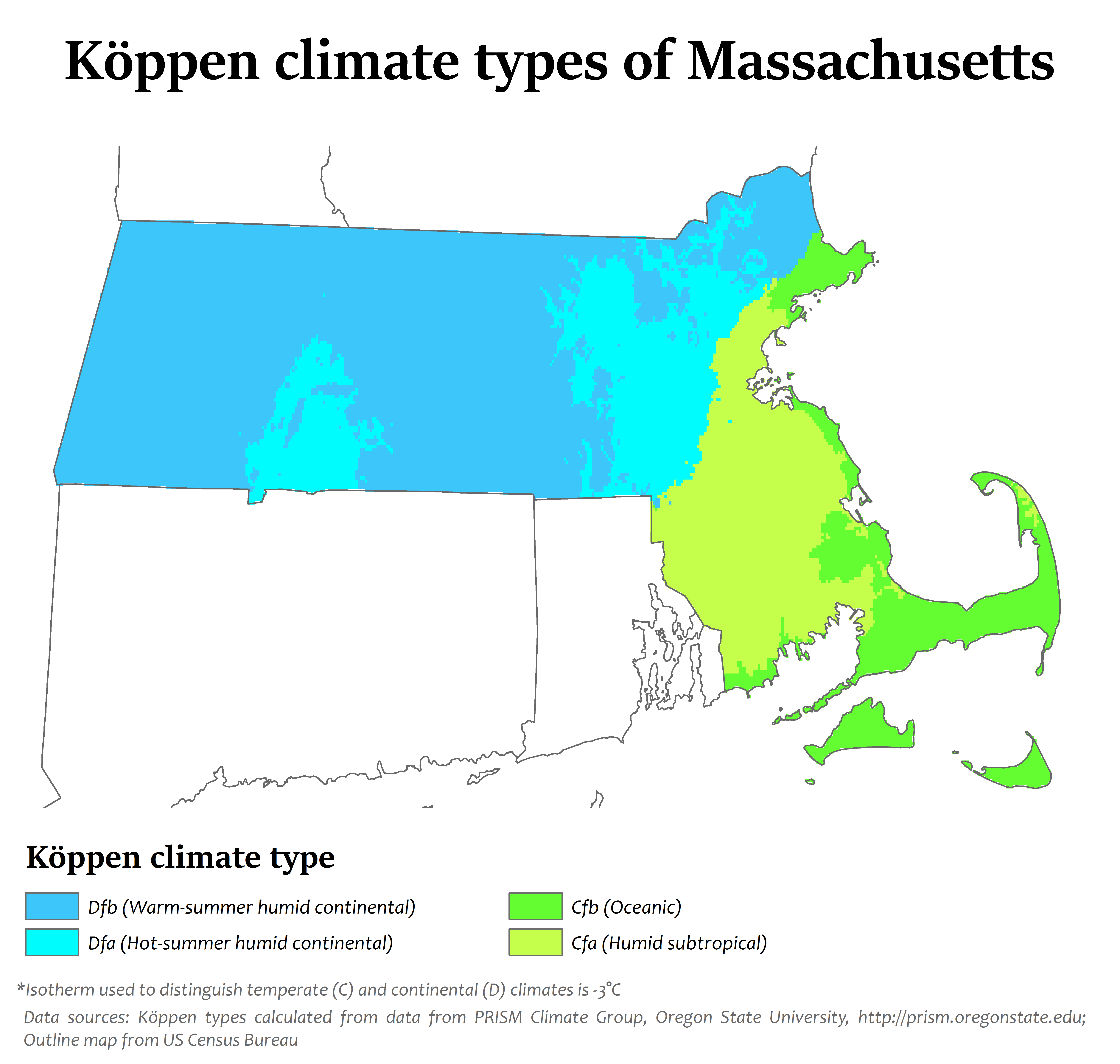
The oceanic climate exists in an arc spreading across the northwestern coast of North America from the Alaskan panhandle to northern Washington. In addition, some east coast areas such as Block Island, Cape Cod, Martha's Vineyard, and Nantucket have a similar climate.[5] An extensive area of oceanic climates distinguishes the coastal regions of southern Chile and extends into bordering Argentina.
Africa[edit]
The only noteworthy area of maritime climate at or near sea-level within Africa is in South Africa from Mossel Bay on the Western Cape coast to Plettenberg Bay (the Garden Route), with additional pockets of this climate inland of the Eastern Cape and KwaZulu-Natal coast. It is usually warm most of the year with no pronounced rainy season, but slightly more rain in autumn and spring. The Tristan da Cunha archipelago in the South Atlantic also has an oceanic climate.
Asia and Oceania[edit]
| Christchurch, New Zealand | ||||||||||||||||||||||||||||||||||||||||||||||||||||||||||||
|---|---|---|---|---|---|---|---|---|---|---|---|---|---|---|---|---|---|---|---|---|---|---|---|---|---|---|---|---|---|---|---|---|---|---|---|---|---|---|---|---|---|---|---|---|---|---|---|---|---|---|---|---|---|---|---|---|---|---|---|---|
| Climate chart (explanation) | ||||||||||||||||||||||||||||||||||||||||||||||||||||||||||||
| ||||||||||||||||||||||||||||||||||||||||||||||||||||||||||||
| ||||||||||||||||||||||||||||||||||||||||||||||||||||||||||||
The oceanic climate is prevalent in the more southerly parts of Oceania. A mild maritime climate is in existence in New Zealand. In Australia, the climate is found in Tasmania, southern half of Victoria and southeastern New South Wales (southwards from Wollongong).
Some parts of the northeastern coast of Honshu, such as Mutsu, Aomori in Japan, feature this climate, although it is rare in Asia due to the lack of a west coast in the middle latitudes.[7]
Indian Ocean[edit]
Île Amsterdam and Île Saint-Paul, both part of the French Southern and Antarctic Lands, are located in the subtropics and have an oceanic climate (akin to Tristan da Cunha; see above).
Varieties[edit]
Marine west coast (Cfb)[edit]
| Plymouth, United Kingdom | ||||||||||||||||||||||||||||||||||||||||||||||||||||||||||||
|---|---|---|---|---|---|---|---|---|---|---|---|---|---|---|---|---|---|---|---|---|---|---|---|---|---|---|---|---|---|---|---|---|---|---|---|---|---|---|---|---|---|---|---|---|---|---|---|---|---|---|---|---|---|---|---|---|---|---|---|---|
| Climate chart (explanation) | ||||||||||||||||||||||||||||||||||||||||||||||||||||||||||||
| ||||||||||||||||||||||||||||||||||||||||||||||||||||||||||||
| ||||||||||||||||||||||||||||||||||||||||||||||||||||||||||||
Temperate oceanic climates, also known as "marine mild winter" climates[8] or simply oceanic climates, are found either at middle latitudes. They are often found on or near the west coast of continents; hence another name for Cfb, "marine west coast climates". In addition to moderate temperatures year-round, one of the characteristics is the absence of a dry season. Except for Europe, this type of climate is confined to narrow bands of territory, largely in mid or high latitudes, although it can appear in elevated areas of continental terrain in low latitudes, e.g. plateaus in the subtropics.[9] It exists in both hemispheres between 35° and 60°: at low altitudes between Mediterranean, humid continental, and subarctic climates.[10]
Western sea breezes ease temperatures and moderates the winter, especially if warm sea currents are present, and cause cloudy weather to predominate. Precipitation is constant, especially in colder months, when temperatures are warmer than elsewhere at comparable latitudes. This climate can occur farther inland if no mountain ranges are present or nearby.[11] As this climate causes sufficient moisture year-round without permitting deep snow cover, vegetation typically prospers in this climate. Deciduous trees are predominant in this climate region. However, conifers such as spruce, pine, and cedar are also common in few areas, and fruits such as apples, pears, and grapes can often be cultivated here.
In the hottest month, the average temperature is below 22 °C (72 °F), and at least four months feature average temperatures higher than 10 °C (50 °F). The average temperature of the coldest month must not be colder than −3–0 °C (27–32 °F), or the climate will be classified as continental.[9][12] The average temperature variations in the year are between 10–15 °C (50–59 °F), with average annual temperatures between 6–13 °C (43–55 °F). Rain values can vary from 50–500 cm (20–197 in), depending on whether mountains cause orographic precipitation. Frontal cyclones can be common in marine west coast regions, with some areas experiencing more than 150 rainy days annually, but strong storms are rare.[10]

Cfb climates are predominant in most of Europe except the northeast, as global temperatures became warmer towards late 20th and early 21st century. They are the main climate type in New Zealand and the Australian states of Tasmania, Victoria, and southeastern New South Wales (starting from the Illawarra region). In North America, they are found mainly in Vancouver Island and neighbouring parts of British Columbia, as well as many coastal areas of southeast Alaska. There are pockets of Cfb in most South American countries, mostly in regions of southern Chile and Argentina, parts of the provinces of Chubut, Santa Cruz, and southeast Buenos Aires province in Argentina, the highest elevations of the Brazilian Highlands, and due to variations in rainfall and temperature patterns in some places of the Tropical Andes in Bolivia, Perú, Ecuador, Colombia and Venezuela. In Western Asia, the climate can be found on the Black Sea coast of northern Turkey and Georgia, often transitional to humid subtropical. While Cfb zones are rare in Africa, one dominates the coastline of the Eastern Cape in South Africa.

The climate subtype can also be found in Nantucket, Massachusetts (in the immediate west and northwest in transition for humid continental, the remainder of Cape Cod[13])[14] and northeastern Georgia both in the eastern United States.[15] It is also found in the highest portions of the Brazilian state of Bahia and Roraima (in transition or strongly influenced for Cwb), Cuyuni-Mazuruni in Guiana, Brønnøy, Nordland at 65.28 °N (Norway north-central coast), South Sudan (border with Uganda), Central Province of the Sri Lanka, the provinces of Bình Định and Quảng Ngãi in Vietnam, Sabah (northeastern Malaysia) and Baluchistan, Pakistan. Although there are more or less rare places associated with relatively isolated mountainous regions (e.g., North Oceania islands and China).[16]
Subtropical highland variety (Cfb, Cwb)[edit]
| Mexico City | ||||||||||||||||||||||||||||||||||||||||||||||||||||||||||||
|---|---|---|---|---|---|---|---|---|---|---|---|---|---|---|---|---|---|---|---|---|---|---|---|---|---|---|---|---|---|---|---|---|---|---|---|---|---|---|---|---|---|---|---|---|---|---|---|---|---|---|---|---|---|---|---|---|---|---|---|---|
| Climate chart (explanation) | ||||||||||||||||||||||||||||||||||||||||||||||||||||||||||||
| ||||||||||||||||||||||||||||||||||||||||||||||||||||||||||||
| ||||||||||||||||||||||||||||||||||||||||||||||||||||||||||||

The subtropical highland climate is a climate variety often grouped together with oceanic climates which exists in some mountainous or elevated portions of the world in either the subtropics or tropics. Despite the latitude, the higher elevations of these regions mean that the climate shares characteristics with oceanic climates.[17][18]
Subtropical highland climates with uniform rainfall (Cfb)[19] usually have rainfall spread relatively evenly throughout the year, similar to other oceanic climates but unlike these climates, they have a high diurnal temperature variation and low humidity, owing to their inland location and relatively high elevation. Subtropical highland climates with monsoon influence (Cwb), have distinctive wet summers and dry winters.[20]
In locations outside the tropics, other than the drying trend in the winter, subtropical highland climates tend to be essentially identical to an oceanic climate, with mild summers and noticeably cooler winters, plus, in some instances, some snowfall. In the tropics, a subtropical highland climate typically features mild weather year-round. Temperatures there remain relatively constant throughout the year and snowfall is seldom seen due to warmer winters than most oceanic climates.
Areas with this climate feature monthly averages below 22 °C (72 °F) but above −3 °C (27 °F) (or 0 °C (32 °F) using American standards). At least one month's average temperature is below 18 °C (64 °F). Without their elevation, many of these regions would likely feature either humid subtropical or tropical climates.
This type of climate exists in parts of east, south and southeastern Africa, interior southern Africa and elevated portions of eastern Africa as far north as Ethiopia and of western Africa (west region of Cameroon) up to the southwestern Angola highlands also share this climate type. It also exists in the exposed areas of the High Atlas, some mountainous areas across southern Europe, mountainous sections of North America, including parts of the southern Appalachians and the Central America Volcanic Arc. In South America, it can be found mainly in temperate mountainous areas in the Tropical Andes, Venezuelan Coastal Range, the highest elevations of Serra do Mar in Southeastern Brazil, and tepuis of the Guiana Shield. Most of Yunnan and mountainous areas across Southeast Asia, parts of the Himalayas, parts of Sri Lanka, and parts of the Hawaiian Islands of Maui and Hawaii. In the Caribbean, only the peaks in the highest mountain ranges have this climate (including the Blue Mountains in Jamaica and Cerro Maravilla in Puerto Rico), with only Hispaniola's Cordillera Central and Chaîne de la Selle having significant urban settlements under this climate zone, such as cities like Kenscoff in Haiti and Constanza in the Dominican Republic.
Subpolar oceanic and cold subtropical highland varieties (Cfc, Cwc)[edit]
| Punta Arenas, Chile | ||||||||||||||||||||||||||||||||||||||||||||||||||||||||||||
|---|---|---|---|---|---|---|---|---|---|---|---|---|---|---|---|---|---|---|---|---|---|---|---|---|---|---|---|---|---|---|---|---|---|---|---|---|---|---|---|---|---|---|---|---|---|---|---|---|---|---|---|---|---|---|---|---|---|---|---|---|
| Climate chart (explanation) | ||||||||||||||||||||||||||||||||||||||||||||||||||||||||||||
| ||||||||||||||||||||||||||||||||||||||||||||||||||||||||||||
| ||||||||||||||||||||||||||||||||||||||||||||||||||||||||||||
Areas with subpolar oceanic climates feature an oceanic climate but are usually located closer to polar regions, with long but relatively mild winters and short, cool summers. As a result of their location, these regions tend to be on the cool end of oceanic climates, approaching to polar regions. Snowfall tends to be more common here than in other oceanic climates. Subpolar oceanic climates are less prone to temperature extremes than subarctic climates or continental climates, featuring milder winters than these climates. Subpolar oceanic climates feature only one to three months of average monthly temperatures that are at least 10 °C (50 °F). As with oceanic climates, none of its average monthly temperatures fall below -3.0 °C (26.6 °F) or 0 °C depending on the isotherm used. Typically, these areas in the warmest month experience daytime maximum temperatures below 17 °C (63 °F), while the coldest month features highs slightly above freezing and lows near or just below freezing while keeping the average warm enough. It typically carries a Cfc designation, though very small areas in Argentina and Chile have summers sufficiently short to be Cwc with fewer than four months over 10 °C (50 °F).[22]
This variant of an oceanic climate is found in parts of coastal Iceland, the Faroe Islands, upland/mountainous parts of Scotland and Northern England, northwestern coastal areas of Norway (most of Lofoten, Vesterålen, warmest part of Tromsø reaching to 71°N on some islands),[23] uplands/highlands in western Norway, the Aleutian Islands of Alaska and northern parts of the Alaskan Panhandle, the southwest of Argentina and Chile, and a few highland areas of Tasmania, and the Australian and Southern Alps.[24] This type of climate is even found in very remote parts of the New Guinea Highlands. The classification used for this regime is Cfc.[1] In the most marine of those areas affected by this regime, temperatures above 20 °C (68 °F) are extreme weather events, even in the midst of summer. Temperatures above 30 °C (86 °F) have been recorded on rare occasions in some areas of this climate, and in winter temperatures down to −20 °C (−4 °F) have seldom been recorded in some areas.
Small areas in Yunnan, Sichuan; parts of Bolivia and Peru; and parts of Mount Kilimanjaro in Tanzania have summers sufficiently short to be Cwc with fewer than four months over 10 °C (50 °F).[22] This is the cold variant of the monsoon-influenced subtropical highland climate. El Alto, Bolivia, is one of the few confirmed towns that features this variation of the subtropical highland climate.
Examples[edit]
^1 According to the Trewartha climate classification the climate is considered humid subtropical (Cf) since at least eight months are greater than 10 °C (50 ″C).
Africa[edit]
- Addis Ababa, Ethiopia1 (Cwb)
- Eldoret, Kenya1 (Cfb)
- George, Western Cape, South Africa1 (Cfb)
- Harare, Zimbabwe1 (Cwb)
- Kabale, Uganda1 (Cfb) [1]
- Johannesburg, Gauteng, South Africa1 (Cwb)
- Maseru, Lesotho1 (Cfb, bordering on Cwb)
- Mthatha, Eastern Cape, South Africa1 (Cfb, bordering on Cfa)
- Nairobi, Kenya1 (Cwb)
- Port Elizabeth, Eastern Cape, South Africa1 (Cfb)
- Tristan da Cunha, United Kingdom1 (Cfb)
Asia[edit]
- Artvin, Turkey (Cfb, bordering on Csb)
- Bolu, Turkey (Cfb)
- Brinchang, Pahang, Malaysia1 (Cfb)
- Goris, Syunik, Armenia (Cfb, bordering on Dfb)
- Hakha, Myanmar1 (Cwb)
- Hengshan, China (Cfb, bordering on Cfa and Dfb)
- Kodaikanal, Tamil Nadu, India1 (Cfb)
- Kunming, China1 (Cwb)
- La Trinidad, Philippines1 (Cwb)
- Nuwara Eliya, Sri Lanka1 (Cfb)
- Phongsali, Laos1 (Cwb)
- Puncak, West Java, Indonesia1 (Cfb) [2]
- Sa Pa, Vietnam1 (Cfb)
- Shimla, Himachal Pradesh, India1 (Cwb)
- Thimphu, Bhutan1 (Cwb, bordering on Cwa)
Europe[edit]
- Amsterdam, North Holland, Netherlands (Cfb)
- Andorra la Vella, Andorra (Cfb)
- Belfast, Northern Ireland, United Kingdom (Cfb)
- Bergen, Vestland, Norway (Cfb)
- Berlin, Germany (Cfb)
- Bern, Switzerland (Cfb, bordering on Dfb)
- Bilbao, Basque Country, Spain1 (Cfb)
- Bordeaux, France1 (Cfb, bordering on Cfa)
- Brussels, Belgium (Cfb)
- Caransebeş, Romania (Cfb, bordering on Dfb)
- Cardiff, Wales, United Kingdom (Cfb)
- Cetinje, Montenegro (Cfb, bordering on Dfb)
- Copenhagen, Denmark (Cfb)
- Corvo Island, Azores, Portugal1 (Cfb, bordering on Cfa)
- Cuneo, Italy (Cfb, bordering on Cfa)
- Dijon, France (Cfb)
- Dublin, Ireland (Cfb)
- Frankfurt, Germany (Cfb)
- Gdynia, Pomeranian Voivodeship, Poland (Cfb, bordering on Dfb)
- Glasgow, Scotland, United Kingdom (Cfb)
- Gothenburg, Västra Götaland County, Sweden (Cfb)
- Győr, Hungary (Cfb, bordering on Cfa/Dfa/Dfb)
- Hamburg, Germany (Cfb)
- Ljubljana, Slovenia (Cfb, bordering on Cfa)
- Lofoten, Nordland, Norway (Cfb, bordering on Cfc/Dfb/Dfc)
- London, England, United Kingdom (Cfb)
- Luxembourg City, Luxembourg (Cfb)
- Malmö, Skåne County, Sweden (Cfb)
- Munich, Bavaria, Germany (Cfb, bordering on Dfb)
- Ørland, Trøndelag, Norway (Cfb)
- Paris, France (Cfb)
- Penzance, England, United Kingdom1 (Cfb) [3]
- Prague, Czech Republic (Cfb, bordering on Dfb)
- Santander, Cantabria, Spain1 (Cfb)
- Santiago de Compostela, Galicia, Spain1 (Cfb)
- Sarajevo, Bosnia and Herzegovina (Cfb, bordering on Dfb)
- Skagen, Denmark (Cfb)
- St Helier, Jersey, United Kingdom1 (Cfb) [4]
- Stavanger, Rogaland, Norway (Cfb)
- Szczecin, West Pomeranian Voivodeship, Poland (Cfb)
- Trevico, Italy (Cfb)[25]
- Ushant, France1 (Cfb)
- Vaduz, Liechtenstein (Cfb)
- Vienna, Austria (Cfb, bordering on Cfa/Dfa/Dfb)
- Wrocław, Lower Silesian Voivodeship, Poland (Cfb, bordering on Dfb)
- Zagreb, Croatia (Cfb, bordering on Dfb)
- Zürich, Switzerland (Cfb, bordering on Dfb)
North America[edit]
- Block Island, Rhode Island, United States (Cfb, bordering on Dfb)
- Blue Mountains, Jamaica1 (Cfb)
- Cobán, Guatemala1 (Cfb)
- Constanza, Dominican Republic1 (Cfb)
- Forks, Washington, United States (Cfb)
- Hope, British Columbia, Canada (Cfb)
- Kenscoff, Haiti1 (Cwb, bordering on Aw)
- Ketchikan, Alaska, United States (Cfb)
- La Esperanza, Honduras1 (Cfb, bordering on Cwb)
- Mexico City. Mexico1 (Cwb)
- Nantucket, Massachusetts, United States (Cfb, bordering on Dfb)
- Prince Rupert, British Columbia, Canada (Cfb)
- Provincetown, Massachusetts, United States (Cfb, bordering on Dfb) [5]
- Sitka, Alaska, United States (Cfb)
- Vancouver, British Columbia, Canada (Cfb, bordering on Csb)
- Waynesville, North Carolina, United States (Cfb)
- Xalapa, Veracruz, Mexico1 (Cfb, bordering on Cfa)
Oceania[edit]
- Ashburton, New Zealand (Cfb)
- Auckland, New Zealand1 (Cfb)
- Canberra, Australian Capital Territory, Australia1 (Cfb)
- Christchurch, New Zealand (Cfb)
- Hobart, Tasmania, Australia1 (Cfb)
- Lithgow, New South Wales, Australia (Cfb)
- Melbourne, Victoria, Australia1 (Cfb)
- Volcano, Hawaii, United States1 (Cfb)
- Wabag, Papua New Guinea1 (Cfb)
- Wellington, New Zealand1 (Cfb)
- Wollongong, New South Wales, Australia1 (Cfb, bordering on Cfa)
South America[edit]
- Bogotá, Colombia1 (Cfb)
- Caxias do Sul, Rio Grande do Sul, Brazil1 (Cfb)
- Chachapoyas, Peru1 (Cfb)
- Cuenca, Ecuador1 (Cfb)
- Curitiba, Paraná, Brazil1 (Cfb)
- La Paz, Bolivia (Cwb, bordering on Cwc)
- Manizales, Colombia1 (Cfb)
- Mar del Plata, Argentina1 (Cfb)
- Mérida, Venezuela1 (Cfb, bordering on Am)
- Mucuchíes, Venezuela1 (Cfb)
- Osorno, Los Lagos Region, Chile (Cfb)
- Puerto Montt, Los Lagos Region, Chile (Cfb)
- Punta del Este, Uruguay1 (Cfb, bordering on Cfa)
- Quito, Ecuador1 (Cfb)
- Sucre, Bolivia1 (Cwb)
- Teresópolis, Rio de Janeiro state, Brazil1 (Cfb)
- Valdivia, Los Ríos Region, Chile1 (Cfb)
Southern Indian Ocean[edit]
- Île Amsterdam, French Southern and Antarctic Lands1 (Cfb)
- Île Saint-Paul, French Southern and Antarctic Lands1 (Cfb)
See also[edit]
- Temperate climate
- Humid temperate climate
- Subhumid temperate climate
- Mediterranean climate
- Köppen climate classification
References[edit]
- ^ a b Tom L. McKnight & Darrel Hess (2000). Climate Zones and Types: The Köppen System. Physical Geography: A Landscape Appreciation. Prentice Hall. pp. 226–235. ISBN 978-0-13-020263-5.
- ^ Briney, Amanda (22 January 2020). "The Gulf Stream". ThoughtCo. Retrieved 1 June 2015.
- ^ "Klimaattabel Schiphol, langjarige gemiddelden, tijdvak 1991–2020" (in Dutch). Royal Netherlands Meteorological Institute. Retrieved 30 March 2022.
- ^ "Klimatoloji-2" (PDF).
- ^ M. C. Peel; B. L. Finlayson & T. A. McMahon (11 October 2007). "Updated world map of the Köppen-Geiger climate classification" (PDF). Hydrology and Earth System Sciences. 11 (5): 1638–1643. Bibcode:2007HESS...11.1633P. doi:10.5194/hess-11-1633-2007. Retrieved 30 January 2011.
- ^ "CliFlo – National Climate Database". NIWA. Archived from the original on 27 November 2015. Retrieved 23 June 2015.
- ^ "Winter in Japan - a Complete Guide to Wintertime in Japan | Compathy Magazine". Compathy Magazine (コンパシーマガジン). 18 September 2016. Retrieved 8 August 2020.
- ^ Michael Pidwirny, 2017, Appendix 3: Köppen Climate Classification: Single appendix from the eBook Understanding Physical Geography. Kelowna BC, Canada; Our Planet Earth Publishing, pp. 8, 24.
- ^ a b "Temperate oceanic climate". www.mindat.org. Retrieved 11 October 2018.
- ^ a b "marine west coast climate | Characteristics & Facts". Encyclopedia Britannica. Retrieved 11 October 2018.
- ^ "Marine West Coast Climate". www.earthonlinemedia.com. Retrieved 11 October 2018.
- ^ "Hot Continental Division". www.fs.fed.us. Retrieved 11 October 2018.
- ^ "Mean Temperature US in January - 30 yrs (normals)".
- ^ "Massachusetts Koppen Climate".
- ^ "Georgia US Koppen Climate".
- ^ "World Maps of Köppen-Geiger climate classification". koeppen-geiger.vu-wien.ac.at. Retrieved 16 October 2018.
- ^ Pacheco-Torgal, Fernando; Goran-Granqvist, Claes (30 January 2023). Adapting the Built Environment for Climate Change. Elsevier. p. 187. ISBN 9780323953375. Retrieved 11 June 2023.
- ^ Herminingrum, Sri; Hum, M (November 2021). Fisheries and Marine Science. Media Nusa Creative (MNC Publishing). p. 17. ISBN 9786024620998. Retrieved 11 June 2023.
- ^ Khan, Ansar; Niyogi, Dev; Fiorito, Francesco; Akbari, Hashem; Mithun, Sk (15 June 2022). Global Urban Heat Island Mitigation. Elsevier Science. p. 253. ISBN 9780323897945. Retrieved 21 June 2023.
- ^ "Mindat.org". www.mindat.org. Retrieved 11 June 2023.
- ^ "Estadistica Climatologica Tomo III (pg 512–537)" (PDF) (in Spanish). Dirección General de Aeronáutica Civil. March 2001. Archived from the original (PDF) on 17 April 2012. Retrieved 15 January 2013.
- ^ a b Peel, M. C.; Finlayson, B. L.; McMahon, T. A. (11 October 2007). "Updated world map of the Köppen-Geiger climate classification" (PDF). Hydrology and Earth System Sciences. 11 (5): 1633–1644. Bibcode:2007HESS...11.1633P. doi:10.5194/hess-11-1633-2007. S2CID 9654551. Retrieved 5 December 2022.
- ^ "Weather statistics for Hasvik (Finnmark)".
- ^ Tapper, Andrew; Tapper, Nigel (1996). Gray, Kathleen (ed.). The weather and climate of Australia and New Zealand (First ed.). Melbourne, Australia: Oxford University Press. p. 300. ISBN 978-0-19-553393-4.
- ^ "World Meteorological Organization Climate Normals for 1991-2020 — Trevico". National Oceanic and Atmospheric Administration. Retrieved 3 February 2024.

External links[edit]
- "Marine (Humid) West Coast Climate", June 21, 2007, The Physical Environment: an Introduction to Physical Geography, Michael Ritter, University of Wisconsin–Stevens Point
- "EPIC Web Browser", NOAA, on-line ocean observational data collection
- "NOAA "Dapper In-situ Ocean Data Viewer", plot and download ocean observations
- "Maritime Climate", Encyclopedia of the Atmospheric Environment, Atmosphere, Climate & Environment Information Programme