


Plus–minus sign
| ± | |
|---|---|
Plus–minus sign | |
| In Unicode | U+00B1 ± PLUS-MINUS SIGN (±, ±, ±) |
| Related | |
| See also | U+2213 ∓ MINUS-OR-PLUS SIGN (∓, ∓, ∓) |
The plus–minus sign, ±, is a symbol with multiple meanings:
- In mathematics, it generally indicates a choice of exactly two possible values, one of which is obtained through addition and the other through subtraction.
- In statistics and experimental sciences, the sign commonly indicates the confidence interval or uncertainty bounding a range of possible errors in a measurement, often the standard deviation or standard error. The sign may also represent an inclusive range of values that a reading might have.
- In chess, the sign indicates a clear advantage for the white player; the complementary minus-plus sign, ∓, indicates the same advantage for the black player.
Other meanings occur in other fields, including medicine, engineering, chemistry, electronics, linguistics, and philosophy.
History[edit]
A version of the sign, including also the French word ou ("or"), was used in its mathematical meaning by Albert Girard in 1626, and the sign in its modern form was used as early as 1631, in William Oughtred's Clavis Mathematicae.[1]
Usage[edit]
In mathematics[edit]
In mathematical formulas, the ± symbol may be used to indicate a symbol that may be replaced by either the plus and minus signs, + or −, allowing the formula to represent two values or two equations.[2]
If x2 = 9, one may give the solution as x = ±3. This indicates that the equation has two solutions: x = +3 and x = −3. A common use of this notation is found in the quadratic formula
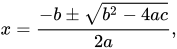
which describes the two solutions to the quadratic equation ax2+bx+c = 0.
Similarly, the trigonometric identity

can be interpreted as a shorthand for two equations: one with + on both sides of the equation, and one with − on both sides.
The minus–plus sign, ∓, is generally used in conjunction with the ± sign, in such expressions as x ± y ∓ z, which can be interpreted as meaning x + y − z or x − y + z (but not x + y + z or x − y − z). The ∓ always has the opposite sign to ±.
The above expression can be rewritten as x ± (y − z) to avoid use of ∓, but cases such as the trigonometric identity are most neatly written using the "∓" sign:

which represents the two equations:

Another example is the conjugate of the perfect squares

which represents the two equations:


A related usage is found in this presentation of the formula for the Taylor series of the sine function:

Here, the plus-or-minus sign indicates that the term may be added or subtracted depending on whether n is odd or even; a rule which can be deduced from the first few terms. A more rigorous presentation would multiply each term by a factor of (−1)n, which gives +1 when n is even, and −1 when n is odd. In older texts one occasionally finds (−)n, which means the same.
When the standard presumption that the plus-or-minus signs all take on the same value of +1 or all −1 is not true, then the line of text that immediately follows the equation must contain a brief description of the actual connection, if any, most often of the form "where the ‘±’ signs are independent" or similar. If a brief, simple description is not possible, the equation must be re-written to provide clarity; e.g. by introducing variables such as s1, s2, ... and specifying a value of +1 or −1 separately for each, or some appropriate relation, like or similar.

In statistics[edit]
The use of ± for an approximation is most commonly encountered in presenting the numerical value of a quantity, together with its tolerance or its statistical margin of error.[3] For example, 5.7 ± 0.2 may be anywhere in the range from 5.5 to 5.9 inclusive. In scientific usage, it sometimes refers to a probability of being within the stated interval, usually corresponding to either 1 or 2 standard deviations (a probability of 68.3% or 95.4% in a normal distribution).
Operations involving uncertain values should always try to preserve the uncertainty, in order to avoid propagation of error. If any operation of the form must return a value of the form , where c is and d is range updated using interval arithmetic.


In chess[edit]
The symbols ± and ∓ are used in chess notation to denote a moderate but significant advantage for white and black, respectively.[4] Weaker and stronger advantages are denoted by ⩲ and ⩱ for only a slight advantage, and +– and –+ for a strong, potentially winning advantage, again for white and black respectively.[5] It is important to distinguish these annotations (always optional and often not clearly, objectively defined) with the mandatory notation of the moves themselves, which leaves no room for interpretation or speculation, and which includes a trailing plus sign + (or formerly a dagger †) to denote a move giving check to the opponent's king, while checkmate is today most commonly denoted by #, but sometimes still with the somewhat outdated ++ or †, although some authors use ++ to denote a double check.
Other meanings[edit]
- In medicine, it may mean "with or without" in some cases.[6][7]
- In engineering, the sign indicates the tolerance, which is the range of values that are considered to be acceptable or safe, or which comply with some standard or with a contract.
- In chemistry, the sign is used to indicate a racemic mixture.
- In electronics, this sign may indicate a dual voltage power supply, such as ±5 volts means +5 volts and −5 volts, when used with audio circuits and operational amplifiers.
- In linguistics, it may indicate a distinctive feature, such as [±voiced].[8]
Encodings[edit]
- In Unicode: U+00B1 ± PLUS-MINUS SIGN
- In ISO 8859-1, -7, -8, -9, -13, -15, and -16, the plus–minus symbol is code 0xB1hex. This location was copied to Unicode.
- The symbol also has a HTML entity representations of
±,±, and±. - The rarer minus–plus sign is not generally found in legacy encodings, but is available in Unicode as U+2213 ∓ MINUS-OR-PLUS SIGN so can be used in HTML using
∓or∓. - In TeX 'plus-or-minus' and 'minus-or-plus' symbols are denoted
\pmand\mp, respectively. - Although these characters may be approximated by underlining or overlining a + symbol ( + or + ), this is discouraged because the formatting may be stripped at a later date, changing the meaning. It also makes the meaning less accessible to blind users with screen readers.
Typing[edit]
- Windows: Alt+241 or Alt+0177 (numbers typed on the numeric keypad).
- Macintosh: ⌥ Option+⇧ Shift+= (equal sign on the non-numeric keypad).
- Unix-like systems: Compose,+,- or ⇧ Shift+Ctrl+u B1space (second works on Chromebook)
- In the Vim text editor (in Insert mode): Ctrl+k +- or Ctrl+v 177 or Ctrl+v x B1 or Ctrl+v u 00B1
- AutoCAD shortcut string:
%%p
Similar characters[edit]

The plus–minus sign resembles the Chinese characters 土 (Radical 32) and 士 (Radical 33), whereas the minus–plus sign resembles 干 (Radical 51).
See also[edit]
- ≈ (approximately equal to)
- Engineering tolerance
- Plus and minus signs
- Sign (mathematics)
- Table of mathematical symbols
References[edit]
- ^ Cajori, Florian (1928), A History of Mathematical Notations, Volume I: Notations in Elementary Mathematics, Open Court, p. 245.
- ^ "Definition of PLUS/MINUS SIGN". www.merriam-webster.com. Retrieved 2020-08-28.
- ^ Brown, George W. (1982). "Standard deviation, standard error: Which 'standard' should we use?". American Journal of Diseases of Children. 136 (10): 937–941. doi:10.1001/archpedi.1982.03970460067015. PMID 7124681.
- ^ Eade, James (2005), Chess For Dummies (2nd ed.), John Wiley & Sons, p. 272, ISBN 9780471774334.
- ^ For details, see Chess annotation symbols#Positions.
- ^ Naess, I. A.; Christiansen, S. C.; Romundstad, P.; Cannegieter, S. C.; Rosendaal, F. R.; Hammerstrøm, J. (2007). "Incidence and mortality of venous thrombosis: a population-based study". Journal of Thrombosis and Haemostasis. 5 (4): 692–699. doi:10.1111/j.1538-7836.2007.02450.x. ISSN 1538-7933. PMID 17367492. S2CID 23648224.
- ^ Heit, J. A.; Silverstein, M. D.; Mohr, D. N.; Petterson, T. M.; O'Fallon, W. M.; Melton, L. J. (1999-03-08). "Predictors of survival after deep vein thrombosis and pulmonary embolism: a population-based, cohort study". Archives of Internal Medicine. 159 (5): 445–453. doi:10.1001/archinte.159.5.445. ISSN 0003-9926. PMID 10074952.
- ^ Hornsby, David. Linguistics, A Complete Introduction. p. 99. ISBN 9781444180336.