


Popocatépetl
| Popocatépetl | |
|---|---|
 Popocatépetl, viewed from the north from Paso de Cortés. | |
| Highest point | |
| Elevation | 5,393 m (17,694 ft)[a] |
| Prominence | 3,020 m (9,910 ft)[2][3] |
| Isolation | 143 km (89 mi)  |
| Listing | |
| Coordinates | 19°01′20″N 98°37′40″W / 19.02222°N 98.62778°W |
| Naming | |
| Etymology | popōcatepētl, Smoking Mountain |
| Nickname | Don Goyo |
| Geography | |
  Popocatépetl Location in Mexico  Popocatépetl Popocatépetl (State of Mexico)  Popocatépetl Popocatépetl (Mexico) | |
| Location | Mexico-Puebla-Morelos, Mexico |
| Geology | |
| Mountain type | Stratovolcano |
| Last eruption | 2024[4] |
| Climbing | |
| Easiest route | rock/snow climb |
 | |
Popocatépetl (UK: /ˌpɒpəˈkætəpɛtəl, ˌpɒpəkætəˈpɛtəl/ POP-ə-KAT-ə-pet-əl, -kat-ə-PET-əl, US: /ˌpoʊp-/ POHP-, Spanish: [popokaˈtepetl] ⓘ; Nahuatl languages: Popōcatepētl [popoːkaˈtepeːt͡ɬ] ⓘ) is an active stratovolcano located in the states of Puebla, Morelos, and Mexico in central Mexico. It lies in the eastern half of the Trans-Mexican volcanic belt. At 5,393 m (17,694 ft)[1] it is the second highest peak in Mexico, after Citlaltépetl (Pico de Orizaba) at 5,636 m (18,491 ft).
It is linked to the twin volcano of Iztaccihuatl to the north by the high saddle known as the "Paso de Cortés".[5] Izta-Popo Zoquiapan National Park, wherein the two volcanoes are located, is named after them.[6][7]
Popocatépetl is 70 km (43 mi) southeast of Mexico City, from where it can be seen regularly, depending on atmospheric conditions. Until recently, the volcano was one of three tall peaks in Mexico to contain glaciers,[8] the others being Iztaccihuatl and Pico de Orizaba. In the 1990s, the glaciers such as Glaciar Norte (North Glacier) greatly decreased in size, partly due to warmer temperatures but largely due to increased volcanic activity.[9] By early 2001, Popocatépetl's glaciers were gone; ice remained on the volcano, but no longer displayed the characteristic features of glaciers such as crevasses.[10][11][12]
Lava erupting from Popocatépetl has historically been predominantly andesitic, but it has also erupted large volumes of dacite.[13] Magma produced in the current cycle of activity tends to be a mixture of the two with the andesites being rich in magnesium.[14]
Name[edit]

The name Popocatépetl comes from the Nahuatl words popōca (Nahuatl pronunciation: [poˈpoːka]) "it smokes" and tepētl [ˈtepeːt͡ɬ] "mountain", meaning Smoking Mountain. The volcano is also referred to by Mexicans as El Popo affectionately, or to shorten the full name. The alternate nickname Don Goyo comes from the mountain's association in the lore of the region with San Gregorio, "Goyo" being a nickname-like short form of Gregorio. The name was extended by those who lived in Santiago Xalitzina, a small community 12 km (7.5 mi) from the volcano. Legend says that many years ago, a villager met an old man on the slopes of the mountain, who introduced himself as Gregorio Chino Popocatépetl. Gregorio was a personification of the spirit of the volcano, and communicates with the locals to warn them if an eruption is about to happen. Thus, every March 12, the day of San Gregorio, the locals bring flowers and food to the volcano to celebrate the saint.[15][16]
Geology[edit]
The stratovolcano contains a steep-walled, 400 m × 600 m (1,300 ft × 2,000 ft) wide crater. The generally symmetrical volcano is modified by the sharp-peaked Ventorrillo on the NW, a remnant of an earlier volcano. At least three previous major cones were destroyed by gravitational failure during the Pleistocene, producing massive debris avalanche deposits covering broad areas south of the volcano. The modern volcano was constructed to the south of the late-Pleistocene to Holocene El Fraile cone.[1] Three major Plinian eruptions, the most recent of which took place about 800 AD, have occurred from Popocatépetl since the mid-Holocene, accompanied by pyroclastic flows and voluminous lahars that swept basins below the volcano.[1]
According to paleomagnetic studies, the volcano is about 730,000 years old. It is cone shaped with a diameter of 25 km (16 mi) at its base, with a peak elevation of 5,450 m (17,880 ft). The crater is elliptical with an orientation northeast-southwest. The walls of the crater vary from 600 to 840 m (1,970 to 2,760 ft) in height. Popocatépetl is currently active after being dormant for about half of last century. Its activity increased in 1991 and smoke has been seen constantly emanating from the crater since 1993. The volcano is monitored by the Deep Earth Carbon Degassing Project.[citation needed]
History[edit]
The geological history of Popocatépetl began with the formation of the ancestral volcano Nexpayantla. About 200,000 years ago, Nexpayantla collapsed in an eruption, leaving a caldera, in which the next volcano, known as El Fraile, began to form. Another eruption about 50,000 years ago caused that to collapse, and Popocatépetl rose from that. Around 23,000 years ago, a lateral eruption (believed to be larger than the 1980 eruption of Mount St. Helens) destroyed the volcano's ancient cone and created an avalanche that reached up to 70 kilometres (43 mi) from the summit. The debris field from that is one of four around the volcano, and it is also the youngest.[17]
Three Plinian eruptions are known to have taken place: 3,000 years ago (3195–2830 BC), 2,150 years ago (800–215 BC), and 1,100 years ago (likely 823 AD).[17] The latter two buried the nearby village of Tetimpa, preserving evidence of preclassical culture.[18]
The first recorded European ascent of the volcano was made by an expedition led by Diego de Ordaz in 1519.[19]: 182 The early-16th-century monasteries on the slopes of the mountain are a World Heritage Site.
Eruptions[edit]


Popocatépetl is one of the most active volcanoes in Mexico and the most famous,[20] having had more than 15 major eruptions since the arrival of the Spanish in 1519.
Timeline[edit]
- Mid-to late first century: A violent VEI-6 eruption may have caused the large migrations that settled Teotihuacan, according to DNA analysis of teeth and bones.[21]
- Eruptions were observed in 1363, 1509, 1512, 1519–1528, 1530, 1539, 1540, 1548, 1562–1570, 1571, 1592, 1642, 1663, 1664, 1665, 1697, 1720, 1802, 1919, 1923, 1925, and 1933.[1]
- January and February 1947: There were brief explosions, expelling steam and ash.[22]
- 21 December 1994: The volcano spewed gas and ash, which was carried as far as 25 km (16 mi) away by prevailing winds. The activity prompted the evacuation of nearby towns and scientists to begin monitoring for an eruption.[16]
- December 2000: Tens of thousands of people were evacuated by the government, based on the warnings of scientists. Then the volcano made its largest display in 1,200 years.[11][12][23][24]
- 25 December 2005: The volcano's crater produced an explosion which ejected a large column of smoke and ash about 3 km (9,800 ft) into the atmosphere and expulsion of lava.[citation needed]
- January and February 2012: Scientists observed increased volcanic activity at Popocatépetl. On January 25, an ash explosion occurred on the mountain, causing much dust and ash to contaminate the atmosphere around it.[16]
- 15 April 2012: There were reports of superheated rock fragments being hurled into the air by the volcano. Ash and water vapor plumes were reported 15 times over 24 hours.[25]
- 8 May 2013: at 7:28 p.m. local time, Popocatépetl erupted again with a high amplitude tremor that lasted and was recorded for 3.5 hours. It began with plumes of ash that rose 3 km (9,800 ft) into the air and began drifting west at first, but later began to drift east-southeast, covering areas of the villages of San Juan Tianguismanalco, San Pedro Benito Juárez and Puebla in smoke and ash. Explosions from the volcano subsequently ejected fragments of fiery volcanic rock to distances of 700 m (2,300 ft) from the crater.[26][27]
- July 4, 2013: Due to several eruptions of steam and ash for at least 24 hours, at least six U.S. airlines canceled more than 40 flights into and out of Mexico City International Airport and Toluca International Airport.[28]
- 27 August–September 2014: CENAPRED reported explosions, accompanied by steam-and-gas emissions with minor ash and ash plumes that rose 800–3,000 m (2,600–9,800 ft) above Popocatépetl's crater and drifted west, southwest, and west-southwest. On most nights incandescence was observed, increasing during times with larger emissions.[29]
- 29 and 31 August 2014: The Washington Volcanic Ash Advisory Center (VAAC) reported discrete ash emissions.[1]
- 7 January 2015: CENAPRED reported that ash from recent explosions coated the snow on the volcano's upper slopes.[30]
- 28 March 2016: An ash column 2,000 m (6,600 ft) high was released, prompting the establishment of a 12-kilometre (7.5 mi) "security ring" around the summit.[31]
- 3 April 2016: Popocatépetl erupted, spewing lava, ash and rock.[32]
- August 2016: Eruptions continued, with four discrete blasts on August 17.[33]
- 10 November 2017: at 7:25 local time, an eruption occurred.[1]
- 15 December 2018: at 18:57 local time, the volcano spewed lava, ash and rocks.[34]
- 22 January 2019: at 21:06 local time, the volcano spewed ash up to 3 km (9,800 ft) high and incandescent fragments 2 km (1.2 mi) away.[35]
- 19 March 2019: at 21:38 local time, fragments of the dome shot within 1.6–2.4-kilometre (1–1+1⁄2 mi) radius.[36] Due to continuing activity, on March 28 2019, based on the analysis of the available information, the Scientific Advisory Committee of the Popocatépetl volcano recommended changing the phase of the Yellow Volcanic Warning Light Phase 2 to Yellow Phase 3, which is a preventive measure against the observed changes.[37]
- June 3, 2019: Popocatépetl fired an ash column to approximately 11 km (37,000 ft) above sea level.[38]
- June 18, 2019: Popocatépetl spewed ash clouds to 8.5 km (28,000 ft).[39]
- June 24, 2019 Popocatépetl erupted once more, sending an ash cloud some kilometres (thousands of feet) into the air.[40]
- July 18, 2019: Popocatépetl erupted three times, sending ash 1.5 km (4,900 ft) into the air each time.[41]
- July 20, 2019: volcanic ash was reported in Xochimilco after a morning eruption.[42]
- October 2019: the volcano erupted multiple times in one night.[43]
- November 2019: an eruption forced a KLM flight from Amsterdam to Mexico City to turn back.[44]
- January 9, 2020: Popocatépetl expelled lava and rock and sent ash clouds to 6.1 km (20,000 ft).[45]
- January 27, 2020: Popocatépetl erupted in a nighttime display of rock and ash.[46][47]
- February 5, 2020: Popocatépetl had a moderate explosion producing an ash plume that went up 1.5 km (0.93 mi). More explosions on February 15, 18, and 22 sent ash plumes rising from 400–1,200 m (1,300–3,900 ft).[48]
- December 19, 2022: Popocatépetl emitted materials up to one kilometer (0.62 mi) high[49]
- May 19, 2023: Popocatépetl emitted some ash causing the closure of schools in 11 nearby towns[50] and two days later on May 21, the alert level in Mexico City was raised to Yellow Phase 3 as incandescent fragments were observed and the airports in Mexico City and Puebla were temporarily shut down.[51]
- February 27-28, 2024: Popocatépetl erupted 13 times within 24 hours, causing the cancellation of 22 flights at Mexico City and Puebla International Airports.[52]
In literature and art[edit]
In the poem Romance ("Chimborazo, Cotopaxi....Popocatapetl") by Walter J. Turner (1916), Cotopaxi is one of the romantic locations that has stolen the poet's heart.[53]
Popocatépetl and Iztaccíhuatl feature prominently in Malcolm Lowry’s 1947 novel Under the Volcano as well as the 1984 feature film of the same name an adaptation of the novel directed by John Huston.[citation needed]
The legend of the two volcanos feature as the central story in Duncan Tonatiuh's children's book The Princess and the Warrior: A Tale of Two Volcanoes.[citation needed]
In visual arts, Popocatépetl is the subject of Marsden Hartley’s 1932 painting Popocatepetl, Spirited Morning--Mexico, now at the Smithsonian American Art Museum in Washington, D.C.[citation needed]
Several works by Dr. Atl feature Popocatépetl, among them his 1928 Self-Portrait with Popocatépetl, now in the Philadelphia Museum of Art and his 1942 The Shadow of Popo, now in the Museo Nacional de Arte in Mexico City.[citation needed]
Popocatépetl also features prominently in the Juan Manuel Martinez Caltenco mural on the upper floor Municipal Palace of Atlixco, Puebla. The murals cover much of the palace’s interior and represent an important Poblano contribution to the Mexican muralism movement.[citation needed]
Jesús Helguera’s 1940 masterpiece La Leyenda de los Volcanes in Chicago’s National Museum of Mexican Art depicts the myth of Popocatépetl and Iztaccíhuatl.[citation needed]
The 1966 Warner Brothers cartoon Snow Excuse is set above the snow line on Popocatépetl.[citation needed]
The band Pop-a-Cat-a-Petal (later Ultrasound) were named after a mondegreen of Popocatépetl.[citation needed]
Gallery[edit]
-
 Fumaroles on Popocatépetl
 -
 Seen from the International Space Station in February 2009
 -
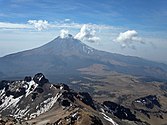 Seen from near the summit of Iztaccihuatl
 -
 Iglesia de Nuestra Señora de los Remedios atop Great Pyramid (Tlalchihualtépetl) in Cholula, Puebla, with the volcano in the background
 -
 Popocatépetl, as viewed from Amecameca (looking south-east) (2011)
 -
 Satellite image of Popocatépetl eruption taken by NOAA


See also[edit]


- List of volcanoes in Mexico
- List of Ultras of Mexico
- Legend of Popocatépetl and Iztaccíhuatl, pre-Hispanic legends on the origin of the two mountains
- 1949 Mexicana DC-3 crash which took place on this volcano
Notes[edit]
References[edit]
- ^ a b c d e f g "Popocatépetl". Global Volcanism Program. Smithsonian Institution. Retrieved 25 May 2023.
- ^ "Mexico Ultras". Peaklist.org. Retrieved 2012-01-29. The prominence value given here of 3,020 m (9,910 ft) is based on a summit elevation of 5,400 m (17,700 ft) for Popocatépetl.
- ^ "Volcán Popocatépetl, Mexico". Peakbagger.com. Retrieved 2012-01-29. The prominence value given here of 3,020 m (9,910 ft) is interpolated from a summit elevation of 5,400 m (17,700 ft) for Popocatépetl.
- ^ "Mexico's Popocatépetl volcano erupts 13 times in past day, prompting airport delays". Associated Press. 29 February 2024.
- ^ Beaman, John H. (July 1962). "The Timberlines of Iztaccihuatl and Popocatépetl, Mexico". Journal of Ecology. 43 (3): 377–385. doi:10.2307/1933367. JSTOR 1933367.
- ^ "Parque Nacional Izta-Popo Zoquiapan". SIMEC: Sistema de Información, Monitoreo, y Evaluación para la Conservación (in Spanish). Comisión Nacional de Áreas Naturales Protegidas. 5 August 2016. Retrieved 10 October 2017.
- ^ "Sistema de Información Geográfica". Comisión Nacional de Áreas Naturales Protegidas. Archived from the original on 27 October 2010. Retrieved 22 February 2011.
- ^ Huggel, C.; Delgado, H. (2000). "Glacier monitoring at Popocatépetl Volcano, México: glacier shrinkage and possible causes" (PDF). In Hegg, C.; Vonder Muehll, D. (eds.). Beiträge zur Geomorphologie.- Proceedings Fachtagung der Schweizerischen Geomorphologischen Gesellschaft, 8–10 July 1999. Bramois, WSL Birmensdorf. pp. 97–106. Archived (PDF) from the original on 2022-10-09. Retrieved 2012-04-17.
- ^ Granados, HD (1997). "The glaciers of Popocatépetl volcano (Mexico): Changes and causes". Quaternary International. 43–44: 53–60. Bibcode:1997QuInt..43...53G. doi:10.1016/S1040-6182(97)00020-7. Retrieved 2012-04-17.
- ^ Delgado Granados H, Miranda PJ, Huggel C, Ortega del Valle S, Alatorre Ibargüengoitia MA (2007). "Chronicle of a death foretold: Extinction of the small-size tropical glaciers of Popocatépetl volcano (Mexico)". Global and Planetary Change. 56 (1–2): 13–22. Bibcode:2007GPC....56...13D. doi:10.1016/j.gloplacha.2006.07.010.
- ^ a b Huggel C, Schneider D, Julio Miranda P, Granados HD, Kääb A (2008). "Evaluation of ASTER and SRTM DEM data for lahar modeling: A case study on lahars from Popocatépetl Volcano, Mexico" (PDF). Journal of Volcanology and Geothermal Research. 170 (1–2): 99–110. Bibcode:2008JVGR..170...99H. doi:10.1016/j.jvolgeores.2007.09.005. S2CID 51845260. Archived from the original (PDF) on 2012-10-29. Retrieved 2012-04-17.
- ^ a b Julio-Miranda P, Delgado-Granados H, Huggel C, Kääb A (2008). "Impact of the eruptive activity on glacier evolution at Popocatépetl Volcano (México) during 1994–2004" (PDF). Journal of Volcanology and Geothermal Research. 170 (1–2): 86–98. Bibcode:2008JVGR..170...86J. CiteSeerX 10.1.1.536.4620. doi:10.1016/j.jvolgeores.2007.09.011. Archived from the original (PDF) on 2012-09-15. Retrieved 2017-11-01.
- ^ Sosa, G.; Gardner, J. E.; Lassiter, J. C. (2009). "Magma evolution during the last 23 ky at Popocatepetl Volcano: insights from Sr, Nd, and Pb isotopes in plagioclase, pyroxene and pumice matrix". Fall Meeting 2009, abstract #V51A-1658. Vol. 2009. American Geophysical Union. pp. V51A–1658. Bibcode:2009AGUFM.V51A1658S.
{{cite book}}:|journal=ignored (help) - ^ Martin, A. L.; Cifuentes, G.; Straub, S.; Mendiola, F. (2007). "Magma Stagnation and Ascent at Popocatepetl Volcano, Mexico during the last 10 years". Spring Meeting 2007, abstract #V42A-05. Vol. 2007. American Geophysical Union. pp. V42A–05. Bibcode:2007AGUSM.V42A..05M.
{{cite book}}:|journal=ignored (help) - ^ Meri_T (1 June 2016). "¿Sabes porqué al Popocatépetl se le dice Don Goyo?" [Do you know why Popocatépetl is called Don Goyo?]. Yo Soy Puebla (in Spanish). Retrieved 25 May 2023.
- ^ a b c "Popocatépetl volcano eruptions". VolcanoDiscovery. Retrieved 2012-04-20.
- ^ a b Macías, José Luis (2007). "Geology and eruptive history of some active volcanoes of México". In Alaniz-Álvarez, S.A.; Nieto-Samaniego, Á.F. (eds.). Geology of México: Celebrating the Centenary of the Geological Society of México. Vol. 422. pp. 199–204. doi:10.1130/2007.2422(06). ISBN 978-0-8137-2422-5. S2CID 33648400.
- ^ Plunket, Patricia; Uruñuela, Gabriela (1998). "Preclassic Household Patterns Preserved Under Volcanic Ash at Tetimpa, Puebla, Mexico". Latin American Antiquity. 9 (4): 287–309. doi:10.2307/3537029. JSTOR 3537029. S2CID 131051324.
- ^ Diaz, B., 1963, The Conquest of New Spain, London: Penguin Books, ISBN 0140441239
- ^ Zeballos, J.L.; Meli, R.; Vilchis, A.; Barrios, L. (1996). "The effects of volcanoes on health: preparedness in Mexico". World Health Statistics Quarterly. 49 (3–4): 204–208. PMID 9170236.
- ^ Robinson, Jennifer (23 May 2016). "Secrets of the Dead: Teotihuacán's Lost Kings". KPBS. Retrieved 23 October 2017.
- ^ "Image GVP-03796: Gas emissions from the summit crater of Popocatépetl volcano on 18 January 1947 are dispersed towards Tonantzintla 40 km away". Global Volcanism Program Smithsonian Institution. Retrieved 25 May 2023.
- ^ "Residents on slopes of Popocatepetl Volcano heed evacuation notice". US Geological Survey. 2000. Archived from the original on 2011-10-22. Retrieved 2012-04-20.
- ^ Julio Miranda, P.; Delgado Granados, H. (2003). "Fast hazard evaluation, employing digital photogrammetry on Popocatépetl glaciers, Mexico". Geofísica Internacional. 42 (2): 275–283. doi:10.22201/igeof.00167169p.2003.42.2.271.
- ^ "Mexican volcano hurls hot rock into sky". CBC News. 2012-04-19. Retrieved 2012-04-20.
- ^ Greenwood, Faine (May 8, 2013). "Mexico's Popocatépetl volcano has erupted". Global Post. Archived from the original on 26 June 2013. Retrieved 9 May 2013.
- ^ "Popocatépetl volcano (Mexico): strong ash emissions and increase of activity". Volcano Discovery. Archived from the original on 9 June 2013. Retrieved 9 May 2013.
- ^ "US Airlines Cancel Mexico Flights Due To Volcano". Associated Press. Archived from the original on 7 July 2013. Retrieved 4 July 2013.
- ^ "Global Volcanism Program: Report on Popocatepetl (Mexico) — 27 August-2 September 2014". volcano.si.edu. doi:10.5479/si.GVP.WVAR20140827-341090 (inactive 31 January 2024). Retrieved 2022-01-27.
{{cite web}}: CS1 maint: DOI inactive as of January 2024 (link) - ^ "Global Volcanism Program | Report on Popocatepetl (Mexico) — 7–13 January 2015". volcano.si.edu. doi:10.5479/si.GVP.WVAR20150107-341090 (inactive 31 January 2024). Retrieved 2022-01-27.
{{cite web}}: CS1 maint: DOI inactive as of January 2024 (link) - ^ "Mexico's Popocatépetl volcano spews ash and gas into sky – video". Reuters via The Guardian. 29 March 2016. Retrieved 23 October 2017.
- ^ "Mexico's Popocatépetl volcano violently erupts, launching burning rocks". upi.com. Retrieved 23 October 2017.
- ^ Klemetti, Erik (18 August 2016). "Science: Here's What's Happening in This Volcanic Explosion at Guatemala's Santiaguito/Popocatépetl". Wired. Retrieved 19 August 2016.
- ^ "Reporte del monitoreo de CENAPRED al volcán Popocatépetl hoy 15 de diciembre". 15 December 2018.
- ^ "Actualización de Reporte del monitoreo de CENAPRED al volcán Popocatépetl hoy 22 de enero". January 22, 2019.
- ^ Malkin, Elisabeth (2019-03-19). "Mexican Volcano Lights Up the Night Sky, and Social Media". The New York Times.
- ^ "March 28, 11:00 h (March 28, 17:00 GMT)". Centro Nacional de Prevencion de Desastres. March 28, 2019. Archived from the original on March 29, 2019. Retrieved March 29, 2019.
- ^ "Reporte del monitoreo de CENAPRED al volcán Popocatépetl hoy 03 de junio". June 3, 2019.
- ^ "Reporte del monitoreo de CENAPRED al volcán Popocatépetl hoy 18 de junio". June 18, 2019.
- ^ "Reporte del monitoreo de CENAPRED al volcán Popocatépetl hoy 24 de junio". June 24, 2019.
- ^ "Popocatépetl lanza tres emisiones de ceniza" [Popocatépetl has three ash eruptons]. UNO TV (in Spanish). July 18, 2019. Retrieved July 19, 2019.
- ^ "Reportan caída de ceniza en Xochimilco" [Ashes from Popocateptl reported in Xochimilco]. Milenio (in Spanish). Mexico City. July 20, 2019. Retrieved July 21, 2019.
- ^ Elassar, Alaa (2019-10-05). "Mexico's Popocatépetl volcano erupted 14 times in one night". CNN. Retrieved 2019-12-06.
- ^ "Popocatépetl: Mexico volcano forces KLM flight back to Amsterdam". BBC. 2019-11-29. Retrieved 2019-12-06.
- ^ "Video: Mexico's Most Active Volcano Erupts, Spews Ash Cloud Nearly 20,000 Feet". NPR. 10 January 2020. Retrieved 29 January 2020.
- ^ "Mexican volcano stages dramatic nighttime show". KYMA. 28 January 2020. Retrieved 29 January 2020.
- ^ Kinver, Mark (2020-04-24). "Volcanic time-bomb threatens nearby trees". BBC News. Retrieved 2020-04-24.
- ^ "Global Volcanism Program | Popocatépetl".
- ^ "Popocatepetl volcano emits exhalations with plumes of more than one kilometer after explosion". 21 December 2022.
- ^ "Mexico's Popocatepetl volcano threatens 22 million people as it rumbles awake". PBS. 19 May 2023.
- ^ "Mexico Raises Alert Level on Volcano Rumbling Near Capital". Bloomberg News. 21 May 2023.
- ^ "Mexico's Popocatépetl volcano erupts 13 times in past day, prompting airport delays". Associated Press. 29 February 2024.
- ^ Romance at poetry.archive.com. Retrieved 16 June 2022
Further reading[edit]
- Secor, R. J. (2008). Mexico's Volcanoes: A Climbing Guide (3rd ed.). Mountaineers Books. p. 160ff. ISBN 978-0-89886-798-5.
- Yarza de la Torre, Esperanza (1971). Volcanes de México (in Spanish). Aguilar. p. 237ff.
External links[edit]

- National Geographic News
- Live webcam of Popocatepetl Archived 2020-04-10 at the Wayback Machine


| International | |
|---|---|
| National | |
| Geographic | |
- Active volcanoes
- Mountains of Mexico
- Stratovolcanoes of Mexico
- Trans-Mexican Volcanic Belt
- Landforms of the State of Mexico
- Landforms of Morelos
- Landforms of Puebla
- Pleistocene stratovolcanoes
- Pleistocene North America
- Quaternary Mexico
- Subduction volcanoes
- VEI-6 volcanoes
- World Heritage Sites in Mexico
- Geography of Mesoamerica
- Locations in Aztec mythology
- Locations in Mesoamerican mythology
- North American 5000 m summits
- Volcanoes of the State of Mexico
- Volcanoes of Morelos
- Volcanoes of Puebla
- Holocene stratovolcanoes