


Trade bloc
A trade bloc is a type of intergovernmental agreement, often part of a regional intergovernmental organization, where barriers to trade (tariffs and others) are reduced or eliminated among the participating states.
Trade blocs can be stand-alone agreements between several states (such as the USMCA) or part of a regional organization (such as the European Union). Depending on the level of economic integration, trade blocs can be classified as preferential trading areas, free-trade areas, customs unions, common markets, or economic and monetary unions.[1]
Use[edit]

Historic trading blocs include the Hanseatic League, a Northern European economic alliance between the 12th and 17th centuries, and the German Customs Union, formed on the basis of the German Confederation and subsequently the German Empire from 1871. Surges of trade bloc formation occurred in the 1960s and 1970s, as well as in the 1990s after the collapse of Communism. By 1997, more than 50% of all world commerce was conducted within regional trade blocs.[2] Economist Jeffrey J. Schott of the Peterson Institute for International Economics notes that members of successful trade blocs usually share four common traits: similar levels of per capita GNP, geographic proximity, similar or compatible trading regimes, and political commitment to regional organization.[3]
Some advocates of global free trade are opposed to trading blocs. Trade blocs are seen by them to encourage regional free trade at the expense of global free trade.[4] Those who advocate for it claim that global free trade is in the interest of every country, as it would create more opportunities to turn local resources into goods and services that are both currently in demand and will be in demand in the future by consumers.[5] However, scholars and economists continue to debate whether regional trade blocs fragment the global economy or encourage the extension of the existing global multilateral trading system.[6][7]
Terminology[edit]
A common market is seen as a stage of economic integration towards an economic union[8] or possibly towards the goal of a unified market.
A single market is a type of trade bloc in which most trade barriers have been removed (for goods) with some common policies on product regulation, and freedom of movement of the factors of production (capital and labour) and of enterprise and services.
Statistics[edit]
 | This article needs to be updated. The reason given is: newer GDP numbers needed. (January 2023) |

| Trade bloc | Population | Gross domestic product (USD) | Members | |||
|---|---|---|---|---|---|---|
| 2006 | 2007 | growth | per capita | |||
| Economic and monetary unions | ||||||
| EMU | 324,879,195 | 10,685,946,928,310 | 12,225,304,229,686 | 14.41% | 37,630 | |
| OECS (sovereign states) | 593,905 | 3,752,679,562 | 3,998,281,731 | 6.54% | 6,732 | |
| OII | 504,476 | 12,264,278,329 | 14,165,953,200 | 15.51% | 28,081 | |
| CCCM | 6,418,417 | 39,616,485,623 | 43,967,600,765 | 10.98% | 6,850 | |
| Customs and monetary unions | ||||||
| CEMAC | 39,278,645 | 51,265,460,685 | 58,519,380,755 | 14.15% | 1,490 | |
| UEMOA | 90,299,945 | 50,395,629,494 | 58,453,871,283 | 15.99% | 647 | |
| Customs unions | ||||||
| CAN | 96,924,486 | 281,269,141,372 | 334,172,968,648 | 18.81% | 3,448 | |
| EAC | 127,107,838 | 49,882,030,443 | 61,345,180,041 | 22.98% | 483 | |
| EUCU | 574,602,745 | 15,331,827,900,202 | 17,679,376,474,719 | 15.31% | 30,768 | 33
|
| GCC | 36,154,528 | 724,460,151,595 | 802,641,302,477 | 10.79% | 22,200 | |
| MERCOSUR | 271,304,946 | 1,517,510,000,000 | 1,886,817,000,000 | 12.44% | 9,757 | |
| SACU | 58,000,000 | 1,499,811,549,187 | 1,848,337,158,281 | 23.24% | 6,885 | |
| Preferential trade areas and Free trade areas | ||||||
| AANZFTA-ASEAN+3 | 2,085,858,841 | 10,216,029,899,764 | 11,323,947,181,804 | 10.84% | 5,429 | 15
|
| ALADI | 499,807,662 | 2,823,198,095,131 | 3,292,088,771,480 | 16.61% | 6,587 | |
| AFTZ | 553,915,405 | 643,541,709,413 | 739,927,625,273 | 14.98% | 1,336 | 26 |
| APTA | 2,714,464,027 | 4,868,614,302,744 | 5,828,692,637,764 | 19.72% | 2,147 | |
| CARIFORUM-EUCU-OCTs | 592,083,950 | 15,437,771,092,522 | 17,798,283,524,961 | 15.29% | 30,060 | 67
|
| CACM | 37,388,063 | 87,209,524,889 | 97,718,800,794 | 12.05% | 2,614 | |
| CEFTA | 27,968,711 | 110,263,802,023 | 135,404,501,031 | 22.80% | 4,841 | |
| CISFTA | 272,897,834 | 1,271,909,586,018 | 1,661,429,920,721 | 30.62% | 6,088 | |
| DR-CAFTA-US | 356,964,477 | 13,345,469,865,037 | 14,008,686,684,089 | 4.97% | 39,244 | 7
|
| ECOWAS | 283,096,250 | 215,999,071,943 | 255,784,634,128 | 18.42% | 904 | 15
|
| EEA (EU + EFTA) | 499,620,521 | 14,924,076,504,592 | 17,186,876,431,709 | 15.16% | 34,400 | 30 |
| EFTA-SACU | 68,199,991 | 1,021,509,931,918 | 1,139,385,636,888 | 11.54% | 16,707 | |
| EAEC | 207,033,990 | 1,125,634,333,117 | 1,465,256,182,498 | 30.17% | 7,077 | |
| USMCA | 449,227,672 | 15,337,094,304,218 | 16,189,097,801,318 | 5.56% | 36,038 | |
| TPP | 25,639,622 | 401,810,366,865 | 468,101,167,294 | 16.50% | 18,257 | |
| SAARC | 1,567,187,373 | 1,162,684,650,544 | 1,428,392,756,312 | 22.85% | 911 | |
| SPARTECA | 35,079,659 | 918,557,785,031 | 1,102,745,750,172 | 20.05% | 31,435 | 21
|
| Pacific Alliance | 218,649,115 | 1,371,197,216,140 | 1,525,825,175,045 | 11.28% | 6,978 | |


Comparison between regional trade blocs[edit]
| Activities | ||||||||||
|---|---|---|---|---|---|---|---|---|---|---|
| Regional bloc | Free Trade Area | Economic and monetary union | Free Travel | Political pact | Defence pact | Other | ||||
| Customs union | Single market | Currency union | Visa-free | Border-less | ||||||
| EU | in force | in force7 | in force2 | in force 1 | in force | in force (Schengen 1, 7, NPU and CTA 1) |
in force | in force (CFSP/ESDP 1) |
ESA 1, 7 | |
| EFTA | in force | in force2, 7 | in force | in force 1, 7 | in force 1, 7 | ESA 1, 7 | ||||
| CARICOM | in force | in force | in force 1 | in force 1 and proposed common |
in force 1 | proposed | proposed | NWFZ | ||
| AU | ECOWAS | in force 1, 3 | in force 1 | proposed[9][10] | in force 1 and proposed for 2012 1 and proposed common |
in force 1 | proposed | proposed | in force | NWFZ1 |
| ECCAS | in force1 | African Continental Free Trade Agreement (AfCFTA)1 | in force1 | proposed | in force1 | in force | in force | NWFZ1 | ||
| EAC | in force | in force | proposed for 2020s | proposed for 2024 | proposed | ? | proposed for 2023 | NWFZ1 | ||
| SADC | in force1 | in force1 | proposed for 2015 | de facto in force 1 and proposed common for 2016 | proposed[11] | NWFZ1 | ||||
| COMESA | in force1 | proposed for 2010 | ? | proposed for 2018 | NWFZ1 | |||||
| Common | in force1 | proposed for 2019 | proposed for 2023 | proposed for 2028 | proposed for 2028 | NWFZ1 | ||||
| Pacific Alliance | in force | in force | NWFZ | |||||||
| USAN | MERCOSUR | in force | in force | proposed for 2015[12] | in force | proposed for 2014[13] | NWFZ | |||
| CAN | in force | in force 1 | proposed1[14] | in force | NWFZ | |||||
| Common | proposed for 2014 4 | proposed for not after 2019 | proposed for 2019 | proposed for 2019 | in force[15] | proposed for 2019 | proposed | in force | NWFZ | |
| EEU | in force | in force1 | in force | Proposed[16] | in force[17] | in force 1 | ||||
| AL | GCC | in force | in force[18] | proposed | proposed 1 | in force | in force | |||
| Common | in force1 | proposed for 2015 | proposed for 2020 | proposed | proposed[19] | |||||
| ASEAN | in force 5 | proposed for 2015[20] | proposed 8[21] | in force[22] | proposed for 2015[23] | proposed for 2020[24] | NWFZ | |||
| CAIS | in force1 | proposed | ? | in force1 | in force1 | proposed | NWFZ | |||
| CEFTA | in force | RCC7 | ||||||||
| USMCA | in force | in force 1, 7 | ||||||||
| SAARC | in force 1, 6 | proposed | proposed | in force9 | ||||||
| PIF | proposed for 20211 | NWFZ1 | ||||||||
1 not all members participating
2 involving goods, services, telecommunications, transport (full liberalisation of railways from 2012), energy (full liberalisation from 2007)
3 telecommunications, transport and energy - proposed
4 sensitive goods to be covered from 2019
5 least developed members to join from 2012
6 least developed members to join from 2017
7 Additionally some non member states also participate (the European Union, EFTA have overlapping membership and various common initiatives regarding the European integration).
8 Additionally some non member states also participate (ASEAN Plus Three)
9 Limited to "entitled persons" and duration of one year.
See also[edit]

Lists of trade blocs[edit]
- List of preferential trade areas
- Lists of free trade agreements
- List of customs unions
- List of common markets
- List of economic unions
- List of monetary unions
- List of customs and monetary unions
- List of economic and monetary unions
-

-
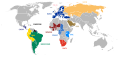 Customs unions worldwide
 -
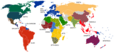 Free trade areas worldwide
 -


References[edit]
- ^ Mansfield and Milner 2005, 333.
- ^ Milner 2002, 450.
- ^ Schott 1991, 2.
- ^ O'Loughlin and Anselin 1996, 136.
- ^ Lal, Deepak (1993). "Trade Blocs and Multilateral Free Trade" (PDF). Journal of Common Market Studies. 31 (3): 349–358. doi:10.1111/j.1468-5965.1993.tb00468.x.
- ^ Milner 2002, 458.
- ^ Mansfield and Milner 2005, 330.
- ^ "Stages of Economic Integration: From Autarky to Economic Union".
- ^ "WT/COMTD/N/11". wto.org. Archived from the original on 2009-03-25.
- ^ "WT/COMTD/N/21". wto.org. Archived from the original on 2009-03-27.
- ^ "Prensa Latina". Prensa Latina. February 3, 2007. Archived from the original on September 27, 2007.
- ^ "WT/REG238/M/1". wto.org. Archived from the original on 2009-03-04.
- ^ "Definidos critérios para o Parlamento do Mercosul". Senado Federal – Notícias. February 3, 2007.
- ^ Twelfth Andean Presidential Council Act of Lima Archived 2010-07-07 at the Wayback Machine
- ^ "?". CNN. February 3, 2007. [dead link]
- ^ "Russia, Kazakhstan, Belarus form Eurasian Economic Union". Washington Post. May 29, 2014. Retrieved June 1, 2014.
- ^ "Archived". www.itar-tass.com. Archived from the original on September 30, 2007.[dead link]
- ^ "GCC customs union fully operational". The Peninsula. 2016-08-13. Archived from the original on 18 January 2015. Retrieved 11 January 2015.
- ^ Yemen Proposes Replacing Arab League With Arab Union, Agence France-Presse, 11 February 2004
- ^ "Asean Trade Mins Meet To Speed Up Plans For Single Market". Malaysia Dual Lingual Business News. February 3, 2007. Archived from the original on 2007-09-28.
- ^ "Envisioning a single Asian currency". International Herald Tribune. February 3, 2007.
- ^ "ASEAN To Sign Accord On Visa-Free Travel". AHN – All Headline News. February 3, 2007. Archived from the original on 2007-09-26.
- ^ "ASEAN Leaders Sign Five Agreements at the 12th ASEAN Summit, Cebu, the Philippines, 13 January 2007" (Press release). ASEAN Secretariat. 2007-01-13. Archived from the original on 2012-03-16. Retrieved 2007-01-28.
On the first day of the 12th ASEAN Summit, five Agreements have been signed by ASEAN leaders – reinforcing their commitment in the continuing integration of ASEAN and enhancing political, economic and social cooperation in the region.
- ^ "ASEAN defense ministers aim for security community". ABS-CBN. February 3, 2007. Archived from the original on June 27, 2006.
Bibliography[edit]
- Mansfield, Edward D. and Helen V. Milner, "The New Wave of Regionalism" in Diehl, Paul F. (2005). The Politics of Global Governance: International Organizations in an Interdependent World. Boulder: Lynne Rienner Publishers. ISBN 978-1-55587-654-8.
- Milner, Helen V., "International Trade" in Carlsnaes, Walter; Thomas Risse; Beth A. Simmons (2002). Handbook of International Relations. London: SAGE Publications. ISBN 978-0-7619-6304-2.
- O'Loughlin, John; Luc Anselin (1996). "Geo-Economic Competition and Trade Bloc Formation: United States, German, and Japanese Exports, 1968–1992". Economic Geography. 72 (2): 131–160. doi:10.2307/144263. JSTOR 144263.
- Schott, Jeffrey J. (1991). "Trading blocs and the world trading system". World Economy. 14 (1): 1–17. doi:10.1111/j.1467-9701.1991.tb00748.x.
| Terminology |
| ||||||||||
|---|---|---|---|---|---|---|---|---|---|---|---|
Organizations and policies | |||||||||||
| Political economy | |||||||||||
| Regional organizations |
| ||||||||||
| Exports by product |
| ||||||||||


