


Trappist beer


Trappist beer is brewed by Trappist monks. Thirteen Trappist monasteries—six in Belgium, two in the Netherlands, and one each in Austria, Italy, England, France, and Spain— produce beer,[1] but the Authentic Trappist Product label is assigned by the International Trappist Association (ITA) to just ten breweries which meet their strict criteria. As of 2021[update], Achel is no longer recognized as a Trappist brewery because it does not have any monks.[2]
History[edit]
The Catholic Trappist order originated in the Cistercian monastery of La Trappe, France. Various Cistercian congregations existed for many years, and by 1664 the Abbot of La Trappe felt that the Cistercians were becoming too liberal. He introduced strict new rules in the abbey and the Strict Observance was born. Since this time, many of the rules have been relaxed. However, a fundamental tenet that monasteries should be self-supporting is still maintained by these groups.[citation needed]
Monastery brewhouses, from different religious orders, have existed across Europe since the Middle Ages. From the very beginning, beer was brewed in French Cistercian monasteries following the Strict Observance. For example, the monastery of La Trappe in Soligny already had its own brewery in 1685. Breweries were later introduced in monasteries of other countries as the Trappist order spread from France into the rest of Europe. The Trappists, like many other religious orders, originally brewed beer to feed the community, in a perspective of self-sufficiency. Nowadays, Trappist breweries also brew beer to fund their works and charitable causes. Many of the Trappist monasteries and breweries were destroyed during the French Revolution and the World Wars. In the last 300 years, there were at least nine Trappist breweries in France, six in Belgium, two in the Netherlands, one in Germany, one in Austria, one in Bosnia and possibly other countries.[citation needed]
In 1997, eight Trappist abbeys – six from Belgium (Orval, Chimay, Westvleteren, Rochefort, Westmalle and Achel), one from the Netherlands (Koningshoeven) and one from Germany (Mariawald) – founded the International Trappist Association (ITA) to prevent non-Trappist commercial companies from abusing the Trappist name. This private association created a logo that is assigned to goods (cheese, beer, wine, etc.) that respect precise production criteria. For the beers, these criteria were the following:[3]
- The beer must be brewed within the walls of a Trappist monastery, either by the monks themselves or under their supervision.
- The brewery must be of secondary importance within the monastery and it should witness to the business practices proper to a monastic way of life.
- The brewery is not intended to be a profit-making venture. The income covers the living expenses of the monks and the maintenance of the buildings and grounds. Whatever remains is donated to charity for social work and to help persons in need.
The German Trappist abbey of Mariawald has not produced beer since 1953, however it is a founding member of the Trappist Association and uses the same Authentic Trappist Product logo for its other products.[citation needed]
As of January 2021, Belgium has only 5 Trappist beers (ATP) left since Achel lost its ATP designation due to the last monk leaving the Order. However, its Trappist beer (not ATP) production is still ongoing and has been taken over by Westmalle.[4] In 2012, Belgian Post honored the Trappist breweries in the country with a commemorative collection of stamps.[5] As of 25 January 2023, Achel lost its designation as a Trappist beer due to selling the abbey to a private person.
In the twentieth century, the growing popularity of Trappist beers led some brewers with no connection to the order to label their beers "Trappist". After unsuccessful negotiations, monks sued one such brewer in 1962 in Ghent, Belgium.[citation needed]
The Dutch brewery De Koningshoeven produces Trappist beers – branded La Trappe – that are able to carry the "Authentic Trappist Product" logo. Their use of the International Trappist Association logo was withdrawn in 1999, but was restored in October 2005 (see Brouwerij de Koningshoeven for details). A second Dutch Trappist beer, branded Zundert and produced by Abdij Maria Toevlucht, made its debut in December 2013, and has also been granted permission to use the International Trappist Association logo.[citation needed]
An expansion of ITA recognized breweries took place for the first time in 2012 when the trappist brewery of the abbey of Engelszell, Trappistenbrauerei Engelszell in Engelhartszell, Austria started brewing beer at the monastery (the former production had stopped in 1929) and in the same year obtained the Authentic Trappist Product logo for their beer.[6]
In December 2013, Maria Toevlucht's abbey (Zundert, the Netherlands) and St. Joseph's Abbey (Spencer, Massachusetts, United States) were both granted the ATP recognition for their Trappist beers, followed in 2015 by Tre Fontane Abbey brewery in Rome.[citation needed]
In June 2018, the monks of Mount Saint Bernard Abbey in Leicestershire became the first in the UK to brew a Trappist ale.[7][8] Called "Tynt Meadow" (7.4% ABV), after the location of the abbey, it is available to visitors and sold through public outlets.[8]

International Trappist Association recognised breweries[edit]
As of January 2022, fourteen Trappist monasteries that are members of the ITA have beers named after them — six in Belgium, two in the Netherlands, and one each in Austria, Italy, England, France, Spain and the United States.[9]
Authentic Trappist Product label[edit]
In addition to being a Trappist brewery, the monastic communities that are members of the ITA can apply for the Authentic Trappist Product (ATP) label.[10] The following criteria are used for ATP label:[11]
- All products must be made within the immediate surroundings of the abbey;
- Production must be carried out under the supervision of the monks or nuns;
- Profits should be intended for the needs of the monastic community, for purposes of solidarity within the Trappist Order, or for development projects and charitable works.
List of Trappist breweries[edit]
There are currently thirteen breweries producing Trappist beer.[9] Ten of them (with the exception of Achel, Mont des Cats, whose beer is not brewed at their monastery but at Chimay,[12] and Cardeña from the Abbey of San Pedro de Cardeña, whose beer is currently produced off-site[13]) are allowed to display the Authentic Trappist Product logo on their beer products.[11] In January 2021, "Achel" of the St. Benedict's Abbey in Hamont-Achel lost the Authentic Trappist Product label, as the brewing process was no longer supervised by monks on site, but the beer remains a Trappist beer, as the Saint Benedict Abbey falls under the Westmalle Abbey and the abbot of Westmalle Abbey visits the Achelse Kluis every week and supervises the brewing and other activities in the Achelse Kluis.[14] In January 2023, the abbey was sold to a private person. From that day on, "Achel" lost the recognition as a Trappist beer. [15] In May 2022, St. Joseph's Abbey ceased beer production.[16] In May 2023, Stift Engelszell published an article about dissolution of the monastery and move all monks to other monasteries.
| Brewery | Location | Opened | Annual production (2004) |
|---|---|---|---|
| Brouwerij der Trappisten van Westmalle |  Belgium Belgium |
1836 | 120,000 hL (100,000 US bbl) |
| Brouwerij Westvleteren (St Sixtus) | Belgium |
1838 | 4,750 hL (4,050 US bbl) |
| Bières de Chimay | Belgium |
1863 | 123,000 hL (105,000 US bbl) |
| Brouwerij de Koningshoeven (La Trappe) |  Netherlands Netherlands |
1884 | 145,000 hL (124,000 US bbl) |
| Brasserie de Rochefort | Belgium |
1899 | 18,000 hL (15,000 US bbl) |
| Brasserie d'Orval | Belgium |
1931 | 71,000 hL (61,000 US bbl) |
| Stift Engelszell |  Austria Austria |
2012 | 2,000 hL (1,700 US bbl) |
| St. Joseph's Abbey in Spencer, Massachusetts Closed in 2022 |  United States United States |
2013 (closed 2022) | 4,694 hL (4,000 US bbl) |
| Brouwerij Abdij Maria Toevlucht (Zundert) | Netherlands |
2013 | 5,000 hL (4,300 US bbl) |
| Tre Fontane Abbey |  Italy Italy |
2015 | 2,000 hL (1,700 US bbl) |
| Mount St Bernard Abbey (Tynt Meadow) |  England England |
2018 | 2,000 hL (1,700 US bbl) |
| Mont des Cats (not ATP) |  France France |
1826 | N/A (not ATP) |
| Cerveza Cardeña Trappist (not ATP) |  Spain Spain |
2016 | N/A (not ATP) |
| Achel Abbey Recognition as Trappist beer lost in 2023 (abbey sold to a private individual) | Belgium |
1850 | N/A (not ATP) |


Belgium


Abbey beer[edit]
The designation "abbey beers" (Bières d'Abbaye or Abdijbier) was originally devised by Belgian breweries for any monastic or monastic-style beer not produced in an actual monastery. After the introduction of an official Trappist beer designation by the International Trappist Association in 1997, it came to mean products similar in style or presentation to monastic beers.[17] In other words, an Abbey beer may be:
- Produced by a non-Trappist monastery—e.g. Cistercian, Benedictine; or
- produced by a commercial brewery under an arrangement with an extant monastery; or
- branded with the name of a defunct or fictitious abbey by a commercial brewer; or
- given a vaguely monastic branding, without specifically mentioning monastery, by a commercial brewer.
Types of beer[edit]
Trappist beers are mostly top-fermented, including La Trappe Bockbier, and mainly bottle conditioned. Trappist breweries use various systems of nomenclature for the different beers produced which relate to their relative strength.[18]
The best known is the system where different beers are called Enkel/Single, Dubbel/Double, Tripel/Triple and Quadrupel/Quadruple. These terms roughly describe both the amount of malt and the original gravity.[19] They may refer to the number of crosses or other marks chalked on the casks - two for a Dubbel and three for a Tripel.[20]
Colours can be used to indicate the different types, dating back to the days when bottles were unlabelled and had to be identified by the capsule or bottle-top alone. Chimay beer labels are based on the colour system (in increasing order of strength red, white and blue). Westvleteren beers are still unlabelled.
There is also a number system (6, 8 and 10, as used by Rochefort), which gives an indication of strength, but is not necessarily an exact alcohol by volume (ABV). Achel combine a strength and a colour (of the beer itself—blond or brown) designation.
Enkel[edit]
Enkel, meaning "single", is a term used by the Trappist breweries to describe the basic recipe of their beers.[18] The name fell out of fashion with no breweries (Trappist or 'Abbey') using the term until recent years.[when?] Instead, "Blond(e)" (La Trappe, Westvleteren), "5" (Achel) or "6" (Rochefort) have been used to describe the brewery's lightest beer. Chimay introduced an Enkel (called Dorée or Gold) commercially in bottles in 2015,[21] Westmalle made their Enkel (called Extra) available commercially through some outlets in 2010.[22] The term is often used interchangeably with 'Patersbier' (meaning Father's beer), as Enkels are a weak beer brewed originally to be consumed by the monks themselves.
Dubbel[edit]
Dubbel is a Trappist breweries' naming convention.[18] The origin of the dubbel was a beer brewed in the Trappist Abbey of Westmalle in 1856. Westmalle Dubbel was imitated by other breweries, Trappist and commercial, Belgian and worldwide, leading to the emergence of a style. Dubbels are understood to be a fairly strong (6–8% ABV) brown ale, with understated bitterness, fairly heavy body, and a pronounced fruitiness and cereal character. Examples are: Westmalle Dubbel, Chimay Red/Premiere, Koningshoeven/La Trappe Dubbel, Achel 8 Bruin, Rochefort 6, and Tynt Meadow.
Tripel[edit]

Tripel is a naming convention traditionally used by Belgian Trappist breweries to describe the strongest beer in their range. Westmalle Tripel is considered to be the foundation of this beer style, and was developed in the 1930s. Achel 8 Blond, Westmalle Tripel, La Trappe Tripel, and Chimay White/Cinq Cents are all examples of Trappist tripels. The style has proven popular among secular breweries like St. Feuillien, Bosteels and St. Bernardus. Tripels as a style are generally beers with an alcohol content ranging from 8% to 10% ABV.
Quadrupel[edit]
Quadrupel is the name Koningshoeven gave to a La Trappe ale they brew which is stronger and darker than their tripel. Rochefort 10, Westvleteren 12 and Zundert 10 are also examples of quadrupels.
Glassware[edit]
Belgian breweries have a tradition of providing custom beer glasses: with Trappist breweries, these often take the form of "chalice" or "goblet" style glasses. The distinction between goblet and chalice is typically in the glass thickness. Goblets tend to be more delicate and thin, while the chalice is heavy and thick walled. Some chalices are etched on the bottom to nucleate a stream of bubbles for maintaining a nice head.
-
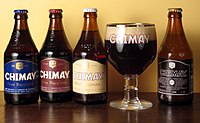 Chimay beers and glass
 -
 Orval beer's "chalice" glass
 -
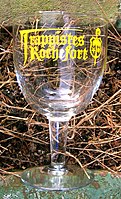 Rochefort beer's "goblet" glass
 -
 Thirteen trappist beers and their glasses.


Beer tourism[edit]
The idea of visiting Trappist monasteries to sample their beers has become more popular in recent years,[when?] partly due to promotion by enthusiasts such as the 'beer hunter' Michael Jackson. Some brewing monasteries maintain a visitors' centre where their beers can be tasted and bought (sometimes with other monastic products such as bread and cheese).[23][24] Visits to the monastery itself are usually not available to the general public, although visitors can overnight in some of the monasteries (like Achel) if their purpose is non-touristic. Currently, Koningshoeven (which brews La Trappe) in Netherlands offers regular tours around their bottling plant, old brewery and parts of their site, along with a beer tasting.[25]
See also[edit]


- Alcohol in Christianity
- Christian dietary laws
- Beer in Belgium
- Beer in the Netherlands
- Barrel-aged beer
References[edit]
- ^ "Beer-brewing monks struggle with demand". BBC News. July 7, 2019.
- ^ "No Monks, No Label". February 13, 2021 – via www.bbc.co.uk.
- ^ "Trappist beers". The International Trappist Association. Retrieved 16 May 2016.
- ^ "Achelse trappist is niet langer échte trappist omdat laatste broeder abdij verliet: "Productie is niet in gevaar"". VRT News. Retrieved 24 January 2021.
- ^ "Belgian Post Honors Trappist Brewers on Stamps". Lyke2Drink. 2 February 2012.
- ^ "The ATP logo for "Gregorius" and "Benno"!". 21 November 2012.
- ^ Owen, Dave (2017-10-25). "Brewery set to be built in county – and ran by Trappist monks". leicestermercury. Retrieved 2018-03-05.
- ^ a b "Monks brew UK's first Trappist beer". BBC News. 25 June 2018. Retrieved 29 June 2018.
- ^ a b "International Trappist Association - Beers". Trappist.be. Retrieved 2019-01-27.
- ^ "International Trappist Association - FAQs". Trappist.be. Retrieved 2019-01-27.
- ^ a b "International Trappist Association - Criteria for obtaining the ATP label". Trappist.be. Retrieved 2019-01-27.
- ^ "Mont des Cats". RateBeer. Retrieved 2020-12-23.
- ^ Barnes, Christopher (2016-05-25). "The Brewing Monks: A Potential 12th Trappist Brewery Begins the Process in Spain". I Think About Beer. Retrieved 2020-12-23.
- ^ "Trappist Achel Brouwt Verder".
- ^ Snoekx, Koen (25 January 2023). "Kempense ondernemer Jan Tormans koopt Sint-Benedictusabdij: 'Einde van Trappist Achel'". Gazet van Antwerpen. Retrieved 2023-01-25.
- ^ Tota, Matthew (2022-05-14). "St. Joseph's Abbey to close Spencer Brewery". Worcester Magazine. Retrieved 2022-05-15.
- ^ McFarland, Ben (2009). World's Best Beers: One Thousand Craft Brews from Cask to Glass. Sterling Publishing Company, Inc. p. 38. ISBN 978-1-4027-6694-7. Retrieved 2011-01-13.
- ^ a b c Geert van Lierde et al., In het Spoor van de Trappisten ISBN 90-261-0704-8, page 25
- ^ Oliver, Garrett (2012). The Oxford Companion to Beer. ISBN 978-0195367133.
- ^ "Michael Jackson's Beer Hunter - Down on your knees to bless monks' top ale". www.beerhunter.com. Retrieved 2009-07-11.
- ^ "Chimay Dorée / Spéciale du Potaupré". RateBeer. Retrieved 2018-03-05.
- ^ "New Product : Shop Westmalle-Extra Trappist Beer @ www.belgiuminabox.com | Belgiuminabox". belgiuminabox.com. Retrieved 2018-03-05.
- ^ "Espace Chimay". Retrieved 2014-09-26.
- ^ "Visit Orval". Retrieved 2014-09-26.
- ^ "Visit us". www.latrappetrappist.com. Retrieved 2018-03-05.