


Addo Elephant National Park
| Addo Elephant National Park | |
|---|---|
 Bull elephant at Addo | |
 Location of the park | |
| Location | Eastern Cape, South Africa |
| Nearest city | Gqeberha |
| Coordinates | 33°26′46″S 25°44′45″E / 33.44611°S 25.74583°E |
| Area | 1,640 km2 (630 sq mi)[1] |
| Established | 1931[1] |
| Governing body | South African National Parks |
| www | |
  Addo Elephant National Park (South Africa) | |
Addo Elephant National Park is a diverse wildlife conservation park situated close to Gqeberha in South Africa and is one of the country's 20 national parks. It currently ranks third in size after Kruger National Park and the Kgalagadi Transfrontier Park.
History
[edit]The original section of the park was founded in 1931,[1] in part due to the efforts of Sydney Skaife,[2] in order to provide a sanctuary for the eleven remaining elephants in the area. The park has proved to be very successful and currently houses more than 600 elephants and a large number of other mammals.
Expansion
[edit]The original park has subsequently been expanded to include the Woody Cape Nature Reserve that extends from the Sundays River mouth towards Alexandria and a marine reserve, which includes St. Croix Island and Bird Island, both breeding habitat for gannets and penguins, not to mention a large variety of other marine life. Bird Island is home to the world's largest breeding colony of gannets - about 120,000 birds - and also hosts the second largest breeding colony of African penguins, the largest breeding colony being St. Croix island. These marine assets form part of the plan to expand the 1,640 km2 Addo National Elephant Park into the 3,600 km2 Greater Addo Elephant National Park. The expanded park contains five of South Africa's seven major vegetation zones (biomes), and is also the only park to house Africa's "Big 7" (elephant, rhinoceros, lion, buffalo, leopard, whale and great white shark) in their natural habitat.[1]
Flora and fauna
[edit]
The flora within the AENP is quite varied, and like all plant life, is a central factor to the ecological system in place. Several species of rare and endemic plants, particularly succulent shrubs and geophytes are native to the South African region within the AENP. Many species are under environmental pressure, however, and are facing possible extinction.[3]
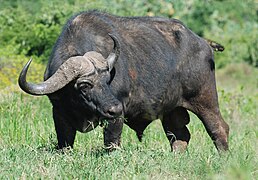
The park is home to more than 600 elephants, 400 Cape buffaloes, over 48 endangered south-western black rhinoceross (Diceros bicornis occidentalis) as well as a variety of antelope species. Lion and spotted hyena have also recently been re-introduced to the area. The largest remaining population of the flightless dung beetle (Circellium bacchus) is located within the park.
Extinction and overpopulation
[edit]Two major environmental issues facing the AENP: extinction and overpopulation, which are interrelated. Since the AENP's original mission was to reintroduce certain mega-herbivores, like the African bush elephant and eastern black rhinoceros,[4] primary ecological efforts were made to preserve mammalian species. However, by overlooking the other contributors to this environmental chain, certain plant species have been subjected to overgrazing and trampling,[5] mostly by the elephants of the park. This overgrazing and trampling not only destroys much of the plant life, but also forces it to adapt its physiology to stimuli[6] that are not inherent to its evolutionary progress. Some biologists argue that it is not herbivorization[7] alone that is threatening the flora, but a number of other ecological factors including zoochory and nutrient cycling. Up to 77 species of South African endemic plant species have been listed as "vulnerable to elephant browsing."
Marine protected areas
[edit]The Addo Elephant National Park Marine Protected Area[8][9] and Bird Island Marine Protected Area are associated with the park.
Tourism
[edit]In 2018 the highest visitor count in the park's 87-year history was recorded. The park received 305,510[10] visitors between 1 April 2017 and 31 March 2018 (up from 265,585 in the previous year).[11] International visitors make up 55% of this number, with German, Dutch and British nationals in the majority.[12]
There is a main camp, featuring a swimming pool, restaurant, flood lit water hole and various accommodation, four other rest camps and four camps run by concessionaires. The main entrance as well as two looped tourist roads in the park are tarred while the others are graveled. There is also an additional access road through the southern block of the park feeding off the N2 highway near Colchester; it joins up with the existing tourist roads in the park.[citation needed]
Gallery
[edit]-
-
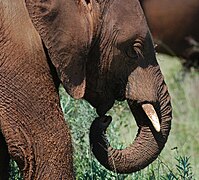 Elephant calf
 -
 Elephant eating grass
 -
 Elephants at the Hapoor Dam in the park
 -
 Adult Burchell's zebra and two foals
 -

-
 Red Hartebeest in early morning light
 -
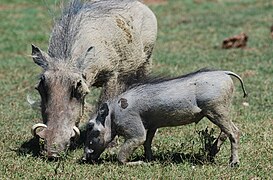 Warthog mother and piglet
 -
![Male lion[13]](//upload.wikimedia.org/wikipedia/commons/thumb/4/4a/Male_lion_%28Addo%29.JPG/267px-Male_lion_%28Addo%29.JPG)
-
 Blue plumbago (Plumbago auriculata)
.JPG)
.JPG)
.JPG)

.JPG)
.JPG)

.JPG)
![Male lion[13]](/wiki/File:Male_lion_(Addo).JPG)

See also
[edit]
References
[edit]- ^ a b c d "Addo Elephant National Park". South African National Parks. Retrieved 2024-08-08.
- ^ "Skaife, Sydney Harold ('Stacey') (1889-1976)". Iziko Museums of Cape Town. Archived from the original on 2011-07-18. Retrieved 2009-04-24.
- ^ Johnson, C.F.; Cowling, R.M.; Phillipson, P.B. (1999). "The Flora of Addo Elephant National Park: are threatened species vulnerable to elephant damage?". Biodiversity and Conservation. 8 (11): 1447–1456. doi:10.1023/A:1008980120379. S2CID 1480328.
- ^ Landman, M. "Relevance of elephant herbivory as a threat to Important Plants in the Addo Elephant National Park, South Africa," Journal of Zoology 2008, p.51-58
- ^ Kerley, Graham. "The impacts of elephants on biodiversity in the Eastern Cape Subtropical Thickets," South African Journal of Science 2006, p.395-402
- ^ Marris, Emma. "Africa conservation: making room," Nature 2008, p.860-863
- ^ Knight, M.H. "Evaluating herbivore extinction probabilities in Addo Elephant National Park, South Africa," African Zoology 2006, p.13
- ^ Sink, K.; Harris, J.; Lombard, A. (October 2004). Appendix 1. South African marine bioregions (PDF). South African National Spatial Biodiversity Assessment 2004: Technical Report Vol. 4 Marine Component DRAFT (Report). pp. 97–109.
- ^ "Marine Protected Areas". World Wildlife Fund. Retrieved 24 May 2018.
- ^ "Record 300 000 tourists visit Addo in past year".
- ^ "SAN Parks Annual Report 2016/2017" (PDF).
- ^ "Visitor numbers to Addo Elephant National Park surpass 300 000".
- ^ Bauer, H.; Packer, C.; Funston, P. F.; Henschel, P.; Nowell, K. (2017) [errata version of 2016 assessment]. "Panthera leo". IUCN Red List of Threatened Species. 2016: e.T15951A115130419. doi:10.2305/IUCN.UK.2016-3.RLTS.T15951A107265605.en. Retrieved 13 January 2018.
External links
[edit]

- Official website
- [1] Park Management Plan


| International | |
|---|---|
| National | |
