


Agaricus bisporus
| Agaricus bisporus | |
|---|---|

| |
Scientific classification 
| |
| Domain: | Eukaryota |
| Kingdom: | Fungi |
| Division: | Basidiomycota |
| Class: | Agaricomycetes |
| Order: | Agaricales |
| Family: | Agaricaceae |
| Genus: | Agaricus |
| Species: | A. bisporus
|
| Binomial name | |
| Agaricus bisporus | |
| Synonyms | |
| |
Agaricus bisporus | |
|---|---|
 | Gills on hymenium |
 | Cap is convex |
 | Hymenium is free |
 | Stipe has a ring |
 | Spore print is brown |
 | Ecology is saprotrophic |
 | Edibility is choice |
Agaricus bisporus, commonly known as the cultivated mushroom, is a basidiomycete mushroom native to grasslands in Eurasia and North America. It is cultivated in more than 70 countries and is one of the most commonly and widely consumed mushrooms in the world. It has two color states while immature – white and brown – both of which have various names, with additional names for the mature state, such as chestnut, portobello, portabellini, button and champignon de Paris.
A. bisporus has some deadly poisonous lookalikes in the wild.
Description[edit]
The pileus or cap of the original wild species is a pale grey-brown, with broad, flat scales on a paler background and fading toward the margins. It is first hemispherical before flattening out with maturity, and measures 5–10 centimetres (2–4 inches) in diameter. The narrow, crowded gills are free and initially pink, then red-brown, and finally a dark brown with a whitish edge from the cheilocystidia. The cylindrical stipe is up to 6 cm (2+1⁄2 in) tall by 1–2 cm (1⁄2–3⁄4 in) wide and bears a thick and narrow ring, which may be streaked on the upper side. The firm flesh is white, although it stains a pale pinkish-red on bruising.[2][3] The spore print is dark brown. The spores are oval to round and measure approximately 4.5–5.5 μm × 5–7.5 μm, and the basidia usually two-spored, although two four-spored varieties have been described from the Mojave Desert and the Mediterranean, with predominantly heterothallic and homothallic lifestyles, respectively.[4][5]
-
 White Agaricus bisporus
 -
 A. bisporus being cultivated
 -
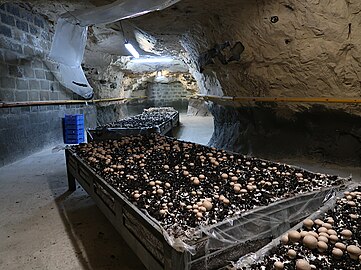 Brown variety grown in a quarry
 -
 Two fused brown mushrooms


.jpg)
Similar species[edit]
The common mushroom could be confused with young specimens of a group of lethal mushrooms in the Amanita genus referred to as destroying angels, but the latter may be distinguished by their volva or cup at the base of the mushroom and pure white gills (as opposed to pinkish or brown of A. bisporus).
A more common and less dangerous mistake is to confuse Agaricus bisporus with A. xanthodermus, an inedible mushroom found worldwide in grassy areas. A. xanthodermus has an odor reminiscent of phenol; its flesh turns yellow when bruised. This fungus causes nausea and vomiting in some people.
The poisonous European species Entoloma sinuatum has a passing resemblance but has yellowish gills, turning pink, and lacks a ring.
Taxonomy[edit]
The common mushroom has a complicated taxonomic history. It was first described by English botanist Mordecai Cubitt Cooke in his 1871 Handbook of British Fungi, as a variety (var. hortensis) of Agaricus campestris.[6][7] Danish mycologist Jakob Emanuel Lange later reviewed a cultivar specimen, and dubbed it Psalliota hortensis var. bispora in 1926.[8] In 1938, it was promoted to species status and renamed Psalliota bispora.[9] Emil Imbach (1897–1970) imparted the current scientific name of the species, Agaricus bisporus after the genus Psalliota was renamed to Agaricus in 1946.[10] The specific epithet bispora distinguishes the two-spored basidia from four-spored varieties.


Etymology[edit]
When immature and white, this mushroom may be known as:
- common mushroom
- white mushroom[11]
- button mushroom[11]
- cultivated mushroom[12]
- table mushroom
- champignon (French for mushroom) de Paris
When immature and brown, it may be known variously as:
- Swiss brown mushroom
- Roman brown mushroom
- Italian brown mushroom
- cremini (also crimini) mushroom[13][14]
- chestnut mushroom (not to be confused with Pholiota adiposa)
- baby bella[13]
When marketed in its mature state, the mushroom is brown with a cap measuring 10–15 cm (4–6 in).[14] This form is commonly sold under the names portobello,[14][15] portabella,[16] or portobella; the etymology is disputed.[14][15]
Distribution and habitat[edit]
This mushroom is commonly found worldwide in fields and grassy areas following rain, from late spring to autumn, especially in association with manure.
Cultivation[edit]
| Mushroom and truffle production – 2022 | |
|---|---|
| Country | Millions of tonnes |
 China China |
45.4 |
 Japan Japan |
0.47 |
 United States United States |
0.32 |
 Poland Poland |
0.26 |
 Netherlands Netherlands |
0.24 |
| World | 48.3 |
| Source: FAOSTAT of the United Nations[17] | |
Production[edit]
In 2022, world production of mushrooms (including truffles) was 48 million tonnes, led by China with 94% of the total (table). Japan and the United States were secondary producers.
History[edit]
The earliest scientific description of the commercial cultivation of A. bisporus was made by French botanist Joseph Pitton de Tournefort in 1707.[18] French agriculturist Olivier de Serres noted that transplanting mushroom mycelia would lead to the propagation of more mushrooms.
Originally, cultivation was unreliable as mushroom growers would watch for good flushes of mushrooms in fields before digging up the mycelium and replanting them in beds of composted manure or inoculating 'bricks' of compressed litter, loam, and manure. Spawn collected this way contained pathogens, and crops would be infected or not grow.[19] In 1893, sterilized, or pure culture, spawn was discovered and produced by the Pasteur Institute in Paris for cultivation on composted horse manure.[20]
| Nutritional value per 100 g (3.5 oz) | |
|---|---|
| Energy | 93 kJ (22 kcal) |
3.26 g | |
| Sugars | 1.98 g |
| Dietary fiber | 1 g |
0.34 g | |
3.09 g | |
| Vitamins | Quantity %DV† |
| Thiamine (B1) | 7% 0.081 mg |
| Riboflavin (B2) | 31% 0.402 mg |
| Niacin (B3) | 23% 3.607 mg |
| Pantothenic acid (B5) | 30% 1.497 mg |
| Vitamin B6 | 6% 0.104 mg |
| Folate (B9) | 4% 17 μg |
| Vitamin B12 | 2% 0.04 μg |
| Vitamin C | 2% 2.1 mg |
| Vitamin D | 1% 0.2 μg |
| Minerals | Quantity %DV† |
| Iron | 3% 0.5 mg |
| Magnesium | 2% 9 mg |
| Phosphorus | 7% 86 mg |
| Potassium | 11% 318 mg |
| Sodium | 0% 3 mg |
| Zinc | 5% 0.52 mg |
| Other constituents | Quantity |
| Water | 92.45 g |
| †Percentages estimated using US recommendations for adults,[21] except for potassium, which is estimated based on expert recommendation from the National Academies.[22] | |
Modern commercial varieties of the common agaricus mushroom were originally light brown. The white mushroom was discovered in 1925 growing among a bed of brown mushrooms at the Keystone Mushroom Farm in Coatesville, Pennsylvania. Louis Ferdinand Lambert, the farm's owner and a mycologist by training, brought the white mushroom back to his laboratory. As with the reception of white bread, it was seen as a more attractive food item and became grown and distributed.[23] Similar to the commercial development history of the navel orange and Red Delicious apple, cultures were grown from the mutant individuals. Most cream-colored store mushrooms marketed today are products of this 1925 chance natural mutation.
A. bisporus is cultivated in at least seventy countries worldwide.[10]
Nutrition[edit]
In a 100-gram serving, raw white mushrooms provide 93 kilojoules (22 kilocalories) of food energy and are an excellent source (20% or more of the Daily Value, DV) of the B vitamins riboflavin, niacin, and pantothenic acid (table). Fresh mushrooms are also a good source (10–19% DV) of the dietary minerals phosphorus and potassium (table).
While fresh A. bisporus only contains 0.2 micrograms (8 IU) of vitamin D per 100 g, the ergocalciferol (D2) content increases substantially to 11.2 micrograms (446 IU)[24] after exposure to UV light.[25][26]
Gallery[edit]
-
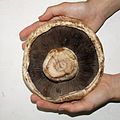 Ventral view of a portobello cultivar with a bisected stipe
 -


See also[edit]

References[edit]
- ^ Imbach EJ (1946). "Pilzflora des Kantons Luzern und der angrenzen Innerschweiz". Mitteilungen der naturforschenden Gesellschaft Luzern (in German). 15: 5–85.
- ^ Zeitlmayr L (1976). Wild Mushrooms:An Illustrated Handbook. Garden City Press, Hertfordshire. pp. 82–83. ISBN 0-584-10324-7.
- ^ Carluccio A. (2003). The Complete Mushroom Book. Quadrille. ISBN 1-84400-040-0.
- ^ Callac P, Billette C, Imbernon M, Kerrigan RW (1993). "Morphological, genetic, and interfertility analyses reveal a novel, tetrasporic variety of Agaricus bisporus from the Sonoran Desert of California". Mycologia. 85 (5): 835–851. doi:10.2307/3760617. JSTOR 3760617.
- ^ Callac P, Imbernon M, Guinberteau J, Pirobe L, Granit S, Olivier JM, Theochari I (2000). "Discovery of a wild Mediterranean population of Agaricus bisporus, and its usefulness for breeding work". Mushroom Science. 15: 245–252.
- ^ Cooke MC (1871). Handbook of British Fungi. Vol. 1. London: Macmillan and Co. p. 138.
- ^ "Species Fungorum – Species synonymy". Index Fungorum. CAB International. Archived from the original on 10 June 2011. Retrieved 21 January 2010.
- ^ Lange JE (1926). "Studies in the agarics of Denmark. Part VI. Psalliota, Russula". Dansk Botanisk Arkiv. 4 (12): 1–52.
- ^ Schäffer J, Møller FH (1939). "Beitrag zur Psalliota Forschung". Annales Mycologici (in German). 36 (1): 64–82.
- ^ a b Cappelli A. (1984). Fungi Europaei:Agaricus (in Italian). Saronno, Italy: Giovanna Biella. pp. 123–25.
- ^ a b "White Button". Fresh Mushrooms. Mushroom Council. n.d. Archived from the original on 29 February 2020. Retrieved 29 February 2020.
- ^ Arora, David (1986). Mushrooms demystified: a comprehensive guide to the fleshy fungi (Second ed.). Berkeley: Ten Speed Press. ISBN 978-0-89815-169-5.
- ^ a b "Crimini". Fresh Mushrooms. Mushroom Council. n.d. Archived from the original on 7 August 2022. Retrieved 29 February 2020.
- ^ a b c d GourmetSleuth (11 November 2013). "Portobello (Portobella) Mushrooms". Gourmet Sleuth. Archived from the original on 10 January 2019. Retrieved 9 January 2019.
- ^ a b "portobello | Definition of portobello by Lexico". Lexico Dictionaries | English. Archived from the original on 31 August 2019. Retrieved 31 August 2019.
- ^ "Portabella". Fresh Mushrooms. Mushroom Council. n.d. Archived from the original on 29 February 2020. Retrieved 29 February 2020.
- ^ "Production of mushrooms and truffles in 2022, Crops/Regions/World list/Production Quantity/Year (pick lists)". UN Food and Agriculture Organization, Corporate Statistical Database (FAOSTAT). 2024. Retrieved 25 February 2024.
- ^ Spencer DM (1985). "The mushroom–its history and importance". In Flegg PB, Spencer DM, Wood DA (eds.). The Biology and Technology of the Cultivated Mushroom. New York: John Wiley and Sons. pp. 1–8. ISBN 0-471-90435-X.
- ^ Genders 1969, p. 19
- ^ Genders 1969, p. 18
- ^ United States Food and Drug Administration (2024). "Daily Value on the Nutrition and Supplement Facts Labels". Retrieved 28 March 2024.
- ^ National Academies of Sciences, Engineering, and Medicine; Health and Medicine Division; Food and Nutrition Board; Committee to Review the Dietary Reference Intakes for Sodium and Potassium (2019). Oria, Maria; Harrison, Meghan; Stallings, Virginia A. (eds.). Dietary Reference Intakes for Sodium and Potassium. The National Academies Collection: Reports funded by National Institutes of Health. Washington (DC): National Academies Press (US). ISBN 978-0-309-48834-1. PMID 30844154.
{{cite book}}: CS1 maint: multiple names: authors list (link) - ^ Genders 1969, p. 121
- ^ Haytowitz DB (2009). "Vitamin D in mushrooms" (PDF). Nutrient Data Laboratory, US Department of Agriculture. Archived (PDF) from the original on 1 February 2021. Retrieved 16 April 2018.
- ^ "Mushrooms and vitamin D". Los Angeles Times. Archived from the original on 4 September 2011. Retrieved 23 August 2003.
- ^ Koyyalamudi SR, Jeong SC, Song CH, Cho KY, Pang G (April 2009). "Vitamin D2 formation and bioavailability from Agaricus bisporus button mushrooms treated with ultraviolet irradiation". Journal of Agricultural and Food Chemistry. 57 (8): 3351–5. doi:10.1021/jf803908q. PMID 19281276.


Sources[edit]
- Genders, Roy (1969). Mushroom Growing for Everyone. London: Faber. ISBN 0-571-08992-5.
Further reading[edit]
- Benjamin, Denis R. (1995). Mushrooms: poisons and panaceas—a handbook for naturalists, mycologists and physicians. New York: WH Freeman and Company. ISBN 0-7167-2600-9.
| Authority control databases: National |
|---|
