


Blondie (band)
Blondie | |
|---|---|
 | |
| Background information | |
| Origin | New York City, U.S. |
| Genres | |
| Years active |
|
| Labels | |
| Members | Debbie Harry Chris Stein Clem Burke Leigh Foxx Matt Katz-Bohen Tommy Kessler |
| Past members | Jimmy Destri Nigel Harrison Frank Infante Gary Valentine Fred Smith Ivan Kral Billy O'Connor |
| Website | blondie |
Blondie is an American rock band formed in 1974 in New York City by singer Debbie Harry and guitarist Chris Stein.[1] The band was a pioneer in the American new wave scene of the mid-1970s in New York City.
The band's first two albums contained strong elements of punk and new wave, and although highly successful in the UK and Australia, Blondie was regarded as an underground band in the U.S. until the release of Parallel Lines in 1978. Over the next four years, the band released several hit singles[2] including "Dreaming", "One Way or Another", "Heart of Glass", "Call Me", "Atomic", "The Tide Is High", and "Rapture".[3] The band became noted for its eclectic mix of musical styles, also incorporating elements of disco, pop, reggae, funk and early rap music.
Blondie disbanded after the release of their sixth studio album, The Hunter, in 1982. Harry continued to pursue a solo career with varied results after taking a few years off to care for partner Stein, who was diagnosed with pemphigus, a rare autoimmune disease of the skin.[4] The band re-formed in 1997,[5] achieving renewed success and their sixth number one single in the UK with "Maria" in 1999, exactly 20 years after their first UK No. 1 single ("Heart of Glass").
The group toured and performed throughout the world[6] during the following years, and was inducted into the Rock and Roll Hall of Fame in 2006.[7] Blondie has sold around 40 million records worldwide[8][9] and is still active. The band's eleventh studio album, Pollinator, was released on May 5, 2017.
History[edit]
1974–1978: Early career[edit]
Inspired by the burgeoning new music scene at the Mercer Arts Center in Manhattan, Stein sought to join a similar band. He joined the Stilettoes in 1973 as their guitarist and formed a romantic relationship with Harry, who was one of the band's vocalists, a former waitress and Playboy Bunny.[10] Harry had been a member of a folk-rock band, the Wind in the Willows, in the late 1960s.[3] In July 1974, Stein and Harry parted ways with the Stilettoes and Elda Gentile, the band's originator, forming a new band with ex-Stilettoes bandmates Billy O'Connor (drums; born 1953, died 2015)[11] and Fred Smith (bass).[3] Originally billed as Angel and the Snake for two shows in August 1974, they had renamed themselves Blondie by October 1974, while Ivan Kral joined the band on guitar.[3] The new name derived from comments made by truck drivers who catcalled "Hey, Blondie" to Harry as they drove past.[12][13][14]
By the spring of 1975, O'Connor had left the music business and Smith replaced Richard Hell in Television,[15] while Kral eventually joined the Patti Smith Group.[3] Stein and Harry continued the band, and proceeded with auditions to recruit drummer Clem Burke and bass player Gary Valentine (Gary J. Lachman).[3]
Blondie became regular performers at Max's Kansas City and CBGB.[16] In June 1975, the band's first recording came in the way of a demo produced by Alan Betrock. To fill out their sound, they recruited keyboard player Jimmy Destri in November 1975.[3] The band signed with Private Stock Records and released their first single "X-Offender" in June 1976, while their debut album, Blondie, was issued in December 1976.[3] Neither was initially a commercial success, and the band spent the rest of the year touring with Television and visiting the UK.[3] Blondie opened for David Bowie and Iggy Pop on the latter's US tour in early 1977 supporting The Idiot. Blondie was invited by Bowie and Pop after the pair had heard their debut.[17][18] In July 1977, Valentine decided to leave the band and form his own group, the Know; he was replaced by Frank Infante.[3]
In September 1977, the band bought back its contract with Private Stock and signed with British label Chrysalis Records.[19] The first album was re-released on the new label in October 1977. Rolling Stone's review of the debut album observed the eclectic nature of the group's music, comparing it both to Phil Spector and to the Who, and commented that the album's two strengths were Richard Gottehrer's production and the persona of Debbie Harry.[20]
_One.jpg)
The band's first commercial success occurred in Australia in 1977, when the music television program Countdown mistakenly played their video "In the Flesh", which was the B-side of the single "X-Offender".[7] Jimmy Destri later credited the show's Molly Meldrum for their initial success, commenting that "we still thank him to this day" for playing the wrong song.[21] In a 1998 interview, drummer Burke recalled seeing the episode in which the wrong song was played, but he and Stein suggested that it may have been a deliberate subterfuge on the part of Meldrum. Stein asserted that "X-Offender" was "too crazy and aggressive [to become a hit]", while "In the Flesh" was "not representative of any punk sensibility. Over the years, I've thought they probably played both things but liked one better. That's all." In retrospect, Burke described "In the Flesh" as "a forerunner to the power ballad".[22]
The single reached number two in Australia,[23] and the album entered the Australian top twenty in November 1977.[23] A subsequent double-A release of "X-Offender" and "Rip Her to Shreds" reached number 81.[23] A successful Australian tour followed in December 1977, though it was marred by an incident in Brisbane when disappointed fans almost rioted after Harry cancelled a performance due to illness.[24]
In February 1978, Blondie released their second album, Plastic Letters (UK number 10,[25] US number 78, Australia number 64[23]). The album was recorded as a four-piece during the summer of 1977, with Stein responsible for both bass and guitars.[26] Plastic Letters was promoted extensively throughout Europe and Asia by Chrysalis Records.[7] The album's first single, "Denis", was a cover version of the Randy and the Rainbows' 1963 hit "Denise".[3] It reached number two on the British singles charts, while both the album and its second single, "(I'm Always Touched by Your) Presence, Dear", reached the British top ten.[3] Chart success, along with a successful 1978 UK tour, including a gig at London's Roundhouse,[27] made Blondie one of the first American new wave bands to achieve mainstream success in the UK.[7] With Infante moving to guitar, the British musician Nigel Harrison was hired as the group's full-time bassist, expanding Blondie to a six-piece for the first time and marking a stabilization in the band's line-up.[3]
1978–1981: Mainstream success[edit]

Blondie completed the recording of their third album, Parallel Lines during the summer of 1978 together with Australian producer Mike Chapman.[3] It was released in September of that year and reached number one in the UK,[25] number six in the US, and number two in Australia.[23] It finally broke the band into the American market on the strength of the worldwide hit single "Heart of Glass".[3] Parallel Lines became the group's most successful album, selling 20 million copies worldwide.[28] The album's first two singles were "Picture This" (UK number 12)[25] and "Hanging on the Telephone" (UK number five).[25] As the band previously had success with a cover, Chrysalis Records chose their version of Buddy Holly's "I'm Gonna Love You Too" as the lead single from Parallel Lines in the US. This turned out to be a miscalculation as the single failed to chart.[29]
"Heart of Glass" was released in early 1979 and the disco-infused[30][31] track topped the UK charts in February 1979,[25] and the US charts in April 1979. It was a reworking of a rock and reggae-influenced song that the group had performed since its formation in the mid-1970s, updated with strong elements of disco music.[3] Burke later said the revamped version was inspired partly by Kraftwerk and partly by the Bee Gees' "Stayin' Alive", whose drum beat Burke tried to emulate. He and Stein gave Destri much of the credit for the final result, noting that Destri's appreciation of technology had led him to introduce synthesizers and to rework the keyboard sections.[32] Although some critics condemned Blondie for "selling out" by dabbling in disco, the song became a worldwide success and one of the biggest selling singles of 1979.[3] As the focal point for the band, Harry began to attain a celebrity status that set her apart from the other band members. She also embarked on an acting career and appeared in the film The Foreigner directed by Amos Poe.[3]
Blondie's next single in the US was a more aggressive rock song, "One Way or Another" (US number 24),[3] though in the UK, an alternate single choice, "Sunday Girl", became a number one hit.[25] Parallel Lines has been ranked number 140 on Rolling Stone's list of 500 greatest albums of all time.[33] In June 1979, Blondie, photographed by Annie Leibovitz, was featured on the cover of Rolling Stone magazine.[34] In the summer of 1979, the band returned to the studio with Chapman to record their next album.[3]
Blondie's fourth album, Eat to the Beat (UK number one,[25] US number seventeen, Australia number nine[23]), also produced by Chapman, was released in September 1979. Although well received by critics as a suitable follow-up to Parallel Lines, the album and its singles failed to achieve the same level of success in the US.[7] In the UK, the album delivered three top 20 hits, including the band's third UK number one ("Atomic", UK number one,[25] US number thirty-nine). The lead track off the album, "Dreaming" featuring Ellie Greenwich, reached number two in the UK.[25][3] But it only made it to number 27 in the US. The second single "Union City Blue" (UK number 13[25]) shared the title of a film featuring Harry, directed by Marcus Reichert.[3] Along with the inspiration from the film, "Union City Blue"'s lyrics derived from her living in Union City, New Jersey. She worked various jobs across the Hudson River from Manhattan, noting the scenic skyline and passion she embraced while living there, before giving birth to Blondie. The single was not released in the US in favor of the track "The Hardest Part".[7] Chrysalis Records' Linda Carhart asked Jon Roseman Productions US division to shoot videos for every song and create the first ever video album.[3] David Mallet directed and Paul Flattery produced it at various locations and studios in and around New York.[29] It was nominated for a Grammy, the first year the Recording Academy instituted an award for music videos.[35] At the end of the year, the show filmed at the Apollo theatre in Glasgow was broadcast by the BBC on the Old Grey Whistle Test.[3] In March 1980, "Atomic" reached number one in the UK and the album was certified gold the following month.[3]
Blondie's next single, the Grammy-nominated "Call Me", was the result of Debbie Harry's collaboration with the Italian songwriter and producer Giorgio Moroder, who had been responsible for many of Donna Summer's biggest hits. The track was recorded as the title theme of the Richard Gere film American Gigolo.[3] Released in the US in February 1980, "Call Me" spent six consecutive weeks at number one in the US and Canada. Released in the UK in April 1980, it reached number one and became a global hit. The single was also number one on Billboard magazine's 1980 year-end chart.[citation needed] In the summer of 1980, the band appeared in a bit part in the film Roadie starring Meat Loaf. Blondie performed the Johnny Cash song "Ring of Fire", and the live recording was featured on the film soundtrack and on a later CD reissue of the Eat to the Beat album.[3]
In November 1980, Blondie's fifth studio album and third with Chapman, Autoamerican (UK number three,[25] US number seven, Australia number eight[23]), was released. Autoamerican contained two more US number one hits: the reggae-styled "The Tide Is High", a cover version of a 1967 song written by John Holt of the Paragons,[3] and the rap-flavored[31] "Rapture", which was the first song featuring rapping to reach number one in the US.[28] In the song, Harry mentions the hip hop and graffiti artist Fab Five Freddy who also appears in the video for the song. Autoamerican featured a far wider stylistic range than previous Blondie albums, including the avant-garde instrumental "Europa", the acoustic jazz of "Faces", and "Follow Me" (from the Broadway show "Camelot"). The album went on to achieve platinum success in both the US and the UK.[citation needed]
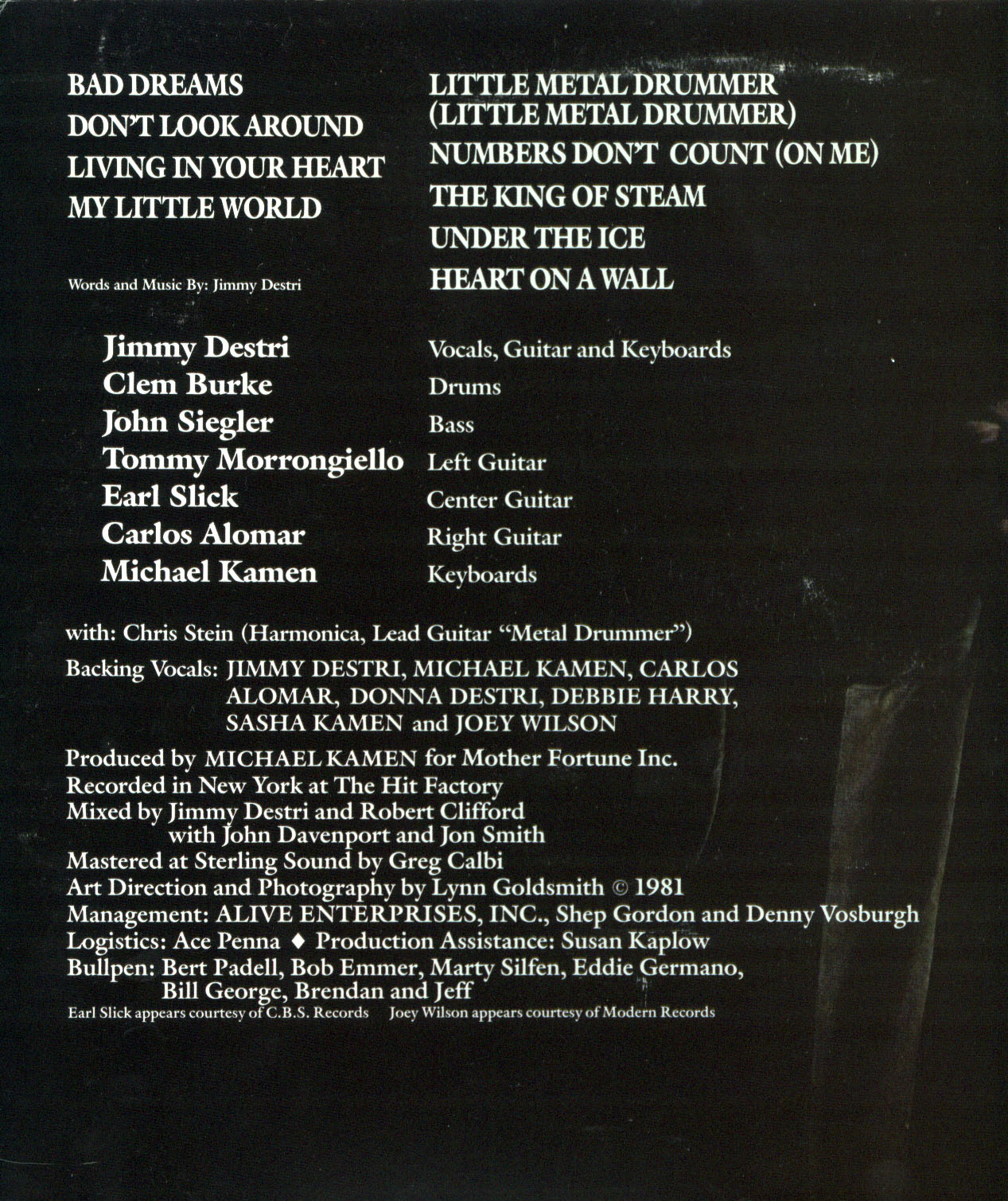
Blondie took a break for most of 1981. Debbie Harry hosted Saturday Night Live in February 1981, with Stein and Burke backing her during her musical performances. Harry and Destri both released solo albums. Stein worked on Harry's album KooKoo (UK number six, US number twenty-eight) produced by Nile Rodgers and Bernard Edwards.[3] He also joined Burke on Destri's album Heart on a Wall.[36] Burke also played drums on the Eurythmics' debut album In The Garden. Harry, Stein and Destri also worked together on music for the 1981 John Waters film Polyester. In October 1981, Chrysalis Records released The Best of Blondie (UK number four,[25] US number thirty, Australia number one[23]), the group's first greatest hits compilation.[37]

1982: The Hunter and breakup[edit]
The band reconvened in December 1981 to record a new album, The Hunter, released in May 1982 (UK number nine,[25] US number thirty-three, Australia number fifteen[23]). Infante was initially not included in the new album due to friction with other group members, but began legal proceedings and was later reinstated after an out-of-court settlement.[3] In contrast to their earlier commercial and critical successes, The Hunter was poorly received. The album did have two moderate hit singles: "Island of Lost Souls" (UK number 11,[25] US number 37, Australia number 13[23]) and "War Child" (UK number 39[25]).[38] The album also included "For Your Eyes Only", a track the band had been commissioned to write and record for the 1981 James Bond film of the same name;[39] however, it was rejected by the film's producers who ultimately chose another song with the same title recorded by Sheena Easton.[40]
In June 1982, Harry contributed backing vocals to The Gun Club's second album Miami, being credited as 'D.H. Lawrence Jr'. Stein produced the record, and is credited as 'bongos' and 'cover photos/design'. The Gun Club's singer Jeffrey Lee Pierce was a fan, emulating Harry's hairstyle and founding the West Coast Blondie Fan Club, before becoming friends with the band in New York.[41][42]
For the brief North American tour (July to August 1982) to promote the Hunter album, guitarist Infante was replaced with session musician Eddie Martinez.[43] Also added to the live lineup were second keyboardist Abel Domingues and a three-man horn section comprising Douglas Harris, Joseph Kohanski, and Arthur Pugh.[43] A UK and European tour was cancelled due to poor ticket sales.[3]
In November 1982, the band publicly announced that they had disbanded.[44] In 1983, Stein was diagnosed with the life-threatening illness pemphigus, and Harry cared for him.[45] Harry embarked on solo career in the mid-1980s, including two singles—the 1983 track "Rush Rush" from the film Scarface, and the 1985 track "Feel The Spin"—released while she continued to feature in films. Harry released the album Rockbird in 1986, with active participation from Stein. The album was a moderate success in the UK where it reached gold certification and gave her a UK top 10 hit with "French Kissin'". Meanwhile, Burke became a much-in-demand session drummer, playing and touring with Eurythmics for their 1986 album Revenge, and Destri maintained an active career as a producer and session musician.[3]
A remix album entitled Once More into the Bleach was released in 1988, and featured remixes of classic Blondie tracks and material from Harry's solo career, including "Denis".[3] Harry continued releasing solo albums, Def, Dumb and Blonde (1989) and Debravation (1993), while continuing to tour. Further collections follow with The Complete Picture - The Very Best of Deborah Harry and Blondie reaching number three in UK charts in 1991.[3] In 1993, a rarities album Blond and Beyond appeared while The Platinum Collection was released a year later in the US. A second remix album Beautiful: The Remix Album was released in 1995 and a live album Picture This Live followed in 1997.[3]
1997–2007: Re-formation, No Exit and The Curse of Blondie[edit]
_(3668215038).jpg)
During the 1990s, Blondie's past work began to be recognized again by a new generation of fans and artists including Garbage and No Doubt.[32][46] Chrysalis/EMI Records also released several compilations and collections of remixed versions of some of their biggest hits.
Harry continued her moderately successful solo career after the band broke up, releasing albums in 1989 and 1993 which helped keep the band in the public eye. In 1990, she reunited with Stein and Burke for a summer tour of mid-sized venues as part of an "Escape from New York" package with Jerry Harrison, the Tom Tom Club and the Ramones.[47]
In 1996, Stein and Harry began the process of reuniting Blondie and contacted original members Burke, Destri, and Valentine. Valentine had by this time moved to London and become a full-time writer under his real name, Gary Lachman—his New York Rocker: My Life in the Blank Generation (2002) is a memoir of his years with the band.[48] Former members Nigel Harrison and Infante did not participate in the reunion, and they unsuccessfully sued to prevent the reunion under the name Blondie.[49]
In 1997, the original five-piece band re-formed—including Valentine on bass—and did three live performances, all at outdoor festivals sponsored by local radio stations. Their first reunion performance occurred on May 31, 1997, when they played the HFStival at R.F.K. Stadium in Washington, DC.[50] An international tour followed in late 1998 and early 1999.[51] During this period, and without Valentine, they released a cover of Iggy Pop's song "Ordinary Bummer" on the tribute album We Will Fall: The Iggy Pop Tribute (1997) under the pseudonym "Adolph's Dog".[52]
A new album, No Exit (UK number three,[25] US number eighteen), was released in February 1999. The band was now officially a four-piece, consisting of Harry, Stein, Burke and Destri. By this point, Valentine had left the group and did not play on the album or contribute to the writing of any songs—two songs on the album co-authored by "Valentine" were in fact co-authored by Kathy Valentine of the Go-Go's, no relation to Gary Valentine. Session musicians Leigh Foxx (bass) and Paul Carbonara (guitar) played on this and subsequent Blondie releases.[53]
No Exit reached number three on the UK charts[25] and the first single "Maria", which Destri had written thinking about his high school days,[54] became Blondie's sixth UK number one single[25] 20 years after their first chart-topper "Heart of Glass". This gave the band the distinction of being one of only two American acts to reach number one in the UK singles charts in the 1970s, 1980s and 1990s (the other being Michael Jackson who had number one hits with the Jacksons and solo in the same decades).[citation needed]
The re-formed band released the follow-up album The Curse of Blondie (UK number 36,[25] US number 160) in October 2003. Curse proved to be Blondie's lowest-charting album since their debut in 1976, although the single "Good Boys" managed to reach number 12 in the UK charts.[25]
In 2004, Jimmy Destri left the group in order to deal with drug addiction, leaving Harry, Stein and Burke as the only members of the original line-up still with the band. Though Destri's stint in rehab was successful, he was not invited back into the band.[55] He intended to work on their 2011 album Panic Of Girls, but did not contribute as either a songwriter or a musician on the finished product.[56]
In 2005, a new CD/DVD hits package titled Greatest Hits: Sight + Sound was released, peaking at number 48 in the UK.[25]
Blondie co-headlined a tour with the New Cars in 2006, releasing a cover of Roxy Music hit "More than This" in support of the tour.[57]
2008–2012: Parallel Lines 30th Anniversary Tour and Panic of Girls[edit]

On June 5, 2008, Blondie commenced a world tour to celebrate the 30th anniversary of Parallel Lines with a concert at Ram's Head Live in Baltimore, Maryland. The tour covered some Eastern and Midwestern US cities throughout the month of June. In July, the tour took the band overseas to Israel, the UK, Russia, Europe and Scandinavia, wrapping up on August 4, 2008, at Store Vega in Copenhagen, Denmark. Inspired by attendances for the tour, Burke and Carbonara both told interviewers in 2008 and 2009 that the band was working on another record, which would be their first new album since the release of The Curse of Blondie in 2003. Carbonara described it as "a real Blondie record."[58][59]
Blondie undertook a North American tour of mid-sized venues with Pat Benatar and the Donnas in the summer of 2009. Following the tour, in October, the band began recording sessions for their ninth studio album with producer Jeff Saltzman in Woodstock, New York.[60] After playing with the band for over a decade, both Foxx (bass) and Carbonara (guitar) were elevated to official membership status with Blondie. Keyboard player Matt Katz-Bohen, who had replaced Destri, was also made an official member, making Blondie a six-piece band.
In December 2009, the band released the song "We Three Kings" to coincide with the Christmas holiday. The new album, to be titled Panic of Girls, which was being mixed at the time, was said to be ready to follow in 2010.[citation needed] Stein stated that Dutch artist Chris Berens would provide the cover art.[61] In April 2010, it was announced that guitarist Carbonara had amicably left Blondie to pursue other projects and was replaced by Tommy Kessler (the finished Panic of Girls album credits both Kessler and Carbonara as official members).
In June 2010, Blondie began the first leg of a world tour named "Endangered Species Tour", which covered the UK and Ireland, supported by UK band Little Fish. The set lists featured both classics and new material from the forthcoming Panic of Girls.[62] After a break in July, the tour resumed in August and covered the US and Canada over the course of six weeks. Blondie then took the "Endangered Species Tour" to Australia and New Zealand in November to December 2010, co-headlining with the Pretenders.
It was first revealed that the band's album was going to be released first in Australia through the Australian Sony label in December 2010, but Sony later backed out of the deal, leaving the album still unreleased.[citation needed] The album's release date was finally set for mid-2011 without the involvement of a major record label.[citation needed] The album was first released in May 2011 as a limited edition "fan pack" in the UK with a 132-page magazine and various collectible items, before being released as a regular CD later in the summer. The lead single "Mother" was released beforehand as a free download.[63] A music video for the song was released on May 18, 2011. It was directed by Laurent Rejto and features cameos by Kate Pierson from the B-52's, James Lorinz (Frankenhooker), Johnny Dynell, Chi Chi Valenti, the Dazzle Dancers, Rob Roth, Barbara Sicuranza, Larry Fessenden, Alan Midgette (Andy Warhol's double), The Five Points Band, Guy Furrow, Kitty Boots, and Hattie Hathaway.[64] A second single from the album, "What I Heard", was available as a digital release in July 2011.[citation needed]
On August 20, 2011, Blondie performed a live set for "Guitar Center Sessions" on DirecTV. The episode included an interview with program host Nic Harcourt.[65] The band continued to tour regularly into 2012. A concert in New York City was streamed live on YouTube on October 11, 2012. The same week, the band listed three previously unreleased songs recorded during the Panic of Girls sessions ("Bride of Infinity", "Rock On", and "Dead Air") on Amazon.com which were made available for free download in the US, and in the UK via the band's official website. Another track, "Practice Makes Perfect", was also made available as a free download in November 2012.
2013–present: Ghosts of Download and Pollinator[edit]
On March 20, 2013, Harry and Stein were interviewed on the radio show WNYC Soundcheck in which they confirmed they were working on a new Blondie album and previewed a new song entitled "Make a Way".[66] In June and July 2013, the band held a "Blast Off Tour" of Europe.[citation needed] The US "No Principals Tour" followed in September and October 2013.[9] The first single from the album, "A Rose by Any Name", was released digitally in Europe on June 24, 2013. A second single, "Sugar on the Side", was released digitally in the US in December 2013.[67]
The album Ghosts of Download was released in May 2014 as part of a two-disc package titled Blondie 4(0) Ever to coincide with the band's 40th anniversary. The package also includes Greatest Hits Deluxe Redux, a compilation of re-recordings of Blondie's past singles. The band's official worldwide 40th anniversary tour began in February 2014.[68]
.jpg)
In the summer of 2015, the band announced they would be working on a new album produced by John Congleton.[citation needed] Other collaborators are Johnny Marr, Sia, Charli XCX and Dave Stewart.[citation needed] Blondie recorded a concert for PBS's Soundstage to be aired some time in 2016 and included two new tracks, "My Monster" and "Gravity".[69]
In 2015, Blondie members Harry and Stein made a guest appearance alongside The Gregory Brothers in an episode of the YouTube series Songify the News, where they collaborated again to parody the 2016 US presidential election debates.[70][71]
In January 2017, it was announced that the band would support Phil Collins at Dublin's Aviva Stadium on June 25, 2017, as part of his Not Dead Yet tour. The band also toured Australia and New Zealand on a co-headlining tour with Cyndi Lauper.[72]
In the March 2017 issue of Mojo magazine, the band announced that their eleventh studio album, Pollinator, would be released on May 5, 2017. The album was recorded at The Magic Shop in SoHo, New York City, and featured songs written by the likes of TV on the Radio's David Sitek, Johnny Marr, Sia, Charli XCX, and Dev Hynes.[73] Pollinator spawned hit singles "Fun" and "Long Time" and embarked Blondie on an extensive promotional tour in North America, South America and Europe. The album peaked at number four in the UK and is Blondie's most successful studio album since No Exit.[citation needed]
On December 21, 2019, Blondie announced through their social media that they would release an EP and mini-documentary entitled Vivir en La Habana. It was recorded during the band's residency in Havana, Cuba, in March 2019, and directed by Rob Roth but no dates or further details were revealed yet. The EP is not entirely a "live" recording as Stein, who was not present at the Havana concerts, added guitar parts in the studio to enhance the live tracks.[74] In October 2020, Harry and Stein appeared in Schmoyoho's parody of the 2020 US presidential debates between vice presidential candidates Kamala Harris and Mike Pence in a song titled "One Heartbeat Away", where they played the role of moderators.
On October 20, 2020, Blondie announced that they would be embarking on a ten-date arena tour of the UK in November 2021 with Garbage as the opening act.[75] The tour was postponed until April 2022 due to the COVID-19 pandemic. Johnny Marr, formerly of The Smiths, replaced Garbage on the tour. Additional dates were subsequently added in the US. In April 2022, prior to the launch of the UK/US tour, it was announced that Stein would be unable to tour with the group due to heart issues. "I've been dealing with a dumbass condition called Atrial Fibrillation or AFib which is irregular heartbeats and combined with the meds I take for it I'm too fatigued to deal," Stein said.[76] He was replaced by Andee Blacksugar. Bassist Foxx, too, was absent due to a back injury. Former Sex Pistols bassist Glen Matlock filled in for Foxx.[77] Matlock will also perform with the band on a forthcoming Blondie album.[78]
Blondie performed at the 22nd Coachella Valley Music and Arts Festival in April 2023.[79]
Style and legacy[edit]
By 1982, the year the band initially broke up, Blondie had released six studio albums, each exhibiting a stylistic progression from the last. The band is known not only for the striking stage persona and vocal performances of Harry but also for incorporating elements in their work from numerous subgenres of music, reaching from their punk roots to embrace new wave, disco,[30][31] pop,[30][31][80] rap,[31][81] and reggae.[31][82]
In March 2006, Blondie, following an introductory speech by Shirley Manson of Garbage,[83][84] was inducted into the Rock and Roll Hall of Fame. Seven members (Harry, Stein, Burke, Destri, Infante, Nigel Harrison, and Valentine) were invited to the ceremony, which led to an on-stage spat between the extant group and their former bandmate Infante, who asked during the live broadcast of the ceremony that he and Nigel Harrison be allowed to perform with the group, a request refused by Harry who stated that the band had already rehearsed their performance.[85] On May 22, 2006, Blondie was inducted into the Rock Walk of Fame at Guitar Center on Hollywood's Sunset Boulevard. New inductees are voted on by previous Rock Walk inductees.[86]
Members[edit]
|
Current members
Touring members
|
Former members
|
Timeline[edit]

Discography[edit]
Studio albums
- Blondie (1976)
- Plastic Letters (1978)
- Parallel Lines (1978)
- Eat to the Beat (1979)
- Autoamerican (1980)
- The Hunter (1982)
- No Exit (1999)
- The Curse of Blondie (2003)
- Panic of Girls (2011)
- Ghosts of Download (2014)
- Pollinator (2017)
Tours[edit]
Headlining (main tours)[edit]
- Plastic Letter Tour (1978)
- Parallel Lines Tour (1979–1980)
- Tracks Across America Tour (1982)
- No Exit Tour (1998–1999)
- Camp Funtime Summer Tour (2002)
- Phasm 8 Tour (2003–2005)
- Parallel Lines 30th Anniversary Tour (2008)
- Endangered Species Tour (2010)
- Panic of Girls Tour (2011)
- Blast Off/No Principals Tour (2013)
- Pollinator Tour (2017–2019)
- Against the Odds Tour (2022)
Co-headlining[edit]
- Road Rage Tour with The New Cars (2006)
- Call Me Invincible Tour with Pat Benatar (2009)
- Endangered Species Tour with The Pretenders and Cheap Trick (2010)
- Whip It To Shreds Tour with Devo (2012)
- No Principals Tour with X (2013)
- Rage and Rapture Tour with Garbage (2017)
- Pandemonium 2024 with Alice Cooper (2024)
Awards and nominations[edit]
- 1980 – Juno Award for Best Selling Single ("Heart of Glass") (Won)
- 1981 – Grammy Award for Best Rock Performance by a Duo or Group with Vocal ("Call Me") (Nominated)
- 1980 – Juno Award for International Single of the Year ("The Tide Is High") (Nominated)
- 1982 – Grammy Award for Video of the Year ("Eat To The Beat") (Nominated)
- 1998 – Q Music Award for Q Inspiration Award (Won)
- 2006 – Rock and Roll Hall of Fame for Inductees (Won)
- 2014 – NME Award for NME Godlike Genius Award (Won)
- 2016 – Q Music Award for Q Inspiration Award (Won)
- 2016 – Grammy Hall of Fame for "Heart of Glass" (Inducted)
- 2022 – BBC Longshots Audience Award for Blondie: Vivir en la Habana (Won)
- 2023 – Grammy Award for Best Historical Album for Against the Odds: 1974–1982 (Nominated)
- 2023 – Songwriters Hall of Fame (Nominated)[87]
See also[edit]
- List of best-selling albums
- List of artists by number of UK Singles Chart number ones
- List of million-selling singles in the UK
Notes and references[edit]
- ^ Chater, David (December 13, 2008). "The X Factor; Iraq: The Legacy; Outnumbered; Blondie; Peter Serafinowicz". Time. London. Retrieved April 26, 2010.
- ^ "Blondie". Rock and Roll Hall of Fame. 2006.
- ^ a b c d e f g h i j k l m n o p q r s t u v w x y z aa ab ac ad ae af ag ah ai Crampton, Luke; Rees, Dafydd (1996). The Q Book of Punk Legends. Enfield, UK: Guinness Publishing Ltd. pp. 17–25.
- ^ "Blondie Is Back". MTV.com. April 29, 1998. Retrieved April 19, 2008.
- ^ Brewster, Bill (January 26, 2018). "Debbie Harry on Blondie's Past and Present". Red Bull Music Academy. Retrieved December 3, 2023.
- ^ "Official Blondie Web Site: Gig List – Blondie". Archive.blondie.net. Retrieved September 16, 2020.
- ^ a b c d e f "Biography". archive.blondie.net. Retrieved September 17, 2023.
- ^ "Blondie's Return to the Beat". Rolling Stone. April 13, 1999. Retrieved February 25, 2010.[dead link]
- ^ a b "TOUR ANNOUNCEMENT: "No Principals Tour"". blondie.net. June 18, 2013. Archived from the original on January 17, 2014. Retrieved January 12, 2014.
- ^ Camuto, Robert (February 1981). "Does Blondie Really Have More Fun?". Boulevards. Archived from the original on October 27, 2006. Retrieved July 30, 2006.
- ^ Mervis, Scott (April 3, 2015). "Obituary: William P. 'Billy' O'Connor Jr. / Original drummer for rock band Blondie was also a chemist". Pittsburgh Post-Gazette. Retrieved April 7, 2015.
- ^ Glickman, Simon (May 1995). Suzanne M. Bourgoin (ed.). "Blondie". Contemporary Musicians. 14. Gale Cengage. ISBN 978-0-8103-5738-9. Retrieved September 12, 2010.
- ^ Wilson, MacKenzie. "Debbie Harry biography". AllMusic. Archived from the original on December 25, 2014. Retrieved July 24, 2006. eNotes.com. 2006. September 12, 2010
- ^ CD:UK DEBBIE HARRY (BLONDIE) INTERVIEW 1999, archived from the original on October 29, 2021, retrieved September 9, 2019
- ^ Hermes, Will (March 25, 2013). "Love Goes To Buildings On Fire (excerpt)". Archived from the original on January 15, 2020. Retrieved February 3, 2020.
- ^ "Timeless band Blondie to bring their iconic music to Dublin". FAME. Archived from the original on November 20, 2008. Retrieved August 2, 2009.
- ^ Goodman, Jessica (January 12, 2016). "Blondie reveal what they learned from touring with David Bowie in the '70s". Entertainment Weekly. Archived from the original on March 3, 2021. Retrieved July 4, 2021.
- ^ Kielty, Martin (March 9, 2020). "What Debbie Harry Learned from David Bowie and Iggy Pop". Ultimate Classic Rock. Archived from the original on April 21, 2021. Retrieved July 4, 2021.
- ^ "Talent Talk", Billboard, October 22, 1977: 54
- ^ Tucker, Ken (April 7, 1977). "Blondie album review". Rolling Stone. Archived from the original on June 26, 2007. Retrieved July 25, 2006.
- ^ Matera, Joe (August 2003). "Blondie, for the Big Takeover No. 53". Blondie official website. Retrieved July 25, 2006.
- ^ Cashmere, Paul (1998). "The Blondie Interview". Undercover Media. Archived from the original on December 31, 2006. Retrieved July 24, 2006.
- ^ a b c d e f g h i j Kent, David (1993). Australian Chart Book 1970–1992 (Illustrated ed.). St. Ives, N.S.W.: Australian Chart Book. pp. 37–38. ISBN 0-646-11917-6.
- ^ "Wild Rock Scenes". Blondie.net (link to copy of Brisbane Telegraph front page, date December 9, 1977). Retrieved July 24, 2006.
- ^ a b c d e f g h i j k l m n o p q r s t u "Official Charts > Blondie". The Official UK Charts Company. February 18, 1978. Retrieved May 26, 2016.
- ^ Valentine, Gary (2002). New York Rocker: My Life In The Blank Generation With Blondie, Iggy Pop and Others 1974–1981. London: Sidgwick & Jackson. pp. 184–185. ISBN 0-283-06367-X. Valentine describes his July 4, 1977, departure from the band.
- ^ Grey, Philip. "In Pictures: My memories of Blondie, 1978". 50.roundhouse.org.uk. Retrieved November 23, 2016.
- ^ a b Taylor, Chuck (March 18, 2006). "Blondie". Billboard. Retrieved February 25, 2010.
- ^ a b Porter, Dick; Needs, Kris (February 13, 2017). Blondie: Parallel Lives. Omnibus Press. ISBN 978-0-85712-780-8.
- ^ a b c Grundy, Gareth, "Blondie record Parallel Lines", The Guardian (UK), Friday June 10, 2011. "June 1978: Number 22 in our series of the 50 key events in the history of pop music"
- ^ a b c d e f Pareles, Jon, "POP REVIEW; No Debutante: Blondie Returns to Its Roots", The New York Times, February 25, 1999.
- ^ a b Cashmere, Paul (1998). "The Blondie Interview". Undercover Media. Archived from the original on November 21, 2007. Retrieved July 24, 2006.
- ^ "140) Parallel Lines". Rolling Stone. November 1, 2003. Archived from the original on April 23, 2006. Retrieved February 25, 2010.
- ^ James, Jamie (June 28, 1979). "Platinum Blondie". Rolling Stone. Archived from the original on February 27, 2007. Retrieved March 2, 2010.
- ^ "Blondie Grammy Nominations".
- ^ "Heart on a Wall". blondie.net. 1981. Retrieved February 25, 2010. The back cover credits of Jimmy Destri's 1981 LP lists "Drums: Clem Burke".
- ^ "Blondie - The Best Of Blondie". The Best Of Blondie. October 31, 1981. Retrieved February 3, 2023.
- ^ "The Hunter – Blondie | AllMusic". Allmusic.com. Retrieved December 29, 2010.
- ^ "The best Bond themes that never made it". www.bbc.com. Retrieved November 25, 2023.
- ^ Simpson, Dave (March 3, 2022). "Blondie's Debbie Harry: 'It wasn't a great idea to be as reckless as I was'". The Guardian.
- ^ "THE GUN CLUB MIAMI ANIMAL RECORDS 12" LP VINYL". Flickr.com. November 17, 2012. Retrieved September 16, 2020.
- ^ "G is for…The Gun Club! 'Miami'". Eddiesrockmusic.wordpress.com. November 26, 2018. Retrieved September 16, 2020.
- ^ a b End credits of Blondie Live it Toronto video
- ^ Goddard, Peter (November 12, 1982). "Blondie splits". Toronto Star, page D8.
- ^ "Debbie Harry and Chris Stein: Blonde on Blonde". The Independent. London. July 13, 2006. Archived from the original on May 26, 2009. Retrieved February 25, 2010.
- ^ "Blondie Announces Release of Greatest Hits – Sound & Vision, Featuring Brand New Mash-Up With The Doors". PRNewsWire.com. Press Release. Retrieved September 7, 2006.
- ^ "Tom Tom Club, Ramones Rev Up 'Escape' Road Show". Chicago Tribune. July 18, 1990. Retrieved April 21, 2017.
- ^ Valentine, Gary (2002). New York Rocker: My Life In The Blank Generation With Blondie, Iggy Pop and Others 1974–1981. London: Sidgwick & Jackson. ISBN 0-283-06367-X. This fact is stated on the back cover of the book, which is his second published work.
- ^ "Rock Hall gives Blondie newfound credibility". MSNBC. The Associated Press. March 10, 2006. Retrieved February 25, 2010.
- ^ "HFSTIVAL". Rolling Stone. June 3, 1997. Retrieved March 2, 2010.[dead link]
- ^ "Blondie gig list". blondie.net. Retrieved September 28, 2007.
- ^ Erlewine, Thomas. "We Will Fall: The Iggy Pop Tribute > Overview". AllMusic. Rovi Corporation. Retrieved October 23, 2013.
- ^ Foxx had been in Harry's backing band as early as her January 17, 1987, musical guest appearance on Saturday Night Live, later touring with her on the 1990 "Escape from New York" tour before both became members of the re-formed band's formal lineup in 1997.[citation needed]
- ^ "Blondie online chat". Blondie.net. December 6, 1999. Retrieved July 23, 2006.
- ^ "Jimmy Destri". Blondie.net. Retrieved April 2, 2007.
- ^ Graff, Gary (August 17, 2010). "Blondie to Spread 'Panic' with First Album in 7 Years". Billboard.
- ^ "LET THE GOOD TIMES ROLL...AGAIN!". blondie.net. March 14, 2006. Retrieved January 12, 2014.
- ^ Thompson, Jody (July 7, 2008). "Exclusive: Blondie to release brand new album". Mirror.co.uk. Retrieved August 26, 2008.
- ^ Green, Mike (May 3, 2009). "Paul Carbonara Interview". Century Road Club Association. Archived from the original on July 24, 2009. Retrieved July 24, 2009.
- ^ "Jeff Saltzman". McDonough Management LLC. Archived from the original on February 3, 2009. Retrieved March 1, 2010.
- ^ Album cover. Chris Stein's blog. February 23, 2010.
- ^ "ENDANGERED SPECIES TOUR (UK/Ireland)". deborah-harry.com. June 13, 2010. Archived from the original on November 21, 2013. Retrieved November 21, 2013.
- ^ "Free download of "Mother" now available!". blondie.net. December 5, 2010. Retrieved November 21, 2013.
- ^ "VIDEO CREDITS". blondie.net. May 18, 2011. Archived from the original on February 25, 2014. Retrieved November 21, 2013.
- ^ Guitar Center Sessions with host Nic Harcourt Retrieved October 10, 2013.
- ^ "Soundcheck WYNC "Blondie shares brand new song" (20 March 2013)". Archived from the original on August 16, 2013. Retrieved September 16, 2020.
- ^ "New Song "Sugar on the Side" Now Available on iTunes (US/Canada Only)!". Blondie.net. December 17, 2013. Archived from the original on January 18, 2017. Retrieved April 21, 2017.
- ^ "V.F. Portrait: Debbie Harry". Vanity Fair. February 2014. Retrieved April 21, 2017.
- ^ "Blondie: BLONDIE News: February 2016". Blondie.fanbridge.com. April 16, 2013. Retrieved March 8, 2017.
- ^ "Blondie's Debbie Harry And Chris Stein 'Moderate' Auto-Tuned First Presidential", RTT News, October 1, 2016, archived from the original on October 25, 2016, retrieved October 24, 2016
- ^ The Gregory Brothers featuring Blondie (September 27, 2016), "Trump vs. Clinton (ft. Blondie) – Songify 2016", Songify the News, thegregorybrothers.com, retrieved October 24, 2016
- ^ "Blondie Touring Australia With Cyndi Lauper In April". Blondie.net. October 29, 2016. Archived from the original on April 22, 2017. Retrieved April 21, 2017.
- ^ Gilbert, Pat (March 2017). "Mojo Working: Blondie". Mojo. No. 280. ISSN 1351-0193.
- ^ Blondie (December 21, 2019). "Coming soon... the Vivir en La Habana EP and mini documentary series". Facebook. Archived from the original on February 26, 2022. Retrieved December 27, 2019.
- ^ Ryan, Gary (October 20, 2020). "Blondie's Debbie Harry on their 2021 UK tour with Garbage and how she wishes she'd written 'WAP'". NME. Archived from the original on October 20, 2020. Retrieved August 27, 2021.
- ^ "Blondie's Chris Stein is forced to pull out of UK tour with heart issues". Cduniverse.com. Retrieved April 23, 2022.
- ^ Ryan, Gary (May 3, 2022). "Blondie live in Manchester: legends refuse to rest on their legacy with a blockbuster set". New Musical Express. Retrieved May 19, 2022.
- ^ Qureshi, Arusa (September 5, 2022). "Sex Pistols' Glen Matlock to play bass on new Blondie album". New Musical Express. Retrieved May 5, 2023.
- ^ "Coachella 2023: Blondie rocks out to '70s, '80s hits; welcomes guest Nile Rodgers". The Desert Sun. Retrieved April 26, 2023.
- ^ Ruhlmann, William. "Parallel Lines – Blondie". AllMusic. Retrieved November 29, 2011.
- ^ Ruhlmann, William. "Autoamerican – Blondie". AllMusic. Retrieved November 29, 2011.
- ^ Scully, Alan (August 7, 2009). "Blondie looks to build on hits with summer tour and new album". The Morning Call. Archived from the original on August 21, 2009. Retrieved March 1, 2010.
- ^ "Shirley inducts Blondie to Rock & Roll Hall of Fame!". garbage.com. Archived from the original on October 11, 2007. Retrieved September 27, 2007.
- ^ "Mayhem and Conflict at the Hall of Fame!!!". Blondie.net. Retrieved November 21, 2017.
- ^ Montgomery, James (March 14, 2006). "Metallica Thud, Blondie Feud At Rock Hall Of Fame Ceremony". MTV. Retrieved July 24, 2006.
- ^ "Blondie inducted in Hollywood's Rock Walk". RockWalk.com. May 22, 2006. Archived from the original on May 12, 2015. Retrieved July 24, 2006.
- ^ Benitez-Eves, Tina (November 14, 2022). "Bryan Adams, Patti Smith, R.E.M., Ann Wilson, Doobie Brothers Among 2023 Songwriters Hall of Fame Nominees". American Songwriter. Retrieved November 16, 2022.
External links[edit]


- Official website

- "Blondie". Rock and Roll Hall of Fame.
- The Complete Blondie Discography
- Blondie at 45cat.com
- Blondie discography at MusicBrainz
- Blondie discography at Discogs
- Blondie's New York Documentary on Smithsonian Channel
- Illustrated early history of the band

| International | |
|---|---|
| National | |
| Artists | |
| Other | |
- Blondie (band)
- American power pop groups
- Chrysalis Records artists
- Musical groups established in 1974
- Musical groups disestablished in 1982
- Musical groups reestablished in 1997
- American new wave musical groups
- American pop rock music groups
- Punk rock groups from New York (state)
- Musical groups from New York City
- NME Awards winners
- Rock music groups from New York (state)
- Juno Award winners
- Private Stock Records artists
- Female-fronted musical groups
- American musical sextets
- Mixed-gender bands
- 1974 establishments in New York City