


Claremont, California
Claremont, California | |
|---|---|
 Flag | |
| Nickname(s): City of Trees and PhDs[1] | |
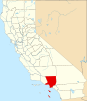
 Location of Claremont in Los Angeles County, California | |
  Claremont Location of Claremont in Los Angeles County, California  Claremont Location of Claremont in California  Claremont Location of Claremont in the USA | |
| Coordinates: 34°6′36″N 117°43′11″W / 34.11000°N 117.71972°W | |
| Country | United States |
| State | California |
| County | Los Angeles |
| Incorporated | October 3, 1907[2] |
| Government | |
| • Type | Council–manager[3] |
| • Mayor | Ed Reece[4] |
| • Mayor Pro Tem | Sal Medina |
| • City Council |
|
| • City Manager | Adam Pirrie |
| Area | |
| • Total | 13.47 sq mi (34.89 km2) |
| • Land | 13.34 sq mi (34.54 km2) |
| • Water | 0.14 sq mi (0.35 km2) 1.03% |
| Elevation | 1,168 ft (356 m) |
| Population (2020) | |
| • Total | 37,266 |
| • Density | 2,794.60/sq mi (1,079.01/km2) |
| Time zone | UTC−8 (PST) |
| • Summer (DST) | UTC−7 (PDT) |
| ZIP Code | 91711 |
| Area code | 909 |
| FIPS code | 06-13756 |
| GNIS feature IDs | 1652685, 2409465 |
| Commuter rail | Claremont  |
| Website | www |
.jpg)


.JPG)

.jpg)
Claremont (/ˈklɛərmɒnt/) is a suburban city in Los Angeles County, California, United States, 30 miles (48 km) east of Los Angeles. It lies in the eastern portion of the county, in Pomona Valley, at the foothills of the San Gabriel Mountains. As of the 2010 census it had a population of 34,926,[7] and in 2020 the population was 37,266.[8]
Claremont is home to the Claremont Colleges and other educational institutions, and the city is known for its tree-lined streets with numerous historic buildings.[9] Because of this, it is sometimes referred to as "The City of Trees and Ph.Ds."[1] It was named the best suburb in the West by Sunset Magazine in 2016, which described it as a "small city that blends worldly sophistication with small-town appeal."[10][11] In 2018, Niche rated Claremont as the 17th best place to live in the Los Angeles area out of 658 communities it evaluated, based on crime, cost of living, job opportunities, and local amenities.[12]
The city is primarily residential, with a significant portion of its commercial activity located in "The Village," a popular collection of street-front small stores, boutiques, art galleries, offices, and restaurants adjacent to and west of the Claremont Colleges. The Village was expanded in 2007, adding a controversial[13][14] multi-use development that includes an indie cinema, a boutique hotel, retail space, offices, and a parking structure on the site of an old citrus packing plant west of Indian Hill Boulevard. Claremont also hosts several large retirement communities.[15]
Claremont has been a winner of the National Arbor Day Association's Tree City USA award for 22 consecutive years. When the city incorporated in 1907, local citizens started what has become the city's tree-planting tradition. Claremont is one of the few remaining places in North America with American Elm trees that have not been exposed to Dutch elm disease. The stately trees line Indian Hill Boulevard in the vicinity of the city's Memorial Park.
History[edit]

Prior to the establishment of the city of Claremont, the area was frequented by the Serrano, Cahuilla, and Tongva for thousands of years.[16] The Tongva established villages in the area as early as 7000 B.C. and thrived from the freshwater of what the Spanish would call the San Antonio Creek.[16] One well-documented Tongva village, known as Torojoatngna,[17] was located at a place called "Indian Hill" by early American settlers.[16] The village was active until the nineteenth century, housing nearly 200 residents in 1870, yet was eventually abandoned after being ravaged by a smallpox epidemic by 1883.[16]
The city of Claremont was first mapped out by developers in a land boom precipitated by the arrival of transcontinental railroads to Southern California.[18] It was likely named after Claremont, New Hampshire.[19] The early history of the city was closely tied to that of Pomona College, which moved there in 1889.[20] In 1902, a town meeting vote established that east–west streets would be numbered and north–south streets named after colleges and universities.[21] The city was incorporated in 1907.[22]

The citrus groves and open space which once dominated the northern portion of the city have been replaced by residential developments of large homes.[19] Construction of Stone Canyon Preserve, one of the final residential tract developments in the north of the city, commenced in 2003 as part of a complicated agreement between Pomona and the City of Claremont which resulted in the creation of the 1,740-acre (7.0 km2) Wilderness Park. The foothill area also includes the Padua Hills Theatre (a historic site constructed in 1930) and the Claraboya residential area.
Geography[edit]

According to the United States Census Bureau, the city has a total area of 13.35 square miles (34.6 km2), of which 13.3 square miles (34 km2) is land and 0.05 square miles (0.13 km2) (1.03%) is water. Claremont is located at the eastern end of Los Angeles County and borders the cities of Upland and Montclair in San Bernardino County, as well as the cities of Pomona and La Verne in Los Angeles County. It is geographically located in the Pomona Valley.[23] Claremont is approximately 30 miles (48 km) east of downtown Los Angeles.
Climate[edit]
Claremont has a Mediterranean climate (Köppen climate classification Csa). During the summer, temperatures may get very hot, sometimes rising above 100 °F (38 °C). In the autumn, Claremont can experience the gusty "Santa Ana Winds", which can bring fire danger to nearby foothill areas. As winter comes along, most of the city's annual rainfall occurs, which is typical around the Los Angeles metropolitan area. Snow is rare in Claremont, but can be viewed in the nearby San Gabriel Mountains in the winter. In the late spring, Claremont can receive many overcast days due to the strong onshore flow from the ocean. This is typically called "May Gray" or "June Gloom" in the region.
| Climate data for Claremont, California | |||||||||||||
|---|---|---|---|---|---|---|---|---|---|---|---|---|---|
| Month | Jan | Feb | Mar | Apr | May | Jun | Jul | Aug | Sep | Oct | Nov | Dec | Year |
| Mean daily maximum °F (°C) | 68 (20) |
69 (21) |
71 (22) |
76 (24) |
79 (26) |
84 (29) |
90 (32) |
92 (33) |
89 (32) |
80 (27) |
74 (23) |
68 (20) |
78.0 (25.6) |
| Mean daily minimum °F (°C) | 43 (6) |
45 (7) |
47 (8) |
49 (9) |
54 (12) |
58 (14) |
62 (17) |
62 (17) |
60 (16) |
55 (13) |
47 (8) |
42 (6) |
52 (11) |
| Average precipitation inches (mm) | 3.11 (79) |
4.76 (121) |
2.63 (67) |
1.20 (30) |
0.23 (5.8) |
0.09 (2.3) |
0 (0) |
0.03 (0.76) |
0.15 (3.8) |
1.05 (27) |
1.62 (41) |
2.45 (62) |
17.32 (439.66) |
| Source: [24] | |||||||||||||
Demographics[edit]
| Census | Pop. | Note | %± |
|---|---|---|---|
| 1930 | 2,719 | — | |
| 1940 | 3,057 | 12.4% | |
| 1950 | 6,327 | 107.0% | |
| 1960 | 12,633 | 99.7% | |
| 1970 | 24,776 | 96.1% | |
| 1980 | 31,028 | 25.2% | |
| 1990 | 32,503 | 4.8% | |
| 2000 | 33,998 | 4.6% | |
| 2010 | 34,926 | 2.7% | |
| 2020 | 37,266 | 6.7% | |
| U.S. Decennial Census[25] | |||
2010[edit]
The 2010 United States Census[26] reported that Claremont had a population of 34,926. The population density was 2,589.7 inhabitants per square mile (999.9/km2). The racial makeup of Claremont was 24,666 (70.6%) White (58.9% Non-Hispanic White),[27] 1,651 (4.7%) African American, 172 (0.5%) Native American, 4,564 (13.1%) Asian, 38 (0.1%) Pacific Islander, 2,015 (5.8%) from other races, and 1,820 (5.2%) from two or more races. Hispanic or Latino of any race were 6,919 persons (19.8%).
The Census reported that 29,802 people (85.3% of the population) lived in households, 4,926 (14.1%) lived in non-institutionalized group quarters, and 198 (0.6%) were institutionalized.
There were 11,608 households, out of which 3,576 (30.8%) had children under the age of 18 living in them, 6,305 (54.3%) were opposite-sex married couples living together, 1,223 (10.5%) had a female householder with no husband present, 397 (3.4%) had a male householder with no wife present. There were 429 (3.7%) unmarried opposite-sex partnerships, and 138 (1.2%) same-sex married couples or partnerships. 2,957 households (25.5%) were made up of individuals, and 1,556 (13.4%) had someone living alone who was 65 years of age or older. The average household size was 2.57. There were 7,925 families (68.3% of all households); the average family size was 3.10.
The population was spread out, with 6,459 people (18.5%) under the age of 18, 6,778 people (19.4%) aged 18 to 24, 6,940 people (19.9%) aged 25 to 44, 8,979 people (25.7%) aged 45 to 64, and 5,770 people (16.5%) who were 65 years of age or older. The median age was 38.6 years. For every 100 females, there were 88.4 males. For every 100 females age 18 and over, there were 84.7 males.
There were 12,156 housing units at an average density of 901.3 per square mile (348.0/km2), of which 7,700 (66.3%) were owner-occupied, and 3,908 (33.7%) were occupied by renters. The homeowner vacancy rate was 0.9%; the rental vacancy rate was 5.5%. 21,209 people (60.7% of the population) lived in owner-occupied housing units and 8,593 people (24.6%) lived in rental housing units.
During 2009–13, Claremont had a median household income of $87,324, with 7.2% of the population living below the federal poverty line.[27]
2000[edit]
As of the census[28] of 2000, there were 33,998 people, 11,281 households, and 7,806 families residing in the city. The population density was 2,586.6 inhabitants per square mile (998.7/km2). There were 11,559 housing units at an average density of 879.4 per square mile (339.5/km2). The racial makeup of the city was 73.48% White, 15.36% of the population were Hispanic or Latino of any race, 11.51% Asian, 4.98% Black or African American, 0.56% Native American, 0.13% Pacific Islander, 5.20% from other races, and 4.14% from two or more races.
31.3% of households included children under the age of 18. 55.7% were married couples living together, 10.4% had a female householder with no husband present, and 30.8% were non-families. 24.9% of all households were made up of individuals, and 10.6% had someone living alone who was 65 years of age or older. The average household size was 2.56 and the average family size was 3.08.
The population was widely distributed in age, with 20.7% under the age of 18, 18.6% from 18 to 24, 22.8% from 25 to 44, 23.3% from 45 to 64, and 14.6% 65 years of age or older. The median age was 36 years. For every 100 females, there were 88.6 males. For every 100 females age 18 and over, there were 85.1 males.
According to a 2009 estimate, the median household income was $83,342 and the median family income was $107,287.[29] The per capita income for the city was $39,648. About 3.5% of families and 5.4% of individuals were below the poverty line.
German (12.0%) and English (11.6%) were the most common ancestries according to the 2000 census. Mexico (12.7%) and Taiwan (11.0%) were the most common foreign places of birth.[30]
Economy[edit]


Top employers[edit]
According to the city's 2009 Comprehensive Annual Financial Report,[31] the top employers in the city are:
| # | Employer | # of Employees |
|---|---|---|
| 1 | Claremont Colleges | 3,000 |
| 2 | Claremont Unified School District | 750 |
| 3 | HiRel Connectors | 300 |
| 4 | City of Claremont | 259 |
| 5 | Claremont Auto Center | 240 |
| 6 | Claremont Manor | 230 |
| 7 | Technip Energies | 205 |
| 8 | Pilgrim Place | 180 |
| 9 | Indian Hill Nursing | 124 |
| 10 | The Webb Schools | 119 |
Arts and culture[edit]

Claremont has been praised for its vibrant arts and culture scene.[32]
Each year, Claremont holds a springtime folk music festival, hosted by the Folk Music Center Store and Museum. The 35th event took place in May 2018.[needs update]
Local museums include the Raymond M. Alf Museum of Paleontology at The Webb Schools (the only high school in the United States to own and host a nationally accredited museum on campus[33]) and the Benton Museum of Art at Pomona College.[citation needed]
Each July, Ophelia's Jump Productions presents their annual Midsummer Shakespeare Festival at The Sontag Outdoor Theatre in Pomona College. Productions are performed in repertory with local community and civic events and festivities.

The Claremont Village hosts a Pie Day Festival every March 14. In past years, attendees could collect pie recipes as they walked around downtown Claremont and checked out different stores.[34]
In 2019, Claremont made national news after the Claremont United Methodist Church unveiled a nativity scene depicting Joseph, Mary, and baby Jesus separated and locked up in individual chain-link pens. This was done to reflect the plight of immigrants and asylum seekers on the U.S. Southern Border in 2019. The Church had constructed similarly non-traditional nativity scenes in prior years.[35]
Points of interest[edit]

- The Claremont Colleges
- The California Botanic Garden (formerly Rancho Santa Ana Botanic Garden) contains a very large and diverse collection of California native plants, and is open daily for self-guided walking tours.
- Padua Hills Theatre[36]
- Folk Music Center Museum[37]
- Claremont Museum of Art[38]
- Ophelia's Jump Theater[39]
- Benton Museum of Art, Pomona College[40]
Government[edit]

In the Los Angeles County Board of Supervisors, Claremont is in the Fifth District, represented by Kathryn Barger.[41]
In the California State Legislature, Claremont is in the 25th Senate District, represented by Anthony Portantino since 2016, and in the 41st Assembly District, represented by Chris Holden since 2012.[42]
In the United States House of Representatives, Claremont is in California's 28th congressional district, represented by Democrat Judy Chu following 2022 redistricting.[43] Claremont was previously represented by Republican David Dreier,[44] who served from 1981 to 2013. Claremont was also represented by President Richard Nixon when he was a member of the House of Representatives from 1947 to 1950, prior to his becoming a United States senator.
Education[edit]
Public schools[edit]

Claremont's school district is known as the Claremont Unified School District (CUSD). It has seven elementary schools, one intermediate school, El Roble, and two high schools, Claremont High School (CHS) and San Antonio High School.
Private schools (non-tertiary)[edit]
The other high school in Claremont is The Webb Schools, a collective name for two private college preparatory schools for grades 9–12, founded by Thompson Webb in 1922. The two schools, officially the Webb School of California (boys' school) and the Vivian Webb School (girls' school), share the same campus in northwest Claremont. Within the campus is the Vivian Webb Chapel, which began initial construction in 1939. It was built by the founder to his wife, Vivian. The Kimberly Bell Tower was added to the chapel in 1955.[45] The Webb Schools is also home to the Raymond M. Alf Museum of Paleontology, America's only accredited museum located on a high school campus.
Post-secondary[edit]

Private educational institutions host approximately 6,500 students every year from across the country and around the world. The Claremont Colleges, a consortium of seven schools of higher education, include five undergraduate institutions—Pomona College (founded in 1887), Scripps College (1926), Claremont McKenna College (1946), Harvey Mudd College (1955), and Pitzer College (1963)—and two graduate institutions—Claremont Graduate University (1925) and the Keck Graduate Institute of Applied Life Sciences (1997). All of these schools are consistently rated among the best in the nation.
Just north of Foothill Boulevard is the college-owned Robert J. Bernard Field Station, which preserves natural coastal sage scrub on its property. Claremont Lincoln University shares some resources with the Claremont Colleges, but is a separate entity. Claremont School of Theology is a school of theology formerly affiliated with the Claremont Colleges. In May 2023, the school moved from its Claremont campus to the Westwood Methodist Church in Los Angeles.
Media[edit]
The Claremont Courier is widely regarded as Claremont's newspaper of record.[46] In 2018, the Courier was named the top community newspaper in California by the California News Publisher's Association.[47] In addition, Claremont High School's students produce the student newspaper The Wolfpacket, with support and printing services from the Courier. [48]
There are also several media outlets based at the Claremont Colleges, including The Student Life, the oldest college newspaper in Southern California,[49] and the radio station KSPC.[50]
Infrastructure[edit]

Transportation[edit]

Commuter train service to Claremont is provided by Metrolink from the Claremont Metrolink Station. The station is on the San Bernardino Line, with trains traveling to Los Angeles Union Station (west) and San Bernardino – Downtown (east) 19 times on weekdays (20 on Fridays), 10 times on Saturdays, and seven times on Sundays.[51] Claremont's train station is known as the Claremont Depot.
Claremont is also planned to eventually connect with the Metro A Line on the Foothill Extension Project, but this station is currently unfunded.[52] This extension will also provide service to L.A. Union Station via Pasadena.
FlixBus utilizes a stop adjacent to the Claremont Metrolink Station.
The local transit bus service Foothill Transit covers Claremont and several other cities in the eastern San Gabriel Valley.[53]
Notable people[edit]
- Jessica Alba – actress
- Matthew Arias[54] – musician and film editor
- Richard Armour – writer, English professor
- Jacob Bertrand - actor[55]
- Tony Beltran – soccer player
- Arthur T. Benjamin – mathematician[56][better source needed]
- Amanda Blake – actress[57]
- Buckethead – musician
- Robert Buckley – actor
- Kori Carter – hurdler
- John B. Cobb – theologian, philosopher, and environmentalist
- Ray Collins – musician
- John Darnielle – musician and novelist
- Glenn Davis – football player
- David Dreier – former member of the U.S. House of Representatives (1981–2013) and chairman of the House Rules Committee (1999–2007, 2011–2013)
- Peter F. Drucker – management consultant, educator and author
- Bob Earl – racing driver
- B. H. Fairchild – poet and college professor
- Justin Germano – baseball pitcher
- Elliot Graham – film editor and producer
- Ben Harper – musician and humanitarian[58]
- Alex Hinshaw – baseball pitcher
- Anastasia Horne – actress and singer
- Raja Kumari – rapper
- Maud Hart Lovelace – author
- Dileep Rao – actor
- Sam Quinones – journalist and author[59]
- Kristin Rossum – murderer[60]
- Millard Sheets - artist and designer[61][62]
- Paul Soldner – artist
- Noah Song – professional baseball pitcher[63]
- Ruth Suckow – author
- David Foster Wallace – author and professor
- Carleton H. Wright – United States Navy admiral
- Frank Zappa – musician[64]
See also[edit]

References[edit]
- ^ a b Carrier, Susan (June 29, 2003). "What's green and well educated? Claremont". Los Angeles Times. Retrieved November 12, 2014.
- ^ "California Cities by Incorporation Date". California Association of Local Agency Formation Commissions. Archived from the original (Word) on November 3, 2014. Retrieved August 25, 2014.
- ^ "Introduction to Claremont's City Government". City of Claremont. Archived from the original on December 19, 2014. Retrieved March 25, 2015.
- ^ "City Council". City of Claremont. Retrieved January 26, 2022.
- ^ "2020 U.S. Gazetteer Files". United States Census Bureau. Retrieved October 30, 2021.
- ^ "Claremont". Geographic Names Information System. United States Geological Survey, United States Department of the Interior. Retrieved October 12, 2014.
- ^ "Geographic Identifiers: 2010 Census Summary File 1 (G001), Claremont city, California". American FactFinder. U.S. Census Bureau. Archived from the original on February 13, 2020. Retrieved September 3, 2019.
- ^ "Population and Housing Unit Estimates". Retrieved May 21, 2020.
- ^ "Los Angeles County Library - Frequently Asked Questions: Claremont". Archived from the original on December 14, 2010. Retrieved February 7, 2007.
- ^ "5 Best Communities in the West". January 8, 2016.
- ^ Marantos, Jeanette (October 4, 2019). "Four Hours: Claremont is vintage, delicious and delightfully smart". Los Angeles Times. Retrieved August 1, 2020.
- ^ "2018 Best Places to Live in the Los Angeles Area". Niche.
- ^ Claremont Institute. "Redevelopment: Fetch the Vet?". Archived from the original on October 4, 2003.
- ^ "Claremont Insider: Village Implosion?". claremontca.blogspot.com. Retrieved February 21, 2024.
- ^ Anderson, Skylar (August 9, 2021). "2021 Senior Services". Claremont Courier. Retrieved January 30, 2023.
- ^ a b c d e Heritage, Eva Landsberg and Sean Stanley, Claremont (2014). Claremont. Arcadia Publishing. pp. 14–15. ISBN 978-1-4671-3191-9.
{{cite book}}: CS1 maint: date and year (link) CS1 maint: multiple names: authors list (link) - ^ "Tongva's history retraced". Daily Breeze. August 22, 2010. Retrieved December 16, 2022.
- ^ "1887". Pomona College Timeline. November 7, 2014. Retrieved July 18, 2020.
- ^ a b Carney, Steve (January 11, 2019). "Neighborhood Spotlight: Claremont owns its lettered and leafy college-town vibe". Los Angeles Times. Retrieved May 14, 2021.
- ^ "1887". Pomona College Timeline. November 7, 2014. Retrieved July 18, 2020.
- ^ "1902". Pomona College Timeline. November 7, 2014. Retrieved August 11, 2020.
- ^ "History of Claremont". City of Claremont. Retrieved July 22, 2021.
- ^ "San Gabriel Valley Council of Governments". San Gabriel Valley Council of Governments. Retrieved June 11, 2018.
- ^ "Average weather for Claremont". Weather.com. Retrieved February 10, 2018.
- ^ "Census of Population and Housing". Census.gov. Retrieved June 4, 2015.
- ^ "2010 Census Interactive Population Search: CA - Claremont city". U.S. Census Bureau. Archived from the original on July 15, 2014. Retrieved July 12, 2014.
- ^ a b "Claremont (city) QuickFacts". United States Census Bureau. Archived from the original on February 11, 2015. Retrieved February 11, 2015.
- ^ "U.S. Census website". United States Census Bureau. Retrieved January 31, 2008.
- ^ "Claremont Facts and Figures". ci.claremont.ca.us. City of Claremont. Archived from the original on January 14, 2011.
- ^ "Claremont". Mapping L.A. Retrieved February 21, 2024.
- ^ City of Claremont CAFR (Report). June 30, 2009. Retrieved October 19, 2020.
- ^ McManis, Sam (November 22, 2014). "Claremont: That rare travel gem in SoCal, a real college town". The Sacramento Bee. Retrieved March 24, 2021.
- ^ "New Director Appointed at Raymond M. Alf Museum of Paleontology, Current Director Transitions to Emeritus". PR Newswire. January 8, 2021. Retrieved June 21, 2021.
- ^ Plessel, John (March 21, 2019). "Dine 909: Claremont Pie Festival returns on Saturday". Inland Valley Daily Bulletin. Retrieved July 22, 2019.
- ^ "Los Angeles Times". Los Angeles Times. December 13, 2019. Retrieved December 13, 2019.
- ^ "California College Town in a Class by Itself". The New York Times. February 23, 1964. Retrieved May 21, 2021.
- ^ "Museum". Folk Music Center Museum. Retrieved December 31, 2016.
- ^ "Claremont Lewis Museum of Art -". Retrieved February 21, 2024.
- ^ "Ophelia's Jump's". Ophelia's Jump's Theater. Archived from the original on January 1, 2017. Retrieved December 31, 2016.
- ^ "Visit | Pomona Museum". www.pomona.edu. Retrieved February 21, 2024.
- ^ "Supervisor Kathryn Barger - The 5th District". Retrieved January 16, 2022.
- ^ "Statewide Database". UC Regents. Archived from the original on February 1, 2015. Retrieved December 8, 2014.
- ^ "California's 27th Congressional District - Representatives & District Map". Civic Impulse, LLC.
- ^ Dreier, David. "David Dreier". www.congress.gov. Retrieved November 20, 2019.
- ^ "Explore Campus". The Webb Schools. Retrieved April 21, 2024.
- ^ "Claremont Heritage on Instagram: "Welcome to Trivia Tuesday! What is the name of Claremont's local newspaper? Claremont Courier Claremont is fortunate to have a locally…"". Instagram. Archived from the original on December 26, 2021. Retrieved August 2, 2020.
- ^ Weinberger, Peter (April 20, 2018). "COURIER honored as state's top newspaper". Claremont Courier. Archived from the original on August 17, 2018. Retrieved August 17, 2018.
- ^ "Wolfpacket Editorial Policy". The Wolfpacket. Retrieved March 10, 2023.
- ^ "Finding Aid for The Student Life". Online Archive of California.
- ^ "About". KSPC 88.7FM. May 11, 2011. Retrieved April 7, 2021.
- ^ "San Bernardino Line". Metrolink.
- ^ "Glendora to Montclair Work Plan" (PDF). Foothill Gold Line.
- ^ "Foothill Transit | Going Good Places". foothilltransit.org. Retrieved January 23, 2017.
- ^ "Claremont High graduate adds 'Emmy winner' to resume | Claremont Courier". Retrieved February 21, 2024.
- ^ Tisopulos, Melina. "From Student to Screen: a spotlight on Cobra Kai actor, Jacob Bertrand". Retrieved February 21, 2024.
- ^ Chiang, Anna (January 20, 2021). "HMC professor Arthur Benjamin: Professional backgammon player, world-renowned 'mathemagician'". The Student Life. Retrieved November 29, 2022.
- ^ "Amanda Blake, 60, Saloonkeeper On TV's 'Gunsmoke' for 19 Years". The New York Times. August 18, 1989. Retrieved November 29, 2022.
- ^ Appleford, Steve (June 28, 2014). "Ben Harper and his mom roam the store that was a childhood home". Los Angeles Times. Retrieved November 29, 2022.
- ^ Quinones, Sam (June 26, 2017). "My High School Reunion — Claremont". Medium. Retrieved February 11, 2023.
- ^ Farrell, Michael (June 24, 2017). Criminology of Homicidal Poisoning: Offenders, Victims and Detection. Springer. p. 195. ISBN 978-3-319-59117-9. Retrieved November 11, 2020.
- ^ Kendall, John (April 2, 1989). "Millard Owen Sheets, 81; Artist, Designer and Teacher". Los Angeles Times. Retrieved January 17, 2022.
- ^ "Millard Sheets: The Scripps Years, 1932-1955". Ruth Chandler Williamson Gallery. Scripps College. September 1, 2007. Retrieved January 17, 2022.
- ^ "Noah Song - Baseball". Naval Academy Athletics. Retrieved November 11, 2020.
- ^ Allen, David (December 12, 2015). "Did Frank Zappa attend Claremont High? Classmates say yes". Inland Valley Daily Bulletin. Retrieved November 29, 2022.
External links[edit]


Places adjacent to Claremont, California | |
|---|---|



| International | |
|---|---|
| National | |
| Geographic | |
| Other | |