Devil sticks
From Wikipedia, the free encyclopedia
| This article does not cite any references or sources. Please help improve this article by adding citations to reliable sources. Unsourced material may be challenged and removed. (December 2006) |
Devil stick (also Devil Stick, devil stick, devil-stick, Rhythm Stick, or Angel stick, etc., or plural forms) manipulation is a form of gyroscopic juggling, or equilibristics and is generally considered to be one of the 'circus arts'. Sometimes called "devil-sticking" other terms often used are: "twirling", "sticking" and "stick juggling".
A "set" of devil sticks is made up of three pieces - the baton and two control sticks - but it will often be called a "pair of sticks". They can also be called Chinese Juggling Sticks
Typically if a center stick is not tapered (i.e. a straight dowel or rod) and possesses tassels at its end, then it is known as a "Flower Stick" (as the tassels, when the stick is spun, will twirl outwards and resemble an open flower). This term is also now used to describe a straight center stick with any weights (not just tassels) at its end and sometimes refers to hybrid sticks which are both tapered and have weights. Tapered sticks without end weights are known simply as Devil Sticks. Flower sticks can also be properly called "Devil Sticks" as that is the more general term.
Contents |
[edit] Description
A set of devil sticks consists of one baton—usually about 60-120 cm (2-4 feet) long—and two control sticks—generally about 1 cm (0.4 inch) thick and 30-50 cm (12-20 inches) long—which are used to manipulate the baton. The baton (often called "the center stick" or simply "the stick") is in some instances tapered from the end to the center, typically about 3 cm (1.2 inch) in diameter at the ends and 1.5 cm (0.6 inch) in the middle. Designs and measurements vary quite widely, in the extreme case the center stick may be as short as 1-foot (0.30 m) or so, ranging to the extreme length of slightly more than twice that of the juggler's height, in which case the juggler has to stand on a table or pedestal. Most commonly, though, control sticks will be about as long as the combined length of the juggler's hand and forearm, the baton being slightly longer than the width of the juggler's upper body.
[edit] Basic manipulation
A devil stick aka staff/baton is lifted/struck/stroked alternately by the two control sticks ('handsticks' or 'sidesticks'). The handsticks, and sometimes the baton as well, are often covered with a material to provide good 'grip' or friction when in contact with the devil stick. Often this material consists of leather, silicon, rubber, various types of tapes, skateboard grip, sandpaper with a sticky back, or cloth. However, some sets are made of slippery polished, bare hardwood. In one basic stick maneuver, known as the Pendulum, the Idle or Tick-tock the center stick is lifted alternately with the left and right handsticks touching the baton at a point about halfway between the center of gravity and each end, causing the ends to swing to either side while the center of the baton remains at a somewhat constant height
the pendulum is an important move to learn, because to a great extent, every other trick is a variation on it.
The 'helicopter' spin is a variation in which a horizontal rotational force is applied as the baton 'pendulums' in the vertical plane, causing a continuous rotation in a nearly horizontal plane. Advanced twirlers can twirl the stick with one stick only (called the propellor), with an arm, knee or other limb and are able to manipulate the baton in any plane above below or in front of or behind the performer's body while walking, unicycling or tightrope balancing. Some can even twirl two batons simultaneously.
There are an infinite number of tricks available to the devil stickers:
- Any trick done with one hand can be learned with the alternate hand.
- Rotations can be reversed, such as helicopter or propeller spins.
- It is possible to cross ones arms as the devil stick is tick-tocked, this can lead to what appears to be a devil stick version of a three-ball juggling trick called 'Mills Mess'.
- The devil stick may be placed vertically on ones nose, chin, elbow, foot, etc and balanced by moving the bottom of the stick in the same direction that the top is beginning to fall towards.
[edit] History
Juggling Sticks have continuously evolved as they were passed down through the centuries.
The origin(s) of Juggling Sticks aka Devil sticks is truly unknown at this time. What is known it that many civilizations all around the world created many types of Juggling Sticks aka Devil sticks starting some time over 3,500 years ago. Devilsticks.Net
[edit] Modern Sticks
[edit] Evolution
Some modern devil sticks have soft ends for safety and a different style of play - although it is actually quite possible to knock oneself unconscious with some of the faster, harder, heavier 'unpadded' batons.
These are often colorfully decorated and are known variously under such brand names as Devil sticks, Quick Stix, Crystal Stix, Hippie Sticks, Mixstix, LunaStix, Equilibristicks (a play on the word 'equilibristics'), Trick Sticks, juggling sticks, Stunt Sticks and many other names. Despite the plethora of names, stick twirlers often call them simply 'sticks'.
As new materials and construction techniques become available, resourceful jugglers and craftspersons have advanced the design of the 'modern devil sticks', making them more durable, more portable, or having physical properties that enable jugglers to perform feats previously deemed impossible or too difficult to accomplish. It is a widely held belief[citation needed] that 'sticks' will continue to advance as construction techniques and materials become more advanced or as materials become more widely available. An example of an advance is stick on which the ends can be lit on fire, often referred to as "fire spinning".
Some new advancements are Fire Flower Sticks. They are very similar to fire devil sticks but have silicon rubber which allows for maximum grip and playability, as well as having flower chain ends that counteract the gravity roll. There are holes drilled into the baton to cool the flame down if the fire back drafts down towards the center of the baton, this protects the rubber as well as your hand stix from burning as much.
[edit] Variations
A variation of the devil sticks is the, "flower sticks,". The flower stick was designed to slow down the very fast movement of the heavier and shorter central baton of the traditional Devil sticks, so it could be used to learn more difficult moves and tricks, but was later found to be a fun toy in itself, although the design was not patentable.
An increasingly common 'modern' variation on stick design is that of Fiddlestix, which are made of cylindrical aluminum alloy or titanium shafts, either hollow or solid. The center stick is wrapped spirally with dense suede, butted edge-to-edge to make a smooth, suede covered 'frictive surface' and the end of the shaft is wrapped with a one to two inch (5 cm) thick layered, floppy 'tassel' of wide-cut, fringed suede. The sidesticks of a set of fiddlestix are either similarly covered with suede ('slider set' is what this is called, as the suede can help the centerstick to slide smoothly along the control stick) or are covered with surgical rubber or silicone tubing (grippier but no slide). In the case of the solid titanium baton, the surface of the stick is either machine-milled or grit-blasted, to produce the friction surface and there is no covering on the length of the center stick. This type of stick is almost universally paired with control sticks covered in a soft natural latex, silicone, or hard vulcanised rubber tubing - materials which provide varying degrees of friction against the bare metal of the baton's control surface.
[edit] Physics of devil sticks Design
The length of the shaft and the weight of the end-pieces work together to retard rotation about the pivot point of the center stick, creating a larger 'sweet spot' (the point at which the control stick has the greatest degree of controlled influence on the movement of the baton). The larger sweet spot combined with increased rotational inertia allows the sticks to be played in ways that would be difficult to learn otherwise. It also increases the illusion that the laws of physics/gravity are being broken. To an extent, the longer the shaft, and the heavier the weight, the greater the illusion.
This process of weight vs. speed can be understood simply with the high school physics equation T=Iα, where T is the torque being applied, I is the moment of inertia and α is the rotational acceleration. Torque is the cross product of Force and radius, or the tendency of a force to cause rotation. For a more intuitive view of the equation rearrange it to be α=T/I; here it is clear the acceleration is dependent upon torque and moment of interia.
It is possible to teach some basic physics using devil sticks. Balancing the devil stick horizontally on one handstick shows a fulcrum (centre of the devil stick) and each side of the fulcrum is equal length, weight and mass. Putting the handstick to one side of the centre and letting go of the devil stick (held with hand) will mean the devil stick will begin to fall down (due to gravity) on the longer, heavier side of the fulcrum. As a devil stick is essentially two pendulums fixed together in the middle, a shorter devil stick will tend to spin (propeller trick) more quickly than a longer one, so demonstrating frequency or natural resonance.
Many tricks learned on the slower Flower sticks can be translated to the higher speed action and reaction time necessary for the more difficult and faster one-piece Devil sticks. It is possible (and fun) to devil stick other objects such as a walking stick, NHS crutch or rolled-up umbrella, indeed, almost any relatively round object with a long axis.
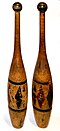
Traditional Devil sticks are made of a one-piece lathed dowel of perhaps two feet long with the ends made at least twice as thick as the middle. The shorter length makes it have a much faster spin and unpredictability factor. It is often wrapped with tape or other material to allow some traction for the contact with the same style rubber hand sticks, and the ends are sometimes slightly padded. This is the more dangerous juggling toy that can split a lip or deliver a serious blow to a learner or the inattentive.
[edit] Group activities
Though stick manipulation may seem at first glance to be a solo performance art, there are numerous group activities which 'stickers' enjoy:
[edit] Passing
Two or more twirlers sling the center stick back and forth amongst themselves, either with one shared stick, or with everyone passing their own stick at once.
[edit] Juggle till you drop
Juggle till you drop is an activity in which a group of twirlers share one stick - the juggler with the stick attempts increasingly more difficult and flamboyant tricks, during his turn, attempting to 'push the envelope' so hard that he loses control and drops the stick - a drop is when the stick hits the ground and comes to rest - whereupon he immediately hands the control sticks to the next player, who attempts an even more difficult combination of moves. The point of the game is to juggle so aggressively that each turn lasts a matter of seconds. This results in:
- everyone gets to play, even with only one stick in the group...
- everyone sees each other push the limits, and often new tricks are invented based on 'mistakes', or derived from another juggler's attempts...
- one has an opportunity to rest, as juggling at the edge of your abilities uses lots of energy.
[edit] Half-sticking
Where two jugglers, standing shoulder to shoulder facing in the same direction, each with one control stick, juggle together 'a la' three-legged race, each one only doing half the work.
[edit] Combat sticks
- 'Solo': two or more stickers use their center stick only, to knock the others' stick to the ground. A variation on this allows them to use their control sticks as well. There are also anything goes variations, where the first to drop the stick loses, and anything short of actual violence is allowed.
- 'Team': Generally the same as above, but with two or more teams competing.
- 'Devil duels': two competitors stand in a circle with devil sticks and attempt to hit the other person's torso with the moving devil stick. The first person to hit the other a certain number of times wins. The stick may be knocked off balance by the other player's stick but not by any part of their body, hitting the stick with parts of your body or knocking the opponent's head with the moving stick may count as a foul, game is forfeit when an agreed-upon number of fouls is reached. Various other rules may be used as appropriate to the players' skill levels.
[edit] Devil stick Volleyball
One player stand on either side of the net with two controllers aka handles and passes or tosses the main Devil stick back and forward over the net. Each player may only tape the Devil stick three times before passing it over the net or over to their team mate. Scoring and faults are the same as normal volleyball.
[edit] Propeller Endurance
A group of spinners will perform an infinite propeller for as long as they can. A host may ask the spinners to change directions or hands. Once only a small amount of spinners are left, the game turns into Gladiators/Combat sticks.
[edit] Fire Devil sticks
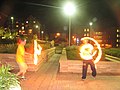
Fire devil sticks includes the same categories of play described above. Fire devil sticks mainly have an aluminum core. Flaming devil sticks have wicks on the ends allowing them to be set afire, using a variety of flammable liquids as fuel. The most commonly used fuel is paraffin oil or kerosene as it is known in the US. Different substances can be added to the fuels to gain different coloured flames. For example copper chloride will produce a blue flame. However, advice should always be sought from an expert before mixing chemicals. Firesticks are an inherently hazardous activity. Appropriate fire precautions should always be taken when using burning fuels. Serious burns, and damage to property, can result from mishandling burning materials.
Fire Devil sticks are sometimes used to add an element of danger to performances. When photographing these performances, long exposure times are used to catch the trails of motion.
[edit] See also
[edit] Cool Links
- Devilsticks.Net The Devilsticks Network is the original Devil sticks web site. This web site has several 3D animations of juggling stick aka devil stick tricks with descriptions, the tricks table, free juggling stick wallpapers, free folder icons, many juggling stick events, "The Sticks Newsletter", Juggling Sticks History on CD-ROM / E-Book, links and information on the next (IJSC) International Juggling Sticks Competition.
- Devilstick.de This site contains many devil stick trick descriptions most of which are accompanied by animations.
- Devil Sticks Tutorials Page This page contains online books and tutorials for learning and performing devil sticks.
- Devilsticks.org Site contains information on devil stick history, what they are, what distinguishes them from "flower sticks" and details various devil stick designs available on the web today.