


Gotthard Base Tunnel
 | This article needs additional citations for verification. (August 2024) |
 Turnout at Faido multifunction station | |
| Overview | |
|---|---|
| Official name | |
| Line | Gotthard Line |
| Location | Switzerland (Uri, Grisons and Ticino) |
| Coordinates |
|
| Status | Active since 11 December 2016[1] (Partially interrupted 10 August 2023 to 2 September 2024)[2] |
| System | Swiss Federal Railways (SBB CFF FFS) |
| Crosses | Alps (western Glarus Alps and central Lepontine Alps at the eastern Gotthard Massif) |
| Start | Erstfeld, canton of Uri (north, 460 m or 1,510 ft) |
| End | Bodio, canton of Ticino (south, 312 m or 1,024 ft) |
| Operation | |
| Work begun | 4 November 1999[3] |
| Opened | 1 June 2016[4] |
| Owner | SBB Infrastructure |
| Operator | SBB CFF FFS |
| Traffic | Railway |
| Character | Passenger and freight |
| Technical | |
| Length | 57.09 km (35.5 mi); total 151.840 km (94.3 mi) for all tunnels, shafts and passages[5] |
| Line length |
|
| No. of tracks | 2 single-track tubes[5] |
| Track gauge | 1,435 mm (4 ft 8+1⁄2 in) (standard gauge) |
| Electrified | 15 kV 16.7 Hz |
| Operating speed | |
| Highest elevation | 549 m (1,801 ft)[5] |
| Lowest elevation | 312 m (1,024 ft) (south portal)[5] |
| Tunnel clearance | 5.20 m (17 ft 1 in) from top of rail to overhead conductor[5] |
| Grade |
|
| Route map | |
 | |
The Gotthard Base Tunnel (GBT; German: Gotthard-Basistunnel, Italian: Galleria di base del San Gottardo, Romansh: Tunnel da basa dal Sogn Gottard) is a railway tunnel through the Alps in Switzerland. It opened in June 2016 and full service began the following December.[9][10] With a route length of 57.09 km (35.5 mi),[5] it is the world's longest railway and deepest traffic tunnel[11][12][13][note 1] and the first flat, low-level route through the Alps.[14] It lies at the heart of the Gotthard axis and constitutes the third tunnel connecting the cantons of Uri and Ticino, after the Gotthard Tunnel and the Gotthard Road Tunnel.
The GBT consists of a large complex with, at its core, two single-track tunnels connecting Erstfeld (Uri) with Bodio (Ticino) and passing below Sedrun (Grisons). It is part of the New Railway Link through the Alps (NRLA) project, which also includes the Ceneri Base Tunnel further south (opened on 3 September 2020) and the Lötschberg Base Tunnel on the other main north–south axis. It is referred to as a "base tunnel" since it bypasses most of the existing vertex line, the Gotthard railway line, a winding mountain route opened in 1882 across the Saint-Gotthard Massif, which was operating at its capacity before the opening of the GBT. The new base tunnel establishes a direct route usable by high-speed rail and heavy freight trains.[15]
The main purpose of the Gotthard Base Tunnel is to increase local transport capacity through the Alpine barrier, especially for freight on the Rotterdam–Basel–Genoa corridor, and more specifically to shift freight volumes from trucks to freight trains. This both significantly reduces the danger of fatal road crashes involving trucks, and reduces the environmental damage caused by heavy trucks. The tunnel also provides a faster connection between the canton of Ticino and the rest of Switzerland, as well as between northern and southern Europe, cutting the Basel/Zürich–Lugano–Milan journey time for passenger trains by one hour (and from Lucerne to Bellinzona by 45 minutes).[16]
After 64 percent of Swiss voters accepted the NRLA project in a 1992 referendum, the first preparatory and exploratory work began in 1996. Construction began in November 1999 at Amsteg.[17] Drilling operations were completed in March 2011. The final cost is projected as CHF 9.560 billion.[18]
Description
[edit]The Gotthard Base Tunnel, with a length of 57.09 km (35.5 mi) and a total of 151.84 km (94.3 mi) of tunnels, shafts and passages, is the longest railway tunnel in the world,[note 2] with a geodetic distance of 55.782 km (34.7 mi) between the two portals.[5][12] It is also the first flat route through the Alps or any other major mountain range, with a maximum elevation of 549 m (1,801 ft) above sea level,[5] corresponding to that of Bern. It is the deepest railway tunnel in the world, with a maximum depth of 2,450 m (8,040 ft),[5] comparable to that of the deepest mines on Earth. Without ventilation, the temperature inside the mountain reaches 46 °C (115 °F).[5]
Like the two other tunnels passing below the Gotthard, the Gotthard Base Tunnel connects two Alpine valleys across the Saint-Gotthard Massif: the Urner Reusstal in the canton of Uri, in which flows the river Reuss, and the Valle Leventina, the largest valley in the canton of Ticino, in which the river Ticino flows. Unlike most other tunnels, the Gotthard Base Tunnel passes under several distinct mountain massifs, two of them being major subranges of the Alps, the Glarus Alps and the Saint-Gotthard Massif, with the valley of the Anterior Rhine, the Surselva in the canton of Graubünden, between them. The tunnel passes under these two ranges more than 2,000 m (6,562 ft) below the Chrüzlistock (2,709 m or 8,888 ft) and the Piz Vatgira (2,983 m or 9,787 ft, near the Lukmanier Pass). While the cantons of Uri and Ticino are part of the German- and Italian-speaking areas of Switzerland respectively, the Surselva is mainly Romansh-speaking.
.jpg)
.jpg)
The Alps strongly influence the European climate – and that of Switzerland in particular – and there can be substantially different weather conditions at each end of the GBT, described by the Ticinese architect Mario Botta: "The light changes at the Gotthard: that of the Mediterranean Sea is not the same as that of the continent, that of the central lands, that of Europe far away from the sea."[19] On average, the temperature is about 3 °C (5 °F) higher on the south side than the north side, but on some days, temperature differences are well over 10 °C (18 °F).[note 3]
The north portal lies in the north of the municipality of Erstfeld at an elevation of 460 m (1,510 ft), east of the Reuss. There, the tunnel penetrates the western slopes of the Bälmeten and Chli Windgällen (although only marginally) before passing below the valley of the Chärstelenbach, a creek in the Maderanertal. From there, the tunnel runs parallel to the small valley of Etzli, below the Witenalpstock. The main crest of the Glarus Alps, which is the watershed between the Reuss and the Anterior Rhine, is crossed below the Chrüzlistock, the crest having an elevation of about 2,700 m (8,900 ft) at this point. From the crest and border, the tunnel runs parallel to the small valley of the river Strem (Val Strem) before passing below Sedrun and the Anterior Rhine. From the bottom of the valley, the tunnel proceeds towards the valley of the Rein da Nalps (Val Nalps) and passes east of Lai da Nalps, before crossing the Gannaretsch range below the western summit of Piz Vatgira (2,981 m (9,780 ft)). This is the deepest point of the tunnel, with a rock layer of 2,450 m (8,040 ft) above it. The tunnel then passes below the valley of the Rein da Medel (Val Medel) and west of Lai da Sontga Maria. After a few kilometres the tunnel crosses the watershed between the Anterior Rhine and the Ticino, just north of Pizzo dell'Uomo (2,525 m (8,284 ft)). This point corresponds to the main chain of the Alps, and is the main drainage divide between the Rhine and the Po. For a few kilometres, the tunnel passes below two western tributaries of the Brenno in the Valle Santa Maria before crossing the last range, west of the Passo Predèlp (about 2,500 m (8,200 ft)) and east of Faido. It then follows the eastern slopes of the large Valle Leventina, the valley of the Ticino, for about 18 km (11 mi) to the south portal at Bodio, at an elevation of 312 m (1,024 ft), just 3 km (1.9 mi) before Biasca, where the Brenno converges with the Ticino.[note 4]
The closest railway stations to the portals are Altdorf and Biasca. The first regularly served railway stations on the base line (as of 2016/17) are those of Arth-Goldau (Schwyz), a railway node with links to Lucerne and Zürich, and Bellinzona (the "Gate of Ticino"), with links to Locarno, Luino and Lugano (via the Monte Ceneri Rail Tunnel). The journey from Arth-Goldau to Bellinzona takes not more than an hour. The station of Altdorf is planned to be served by 2021. There also have been talks of using that of Biasca. The travel between Altdorf and Biasca would last less than 25 minutes.
-
 Erstfeld, north portal, 460 m (1,510 ft) a.s.l.
 -
 Amsteg portal (maintenance access), 507 m (1,663 ft) a.s.l.
 -
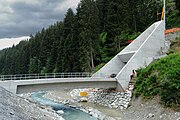 Sedrun portal (maintenance access, bridge over the Anterior Rhine), 1,334 m (4,377 ft) a.s.l.
 -
 Faido portal (maintenance access), 757 m (2,484 ft) a.s.l.
 -
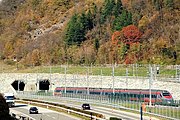 Biasca, south portal, 312 m (1,024 ft) a.s.l.

.jpg)

.jpg)

History
[edit]Background
[edit]
Since the 13th century, the 2,106 m-high (6,909 ft) Gotthard Pass has been an important trade route from northern to southern Europe. Control of its access routes led to the birth of the Swiss Confederacy. The Gotthard Pass is located halfway between Lake Lucerne and Lake Maggiore. It is the shortest link between the navigable Rhine and the Po. Before modern transport, the traverse of the pass took days, and snow makes it a challenge in winter.[20]
Quite late, compared to other current top-importance routes through the Alps (e.g. Simplon, San Bernardino, Brenner, Mont Cenis), namely in 1830, the first Saint-Gotthard Pass road was established after centuries-long usage of a bridle path. From 1842 onwards, a daily course by the Gotthard Post, a stagecoach drawn by five horses with ten seats, still took about 23 hours from Como to Flüelen. It would last until 1921.


In 1882, with the inauguration of the Gotthard Railway Tunnel, the travel time between Altdorf and Biasca was reduced dramatically to only hours, though often accompanied with overnight stays in large Fin de siècle-hotels, for example in Biasca. In those days, it was still an adventure and it was only affordable to the rich. Electrification of the railway line in 1922 significantly reduced travel time again. Refilling water boilers of steam locomotives was no longer necessary. There were also the technical advantages of electrical engines and future technical improvements.
From 1924, car transport on trains through the railway tunnel began. The road between Göschenen and Airolo over the summit of the pass, comporting notably the Schöllenen ravine and the Tremola, had countless hairpin turns and serpentine curves, dropping 1,000 m (3,300 ft) in altitude. It posed a huge challenge for automobiles of those days. From 1953 onwards, the pass road was sequentially improved and expanded at several sections along the Gotthard route, finally ending in 1977 with the opening of an expressway fully circumventing the Tremola. In winter, however, due to the snow, cars could only cross the Gotthard on the train.
Transit time was further dramatically reduced with the opening of the Gotthard Road Tunnel and the finalization of the northern part of A2 motorway through the Urner Reusstal (in close proximity to the railway), with many additional tunnels (then leading from Basel to the Gotthard Road Tunnel), in 1980. With the completion in 1986 of the A2 motorway in the Valle Leventina, the main valley leading from Airolo down to Bellinzona, and the surmounting of the Monte Ceneri between Bellinzona and Lugano in 1983, finally a continuous motorway was established from the northern border of Switzerland in Basel to the southern border in Chiasso, or the shortest motorway route from North-German Hamburg as far as South-Italian Sicily, bringing down the competitiveness of the railway line.[21] Passenger speed was also increased on the railway line with the use of tilting trains, notably the ICN, although maximum speed remaining far lower than on a modern straight high-speed line. Both modern motorway and historic railway rely on heavy rockfall and avalanche protection equipments and are exposed to harsh weather condition in winter.
After the opening of the auto tunnel, in 1980, traffic increased more than tenfold. The existing tunnel was at its capacity by 2013.[22] A second tunnel will be built next to the first, following a national referendum.[23][24] Construction started in 2021 and is scheduled to finish in 2027.

As early as 1947, engineer Eduard Gruner imagined a two-story base tunnel from Amsteg to Biasca, both rail and road, with a stop at Sedrun, to provide a faster and flatter passage through the Swiss Alps. Similarly to Gruner's idea, the GBT cuts through the Gotthard Massif some 600 m (2,000 ft) below the older tunnel. On the historic track only the Gotthard Railway trains up to 1,300 t (2.9×10⁶ lb)[25] when using two locomotives or up to 1,500 t (3.3×10⁶ lb) with an additional bank engine at the end of the train are able to pass through the narrow mountain valleys and through spiral tunnels climbing up to the portals of the old tunnel at a height of 1,151 m (3,776 ft) above sea level. Since the GBT is in full service, standard freight trains of up to 3,600 t (7.9×10⁶ lb) are able to pass this natural barrier.
Because of ever-increasing international truck traffic, Swiss voters chose a shift in transportation policy in September 1992 by accepting the NRLA proposal. A second law, the Alpine Protection Act of February 1994,[26] requires a shift of as much tonnage as possible from truck transport to train transport.
The goal of both the laws is to transport trucks, trailers and freight containers through Switzerland, from Basel to Chiasso, and beyond by rail to relieve the overused roads, and that of the Gotthard in particular, by using intermodal freight transport and rolling highways (where the entire truck is transported). The GBT substantially contributes to the requirements of both laws and enables a direct flat route from the ports of the North Sea (notably Rotterdam) to those of the Mediterranean Sea (notably Genoa), via the Rhine corridor.
Although the technical maximum speed is 250 km/h (155 mph) through the GBT, the maximal authorized speed has been reduced to 230 km/h (145 mph) for ecological and economical reasons, while the operating speed of passenger trains is restricted to 200 km/h (125 mph) in order to accommodate the freight traffic, with the possibility to accelerate up to 230 km/h (145 mph) in case of delay.[6][7][8] At opening the GBT reduced travel times for trans-Alpine train journeys by about 40 minutes, and by one hour when the adjacent Zimmerberg and Ceneri Base Tunnels were completed. This is viewed as a revolution, especially in the isolated region of Ticino, which is separated from the rest of the country by the Alps and the Gotthard. The two stations of Bellinzona and Lugano (respectively named "Gate of Ticino" and "Terrace of Ticino") were entirely renovated for the opening of the GBT, among other improvements.[citation needed]
As of 2016, the Gotthard Base Tunnel is the longest railway tunnel in the world. It is the third Swiss tunnel to bear this title, after the Gotthard Tunnel (15 km or 9.3 mi, 1882) and the Simplon Tunnel (19.8 km or 12.3 mi, 1905).[27] It is the third tunnel built under the Gotthard, after the Gotthard Tunnel and the Gotthard Road Tunnel.
Construction
[edit]| Year | Month | Total excavated | ||
|---|---|---|---|---|
| (kilometres) | (miles) | Of planned (%) | ||
| 2004 | July | 52.34 | 32.52 | 34.1 |
| 2005 | June | 74.59 | 46.35 | 48.6 |
| 2006 | June | 94.10 | 58.47 | 61.3 |
| 2007 | June | 103.67 | 64.42 | 67.6 |
| 2008 | March | 108.02 | 67.12 | 70.4 |
| April | 109.00 | 67.73 | 71.0 | |
| July | 113.20 | 70.34 | 73.8 | |
| August | 115.20 | 71.58 | 75.1 | |
| October | 118.40 | 73.57 | 77.2 | |
| 2009 | January | 124.00 | 77.05 | 81.6 |
| March | 127.30 | 79.10 | 83.9 | |
| May | 131.00 | 81.40 | 86.3 | |
| June | 133.00 | 82.64 | 87.6 | |
| July | 134.80 | 83.76 | 87.9 | |
| August | 136.60 | 84.88 | 90.0 | |
| September | 137.30 | 85.31 | 90.4 | |
| October | 138.60 | 86.12 | 91.3 | |
| November | 140.00 | 86.99 | 92.2 | |
| December | 141.38 | 87.85 | 93.0 | |
| 2010 | January | 141.82 | 88.12 | 93.4 |
| February | 142.48 | 88.53 | 93.8 | |
| March | 143.80 | 89.35 | 94.7 | |
| April | 144.80 | 89.97 | 95.4 | |
| May | 145.40 | 90.35 | 95.8 | |
| June | 146.10 | 90.78 | 96.2 | |
| July | 146.60 | 91.09 | 96.6 | |
| August | 147.33 | 91.55 | 97.0 | |
| September | 147.98 | 91.95 | 97.5 | |
| October | 149.10 | 92.65 | 98.2 | |
| November | 149.90 | 93.14 | 98.7 | |
| December | 150.40 | 93.45 | 99.0 | |
| 2011 | January | 150.49 | 93.51 | 99.1 |
| February | 150.77 | 93.68 | 99.3 | |
| March | 151.26 | 93.99 | 99.6 | |
| April | 151.70 | 94.26 | 99.91 | |
| May | 151.75 | 94.29 | 99.94 | |
| June | 151.82 | 94.34 | 99.99 | |
| July | 151.82 | 94.34 | 100[30] | |
AlpTransit Gotthard AG was responsible for construction. It is a wholly owned subsidiary of the Swiss Federal Railways (SBB CFF FFS).
To cut construction time in half, four access tunnels were built so that construction could start at four different sites simultaneously: Erstfeld, Amsteg, Sedrun, and Faido. A fifth at Bodio was added later. The two tunnels are joined approximately every 325 m (1,066 ft) by connecting galleries. Trains can move between the tunnels in the two multifunction stations at Sedrun and Faido. These stations house ventilation equipment and technical infrastructure and serve as emergency stops and evacuation routes.[15]
Access to the Sedrun station site is by a level access tunnel 1 km (0.6 mi) long from the valley floor near Sedrun. At the end of the access tunnel, two vertical shafts lead 800 m (2,625 ft) down to the base tunnel level. A proposal to construct a functioning railway station, called Porta Alpina (from Romansh, "Alpine Gate"), at this site was evaluated, but the project was put on hold in 2007 and definitively cancelled by the federal authorities in 2012 as uneconomical.[31]
The final breakthrough in the east tube occurred on 15 October 2010 at 14:17 +02:00.[32] The final breakthrough in the west tube occurred on 23 March 2011 at 12:20.[33][34]
On 30 August 2013, the tunnel was entirely traversed for the first time from Bodio to Erstfeld in six hours, by diesel train, buses and by foot.[35]
On 16 December 2013, the operational test phase started on a 13-kilometre (8.1 mi) stretch in the southern section of the west tube between Faido and Bodio. Its purpose was to test the infrastructure and any ancillary systems.[36]
On 31 October 2014, the railway track installation was completed. A gold sleeper on the very last part of the track was installed during the event to mark this milestone of progress.[37][38]
On 1 October 2015, following permission by the Federal Office of Transport, the first tests on the entire length of the GBT were performed, with steadily increasing speed. On 8 November, a train reached the top speed of 275 km/h (171 mph).[39]

Allocation of work
[edit]
The contracts were awarded in sections:
- Erstfeld (the 7.7 km (4.8 mi) section from Erstfeld to Amsteg), with two tunnel boring machines (TBM) boring the two tubes. The break-through of the east tube between Erstfeld and Amsteg took place on 15 June 2009. The portal area was surface-mined.
- Amsteg (the 11.3 km (7.0 mi) section from Amsteg to north of Sedrun), ARGE AGN (Strabag and Züblin Murer) received the contract for work in this sector.[40] On 9 December 2009, the Amsteg section was officially delivered to the owner for fitting-out,[41] with civil engineering, construction, concrete and lining work completed in early 2010.[42]
- Sedrun (the 8.6 km (5.3 mi) East tube and 8.7 km (5.4 mi) West tube in the section immediately north and south of Sedrun), along with work performed by Transco (Bilfinger SE, Implenia, Frutiger and Impresa Pizzarotti).[43][44] The final breakthrough in the west tube occurred in March 2011.[45] The northbound tubes from Amsteg to the Sedrun multifunction station (north) were handed over to the railway systems contractor Transtec Gotthard on 15 September 2011, the date specified in the construction schedule.[46]
- Faido (13.4 km (8.3 mi) East tube and 13.6 km (8.5 mi) West tube in the section from south of Sedrun to Faido), with Consorzio TAT (Alpine Mayreder Bau, CSC Impresa costruzioni, Hochtief and Implenia and Impregilo).[47]
- Bodio (15.9 km (9.9 mi) East tube and 15.6 km (9.7 mi) West tube in the section from Faido to Bodio), with work performed by Consorzio TAT (Alpine Mayreder Bau, CSC Impresa costruzioni, Hochtief, Implenia and Impregilo).[47] Civil engineering construction, concrete and lining works were completed in early 2010.[42]
Deaths during construction
[edit]Nine workers died during construction; one in the Amsteg section, two in the Sedrun section, and three each in the southernmost Faido and Bodio sections.[48]
| Date | Nationality | Details |
|---|---|---|
| 8 June 2000 | German | Hit by a boring bar that fell 700 m (2,300 ft).[49] |
| 12 March 2002 | South African | Buried by excavation material.[50] |
| 3 April 2003 | German | Hit by a rock.[51] |
| 11 September 2003 | Austrian | Crushed by a toppling cable drum.[52][53] |
| 21 January 2005 | Italian (1) Italian (1) |
Hit in a mine train collision.[54][55] |
| 23 November 2006 | German | Crushed by a mine train.[56] |
| 24 June 2010 | German | Catapulted from an inspection train.[57] |
| 16 July 2012 | Italian | Fell from a scaffold.[58] |
Inauguration and commissioning
[edit]
In 2016, several events, including festivities and special exhibitions, were held around the Gotthard, culminating in the inaugurations in early June, dubbed Gottardo 2016. Public institutions joined the celebrations: Swiss Post issued a special stamp commemorating the Gotthard Base Tunnel,[59][60] and Swissmint issued gold and silver coins dedicated to the opening.
On 31 May 2016, a day before the inauguration, the nine people who died during construction were commemorated in a ceremony at the north portal in Erstfeld that was led by a Catholic vicar general, a vicar of the Evangelical-Reformed Church of Uri, a Jewish rabbi, and a Muslim imam. A bronze memorial plaque with their names — four coming from Germany, three from Italy, and one from each of South Africa and Austria – was unveiled by AlpTransit Gotthard AG CEO Renzo Simoni.[48] A Catholic shrine to Saint Barbara, the patron of miners, stands inside the tunnel as a memorial.[61]
.jpg)
The tunnel was officially inaugurated on 1 June 2016.[61] At the northern entrance in Erstfeld, President of the Confederation Johann Schneider-Ammann spoke of a "giant step for Switzerland but equally for our neighbours and the rest of the continent", while a live relay carried a speech given by Transport Minister Doris Leuthard at the southern entrance in Bodio. The first journey carried hundreds of Swiss citizens who had won tickets in a draw, while the assembled guests in Erstfeld, including the Federal Council in corpore, heads of state and government from neighbouring countries and transport ministers from European countries, attended the opening show Sacre del Gottardo by Volker Hesse featuring 600 dancers, acrobats, singers and musicians celebrating Alpine culture and myths around the Gotthard.[61] On the following weekend, popular festivities and special exhibitions, attended by more than 100,000 visitors, were held.
From 2 August to 27 November 2016, the Swiss Federal Railways ran a special train service through the tunnel called "Gottardino" which was open to the public. It was a once-daily service from Flüelen railway station to Biasca railway station and in reverse. The trains made a stop inside the tunnel, to allow passengers to visit an exhibition inside the underground multifunction station in Sedrun which would normally be used in emergency only.[62]
Regular services
[edit]
During 2016, the GBT was tested extensively[63][64] before its integration into the regular schedule on 11 December.[65] On 5 December, the Swiss Federal Railways were granted permission from the Federal Transport Office to use the new base line. While the base tunnel is used for InterCity trains (ICN) and EuroCity trains (EC), the vertex line remains in use for regional trains.[63] Since 2019, the Gotthard axis is served by the Stadler EC250 (Giruno) high-speed train and future flagship of the SBB fleet.
From the Amsteg portal, guided tours are organised inside the Gotthard Base Tunnel complex. A window allows visitors to watch the trains running in the tunnel.
2023 derailment and closure
[edit]On 10 August 2023, a freight train derailed while traveling through the tunnel, causing extensive damage to the tunnel infrastructure.[66] The incident occurred near the multi-functional station of Faido, in the canton of Ticino. No one was injured, and no hazardous materials were released. The derailment caused significant damage to the tunnel, prompting its closure to both passenger and freight traffic. The tunnel returned to normal service on 2nd September 2024. See more information in the incidents section.
Politics
[edit]
The realization of the GBT, as the centrepiece of the NRLA, is also a prototypical example of direct democracy in Switzerland. In order to accomplish this mega-project the political institutions also had to overcome many parliamentary sessions and several major popular votes, including the following:[67]
- 27 September 1992, NRLA proposal (mandatory referendum): The final proposal by the Federal Council was accepted by 63.6% yes votes (declined by 1+2/2 cantons, turnout 45.9%)[68][69]
- 20 February 1994, Alps Initiative (federal popular initiative): Initiated by a few private people with the goal to protect the Alpine environment from the negative impact of traffic was accepted[70] by 51.9% yes votes (declined by 7 cantons, turnout 41%).[71][72] The initiative was accepted despite the recommendation by the Federal Council from 12 February 1992 to decline the initiative without any counterproposal,[72][73] and despite the parliamentary recommendation (both chambers) from 18 June 1993 to decline the initiative.[72][74]
- 29 November 1998, Public Transport Funding (mandatory referendum): A total budget of CHF 30 billion for several public transport projects was accepted by 63.5% yes votes (declined by 1+3/2 cantons, turnout 38.3%); "the NRLA is to receive CHF 13.6 billion"[75][76]
- 21 May 2000, Bilateral EU Agreements / 40-tonne Trucks / Heavy Traffic Fee (optional referendum): As part of a whole package of several bilateral agreements with the EU the Swiss also accepted by 67.2% yes votes (declined by 2 cantons, turnout 48.3%) the shift of an upper limit for trucks from 28 tonnes (62 thousand pounds) to 40 tonnes (88 thousand pounds), but at the same time the EU agreed to a new heavy-traffic fee, which would also be used to finance the NRLA[77][78]
- 17 December 2003, Ceneri Base Tunnel (parliamentary session): The controversial funding of the Ceneri Base Tunnel was finally passed by parliamentary approval only; the possibility for an optional referendum was not raised by any political groups, nor by the public. The then-in-charge transport minister, Federal Councilor Moritz Leuenberger, was quoted as saying "This is the only way to make the railway [the Gotthard axis] a flat line between Basel and Chiasso."[79]
Figures
[edit]Route overview | ||||||||||||||||||||||||||||||||||||||||||||||||||||||||||||||||||||||||||||||||||||||||||||||||||||||||||||||||||||||||||||||||||||||||||||||||||||||||||||||||||||||||||||||||||||||||||||||||||||||||||||||||||||||||
|---|---|---|---|---|---|---|---|---|---|---|---|---|---|---|---|---|---|---|---|---|---|---|---|---|---|---|---|---|---|---|---|---|---|---|---|---|---|---|---|---|---|---|---|---|---|---|---|---|---|---|---|---|---|---|---|---|---|---|---|---|---|---|---|---|---|---|---|---|---|---|---|---|---|---|---|---|---|---|---|---|---|---|---|---|---|---|---|---|---|---|---|---|---|---|---|---|---|---|---|---|---|---|---|---|---|---|---|---|---|---|---|---|---|---|---|---|---|---|---|---|---|---|---|---|---|---|---|---|---|---|---|---|---|---|---|---|---|---|---|---|---|---|---|---|---|---|---|---|---|---|---|---|---|---|---|---|---|---|---|---|---|---|---|---|---|---|---|---|---|---|---|---|---|---|---|---|---|---|---|---|---|---|---|---|---|---|---|---|---|---|---|---|---|---|---|---|---|---|---|---|---|---|---|---|---|---|---|---|---|---|---|---|---|---|---|---|
| ||||||||||||||||||||||||||||||||||||||||||||||||||||||||||||||||||||||||||||||||||||||||||||||||||||||||||||||||||||||||||||||||||||||||||||||||||||||||||||||||||||||||||||||||||||||||||||||||||||||||||||||||||||||||


- Diameter of each of the single-track tubes: 8.83–9.58 m (29.0–31.4 ft)[5]
- Distance between cross passage tubes: ca. 325 m (1,066 ft)[5]
- Numbers of cross passage tubes: 178[5][7]
- Maximum rock overlay: 2,450 m (8,040 ft) (at Piz Vatgira)[5]
- Start of construction: 1993 (sounding drills), 1996 (preparations), 4 November 1999 (official start, first blasting), 2003 (mechanical excavation)
- Breakthrough: 15 October 2010 (Eastern tube), 23 March 2011 (Western tube)[5]
- Commissioning: May 2016
- Inauguration/opening: 1 June 2016
- Start of daily passenger service: 11 December 2016 (see public transport timetable#Switzerland)[80]
- Total cost: CHF 9.560 billion[18] (as of December 2015[update])
- Travel time: Passenger trains – 20 minutes[7]
- Amount of excavated rock: 28,200,000 t (31,100,000 short tons; 27,800,000 long tons),[5][81] 13,300,000 m3 or 17,400,000 cu yd, the equivalent of 5 Giza pyramids
- Number of tunnel boring machines (TBM): Four Herrenknecht Gripper TBMs. Machine numbers S-210 and S-211 operated northbound from Bodio to Faido and Sedrun and were nicknamed Sissi and Heidi respectively; Machines S-229 and S-230 operated southbound from Erstfeld to Sedrun and were known as Gabi I and Gabi II.
- Total length: 440 m (1,440 ft) (including back-up equipment)
- Total weight: 3,000 t (3,300 short tons; 3,000 long tons)
- Power: 5 MW
- Max. excavation daily: 25–30 m (82–98 ft) (in excellent rock conditions)
- Total excavation length by TBM: about 45 km (28 mi) (for each tube)
- Manufacturer: Herrenknecht, Schwanau, Germany
-
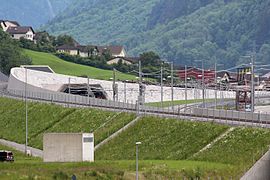 Integration of the portals into the landscape
 -
 The new 4-kilometre-long (2.5 mi) open-air section from Rynächt to the north portal
 -
 Start of the new 7-kilometre-long (4.3 mi) open-air section from Giustizia to the south portal
 -

.jpg)
.jpg)
.jpg)

Operation
[edit]Reduced travel times
[edit]| Shortest journey time by train | Time saved | |||
|---|---|---|---|---|
| vertex route | through GBT | |||
| 2006 | 2016 | 2022 | ||
| Milano – Zürich | 4:26 (EC) / 3:41 (CIS)[82] | 4:03 (EC)[83] | 3:17 (EC)[84] | 1:09 / :24 / :46 |
| Lugano – Zürich | 2:56 (EC/IC) / 2:42 (CIS)[82] | 2:41 (ICN)[83] | 1:53 (IC2/IC21)[84] | 1:03 / :49 / :48 |
Safety
[edit]![[icon]](/wiki/File:Wiki_letter_w_cropped.svg) | This section needs expansion. You can help by adding to it. (October 2018) |
The safety requirements on the rolling stock are similar to those of other long Swiss tunnels, including the ability for the emergency brake to be overridden.
Incidents
[edit]On 10th August 2023, a freight train heading north derailed inside the tunnel causing it to be shut. Trains scheduled to use the tunnel were either cancelled or redirected via the "panorama route" which added around one to two hours to journeys. Since the alternate route was unable to accommodate bi-level equipment, passenger capacity was reduced by around two thirds. According to an SBB press conference, around 8km of tracks, 20,000 concrete sleepers and a lane change gate in the tunnel were severely damaged. The gate is needed to separate the two tunnel tubes which is why the second tunnel could not initially be used to run trains.[85][86]
Experts from the Swiss Transportation Safety Investigation Board (STSB) were dispatched to the site to preserve and document evidence of the crash. Investigators found fragments of a wheel and signs of derailment several kilometers before the crash site. At the Faido station, they discovered a pile of derailed wagons. The STSB's mission is to determine the causes of accidents to ensure or improve safety, rather than to assign guilt or responsibility.[87] The STSB believes that the derailment was likely caused by a broken wheel tread inside the tunnel. All fragments of the wheel were found, consisting of several large pieces.[87] The cause of the breakage has not yet been determined. External influence or fatigue fracture are possible explanations. The wheel fragments will be subjected to metallurgical analysis to determine the cause. Despite the broken wheel, the wagon was dragged by the train for several kilometers. At the switching point of the multi-functional station, where trains can switch between the two tubes of the tunnel, the wagon derailed, pulling more than 20 following wagons off the tracks.[87]
The tunnel's repair work was extensive. Originally expected to be completed by the end of 2023, it was announced in November 2023 that the repairs would not be finished before September 2024, with the tunnel operating at reduced capacity until then.[88] This was due to repairs requiring a complete replacement of seven kilometers of rails, including 20,000 sleeper blocks and their concrete foundations, a damaged lane-change gate, two high-speed switches and many other safety and operationally relevant parts.[89] Freight trains were allowed to use the east tunnel from 23 August due to a temporary maintenance gate replacing the damaged one whilst passenger services remained rerouted.[90][85]
Freight capacity in the tunnel was gradually increased on weekdays, while passenger services saw expansion on weekends. In case of emergency, passengers would be evacuated through the other tunnel tube.[91] Following the reopening of the undamaged northern third of the western tube, additional freight and passenger services were scheduled to use the tunnel, with a full reopening and a return to normal service commencing on 2nd September 2024.[92]
Traffic
[edit]
Since the opening date on 1 June 2016, between 130 and 160 trains on an average working day operated through the Gotthard Base Tunnel, which in March 2019 marked the 100,000th transit. Around two-thirds of the passages were freight trains and the remaining quota were passenger trains, both national and international.[93]
Projections
[edit]The number of projected trains per day was 180–260 freight trains and 50 (65 from 2020) passenger trains.[7]
Passengers
[edit]After the opening of the tunnel there was an increase in passengers crossing the trans-alpine line, with 2.3 million passengers in the first 8 months, an increase of 30% over the previous year.[94]
In August 2017, an average of 10,400 people crossed the tunnel daily. Train services from Italy to Switzerland through the line are expected to become faster from 2020,[needs update] with the opening of the Ceneri Base Tunnel, with an expected further increase in passenger numbers.[95] There are plans for a train service between Zürich and Milan with a journey time of 2:45 hours, down from 3:50 hours.[94]
Freight
[edit]67,000 tonnes (150 million pounds) on 120 trains passed through the tunnel each day during the first half year of operation.[96]
See also
[edit]- Brenner Base Tunnel – Railway under construction through the Alps
- Mont d'Ambin Base Tunnel, a planned base tunnel that will be slightly longer than the GBT.
- Rail transport in Switzerland
- High-speed rail in Switzerland
- List of tunnels in Switzerland
- List of tunnels in the Alps
- List of tunnels by country
- List of transport megaprojects
Notes
[edit]- ^ The world longest tunnel for transport of people is the Guangzhou Metro Line 3 in China (60 km). Reference: (in French) Nic Ulmi, "Des trous suisses remplis d'imaginaire" [interview with André Ourednik], Horizons, magazine of the Swiss National Science Foundation and the Swiss Academies of Arts and Sciences, number 118, September 2018, pages 22-23.
- ^ Excluding subway tunnels that lie near the surface. See also: List of longest subway tunnel sections and List of longest tunnels.
- ^ See the climate tables of Altdorf and Grono, two towns situated near each end of the tunnel. See also normals/climate-diagrams-and- normal-values-per-station.html?region=Map Climate diagrams and normal values per station Archived 7 October 2018 at the Wayback Machine (MeteoSwiss).
- ^ See Swisstopo topographic maps with catchment areas layer: map.geo.admin.ch.
References
[edit]- ^ "Commissioning". Lucerne, Switzerland: AlpTransit Gotthard AG. Retrieved 12 May 2016.[permanent dead link]
- ^ "Gotthard Base Tunnel Derailment: everything you need to know for your trip". Berne, Switzerland: SBB CFF FFS. 16 August 2023.
- ^ "Construction begins". Bern, Switzerland: Swiss Federal Archives SFA, Swiss Federal Office of Transport FOT, Swiss Confederation. 2016. Retrieved 4 July 2016.
- ^ "155 days until opening". Lucerne, Switzerland: AlpTransit Gotthard AG. Retrieved 29 December 2015.[permanent dead link]
- ^ a b c d e f g h i j k l m n o p q r "Project data – raw construction Gotthard Base Tunnel" (PDF). Lucerne, Switzerland: AlpTransit Gotthard AG. 1 June 2016. Retrieved 15 December 2016.[permanent dead link]
- ^ a b Axe nord-sud du Saint-Gothard (SBB/CFF website).
- ^ a b c d e "The Gotthard Base Tunnel". Bern, Switzerland: SBB CFF FFS. 2016. Archived from the original on 20 June 2016. Retrieved 17 June 2016.
- ^ a b Giruno (SBB/CFF website).
- ^ "Über und durch den Gotthard – eine Zeitreise durch die Jahrhunderte" (in German). Zürich, Switzerland: SRF Swiss Radio and Television. 1 June 2016. Retrieved 4 June 2016.
- ^ "World's longest and deepest rail tunnel to open in Switzerland". BBC News. June 2016. Retrieved 1 June 2016.
- ^ "Gotthard- und CeneriBasistunnel: die neue Gotthard-Bahn nimmt Gestalt an" (PDF). Geomatik Schweiz. Archived from the original (PDF) on 4 March 2016. Retrieved 8 June 2015.
- ^ a b "Wer hat die grösste Röhre?" [Who has the longest tube?]. Tages-Anzeiger (graphical animation) (in German). Zürich, Switzerland. 14 April 2016. Retrieved 11 May 2016.
- ^ "Gotthard tunnel: World's longest and deepest rail tunnel opens in Switzerland". BBC News. 1 June 2016. Retrieved 1 June 2016.
- ^ Yücel Erdem, Tülin Solak, Underground Space Use. Analysis of the Past and Lessons for the Future, CRC Press, 2005 (p. 485)
- ^ a b Malins, Richard (December 2010). "Crossing the Alps". Modern Railways. London. pp. 79–81. ISSN 0026-8356.
- ^ Monnat, Lucie (11 December 2014). "Le tunnel de base du Gothard révolutionnera le rail dans deux ans". 24 heures. Lausanne. Retrieved 7 June 2015.
- ^ "Chronology of a Project of the Century: Milestones in the Construction History up to 2010" (PDF). Lucerne, Switzerland: AlpTransit Gotthard AG. Archived from the original (PDF) on 13 March 2012. Retrieved 20 April 2013.
- ^ a b Thomas Müller; Isidor Baumann (29 April 2016). "Oberaufsicht über den Bau der Neat im Jahre 2015: Bericht der Neat-Aufsichtsdelegation der eidgenössischen Räte zuhanden der Finanzkommissionen, der Geschäftsprüfungskommissionen und der Kommissionen für Verkehr und Fernmeldewesen" (PDF). Bundesblatt (in German, French, and Italian). Vol. 2016, no. 16.005. NRLA supervisory board of the federal councils. p. 6686. BBl 2016 6665 (-6732). Retrieved 6 June 2017.
- ^ Mario Botta (27 May 2016). Der Gotthard-Basistunnel. / La galleria di base del San Gottardo (Trailer) (in Italian). Bern, Switzerland: SBB CFF FFS. Event occurs at 1:45. Archived from the original on 22 December 2021. Retrieved 12 December 2016 – via YouTube.
la luce del Mare Nostrum, è diversa rispetto alla luce del mondo interno, del mondo dell'altopiano, del mondo dell'Europa lontana dal mare Mediterraneo
- ^ Tellier, Luc-Normand (2009). Urban World History: An Economic and Geographical Perspective. Quebec City, Canada: Presses de l'Université du Québec. p. 314. ISBN 9782760522091.
- ^ "Trois heures en 20 ans, le temps gagné pour traverser l'Europe par le Gothard" (in French). Radio Télévision Suisse. 5 December 2016. Retrieved 5 July 2017.
- ^ Cendrowicz, Leo (20 October 2010). "Switzerland Celebrates World's Longest Rail Tunnel". Time. time.com. Archived from the original on 22 October 2010. Retrieved 11 April 2013.
- ^ Jorio, Luigi (6 January 2016). "Opposing views on doubling the Gotthard tunnel – SWI". Swissinfo.ch. Retrieved 5 March 2016.
- ^ "Voters give green light to new Gotthard road tunnel". The Local. Archived from the original on 1 March 2016.
- ^ "SBB-CFF-FFS Re 420 locomotive" (private fan site) (in German). Lokifahrer.ch. 23 August 2010. Retrieved 18 December 2017.
- ^ Prince, Martin F. (1 May 2000). "The Alpine Convention: A Model for Other Mountain Regions?". Mountain Research and Development. 20 (2). Perth College, UK: Centre for Mountain Studies: 192–194. doi:10.1659/0276-4741(2000)020[0192:TACAMF]2.0.CO;2.
- ^ Bernard Wuthrich, "Le Romand du Gothard", Le Temps, Monday 1 June 2015, page 20.
- ^ "Status of the work". Lucerne, Switzerland: AlpTransit Gotthard AG. 1 November 2011. Retrieved 11 November 2011.[permanent dead link]
- ^ "Overview Gotthard Base Tunnel". Lucerne, Switzerland: AlpTransit Gotthard AG. 1 January 2012. Retrieved 5 February 2012.[permanent dead link]
- ^ "Gotthard Base Tunnel: Driving complete". Lucerne, Switzerland: AlpTransit Gotthard AG. 23 March 2011. Retrieved 16 November 2011.[permanent dead link]
- ^ "Bundesrat bestätigt vorläufigen Verzicht auf die Porta Alpina" (Press release). Swiss federal authorities. 16 May 2012. Retrieved 31 December 2014.
- ^ "Final breakthrough of the longest railway tunnel in the world". Lucerne, Switzerland: AlpTransit Gotthard AG. 15 October 2010. Retrieved 5 June 2017.[permanent dead link]
- ^ Bedding, James (19 February 2013). "Switzerland's Gotthard Base train tunnel is redefining Europe". The Telegraph. Retrieved 11 April 2013.
- ^ "Gotthard Base Tunnel: Driving complete". Lucerne, Switzerland: AlpTransit Gotthard AG. 23 March 2011. Retrieved 1 June 2016.[permanent dead link]
- ^ "Switzerland: First transit in the Gotthard Base Tunnel". corridor-rhine-alpine.eu. Retrieved 7 December 2016.
- ^ "Test trains running on Gotthard Base Tunnel". Global Rail News. 17 December 2013. Archived from the original on 3 February 2016. Retrieved 21 December 2013.
- ^ "The construction of the century takes shape". Lucerne, Switzerland: AlpTransit Gotthard AG. Archived from the original on 1 June 2016. Retrieved 20 June 2016.
- ^ "Celebrations as last piece of track is laid in record-breaking Gotthard rail tunnel | euronews, world news". Euronews.com. 31 October 2014. Archived from the original on 4 March 2016. Retrieved 25 January 2016.
- ^ "Mit 275 Sachen durch den Gotthard-Basistunnel". luzernerzeitung.ch. Neue Luzerner Zeitung. 19 November 2015. Retrieved 7 December 2016.
- ^ "Projektbeschrieb" (in German). AGN Strabag. 24 September 2010. Archived from the original on 8 October 2014. Retrieved 19 October 2010.
- ^ "Structurally complete tunnels of the Amsteg section handed over". Lucerne, Switzerland: AlpTransit Gotthard AG. 10 December 2009. Retrieved 12 November 2011.[permanent dead link]
- ^ a b "Gotthard approaches final breakthrough, Ceneri starts main drive". Lucerne, Switzerland: AlpTransit Gotthard AG. 31 March 2010. Retrieved 12 November 2011.[permanent dead link]
- ^ "Transco Sedrun" (in German). Transco. Archived from the original on 29 May 2010. Retrieved 15 October 2010.
- ^ Booth, Martina (29 April 2010). "Gotthard: A titanic tunnel". New Civil Engineer. EMAP Publishing Limited. Retrieved 15 July 2015.
- ^ "Final breakthrough of the longest railway tunnel in the world". Lucerne, Switzerland: AlpTransit Gotthard AG. 15 October 2011. Retrieved 12 November 2011.[permanent dead link]
- ^ "Installation of the railway systems in the north has begun". Lucerne, Switzerland: AlpTransit Gotthard AG. 2 September 2011. Retrieved 12 November 2011.[permanent dead link]
- ^ a b "St. Barbara Celebration 2012" (in German). Consorzio TAT. Archived from the original on 13 September 2012. Retrieved 11 April 2013.
- ^ a b "Memorial ceremony for deceased tunnel workers". Lucerne, Switzerland: AlpTransit Gotthard AG. 31 May 2016.[permanent dead link]
- ^ Gieri Venzin (30 May 2016). "Andreas Reichhardt, † 8. Juni 2000" (in German). SRF. Retrieved 1 June 2016.
- ^ Gieri Venzin (30 May 2016). "Jacques Du Plooy, † 12. März 2002" (in German). SRF. Retrieved 1 June 2016.
- ^ Gieri Venzin (30 May 2016). "Heiko Bujack, † 3. April 2003" (in German). SRF. Retrieved 1 June 2016.
- ^ Gieri Venzin (30 May 2016). "Albert Ginzinger, † 11. September 2003" (in German). SRF. Retrieved 1 June 2016.
- ^ Matthias Chapman (12 October 2010). "Die Toten vom Gotthard". Tages-Anzeiger (in German). Retrieved 1 June 2016.
- ^ Gieri Venzin (30 May 2016). "Salvatore di Benedetto, † 21. Januar 2005" (in German). SRF. Retrieved 1 June 2016.
- ^ Gieri Venzin (30 May 2016). "Andrea Astorino, † 21. January 2005" (in German). SRF. Retrieved 1 June 2016.
- ^ Gieri Venzin (30 May 2016). "Thorsten Elsemann, † 23. November 2006" (in German). SRF. Retrieved 1 June 2016.
- ^ Gieri Venzin (30 May 2016). "Hans Gammel, † 24. Juni 2010" (in German). SRF. Retrieved 1 June 2016.
- ^ Gieri Venzin (30 May 2016). "Giuseppe Liuzzo, † 16. Juni 2012" (in German). SRF. Retrieved 1 June 2016.
- ^ "Timbre-poste spécial avec de la pierre du Gothard" (press release) (in French). Swiss Post. 11 May 2016. Retrieved 7 September 2016.
- ^ Besson, Sylvain (30 May 2016). "Gothard, l'âme de pierre de la Suisse" (in French). Le temps. Archived from the original on 12 December 2016. Retrieved 7 September 2016.
- ^ a b c "World's Longest Rail Tunnel Opens in Switzerland". Swissinfo. Bern, Switzerland. 1 June 2016. Retrieved 3 June 2016.
- ^ "The Gottardino special train". Swiss Federal Railways. Archived from the original on 6 November 2016. Retrieved 6 November 2016.
- ^ a b "World's longest tunnel prepares for first scheduled services". thelocal.ch. The Local. 6 December 2016. Retrieved 7 December 2016.
- ^ "Longest Rail Tunnel Clears Major Safety Hurdle". Swissinfo. 15 November 2016. Retrieved 27 December 2016.
- ^ "First Full Day of Service for Gotthard Rail Tunnel". Swissinfo. 11 December 2016. Retrieved 27 December 2016.
- ^ "Un train de marchandises déraille dans le tunnel de base du Gothard - Le Temps" (in French). 10 August 2023. ISSN 1423-3967. Retrieved 17 August 2023.
- ^ "Politics". Bern, Switzerland: Swiss Federal Archives SFA, Swiss Federal Office of Transport FOT, Swiss Confederation. 2016. Retrieved 18 June 2016.
- ^ "Yes to the NRLA". Bern, Switzerland: Swiss Federal Archives SFA, Swiss Federal Office of Transport FOT, Swiss Confederation. 1 December 1992. Retrieved 18 June 2016.
- ^ "Bundesbeschluss über den Bau der schweizerischen Eisenbahn-Alpentransversale (Alpentransit-Beschluss) – Chronologie" (in German, French, and Italian). Bern, Switzerland: Swiss Federal Chancellery, Swiss Federal Council, Swiss Confederation. 14 June 2016. Retrieved 18 June 2016.
- ^ Duc-Quang Nguyen (6 June 2016). "How direct democracy has grown over the decades". swissinfo.ch – a branch of the Swiss Broadcasting Corporation SRG SSR. Explore 600 national votes. Bern, Switzerland: Swiss Broadcasting Corporation SRG SSR. Retrieved 24 July 2016.
- ^ "Yes to the Alps Initiative". Bern, Switzerland: Swiss Federal Archives SFA, Swiss Federal Office of Transport FOT, Swiss Confederation. 2016. Retrieved 18 June 2016.
- ^ a b c "Volksinitiative 'zum Schutze des Alpengebietes vor dem Transitverkehr'" (in German, French, and Italian). Bern, Switzerland: Swiss Federal Chancellery, Swiss Federal Council, Swiss Confederation. 14 June 2016. Retrieved 18 June 2016.
- ^ "Botschaft über die Volksinitiative "zum Schutze des Alpengebietes vor dem Transitverkehr" vom 12. Februar 1992" (PDF). Bundesblatt 1992 (in German, French, and Italian). Vol. II, no. 13. Bern, Switzerland: The Swiss Federal Council. 12 February 1992. BBI 1992 II 788. Retrieved 27 July 2016.
- ^ "Bundesbeschluss über die Volksinitiative "zum Schutze des Alpengebietes vor dem Transitverkehr" vom 18. Juni 1993" (PDF). Bundesblatt 1993 (in German, French, and Italian). Vol. II, no. 26. Bern, Switzerland: The Swiss Federal Council. 18 June 1993. BBI 1993 II 888. Retrieved 27 July 2016.
- ^ "Yes to public transport funding". Bern, Switzerland: Swiss Federal Archives SFA, Swiss Federal Office of Transport FOT, Swiss Confederation. 2016. Retrieved 18 June 2016.
- ^ "Bundesbeschluss über Bau und Finanzierung von Infrastrukturvorhaben des öffentlichen Verkehrs – Chronologie" (in German, French, and Italian). Bern, Switzerland: Swiss Federal Chancellery, Swiss Federal Council, Swiss Confederation. 29 November 1998. Retrieved 18 June 2016.
- ^ "The end of the 28-tonne limit". Bern, Switzerland: Swiss Federal Archives SFA, Swiss Federal Office of Transport FOT, Swiss Confederation. 2016. Retrieved 18 June 2016.
- ^ "Bundesbeschluss über die Genehmigung der sektoriellen Abkommen zwischen der Schweizerischen Eidgenossenschaft einerseits und der Europäischen Gemeinschaft sowie gegebenenfalls ihrer Mitgliedstaaten oder der Europäischen Atomgemeinschaft andererseits – Chronologie" (in German, French, and Italian). Bern, Switzerland: Swiss Federal Chancellery, Swiss Federal Council, Swiss Confederation. 1 July 2002. Retrieved 18 June 2016.
- ^ "Yes to the Ceneri Base Tunnel". Bern, Switzerland: Swiss Federal Archives SFA, Swiss Federal Office of Transport FOT, Swiss Confederation. 2016. Retrieved 18 June 2016.
Federal Councilor Moritz Leuenberger: «This is the only way to make the railway a flat line between Basel and Chiasso.»
- ^ "Was passiert eigentlich mit der Gotthard-Bergstrecke? | SBB Stories". Archived from the original on 12 December 2016. Retrieved 5 September 2016.
- ^ "Experience in Spoil Management on Conclusion of Excavations for the Gottard Base Tunnel" (PDF). Lucerne, Switzerland: AlpTransit Gotthard AG. 2 March 2011. Retrieved 15 November 2011.[permanent dead link]
- ^ a b "600 – 2006" (PDF). www.fahrplanfelder.ch (official document). Berne, Switzerland: Swiss Federal Office of Transport. November 2005. pp. 740, 741. Retrieved 21 July 2022.
EC170, CIS156
- ^ a b "600 – 2016" (PDF). www.fahrplanfelder.ch (official document). Berne, Switzerland: Swiss Federal Office of Transport. November 2015. pp. 842, 841. Retrieved 21 July 2022.
EC12, ICN866
- ^ a b "600 – 2022" (PDF). www.fahrplanfelder.ch (official document). Berne, Switzerland: Swiss Federal Office of Transport. 16 November 2021. p. 4. Retrieved 21 July 2022.
EC312, IC2 866
- ^ a b "Bahnverkehr im Gotthard-Basistunnel unterbrochen". SBB News (in German). Retrieved 11 August 2023.
- ^ "Entgleisung im Gotthard - SBB: «Es ist das eingetreten, was wir nie gehofft haben»". Schweizer Radio und Fernsehen (SRF) (in German). 10 August 2023. Retrieved 11 August 2023.
- ^ a b c "Le déraillement d'un train au Gothard a été provoqué par le bris d'une roue - Le Temps" (in French). 13 August 2023. ISSN 1423-3967. Retrieved 17 August 2023.
- ^ "Tagesschau" (in German). 2 November 2023. Retrieved 10 November 2023.
- ^ "Gotthard-Basistunnel: Schäden gravierend, Normalbetrieb voraussichtlich ab September 2024". SBB News (in German). Retrieved 10 November 2023.
- ^ "Derailment closes Switzerland's Gotthard Base Tunnel". Trains. 11 August 2023. Retrieved 11 August 2023.
- ^ "Gotthard-Basistunnel: Schäden gravierend, Normalbetrieb voraussichtlich ab September 2024". SBB News (in German). Retrieved 10 November 2023.
- ^ Bovenizer, Noah (2 September 2024). "Gotthard Base Tunnel fully reopens 13 months after derailment". Railway Technology. Retrieved 4 September 2024.
- ^ Burroughs, David (6 March 2019). "100,000th train travels through the Gotthard Base Tunnel". International Railway Journal. Archived from the original on 9 July 2019. Retrieved 9 July 2019.
- ^ a b swissinfo.ch/ug (2 August 2017). "Gotthard rail tunnel boosts north-south traffic by a third". swissinfo.ch. Bern, Switzerland: SWI swissinfo.ch, a branch of the Swiss Broadcasting Corporation SRG SSR. Retrieved 18 December 2017.
- ^ Green, Anitra (4 August 2017). "Strong start for Gotthard Base Tunnel". International Railway Journal. Falmouth, Cornwall, UK: Simmons-Boardman Publishing Inc. Retrieved 19 December 2017.
- ^ Jorio, Luigi (1 June 2017). "Längster Eisenbahntunnel der Welt ist fast zu erfolgreich" (in German). Zürich, Switzerland: SWI swissinfo.ch – a branch of the Swiss Broadcasting Corporation SRG SSR. Retrieved 6 May 2017.
External links
[edit]

- Official website

- Gotthard Tunnel Experience, Uri Tourism
- Gottardo 2016, official inauguration website
- SRF Gotthard – Die Eröffnung, official coverage and background information by SRF Swiss Radio and Television (in German)
- RTS Gothard – L'inauguration du tunnel, official coverage and background information by RTS Radio Télévision Suisse (in French)
- Alptransit Gotthard AG official website[permanent dead link]
- Gotthard Base Tunnel at Structurae
- AGN Erstfeld Amsteg Constructors Web Site (many photos and designs)
- Faido Bodio Constructors Web Site (many photos and designs)
- Publications by and about Gotthard Base Tunnel in the catalogue Helveticat of the Swiss National Library

- Videos
- Aerial views of the works (by AlpTransit AG): 2012, 2013, 2014, 2015
- Journey through the GBT (SRF DOK)
- Flight over the GBT (SRF DOK)
- 17 years of construction (NRLA)
- Corporate videos: AlpTransit Gotthard AG (main contractor), Herrenknecht (TBM), ABB (ventilation), Thales (railway signalling), Transtec Gotthard (railway technology)
- Routes
| Gotthard axis | |
|---|---|
| Lötschberg axis | |


| International | |
|---|---|
| National | |
| Geographic | |
- Railway tunnels in Switzerland
- Railway tunnels
- High-speed railway lines in Switzerland
- Tunnels in the Alps
- Base tunnels
- Tunnels in the canton of Uri
- Graubünden–Uri border
- Tunnels in Graubünden
- Graubünden–Ticino border
- Tunnels in Ticino
- Ticino–Uri border
- Tunnels completed in 2016
- Gotthard railway
- 2016 establishments in Switzerland