


Green bean

Green beans are young, unripe fruits of various cultivars of the common bean (Phaseolus vulgaris),[1][2] although immature or young pods of the runner bean (Phaseolus coccineus), yardlong bean (Vigna unguiculata subsp. sesquipedalis), and hyacinth bean (Lablab purpureus) are used in a similar way.[3] Green beans are known by many common names, including French beans (French: haricot vert),[4] string beans (although most modern varieties are "stringless"),[4] and snap beans[4] or simply "snaps."[5][6] In the Philippines, they are also known as "Baguio beans" or "habichuelas" to distinguish them from yardlong beans.[7]
They are distinguished from the many other varieties of beans in that green beans are harvested and consumed with their enclosing pods before the bean seeds inside have fully matured. An analogous practice is the harvest and consumption of unripened pea pods, as is done with snow peas or sugar snap peas.
Uses[edit]
| Nutritional value per 100 g (3.5 oz) | |
|---|---|
| Energy | 131 kJ (31 kcal) |
6.97 g | |
| Dietary fiber | 2.7 g |
0.22 g | |
1.83 g | |
| Vitamins | Quantity %DV† |
| Vitamin A equiv. | 4% 35 μg |
| Thiamine (B1) | 7% 0.082 mg |
| Riboflavin (B2) | 8% 0.104 mg |
| Niacin (B3) | 5% 0.734 mg |
| Pantothenic acid (B5) | 5% 0.225 mg |
| Vitamin B6 | 8% 0.141 mg |
| Folate (B9) | 8% 33 μg |
| Vitamin C | 14% 12.2 mg |
| Vitamin K | 12% 14.4 μg |
| Minerals | Quantity %DV† |
| Calcium | 3% 37 mg |
| Iron | 6% 1.03 mg |
| Magnesium | 6% 25 mg |
| Manganese | 9% 0.216 mg |
| Phosphorus | 3% 38 mg |
| Potassium | 7% 211 mg |
| Zinc | 2% 0.24 mg |
| Other constituents | Quantity |
| Water | 90 g |
| †Percentages estimated using US recommendations for adults,[8] except for potassium, which is estimated based on expert recommendation from the National Academies.[9] | |
As common food in many countries, green beans are sold fresh, canned, and frozen. They can be eaten raw or steamed, boiled, stir-fried, or baked. They are commonly cooked in other dishes, such as soups, stews, and casseroles. Green beans can be pickled, similarly to cucumbers.
A dish with green beans common throughout the northern US, particularly at Thanksgiving, is green bean casserole, a dish of green beans, cream of mushroom soup, and French-fried onions.[10]
Nutrition[edit]
Raw green beans are 90% water, 7% carbohydrates, 2% protein, and contain negligible fat (table). In a 100-gram (3.5-ounce) reference amount, raw green beans supply 31 calories and are a moderate source (range 10–19% of the Daily Value) of vitamin C, vitamin K, vitamin B6, and manganese, while other micronutrients are in low supply (table).
Domestication[edit]
The green bean (Phaseolus vulgaris) originated in Central and South America, where there is evidence that it has been cultivated in Mexico and Peru for thousands of years.[11]
Characteristics[edit]
The first "stringless" bean was bred in 1894 by Calvin Keeney, called the "father of the stringless bean," while working in Le Roy, New York.[12] Most modern green bean varieties do not have strings.[3]
Plant[edit]
Green beans are classified by growth habit into two major groups, "bush" (or "dwarf") beans and "pole" (or "climbing") beans.[13][14][15]
Bush beans are short plants, growing to not more than 2 feet (61 cm) in height, often without requiring supports. They generally reach maturity and produce all of their fruit in a relatively short period, then cease to produce. Owing to this concentrated production and ease of mechanized harvesting, bush-type beans are those most often grown on commercial farms. Bush green beans are usually cultivars of the common bean (Phaseolus vulgaris).
Pole beans have a climbing habit and produce a twisting vine, which must be supported by "poles," trellises, or other means. Pole beans may be common beans (Phaseolus vulgaris), runner beans (Phaseolus coccineus) or yardlong beans (Vigna unguiculata subsp. sesquipedalis).[16][17]
Half-runner beans have both bush and pole characteristics, and are sometimes classified separately from bush and pole varieties.[18][19][20][21] Their runners can be about 3–10 feet long.[22][irrelevant citation]
Varieties[edit]

Over 130 varieties (cultivars) of edible pod beans are known.[23] Varieties specialized for use as green beans, selected for the succulence and flavor of their green pods, are the ones usually grown in the home vegetable garden, and many varieties exist. Beans with various pod colors (green, purple, red, or streaked.[24]) are collectively known as snap beans, while green beans are exclusively green. Pod shapes range from thin and circular ("fillet" types) to wide and flat ("romano" types) and more common types in between.
The three most commonly known types of green beans belonging to the species Phaseolus vulgaris are string or snap beans, which may be round or have a flat pod; stringless or French beans, which lack a tough, fibrous string running along the length of the pod; and runner beans, which belong to a separate species, Phaseolus coccineus. Green beans may have a purple rather than green pod, which changes to green when cooked.[25][page needed] Yellow-podded green beans are also known as wax beans.[3] Wax bean cultivars are commonly of the bush or dwarf form.[26][page needed]
All of the following varieties have green pods and are Phaseolus vulgaris unless otherwise specified:
Bush (dwarf) types[edit]
- Blue Lake 274[2]
- Contender[27]
- Derby (1990 AAS winner)[2]
- Golden Wax Improved (yellow/wax), 60 days
- Greencrop, 53 days
- Heavyweight II, 53 days
- Improved Tendergreen[28]
- Provider[27]
- Rocquencourt (yellow/wax), 50 days, heirloom[29]
- Royal Burgundy (purple pod), 55 days
- Stringless Green Pod, heirloom[30]
- Triomphe de Farcy, 48 days, heirloom
| Production of green beans – 2020 | |
|---|---|
| Country | (Millions of tonnes) |
 China China |
18.0 |
 Indonesia Indonesia |
0.9 |
 India India |
0.6 |
 Turkey Turkey |
0.5 |
 Thailand Thailand |
0.3 |
| World | 23.3 |
| Source: FAOSTAT of the United Nations[31] | |
Pole (climbing) types[edit]
- Algarve[15]
- Blue Lake[2]
- Golden Gate (yellow/wax)[15]
- Gold Marie, 75 days, Common Mosaic virus (BCMV) resistant
- Kentucky Blue (AAS Winner)[2]
- Kentucky Wonder[2], 65 days, heirloom
- Rattlesnake bean, 65 days, heirloom
- Scarlet Runner (Phaseolus coccineus)[32]
- Trionfo Violetto (purple pod), 60 days
Production[edit]
In 2020, world production of green beans was 23 million tonnes, with China accounting for 77% of the total (table).
Gallery[edit]
-
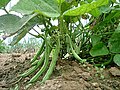 Green common beans on the plant
 -
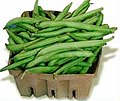 Whole raw green beans packed in a punnet for sale
 -
 Green beans with bean slicer
 -
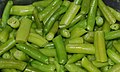 Cut and cooked green beans
 -
 Four varieties of the common green bean presenting variations in color, size, shape, and texture
 -
 Pickled beans
 -
 Green beans on a bush plant
 -
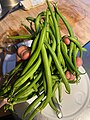 Mature green beans, freshly picked in France
 -
 Dried green beans (known as leather britches or shucky beans)


.jpg)
.jpg)


References[edit]
- ^ "Green Beans". The World's Healthiest Foods. Archived from the original on August 2, 2016. Retrieved March 2, 2017.
- ^ a b c d e f "Beans – Vegetable Directory – Watch Your Garden Grow – University of Illinois Extension".
- ^ a b c "Growing beans in Minnesota home gardens". University of Minnesota Agricultural Extension. Retrieved December 23, 2018.
- ^ a b c Green, Aliza (2004). Field Guide to Produce. Quirk Books. p. 126. ISBN 978-1-931686-80-8.
- ^ Singh BK and Singh B. 2015. Breeding perspectives of snap bean (Phaseolus vulgaris L.). Vegetable Science 42(1): 1-17.
- ^ Hatch, Peter J. (April 24, 2012). "A Rich Spot of Earth": Thomas Jefferson's Revolutionary Garden at Monticello. Yale University Press. pp. 159–161. ISBN 978-0-300-17114-3.
- ^ "Baguio Beans". Maribehlla. January 25, 2011. Retrieved October 20, 2019.
- ^ United States Food and Drug Administration (2024). "Daily Value on the Nutrition and Supplement Facts Labels". Retrieved March 28, 2024.
- ^ National Academies of Sciences, Engineering, and Medicine; Health and Medicine Division; Food and Nutrition Board; Committee to Review the Dietary Reference Intakes for Sodium and Potassium (2019). Oria, Maria; Harrison, Meghan; Stallings, Virginia A. (eds.). Dietary Reference Intakes for Sodium and Potassium. The National Academies Collection: Reports funded by National Institutes of Health. Washington (DC): National Academies Press (US). ISBN 978-0-309-48834-1. PMID 30844154.
{{cite book}}: CS1 maint: multiple names: authors list (link) - ^ Cook's Illustrated (2004). The New Best Recipe. America's Test Kitchen.
- ^ "Archived copy" (PDF). Archived from the original (PDF) on January 12, 2020. Retrieved November 30, 2019.
{{cite web}}: CS1 maint: archived copy as title (link) - ^ Taylor's guide to heirloom vegetables. Boston: Houghton Mifflin. 1996. ISBN 0-395-70818-4.
- ^ McGee, Rose Marie Nichols; Stuckey, Maggie (2002). The Bountiful Container. Workman Publishing.
- ^ Garrelts, C.; Garrelts, Megan; Lee, Bonjwing (2011). Bluestem: The Cookbook. Andrews McMeel Publishing. p. 71. ISBN 978-1-4494-0061-3.
- ^ a b c How to Grow French Beans – Royal Horticultural Society, RHS Gardening
- ^ Capomolla, F. (2017). Growing Food the Italian Way. Pan Macmillan Australia. p. 143. ISBN 978-1-76055-490-3. Retrieved February 26, 2018.
- ^ Watson, B. (1996). Taylor's Guide to Heirloom Vegetables. TAYLOR'S WEEKEND GARDENING GUIDES. Houghton Mifflin. p. 238. ISBN 978-0-395-70818-7. Retrieved February 26, 2018.
- ^ "Planting Directions for White Half-Runner Beans". sfgate.com. September 30, 2012. Retrieved May 24, 2018.
- ^ Torpey, Jodi (January 9, 2016). Blue Ribbon Vegetable Gardening: The Secrets to Growing the Biggest and Best Prizewinning Produce. Storey Publishing. ISBN 978-1-61212-395-0. Retrieved May 24, 2018 – via Google Books.
- ^ Wonning, Paul R. Gardeners' Guide to Growing Green Beans in the Vegetable Garden: The Green Bean Book – Growing Bush, Pole Beans For Beginning Gardeners. Mossy Feet Books. ISBN 978-1-311-55978-4. Retrieved May 24, 2018 – via Google Books.
- ^ Gutierrez, Sandra A. (October 15, 2015). Beans and Field Peas: a Savor the South® cookbook. UNC Press Books. ISBN 978-1-4696-2396-2. Retrieved May 24, 2018 – via Google Books.
- ^ Séguret, Susi Gott (January 24, 2017). Appalachian Appetite: Recipes from the Heart of America. Hatherleigh Press. ISBN 978-1-57826-705-7. Retrieved May 24, 2018 – via Google Books.
- ^ Facciola, Stephen (1998). Cornucopia II : a source book of edible plants. Kampong Publications. ISBN 0-9628087-2-5.
- ^ Singh B K, Pathak K A, Ramakrishna Y, Verma V K and Deka B C. 2011. "Purple-podded French bean with high antioxidant content." ICAR News: A Science and Technology Newsletter 17 (3): 9.
- ^ Press, L. (2002). The Bean Book: Over Seventy Incredible Recipes. Guilford, Conn.: Globe Pequot Press. ISBN 978-1-58574-473-2.
- ^ Phillips, R.; Rix, M. (1993). Vegetables. New York: Random House. ISBN 978-0-679-75024-6.
- ^ a b "Bean Varieties: Best Bets and Easy-to-Grow". May 10, 2009. Retrieved December 23, 2018.
- ^ "Improved Tendergreen Bush Green Bean". Retrieved December 23, 2018.
- ^ "Three Heirloom Beans". April 2006. Retrieved May 17, 2020.
- ^ "Seedsmen Hall of Fame". Retrieved December 23, 2018.
- ^ "Production of green beans in 2020, Crops/Regions/World list/Production Quantity (pick lists)". UN Food and Agriculture Organization, Corporate Statistical Database (FAOSTAT). 2022. Retrieved May 6, 2022.
- ^ Runner beans are edible – Oregon State University Agricultural Extension
External links[edit]


| Authority control databases: National |
|---|
