


Lemon

| Lemon | |
|---|---|

| |
| A fruiting lemon tree (blossom visible) | |
Scientific classification 
| |
| Kingdom: | Plantae |
| Clade: | Tracheophytes |
| Clade: | Angiosperms |
| Clade: | Eudicots |
| Clade: | Rosids |
| Order: | Sapindales |
| Family: | Rutaceae |
| Genus: | Citrus |
| Species: | C. × limon
|
| Binomial name | |
| Citrus × limon | |
| Synonyms[1] | |
|
List
| |
The lemon (Citrus × limon) is a species of small evergreen tree in the flowering plant family Rutaceae, native to Asia, primarily Northeast India (Assam), Northern Myanmar, and China.[2]
The tree's ellipsoidal yellow fruit is used for culinary and non-culinary purposes throughout the world, primarily for its juice, which has both culinary and cleaning uses.[2] The pulp and rind are also used in cooking and baking. The juice of the lemon is about 5–6% citric acid,[citation needed] with a pH of around 2.2,[3] giving it a sour taste. The distinctive sour taste of lemon juice, derived from the citric acid, makes it a key ingredient in drinks and foods[4] such as lemonade and lemon meringue pie.
Description
The lemon tree produces an ellipsoidal yellow fruit.
-
 Lemon seedling
 -
 Full-sized tree
 -
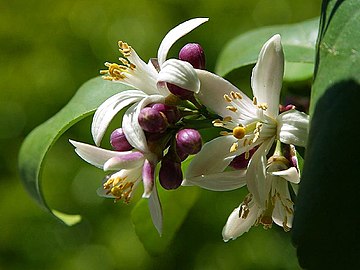 Flower
 -
 Lemon with leaves
 -
 Lemon cidra
 -
 Mature lemons
 -
 Variegated pink lemon


Chemistry
Lemons contain numerous phytochemicals, including polyphenols, terpenes, and tannins.[5] Lemon juice contains slightly more citric acid than lime juice (about 47 g/L), nearly twice the citric acid of grapefruit juice, and about five times the amount of citric acid found in orange juice.[6]
Taxonomy

The origin of the lemon is unknown, though lemons are thought to have first grown in Assam (a region in northeast India), northern Myanmar, or China.[2][failed verification] A genomic study of the lemon indicated it was a hybrid between bitter orange (sour orange) and citron.[7][8]
The origin of the word lemon may be Middle Eastern.[2] The word draws from the Old French limon, then Italian limone, from the Arabic laymūn or līmūn, and from the Persian līmūn, a generic term for citrus fruit, which is a cognate of Sanskrit (nimbū, 'lime').[9]
Varieties
The 'Bonnie Brae' is oblong, smooth, thin-skinned, and seedless.[10] These are mostly grown in San Diego County, US.[11]
The 'Eureka' grows year-round and abundantly. This is the common supermarket lemon, also known as "Four Seasons" (Quatre Saisons) because of its ability to produce fruit and flowers together throughout the year. This variety is also available as a plant for domestic customers.[12] There is also a pink-fleshed Eureka lemon with a green and yellow variegated outer skin.[13]
The Lisbon lemon is very similar to the Eureka and is the other common supermarket lemon. It is smoother than the Eureka, has thinner skin, and has fewer or no seeds. It generally produces more juice than the Eureka.[14][15]
The 'Femminello St. Teresa', or 'Sorrento'[16] originates in Italy. This fruit's zest is high in lemon oils. It is the variety traditionally used in the making of limoncello.
The 'Yen Ben' is an Australasian cultivar.[17]
Cultivation
History
Lemons are supposed to have entered Europe near southern Italy no later than the second century AD, during the time of Ancient Rome.[2] They were later introduced to Persia and then to Iraq and Egypt around 700 AD.[2] The lemon was first recorded in literature in a 10th-century Arabic treatise on farming and was also used as an ornamental plant in early Islamic gardens.[2] It was distributed widely throughout the Arab world and the Mediterranean region between 1000 and 1150.[2] An article on Lemon and lime tree cultivation in Andalusia, Spain, is brought down in Ibn al-'Awwam's 12th-century agricultural work, Book on Agriculture.[18]
The first substantial cultivation of lemons in Europe began in Genoa in the middle of the 15th century. The lemon was later introduced to the Americas in 1493, when Christopher Columbus brought lemon seeds to Hispaniola on his voyages. Spanish conquest throughout the New World helped spread lemon seeds. It was mainly used as an ornamental plant and for medicine.[2] In the 19th century, lemons were increasingly planted in Florida and California.[2]
In 1747, James Lind's experiments on seamen suffering from scurvy involved adding lemon juice to their diets, though vitamin C was not yet known as an important dietary ingredient.[2][19]
Propagation
Lemons need a minimum temperature of around 7 °C (45 °F), so they are not hardy year-round in temperate climates, but become hardier as they mature.[20] Citrus require minimal pruning by trimming overcrowded branches, with the tallest branch cut back to encourage bushy growth.[20] Throughout summer, pinching back tips of the most vigorous growth assures more abundant canopy development. As mature plants may produce unwanted, fast-growing shoots (called "water shoots"), these are removed from the main branches at the bottom or middle of the plant.[20]
The tradition of urinating near a lemon tree[21][22][23] may be beneficial as urine is a fertilizer.
In cultivation in the UK, the cultivars "Meyer"[24] and "Variegata"[25] have gained the Royal Horticultural Society's Award of Garden Merit (confirmed 2017).[26]
Production
| Lemon (and lime) production, 2022
(in millions of tonnes) | |
|---|---|
| Country | 2022 |
 India India |
3.8 |
 Mexico Mexico |
3.1 |
 China China |
2.6 |
 Argentina Argentina |
1.8 |
 Brazil Brazil |
1.6 |
 Turkey Turkey |
1.3 |
| World | 21.5 |
| Source: FAOSTAT of the United Nations.[27] | |
In 2022, world production of lemons (combined with limes for reporting) was 22 million tonnes led by India with 18% of the total. Mexico and China were major secondary producers (table).
| Nutritional value per 100 g (3.5 oz) | |
|---|---|
| Energy | 121 kJ (29 kcal) |
9.32 g | |
| Sugars | 2.5 g |
| Dietary fiber | 2.8 g |
0.3 g | |
1.1 g | |
| Vitamins | Quantity %DV† |
| Thiamine (B1) | 3% 0.04 mg |
| Riboflavin (B2) | 2% 0.02 mg |
| Niacin (B3) | 1% 0.1 mg |
| Pantothenic acid (B5) | 4% 0.19 mg |
| Vitamin B6 | 5% 0.08 mg |
| Folate (B9) | 3% 11 μg |
| Choline | 1% 5.1 mg |
| Vitamin C | 59% 53 mg |
| Minerals | Quantity %DV† |
| Calcium | 2% 26 mg |
| Iron | 3% 0.6 mg |
| Magnesium | 2% 8 mg |
| Manganese | 1% 0.03 mg |
| Phosphorus | 1% 16 mg |
| Potassium | 5% 138 mg |
| Zinc | 1% 0.06 mg |
| †Percentages estimated using US recommendations for adults,[28] except for potassium, which is estimated based on expert recommendation from the National Academies.[29] | |
Uses
Nutrition
Lemon is a rich source of vitamin C, providing 64% of the Daily Value in a 100 g reference amount. Other essential nutrients are low in content.
Culinary
Lemon juice, rind, and peel are used in a wide variety of foods and drinks. The whole lemon is used to make marmalade, lemon curd and lemon liqueur. Lemon slices and lemon rind are used as a garnish for food and drinks. Lemon zest, the grated outer rind of the fruit, is used to add flavor to baked goods, puddings, rice, and other dishes.
-
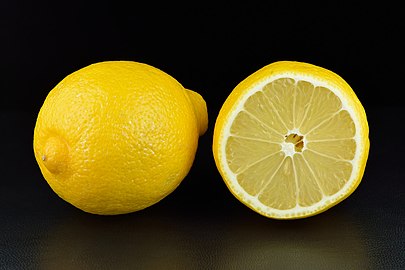 Lemon external surface and cross-section

Juice
Lemon juice is used to make lemonade, soft drinks, and cocktails. It is used in marinades for fish, where its acid neutralizes amines in fish by converting them into nonvolatile ammonium salts. In meat, the acid partially hydrolyzes tough collagen fibers, tenderizing it.[30] In the United Kingdom, lemon juice is frequently added to pancakes, especially on Shrove Tuesday.
Lemon juice is also used as a short-term preservative on certain foods that tend to oxidize and turn brown after being sliced (enzymatic browning), such as apples, bananas, and avocados, where its acid denatures the enzymes.
Peel
In Morocco, lemons are preserved in jars or barrels of salt. The salt penetrates the peel and rind, softening them, and curing them so that they last almost indefinitely.[31] The preserved lemon is used in a wide variety of dishes. Preserved lemons can also be found in Sicilian, Italian, Greek, and French dishes.
The peel can be used in the manufacture of pectin, a polysaccharide used as a gelling agent and stabilizer in food and other products.[32]
Oil
Lemon oil is extracted from oil-containing cells in the skin. A machine breaks up the cells and uses a water spray to flush off the oil. The oil–water mixture is then filtered and separated by centrifugation.[33]
Leaves
The leaves of the lemon tree are used to make a tea and for preparing cooked meats and seafoods.
Other uses
Industrial
Lemons were the primary commercial source of citric acid before the development of fermentation-based processes.[34]
Aroma
Lemon oil may be used in aromatherapy. Lemon oil aroma does not influence the human immune system,[35] but may contribute to relaxation.[36]
Other
One educational science experiment involves attaching electrodes to a lemon and using it as a battery to produce electricity. Although very low power, several lemon batteries can power a small digital watch.[37] These experiments also work with other fruits and vegetables.
Lemon juice may be used as a simple invisible ink, developed by heat.[38]
Lemon juice can be used to increase the blonde colour of hair, acting as a natural highlight after the moistened hair is exposed to sunlight. This is due to the citric acid that acts as bleach.[39][40]
Other citrus called "lemons"
- Flat lemon, a mandarin hybrid.
- Meyer lemon, a cross between a citron and a mandarin/pomelo hybrid distinct from sour or sweet orange,[41] named after Frank N. Meyer, who first introduced it to the United States in 1908. Thin-skinned and slightly less acidic than the Lisbon and Eureka lemons, Meyer lemons require more care when shipping and are not widely grown on a commercial basis. Meyer lemons often mature to a yellow-orange color. They are slightly more frost tolerant.
- Ponderosa lemon, more cold-sensitive than true lemons, the fruit are thick-skinned and very large. Genetic analysis showed it to be a complex hybrid of citron and pomelo.[41]
- Rough lemon, a citron-mandarin cross, cold-hardy and often used as a citrus rootstock[41]
- Sweet lemons or sweet limes, a mixed group including the lumia (pear lemon), limetta, and Palestinian sweet lime. Among them is the Jaffa lemon, a pomelo-citron hybrid.[41]
- Volkamer lemon, like the rough lemon, a citron-mandarin cross[41]

In culture
![[icon]](/wiki/File:Wiki_letter_w_cropped.svg) | This section needs expansion. You can help by adding to it. (December 2023) |
In India, a lemon may be ritually encircled around a person due to the belief that it would repel negative energies or ward off the evil eye, called nazar or drishti. It is also a common practice for owners of a new car to drive over four lemons, one under each wheel, crushing them during their first drive. This is believed to protect the driver from accidents.[42]
Hindu deities are sometimes depicted with lemons in their iconography, representing the attribute of wealth or abundance.[43]
See also

References
- ^ "Citrus limon (L.) Osbeck". World Flora Online. The World Flora Online Consortium. 2022. Archived from the original on March 14, 2024. Retrieved July 23, 2022.
- ^ a b c d e f g h i j k Julia F. Morton (1987). "Lemon in Fruits of Warm Climates". Purdue University. pp. 160–168. Archived from the original on November 26, 2019. Retrieved December 18, 2007.
- ^ James N. Spencer; George M. Bodner; Lyman H. Rickard (2010). Chemistry: Structure and Dynamics. John Wiley & Sons. p. 481. ISBN 9780470920930. Archived from the original on October 4, 2023. Retrieved August 22, 2023.
- ^ Comprehensive Natural Products II: Chemistry and Biology. Elsevier. 2010. ISBN 9780080453828. Archived from the original on October 4, 2023. Retrieved August 22, 2023.
- ^ Rauf A, Uddin G, Ali J (2014). "Phytochemical analysis and radical scavenging profile of juices of Citrus sinensis, Citrus aurantifolia, and Citrus limonum". Org Med Chem Lett. 4: 5. doi:10.1186/2191-2858-4-5. PMC 4091952. PMID 25024932.
- ^ Penniston KL, Nakada SY, Holmes RP, Assimos DG (2008). "Quantitative Assessment of Citric Acid in Lemon Juice, Lime Juice, and Commercially-Available Fruit Juice Products". Journal of Endourology. 22 (3): 567–570. doi:10.1089/end.2007.0304. PMC 2637791. PMID 18290732.
- ^ Gulsen, O.; M. L. Roose (2001). "Lemons: Diversity and Relationships with Selected Citrus Genotypes as Measured with Nuclear Genome Markers". Journal of the American Society for Horticultural Science. 126 (3): 309–317. doi:10.21273/JASHS.126.3.309.
- ^ Genetic origin of cultivated citrus determined: Researchers find evidence of origins of orange, lime, lemon, grapefruit, other citrus species" Archived September 21, 2017, at the Wayback Machine, Science Daily, January 26, 2011 (Retrieved February 10, 2017).
- ^ Douglas Harper. "Online Etymology Dictionary". Archived from the original on August 6, 2011. Retrieved May 13, 2012.
- ^ Spalding, William A. (1885). The orange: its culture in California. Riverside, California: Press and Horticulturist Steam Print. p. 88. Retrieved March 2, 2012.
Bonnie Brae lemon.
- ^ Carque, Otto (2006) [1923]. Rational Diet: An Advanced Treatise on the Food Question. Los Angeles, California: Kessinger Publishing. p. 195. ISBN 978-1-4286-4244-7. Archived from the original on March 14, 2024. Retrieved March 2, 2012.
- ^ Buchan, Ursula (January 22, 2005). "Kitchen garden: lemon tree". The Daily Telegraph. London. Archived from the original on March 13, 2014. Retrieved January 24, 2014.
- ^ Vaiegated pink Archived December 1, 2017, at the Wayback Machine at the Citrus Variety Collection.
- ^ "frostlisbon". citrusvariety.ucr.edu. Archived from the original on November 6, 2020. Retrieved September 27, 2020.
- ^ says, 3 Easy Tips: How to Plant Lemon Seeds at Home Indoors or Outdoors (February 1, 2007). "Eureka Lemon and Lisbon Lemon: Kitchen Basics". Harvest to Table. Archived from the original on November 6, 2020. Retrieved September 27, 2020.
{{cite web}}: CS1 maint: numeric names: authors list (link) - ^ "Taste of a thousand lemons". Los Angeles Times. September 8, 2004. Archived from the original on December 22, 2013. Retrieved November 21, 2011.
- ^ "New Zealand Citrus". ceventura.ucdavis.edu. Archived from the original on June 10, 2010. Retrieved June 13, 2010.
- ^ Ibn al-'Awwam, Yaḥyá (1864). Le livre de l'agriculture d'Ibn-al-Awam (kitab-al-felahah) (in French). Translated by J.-J. Clement-Mullet. Paris: A. Franck. pp. 300–301 (ch. 7 - Article 32). OCLC 780050566. (pp. 300–301 (Article XXXII)
- ^ James Lind (1757). A treatise on the scurvy. Second edition. London: A. Millar.
- ^ a b c "Citrus". Royal Horticultural Society. 2017. Archived from the original on April 20, 2017. Retrieved April 19, 2017.
- ^ Capomolla, Fabian; Pember, Matthew (2011). "Lemon". The Little Veggie Patch Co. Sydney, New South Wales: Plum. p. 129. ISBN 9781742628417. Archived from the original on March 14, 2024. Retrieved April 27, 2020.
Urinating around a lemon tree provides a tonic of water, salt and minerals, much like that of an organic fertiliser [...].
- ^ Capomolla, Fabian (2017). Growing Food the Italian Way. The Hungry Gardener. Plum. p. 168. ISBN 9781760554903. Archived from the original on March 14, 2024. Retrieved April 27, 2020.
Yes, it is true - urinating on the soil around a lemon tree is beneficial to the plant. Just don't overdo it, as that can be detrimental.
- ^ The World's Fastest Indian - "Munro was never known to actually urinate on his lemon tree; film director Roger Donaldson added that detail as a tribute to his own father, who did."
- ^ "RHS Plantfinder - Citrus × limon 'Meyer'". Archived from the original on January 4, 2020. Retrieved January 30, 2018.
- ^ "RHS Plantfinder - Citrus × limon 'Variegata'". Archived from the original on December 30, 2019. Retrieved January 30, 2018.
- ^ "AGM Plants - Ornamental" (PDF). Royal Horticultural Society. July 2017. p. 20. Archived (PDF) from the original on January 5, 2018. Retrieved January 24, 2018.
- ^ "FAOSTAT". www.fao.org. Retrieved March 23, 2024.
- ^ United States Food and Drug Administration (2024). "Daily Value on the Nutrition and Supplement Facts Labels". Retrieved March 28, 2024.
- ^ National Academies of Sciences, Engineering, and Medicine; Health and Medicine Division; Food and Nutrition Board; Committee to Review the Dietary Reference Intakes for Sodium and Potassium (2019). Oria, Maria; Harrison, Meghan; Stallings, Virginia A. (eds.). Dietary Reference Intakes for Sodium and Potassium. The National Academies Collection: Reports funded by National Institutes of Health. Washington (DC): National Academies Press (US). ISBN 978-0-309-48834-1. PMID 30844154.
{{cite book}}: CS1 maint: multiple names: authors list (link) - ^ "Fruit enzymes tenderise meat". Science Learning Hub. Archived from the original on May 23, 2020. Retrieved May 14, 2020.
- ^ Moskin, Julia. "Preserved Lemons Recipe". NYT Cooking. Archived from the original on May 13, 2020. Retrieved May 14, 2020.
- ^ Dimopoulou, Maria; Alba, Katerina; Campbell, Grant; Kontogiorgos, Vassilis (November 1, 2019). "Pectin recovery and characterization from lemon juice waste streams". Journal of the Science of Food and Agriculture. 99 (14): 6191–6198. Bibcode:2019JSFA...99.6191D. doi:10.1002/jsfa.9891. ISSN 1097-0010. PMID 31250441. S2CID 195760607.
- ^ Tranchida, Peter Quinto (2010), "Advanced Analytical Techniques for the Analysis of Citrus Oils", Citrus Oils, CRC Press, pp. 482–516, doi:10.1201/b10314-16, ISBN 978-1-4398-0029-4
- ^ M. Hofrichter (2010). Industrial Applications. Springer. p. 224. ISBN 978-3-642-11458-8.
- ^ Kiecolt-Glaser, J. K.; Graham, J. E.; Malarkey, W. B.; Porter, K; Lemeshow, S; Glaser, R (2008). "Olfactory influences on mood and autonomic, endocrine, and immune function". Psychoneuroendocrinology. 33 (3): 328–39. doi:10.1016/j.psyneuen.2007.11.015. PMC 2278291. PMID 18178322.
- ^ Cooke, B; Ernst, E (2000). "Aromatherapy: A systematic review". British Journal of General Practice. 50 (455): 493–6. PMC 1313734. PMID 10962794.
- ^ "Lemon Power". California Energy Commission. Archived from the original on May 19, 2017. Retrieved December 7, 2014.
- ^ Mirsky, Steve (April 20, 2010). "Invisible Ink and More: The Science of Spying in the Revolutionary War". Scientific American. Archived from the original on October 21, 2016. Retrieved October 15, 2016.
- ^ "Here's how to lighten your hair at home with lemon juice (it actually works)". Glamour UK. Bianca London. 2020. Archived from the original on September 28, 2020. Retrieved September 16, 2020.
- ^ "Does lemon juice really lighten hair?". Klorane Laboratories. 2020. Archived from the original on January 22, 2022. Retrieved September 18, 2020.
- ^ a b c d e Curk, Franck; Ollitrault, Frédérique; Garcia-Lor, Andres; Luro, François; Navarro, Luis; Ollitrault, Patrick (2016). "Phylogenetic origin of limes and lemons revealed by cytoplasmic and nuclear markers". Annals of Botany. 11 (4): 565–583. doi:10.1093/aob/mcw005. PMC 4817432. PMID 26944784.
- ^ Leslie, Julia (1992). Roles and Rituals for Hindu Women. Motilal Banarsidass Publ. p. 116. ISBN 978-81-208-1036-5.
- ^ Pal, Pratapaditya; Canada, National Gallery of; Arts (Firm), Bayeux (1997). Divine Images, Human Visions: The Max Tanenbaum Collection of South Asian and Himalayan Art in the National Gallery of Canada. National Gallery of Canada. p. 41. ISBN 978-1-896209-05-0.
External links

 Media related to Citrus × limon at Wikimedia Commons
 Data related to Citrus × limon at Wikispecies
- . Encyclopædia Britannica. Vol. 16 (11th ed.). 1911. pp. 413–415. (with illustrations)


| Fruit juice |  | |
|---|---|---|
| Vegetable juice | ||
| Animal liquid | ||
| Related | ||

| Authority control databases: National |
|---|
