


Sardine
.jpg)

Sardine and pilchard are common names for various species of small, oily forage fish in the herring suborder Clupeoidei.[2] The term 'sardine' was first used in English during the early 15th century; a somewhat dubious etymology says it comes from the Italian island of Sardinia, around which sardines were once supposedly abundant.[3][4][5]
The terms 'sardine' and 'pilchard' are not precise, and what is meant depends on the region. The United Kingdom's Sea Fish Industry Authority, for example, classifies sardines as young pilchards.[6] One criterion suggests fish shorter in length than 15 cm (6 in) are sardines, and larger fish are pilchards.[7]
The FAO/WHO Codex standard for canned sardines cites 21 species that may be classed as sardines.[8] FishBase, a database of information about fish, calls at least six species pilchards, over a dozen just sardines, and many more with the two basic names qualified by various adjectives.
Etymology
[edit]The word 'sardine' first appeared in English in the 15th century, a loanword from French sardine, derived from Latin sardina, from Ancient Greek σαρδίνη (sardínē) or σαρδῖνος (sardĩnos),[9] possibly from the Greek Σαρδώ (Sardō) 'Sardinia'. Athenaios quotes a fragmentary passage from Aristotle mentioning the fish σαρδῖνος (sardĩnos), referring to the sardine or pilchard.[10] However, Sardinia is over 1000 km from Athens, so it seems "hardly probable that the Greeks would have obtained fish from so far as Sardinia at a time relatively so early as that of Aristotle."[11]
The flesh of some sardines or pilchards is a reddish-brown colour similar to some varieties of red sardonyx or sardine stone; this word derives from σαρδῖον (sardĩon) with a root meaning 'red' and possibly cognate with Sardis, the capital of ancient Lydia (now western Turkey) where it was obtained. However, the name may refer to the reddish-pink colour of the gemstone sard (or carnelian) known to the ancients.[12][13]
The phrase "packed like sardines" (in a tin) is recorded from 1911.[11] The phrase "packed up like sardines" appears in The Mirror of Literature, Amusement, and Instruction from 1841,[14] and is a translation of "encaissés comme des sardines", which appears in La Femme, le mari, et l'amant from 1829.[15] Other early appearances of the idiom are "packed together ... like sardines in a tin-box" (1845),[16] and "packed ... like sardines in a can" (1854).[17]
Genera
[edit]| This article is part of a series on |
| Commercial fish |
|---|
 |
| Large predatory |
| Forage |
| Demersal |
| Mixed |
Sardines occur in several genera.
- Genus Dussumieria
- Rainbow sardine (Dussumieria acuta)
- Slender rainbow sardine (Dussumieria elopsoides)
- Genus Escualosa
- Slender white sardine (Escualosa elongata)
- White sardine (Escualosa thoracata)
- Genus Sardina
- European pilchard (true sardine) (Sardina pilchardus)
- Genus Sardinella
- Goldstripe sardinella (Sardinella gibbosa)
- Indian oil sardine (Sardinella longiceps)
- Round sardinella (Sardinella aurita)
- Freshwater sardine (Sardinella tawilis)
- Marquesan sardinella (Sardinella marquesensis)
- Genus Sardinops
- South American pilchard (Sardinops sagax)
Although they are not true sardines, sprats are sometimes marketed as sardines. For example, the european sprat, Sprattus sprattus, is sometimes marketed as the 'brisling sardine'.
Species
[edit]| Commercially significant species | ||||||||||||||
|---|---|---|---|---|---|---|---|---|---|---|---|---|---|---|
| Genus | Common name | Scientific name | Max. length | Typ. length | Max. mass | Max. age years |
Trophic level |
Fish- Base |
FAO | ITIS | IUCN status | |||
| cm | in | cm | in | g | oz | |||||||||
| Sardina | European pilchard | Sardina pilchardus (Walbaum, 1792) | 27.5 | 10.8 | 20.0 | 7.9 | 15 | 3.05 | [18] | [19] | [20] |  [21] | ||
| Sardinops | South American pilchard | Sardinops sagax (Jenyns, 1842) | 39.5 | 15.6 | 20.0 | 7.9 | 490 | 17 | 25 | 2.43 | [22] | [23] | [24] | [25] |
| Japanese pilchard[note 1] | Sardinops melanostictus (Schlegel, 1846) | [27] | [28] | [29] | ||||||||||
| Californian pilchard[note 1] | Sardinops caeruleus (Girard, 1854) | [30] | [31] | [32] | ||||||||||
| southern African pilchard[note 1] | Sardinops ocellatus (Pappe, 1854) | [33] | [34] | [35] | ||||||||||
| Sardinella | Bali sardinella | Sardinella lemuru (Bleeker, 1853) | 23 | 9.1 | 20 | 7.9 | [36] | [37] | [38] |  [39] | ||||
| Brazilian sardinella | Sardinella brasiliensis (Steindachner, 1879) | 3.10 | [40] | [41] | [42] |  [43] | ||||||||
| Japanese sardinella | Sardinella zunasi (Bleeker, 1854) | 3.12 | [44] | [45] | [46] | [47] | ||||||||
| Indian oil sardine | Sardinella longiceps (Valenciennes, 1847) | 2.41 | [48] | [49] | [50] | [51] | ||||||||
| Goldstripe sardinella | Sardinella gibbosa (Bleeker, 1849) | 2.85 | [52] | [53] | [54] | [55] | ||||||||
| Round sardinella | Sardinella aurita (Valenciennes, 1847) | 3.40 | [56] | [57] | [58] | [59] | ||||||||
| Madeiran sardinella | Sardinella maderensis (Lowe, 1839) | 3.20 | [60] | [61] | [62] |  [63] | ||||||||
| Marquesan sardinella | Sardinella marquesensis (Berry & Whitehead, 1968) | 16 | 6.3 | 10 | 3.9 | 2.90 | [64] |
| ||||||
| Dussumieria | Rainbow sardine | Dussumieria acuta (Valenciennes, 1847) | 20 | 7.9 | 3.40 | [65] | [66] | [67] | [68] | |||||
-
 The European pilchard, Sardina pilchardus
 -
 In the 1980s the South American pilchard, Sardinops sagax, was the most intensively fished species of sardine. Some major stocks declined precipitously in the 1990s (see chart below).
 -
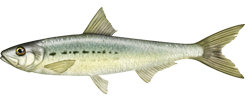 The Pacific sardine, Sardinops sagax caerulea


Feeding
[edit]Sardines feed almost exclusively on zooplankton, (lit. "animal plankton"), and congregate wherever this is abundant.
Fisheries
[edit]

Typically, sardines are caught with encircling nets, particularly purse seines. Many modifications of encircling nets are used, including traps or fishing weirs. The latter are stationary enclosures composed of stakes into which schools of sardines are diverted as they swim along the coast. The fish are caught mainly at night, when they approach the surface to feed on plankton. After harvesting, the fish are submerged in brine while they are transported to shore.
Sardines are commercially fished for a variety of uses: for bait; for immediate consumption; for drying, salting, or smoking; and for reduction into fish meal or oil. The chief use of sardines is for human consumption, but fish meal is used as animal feed, while sardine oil has many uses, including the manufacture of paint, varnish, and linoleum.
Food and nutrition
[edit]| Nutritional value per 100 g (3.5 oz) | |||||||||||||||||||||||||||||||||||||||||||
|---|---|---|---|---|---|---|---|---|---|---|---|---|---|---|---|---|---|---|---|---|---|---|---|---|---|---|---|---|---|---|---|---|---|---|---|---|---|---|---|---|---|---|---|
| Energy | 774 kJ (185 kcal) | ||||||||||||||||||||||||||||||||||||||||||
0.54 g | |||||||||||||||||||||||||||||||||||||||||||
10.4 g | |||||||||||||||||||||||||||||||||||||||||||
20.9 g | |||||||||||||||||||||||||||||||||||||||||||
| |||||||||||||||||||||||||||||||||||||||||||
| Other constituents | Quantity | ||||||||||||||||||||||||||||||||||||||||||
| Water | 66.9 g | ||||||||||||||||||||||||||||||||||||||||||
| †Percentages estimated using US recommendations for adults,[69] except for potassium, which is estimated based on expert recommendation from the National Academies.[70] | |||||||||||||||||||||||||||||||||||||||||||
Sardines are commonly consumed by humans as a source of protein, omega-3 fatty acids, and micronutrients.[71] Sardines may be grilled, pickled, smoked, or preserved in cans.
Canned sardines are 67% water, 21% protein, 10% fat, and contain negligible carbohydrates (table). In a reference amount of 100 g (3.5 oz), canned sardines supply 185 calories of food energy and are a rich source (20% or more of the Daily Value, DV) of vitamin B12 (375% DV), phosphorus (29% DV), and niacin (26% DV) (table). Sardines are a moderate source (10-19% DV) of the B vitamins, riboflavin and pantothenic acid, and several dietary minerals, including calcium and sodium (18% DV each) (table). A 100 g serving of canned sardines supplies about 7 g combined of monounsaturated and polyunsaturated fatty acids (USDA source in table).
Because they are low in the food chain, sardines are low in contaminants, such as mercury, relative to other fish commonly eaten by humans,[71][72] and have a relatively low impact in production of greenhouse gases.[71]
History
[edit]History of sardine fishing in the UK
[edit]Pilchard fishing and processing became a thriving industry in Cornwall, England from around 1750 to around 1880, after which it went into decline. Catches varied from year to year, and in 1871, the catch was 47,000 hogsheads, while in 1877, only 9,477 hogsheads. A hogshead contained 2,300 to 4,000 pilchards, and when filled with pressed pilchards, weighed 476 lbs. The pilchards were mostly exported to Roman Catholic countries such as Italy and Spain, where they are known as fermades. The chief market for the oil was Bristol, where it was used on machinery.[73]
Since 1997, sardines from Cornwall have been sold as 'Cornish sardines', and since March 2010, under EU law, Cornish sardines have Protected Geographical Status.[74] The industry has featured in numerous works of art, particularly by Stanhope Forbes and other Newlyn School artists.
The traditional "Toast to Pilchards" refers to the lucrative export of the fish to Catholic Europe:
- Here's health to the Pope, may he live to repent
- And add just six months to the term of his Lent
- And tell all his vassals from Rome to the Poles,
- There's nothing like pilchards for saving their souls![75]
History of sardine fishing in the United States
[edit]In the United States, the sardine canning industry peaked in the 1950s. Since then, the industry has been on the decline. The canneries in Monterey Bay, in what was known as Cannery Row in Monterey County, California (where John Steinbeck's novel of the same name was set), failed in the mid-1950s. The last large sardine cannery in the United States, the Stinson Seafood plant in Prospect Harbor, Maine, closed its doors on 15 April 2010 after 135 years in operation.[76]
In April 2015 the Pacific Fishery Management Council voted to direct NOAA Fisheries Service to halt the current commercial season in Oregon, Washington and California, because of a dramatic collapse in Pacific sardine stocks. The ban affected about 100 fishing boats with sardine permits, although far fewer were actively fishing at the time. The season normally would end 30 June.[77] The ban was expected to last for more than a year, and was still in place as of May 2019[update].[78]
In popular culture
[edit]The manner in which sardines can be packed in a can has led to the popular English language saying "packed like sardines", which is used metaphorically to describe situations where people or objects are crowded closely together.[79]
'Sardines' is also the name of a children's game, where one person hides and each successive person who finds the hidden one packs into the same space until only one is left out, who becomes the next one to hide.[80]
Among the residents of the Mediterranean city of Marseille, the local tendency to exaggerate is linked to a folk tale about a sardine that supposedly blocked the city's port in the 18th century. It was actually blocked by a ship called the Sartine.
Gallery
[edit]-
Sardines use body-caudal fin locomotion to swim, and streamline their bodies by holding their other fins flat against the body
-
 French sardine seiner
 -
 Exhibit of a woman canning sardines at the Maine State Museum in Augusta
.JPG)

See also
[edit]

References
[edit]- ^ a b c "FAO Fisheries & Aquaculture – FI fact sheet search". fao.org. Archived from the original on 8 May 2009. Retrieved 10 August 2018.
- ^ "What's an oily fish?". Food Standards Agency. 24 June 2004. Archived from the original on 10 December 2010.
- ^ "Sardine | Origin and meaning of sardine by Online Etymology Dictionary". etymonline.com. Archived from the original on 22 August 2011. Retrieved 10 August 2018.
- ^ "Sardine". The Good Food Glossary. BBC Worldwide. 2009. Archived from the original on 12 October 2008. Retrieved 1 November 2009.
- ^ "Sarda, Sardina". Dizionario Etimologico Online.
- ^ "FAQs". Seafish. Archived from the original on 22 July 2011. Retrieved 22 February 2010.
- ^ Stummer, Robin (17 August 2003). "Who are you calling pilchard? It's 'Cornish sardine' to you..." The Independent. Archived from the original on 12 September 2010. Retrieved 1 November 2009.
- ^ "Codex standard for canned sardines and sardine-type products codex stan 94 –1981 REV. 1–1995" (PDF). Codex Alimentarius. FAO/WHO Codex Alimentarius Commission. pp. 1–7. Archived (PDF) from the original on 25 March 2007. Retrieved 18 January 2007.
- ^ "sardine". Wiktionary. Retrieved 28 March 2018.
- ^ "σαρδίνη". The Online Liddell-Scott-Jones Greek-English Lexicon. Archived from the original on 12 May 2011. Retrieved 28 March 2018.
- ^ a b "sardine (n.)". Online Etymology Dictionary. Archived from the original on 21 April 2019. Retrieved 28 March 2018.
- ^ This article incorporates text from a publication now in the public domain: "Sard". Encyclopædia Britannica (11th ed.). 1911.
- ^ "Sardius, Sardine". Vine's Expository Dictionary of NT Words (1940), hosted at StudyLight.org. Retrieved 28 March 2018.
- ^ "The Cottage Bonnet". The Mirror of Literature, Amusement, and Instruction: Containing Original Papers (1075): 155. 4 September 1841.
- ^ de Kock, Paul (1879) [1829]. La femme, le mari, et l'amant (in French). Sceaux, Paris: Imprimerie de Charaire et fils. p. 1.
- ^ Lippard, George (1849) [1845]. The Quaker City, Or, The Monks of Monk-Hall: A Romance of Philadelphia Life, Mystery, and Crime. Philadelphia: T. B. Peterson & Brothers. p. 222.
- ^ Canot, Théodore (September 1854). Mayer, Brantz (ed.). "Revelations of a slave trader; or Twenty years' adventures of Captain Canot". London: Richard Bentley. p. 61., although this is a free rendering from the French original "...il fallut...les entassér commes des sardines." (Canot, Théodore (1860) [1854]. Le capitaine Canot, ou vingt années de la vie d'un négrier (in French). Paris: Amyot. p. 88.) where 'entassér' can mean 'to cram together.
- ^ Froese, Rainer; Pauly, Daniel (eds.). "Sardina pilchardus". FishBase. April 2012 version.
- ^ "Species Fact Sheet: Sardina pilchardus". FAO. Archived from the original on 25 July 2012. Retrieved 10 August 2018.
- ^ "Sardina pilchardus". Integrated Taxonomic Information System. Retrieved 11 April 2012.
- ^ Tous P, Sidibé A, Mbye E, de Morais L, Camara YH, Adeofe TA, Munroe T, Camara K, Cissoko K, Djiman R, Sagna A, Sylla M (2015). "European Pilchard – Sardina pilchardus". IUCN Red List of Threatened Species. 2015: e.T198580A15542481. doi:10.2305/IUCN.UK.2015-4.RLTS.T198580A15542481.en.
- ^ Froese, Rainer; Pauly, Daniel (eds.). "Sardinops sagax". FishBase. April 2012 version.
- ^ "Species Fact Sheet: Sardinops sagax". FAO. Archived from the original on 29 July 2012. Retrieved 10 August 2018.
- ^ "Sardinops sagax". Integrated Taxonomic Information System. Retrieved 11 April 2012.
- ^ Gaughan D, Di Dario F, Hata H (2018). "Sardinops sagax". IUCN Red List of Threatened Species. 2018: e.T183347A15602965. Retrieved 11 December 2018.
- ^ Grant, W. S.; et al. (1998). "Why restriction fragment length polymorphism analysis of mitochondrial DNA failed to resolve sardine (Sardinops) biogeography: insights from mitochondrial DNA cytochrome b sequences". Canadian Journal of Fisheries and Aquatic Sciences. 55 (12): 2539–47. doi:10.1139/f98-127.
- ^ Froese, Rainer; Pauly, Daniel (eds.). "Sardinops melanostictus". FishBase. April 2012 version.
- ^ "Species Fact Sheet: Sardinops melanostictus". FAO. Archived from the original on 24 September 2015. Retrieved 10 August 2018.
- ^ "Sardinops melanostictus". Integrated Taxonomic Information System. Retrieved 11 April 2012.
- ^ Froese, Rainer; Pauly, Daniel (eds.). "Sardinops caeruleus". FishBase. April 2012 version.
- ^ "Species Fact Sheet: Sardinops caeruleus". FAO. Archived from the original on 14 December 2012. Retrieved 10 August 2018.
- ^ "Sardinops caeruleus". Integrated Taxonomic Information System. Retrieved 11 April 2012.
- ^ Froese, Rainer; Pauly, Daniel (eds.). "Sardinops ocellatus". FishBase. April 2012 version.
- ^ "Species Fact Sheet: Sardinops ocellatus". FAO. Archived from the original on 13 December 2012. Retrieved 10 August 2018.
- ^ "Sardinops ocellatus". Integrated Taxonomic Information System. Retrieved 11 April 2012.
- ^ Froese, Rainer; Pauly, Daniel (eds.). "Sardinella lemuru". FishBase. April 2012 version.
- ^ "Species Fact Sheet: Sardinella lemuru". FAO. Archived from the original on 13 December 2012. Retrieved 10 August 2018.
- ^ "Sardinella lemuru". Integrated Taxonomic Information System. Retrieved 11 April 2012.
- ^ Santos M (2018). "Bali sardinella – Sardinella lemuru". IUCN Red List of Threatened Species. 2018: e.T75154879A75154994. Retrieved 11 December 2018.
- ^ Froese, Rainer; Pauly, Daniel (eds.). "Sardinella brasiliensis". FishBase. April 2012 version.
- ^ "Species Fact Sheet: Sardinella brasiliensis". FAO. Archived from the original on 7 November 2012. Retrieved 10 August 2018.
- ^ "Sardinella brasiliensis". Integrated Taxonomic Information System. Retrieved 11 April 2012.
- ^ Di Dario F (2018). "Brazilian Sardinella – Sardinella brasiliensis". IUCN Red List of Threatened Species. 2018: e.T16466246A16510172. Retrieved 11 December 2018.
- ^ Froese, Rainer; Pauly, Daniel (eds.). "Sardinella zunasi". FishBase. April 2012 version.
- ^ "Species Fact Sheet: Sardinella zunasi". FAO. Archived from the original on 13 December 2012. Retrieved 10 August 2018.
- ^ "Sardinella zunasi". Integrated Taxonomic Information System. Retrieved 11 April 2012.
- ^ Hata H, Munroe TA, Gaughan D, Mohd Arshaad W (2017). "Sardinella zunasi". IUCN Red List of Threatened Species. 2017: e.T75155119A75155131. doi:10.2305/IUCN.UK.2017-3.RLTS.T75155119A75155131.en.
- ^ Froese, Rainer; Pauly, Daniel (eds.). "Sardinella longiceps". FishBase. April 2012 version.
- ^ "Species Fact Sheet: Sardinella longiceps". FAO. Archived from the original on 8 May 2012. Retrieved 10 August 2018.
- ^ "Sardinella longiceps". Integrated Taxonomic Information System. Retrieved 11 April 2012.
- ^ Munroe TA; Priede IG (2010). "Sardinella longiceps". IUCN Red List of Threatened Species. 2010: e.T154989A55159768. doi:10.2305/IUCN.UK.2020-1.RLTS.T154989A55159768.en. Retrieved 18 October 2022.
- ^ Froese, Rainer; Pauly, Daniel (eds.). "Sardinella gibbosa". FishBase. April 2012 version.
- ^ "Species Fact Sheet: Sardinella gibbosa". FAO. Archived from the original on 1 November 2012. Retrieved 10 August 2018.
- ^ "Sardinella gibbosa". Integrated Taxonomic Information System. Retrieved 11 April 2012.
- ^ Santos M, Villarao MC, Tambihasan AM, Villanueva JA, Parido L, Lopez G, Deligero R, Alcantara M, Doyola MC, Gatlabayan LV, Buccat FGA, Lanzuela N, Belga PB, Gapuz AV, Al-Khalaf K, Kaymaram F (2018). "Goldstripe Sardinella – Sardinella gibbosa". IUCN Red List of Threatened Species. 2018: e.T46075248A46664239. Retrieved 11 December 2018.
- ^ Froese, Rainer; Pauly, Daniel (eds.). "Sardinella aurita". FishBase. April 2012 version.
- ^ "Species Fact Sheet: Sardinella aurita". FAO. Archived from the original on 7 November 2012. Retrieved 10 August 2018.
- ^ "Sardinella aurita". Integrated Taxonomic Information System. Retrieved 11 April 2012.
- ^ Munroe T, Brown J, Aiken KA, Grijalba Bendeck L (2017) [errata version of 2015 assessment]. "Round Sardinella – Sardinella aurita". IUCN Red List of Threatened Species. 2015: e.T198581A115340607. doi:10.2305/IUCN.UK.2015-4.RLTS.T198581A15542908.en.
- ^ Froese, Rainer; Pauly, Daniel (eds.). "Sardinella maderensis". FishBase. April 2012 version.
- ^ "Species Fact Sheet: Sardinella maderensis". FAO. Archived from the original on 14 December 2012. Retrieved 10 August 2018.
- ^ "Sardinella maderensis". Integrated Taxonomic Information System. Retrieved 11 April 2012.
- ^ Tous P, Sidibé A, Mbye E, de Morais L, Camara K, Munroe T, Adeofe TA, Camara YH, Djiman R, Sagna A, Sylla M (2015). "Madeiran Sardinella – Sardinella madeirensis". IUCN Red List of Threatened Species. 2015: e.T198582A15543624. doi:10.2305/IUCN.UK.2015-4.RLTS.T198582A15543624.en.
- ^ Froese, Rainer; Pauly, Daniel (eds.). "Sardinella marquesensis". FishBase. August 2021 version.
- ^ Froese, Rainer; Pauly, Daniel (eds.). "Dussumieria acuta". FishBase. April 2012 version.
- ^ "Species Fact Sheet: Dussumieria acuta". FAO. Archived from the original on 13 December 2012. Retrieved 10 August 2018.
- ^ "Dussumieria acuta". Integrated Taxonomic Information System. Retrieved 11 April 2012.
- ^ Santos M, Hata H, Villanueva JA, Parido L, Lanzuela N, Gapuz AV, Deligero R, Belga PB, Alcantara M, Buccat FGA, Doyola MC, Gatlabayan LV, Lopez G, Tambihasan AM (2017). "Hasselt's Sprat – Dussumieria acuta". IUCN Red List of Threatened Species. 2017: e.T18124721A46663954. doi:10.2305/IUCN.UK.2017-3.RLTS.T18124721A46663954.en.
- ^ United States Food and Drug Administration (2024). "Daily Value on the Nutrition and Supplement Facts Labels". FDA. Archived from the original on 27 March 2024. Retrieved 28 March 2024.
- ^ National Academies of Sciences, Engineering, and Medicine; Health and Medicine Division; Food and Nutrition Board; Committee to Review the Dietary Reference Intakes for Sodium and Potassium (2019). Oria, Maria; Harrison, Meghan; Stallings, Virginia A. (eds.). Dietary Reference Intakes for Sodium and Potassium. The National Academies Collection: Reports funded by National Institutes of Health. Washington, DC: National Academies Press (US). ISBN 978-0-309-48834-1. PMID 30844154. Archived from the original on 9 May 2024. Retrieved 21 June 2024.
- ^ a b c "Why eat lower on the seafood chain?". Harvard Health Publishing, Harvard University Medical School. 22 March 2023. Retrieved 3 September 2024.
- ^ "Mercury Levels in Commercial Fish and Shellfish". U S Food and Drug Administration. 5 July 2009. Archived from the original on 24 October 2011. Retrieved 1 November 2009.
- ^ Buckland, Frank (26 February 1880). "Our Fisheries". The Cornishman. No. 85. p. 6.
- ^ "Directory of PGI/PDO/TSG – Cornish Sardines profile". EC, Agriculture and Rural Development. Archived from the original on 10 August 2018. Retrieved 1 November 2010.
- ^ Rawe, Donald R (1992). Traditional Cornish Stories and Rhymes. Lodenek Press. ISBN 0-902899-08-2.
- ^ Canfield, Clarke (15 April 2010). "Last sardine plant in U.S. shuts its doors". Associated Press. Archived from the original on 23 September 2020. Retrieved 15 April 2010.
- ^ "Feds Cancel Commercial Sardine Fishing After Stocks Crash". North Country Public Radio, St. Lawrence University, Canton, New York. 16 April 2015. Retrieved 28 March 2018.
- ^ "Pacific Sardine". NOAA Fisheries. Retrieved 1 May 2019.
- ^ "packed like sardines | Definition of packed like sardines in English by Oxford Dictionaries". Oxford Dictionaries | English. Archived from the original on 11 October 2017. Retrieved 10 August 2018.
- ^ "Stinky Sardine Club – ITPedia". Itpedia.nyu.edu. 9 April 2010. Archived from the original on 29 November 2014. Retrieved 21 June 2012.
Further reading
[edit]- Parrish, R. H.; et al. (1989). "The monotypic sardines, Sardina and Sardinops: Their taxonomy, distribution, stock structure, and zoogeography" (PDF). Can. J. Fish. Aquat. Sci. 46 (11): 2019–36. doi:10.1139/f89-251.
External links
[edit]

Sardines (pilchards) | ||
|---|---|---|
| Notable species |  | |
| Ecology | ||
| Culinary use | ||
| Popular culture | ||

Principal commercial fishery species groups | ||||||||||||||||||||
|---|---|---|---|---|---|---|---|---|---|---|---|---|---|---|---|---|---|---|---|---|
| Wild |
|  .png)  | ||||||||||||||||||
| Farmed | ||||||||||||||||||||
