


Gac
| Gac | |
|---|---|

| |
| Exterior and cross-sectional interior of gac | |
Scientific classification 
| |
| Kingdom: | Plantae |
| Clade: | Tracheophytes |
| Clade: | Angiosperms |
| Clade: | Eudicots |
| Clade: | Rosids |
| Order: | Cucurbitales |
| Family: | Cucurbitaceae |
| Genus: | Momordica |
| Species: | M. cochinchinensis
|
| Binomial name | |
| Momordica cochinchinensis | |
| Synonyms[1] | |
| |
Gac, from the Vietnamese gấc (pronounced [ɣək˦˥]), scientific name Momordica cochinchinensis, is a species of plant in the melon and cucumber family Cucurbitaceae which is native to countries throughout Southeast Asia and to Queensland, Australia. It is notable for its vivid orange-reddish color resulting from its rich content of beta-carotene and lycopene.
Description[edit]
Momordica cochinchinensis is a perennial tendril climber which may reach up to 15 metres (50 feet) long and a stem diameter up to four centimetres (1+1⁄2 inches).[2][3][4] The palmate leaves have 3 to 5 lobes and are carried on a petiole (leaf stem) measuring 6–10 cm (2+1⁄2–4 in) long.[2][3][4] They are arranged alternately on the stems and measure up to 20 cm (8 in) wide and long.[2][3][4]
This species is dioecious, meaning that male and female flowers are borne on separate plants. The inflorescence on a male plant consists of either a solitary flower or a raceme up to 10 cm (4 in) long, while female flowers are solitary.[2][3][4][5] All flower buds are fully enclosed by bracts, which split open as the flower matures.[4][6] The mature flowers have five yellowish petals and a black centre.[6]
The fruit are ovoid to broadly ellipsoid, about 15 cm (6 in) long by 10 cm (4 in) diameter, and are covered with numerous small spines on the skin.[2][3][4][5][6] They are initially green but turn a deep orange/red at maturity, and they contain numerous irregularly-shaped brown or grey seeds which are enclosed in a bright red aril.[2][3][4][5][6]
Phenology[edit]
In the northern hemisphere this species flowers from June to August and fruit appear around August to October.[3] In Australia, flowering occurs from December to January and fruit appear from February to April.[7]
Phytochemistry[edit]
The fruit, seeds, and seed oil contain substantial amounts of beta-carotene and lycopene which collectively impart the characteristic red-orange color to the fruit's tissues.[8][9][10][11] Both aril and seeds are rich in monounsaturated and polyunsaturated fatty acids,[12] with oil containing 69% unsaturated fats, including 35% as polyunsaturated fats.[11] Gac has a high concentration of linoleic acid (omega-6) and omega-3 fatty acids.[12]
Taxonomy[edit]
This species was first described in 1790 by the Portuguese botanist João de Loureiro, who published it in his book Flora cochinchinensis. Loureiro gave this plant the combination Muricia cochinchinensis and noted that it was found in "Cochinchinensis & China."[13] In 1826 the German botanist Kurt Polycarp Joachim Sprengel transferred the species to the genus Momordica.[14]
Etymology[edit]
The genus name Momordica is derived from the Latin word mordeo meaning to bite, a reference to the seeds' appearance as though chewed.[7] The species epithet cochinchinensis means "from Cochinchina", the region in the southern part of Vietnam where the plant was first observed by Loureiro.[7][15]
Common names[edit]
As this plant is native to many countries throughout the Asia-Pacific region, it has a diverse number of common names including: bhat kerala (Assamese), mu bie gua, mu bie zi and teng tong (Chinese), balsam pear, Chinese cucumber, and giant spiny gourd (English), kakur, kantola and kakrol (Hindi), tepurang (Indonesian), mokube tsushi (Japanese), makkao (Khmer), khaawz (Laotian), pupia, teruah and torobuk (Malay), jhuse karelaa (Nepalese), pakurebu (Sulawesi), buyok buyok (Tagalog), phak khao (Thai), and gac (Vietnamese).[4][16][17]
Cultivation[edit]
As gac plant is dioecious, both male and female plants are needed; hence, farmers must have at least one corresponding male plant growing in or around the gardens for the fruit-bearing female plants to be pollinated. When grown from seed, the ratio of male to female plants is unpredictable.[18]
Pollination may be facilitated by insects, but hand pollination allows for better fruit yield. An alternative method is to graft female material onto the main shoot of a male plant.[19]
For maximum insect-aided pollination, the recommended ratio is about 1 male for every 10 female plants.[18] If propagating from vines, farmers make diagonal cut (around 15–20 cm or 6–8 in long and 3–6 mm or 1⁄8–1⁄4 in wide), then root the tubers in water or well-aerated, moist potting media before planting.[18]
Apart from Southeast Asian countries where the fruits are native, gac can be grown in sub-tropical climate regions.[17] Cool temperatures inhibit growth.[18]
Uses[edit]
Gac has been commonly used in its native countries, mainly as food and traditional medicine. Its use as a folk medicine dates back over centuries in China and Vietnam.[20] Gac seeds, known as mù biē zǐ (meaning 'wooden turtle seed'), are used for a variety of internal and topical purposes in traditional medicine.[21]
The aril surrounding gac seeds when the fruits are ripe is cooked with sticky rice to make xôi gac, a traditional Vietnamese dish in red color served at weddings and New Year celebrations. In addition, the immature green fruit is also used as a vegetable in India.[22] The spiny skin is removed and the fruits are sliced and cooked sometimes with potato or bottle gourd. In Sri Lanka, gac is used in curry, and in Thailand, gac is served with ice cream.[23]
Due to the high contents of beta-carotene and lycopene, extracts from the fruit's arils are used to manufacture dietary supplements in soft capsules or are sometimes mixed into beverages.[24][failed verification]
Gallery[edit]
-
 Habit
Habit -
 Foliage
 -
 Flowers
 -
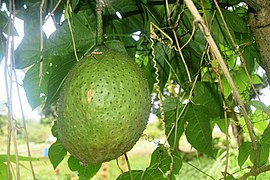 Unripe fruit
 -
 Ripe fruit
 -
 Fruit
Fruit -
 Seeds
Seeds -
 A plate of Xôi gấc


References[edit]
- ^ a b "Momordica cochinchinensis (Lour.) Spreng". Plants of the World Online. Royal Botanic Gardens, Kew. 2023. Retrieved 16 December 2023.
- ^ a b c d e f Telford, I.R.H. (2022). "Momordica cochinchinensis". Flora of Australia. Australian Biological Resources Study, Department of Climate Change, Energy, the Environment and Water: Canberra. Retrieved 19 December 2023.
- ^ a b c d e f g "Momordica cochinchinensis (Lour.) Spreng". Flora of China (eFloras). Missouri Botanical Garden, St. Louis, MO & Harvard University Herbaria, Cambridge, MA. Retrieved 19 December 2023.
- ^ a b c d e f g h F.A.Zich; B.P.M.Hyland; T.Whiffen; R.A.Kerrigan (2020). "Momordica cochinchinensis". Australian Tropical Rainforest Plants Edition 8 (RFK8). Centre for Australian National Biodiversity Research (CANBR), Australian Government. Retrieved 19 December 2023.
- ^ a b c "Momordica cochinchinensis". Flora Malesiana. Retrieved 19 December 2023.
- ^ a b c d Slik, J.W.F. "Momordica cochinchinensis Spreng. Syst. Veg. 3: 14 (1826)". Plants of Southeast Asia. Ferry Slik. Retrieved 19 December 2023.
- ^ a b c Cooper, Wendy; Cooper, William T. (June 2004). Fruits of the Australian Tropical Rainforest. Clifton Hill, Victoria, Australia: Nokomis Editions. p. 140. ISBN 978-0958174213.
- ^ Mai, H. C.; Truong, V; Debaste, F (2014). "Carotenoids concentration of gac (Momordica cochinchinensis Spreng.) fruit oil using cross-flow filtration technology". Journal of Food Science. 79 (11): E2222–31. doi:10.1111/1750-3841.12661. PMID 25367308.
- ^ Maoka, T; Yamano, Y; Wada, A; et al. (2015). "Oxidative metabolites of lycopene and γ-carotene in gac (Momordica cochinchinensis)". Journal of Agricultural and Food Chemistry. 63 (5): 1622–30. doi:10.1021/jf505008d. PMID 25633727.
- ^ Wimalasiri, Dilani; Brkljača, Robert; Piva, Terrence J.; et al. (2017). "Comparative analysis of carotenoid content in Momordica cochinchinensis (Cucurbitaceae) collected from Australia, Thailand and Vietnam". Journal of Food Science and Technology. 54 (9): 2814–2824. doi:10.1007/s13197-017-2719-0. ISSN 0022-1155. PMC 5583111. PMID 28928521.
- ^ a b Vuong, LT; King, JC (June 2003). "A method of preserving and testing the acceptability of gac fruit oil, a good source of beta-carotene and essential fatty acids". Food and Nutrition Bulletin. 24 (2): 224–230. doi:10.1177/156482650302400209. ISSN 0379-5721. PMID 12891827. S2CID 7515533.
- ^ a b Ishida, Betty; Turner, Charlotta; Chapman, Mary; A McKeon, Thomas (2004). "Fatty acid and carotenoid composition of gac (Momordica cochinchinensis Spreng) fruit". Journal of Agricultural and Food Chemistry. 52 (2): 274–9. doi:10.1021/jf030616i. PMID 14733508.
- ^ Loureiro, João de (1790). Flora cochinchinensis. Vol. 2. p. 596. Retrieved 19 December 2023.
- ^ Sprengel, Kurt Polycarp Joachim, ed. (1826). Systema vegetabilium Ed. 17. Vol. 3. p. 14. Retrieved 19 December 2023.
- ^ Vuong, Le Thuy; Franke, Adrian A.; Custer, Laurie J.; Murphy, Suzanne P. (2006). "Momordica cochinchinensis Spreng. (gac) fruit carotenoids reevaluated". Journal of Food Composition and Analysis. 19 (6–7): 664–668. doi:10.1016/j.jfca.2005.02.001. ISSN 0889-1575.
- ^ "Sorting Momorcodia names". Multilingual Multiscript Plant Name Database. The University of Melbourne, Australia. Retrieved 19 December 2023.
- ^ a b "Momordica cochinchinensis (Lour.) Spreng". GRIN-Global. United States Department of Agriculture. Retrieved 19 December 2023.
- ^ a b c d Parks, Sophie; Murray, Carly; Gale, David; et al. (2013). "Propagation and production of gac (Momordica cochinchinensis Spreng.), A greenhouse case study". Experimental Agriculture. 49 (2): 234–243. doi:10.1017/S0014479712001081. S2CID 86531219.
- ^ "Propagation and cultivation of Gac plant". Gac Research
University of Newcastle, Australia. Retrieved 2018-11-26. - ^ "Researchers use nature to fight cancer". Centre for Biodiscovery and Molecular Development of Therapeutics. James Cook University. Archived from the original on 26 November 2018. Retrieved 19 December 2023.
- ^ Chuyen, Hoang; Nguyen, Minh; Roach, Paul; et al. (Spring 2015). "Gac fruit (Momordica cochinchinensis Soreng,): a rich source of bioactive compounds and its potential health benefits". Food Science and Technology. 50 (3): 567–577. doi:10.1111/ijfs.12721.
- ^ Tran, Xuan T.; Parks, Sophie E.; Roach, Paul D.; et al. (2015-10-06). "Effects of maturity on physicochemical properties of Gac fruit (Momordica cochinchinensis Spreng.)". Food Science & Nutrition. 4 (2): 305–314. doi:10.1002/fsn3.291. ISSN 2048-7177. PMC 4779482. PMID 27004120.
- ^ "RMIT researcher uncovers the exceptional health benefits of gac fruit". RMIT University Vietnam. Retrieved 2018-11-26.
- ^ Goodman, Lawrence (August 2015). "The Next Big Fruit Juice?". Brown Alumni Magazine. Retrieved 12 August 2017.
External links[edit]
 Media related to Momordica cochinchinensis at Wikimedia Commons

- Momordica
- Dietary supplements
- Dioecious plants
- Edible fruits
- Medicinal plants of Asia
- Medicinal plants of Oceania
- Plants used in traditional Chinese medicine
- Flora of China
- Flora of tropical Asia
- Flora of Queensland
- Plants described in 1790
- Taxa named by João de Loureiro
- Taxa named by Kurt Polycarp Joachim Sprengel