


Mahi-mahi
| Mahi-mahi | |
|---|---|

| |
Scientific classification 
| |
| Domain: | Eukaryota |
| Kingdom: | Animalia |
| Phylum: | Chordata |
| Class: | Actinopterygii |
| Order: | Carangiformes |
| Family: | Coryphaenidae |
| Genus: | Coryphaena |
| Species: | C. hippurus
|
| Binomial name | |
| Coryphaena hippurus | |
| Synonyms[2] | |
| |


The mahi-mahi (/ˈmɑːhiːˈmɑːhiː/)[3] or common dolphinfish[2] (Coryphaena hippurus) is a surface-dwelling ray-finned fish found in off-shore temperate, tropical, and subtropical waters worldwide. Also widely called dorado (not to be confused with Salminus brasiliensis, a freshwater fish) and dolphin, it is one of two members of the family Coryphaenidae, the other being the pompano dolphinfish. These fish are most commonly found in the waters around the Gulf of Mexico, Costa Rica, Hawaii and the Indian Ocean.
Nomenclature[edit]
The name mahi-mahi comes from the Hawaiian language[4] and means 'very strong', through the process of reduplication.[5] By chance in Persian, mahi (ماهی) means 'fish', but the word mahi-mahi is Hawaiian. Though the species is also referred to as the common dolphinfish, the use of dolphin can be misleading as they are not related to dolphins; see Coryphaena for the possible etymologies of dolphinfish. In parts of the Pacific and along the English-speaking coast of South Africa, the mahi-mahi is commonly referred to by its name in Spanish, dorado.[6] On the Mediterranean island of Malta, the mahi-mahi is referred to as the lampuka. In Indonesian, they are called ikan lemadang.
Linnaeus named the genus, derived from the Greek word, κορυφή, koryphe, meaning 'top' or 'apex', in 1758. Synonyms for the species include Coryphaena argyrurus, Coryphaena chrysurus, and Coryphaena dolfyn.[2]
Description[edit]
Mahi-mahi have compressed bodies and one very long dorsal fin extending from the head almost to the tail fin. Mature males have distinctive "foreheads"; it grows as the fish matures and often protrudes well above the body proper, which is streamlined by the musculature of the back. This "hump" is a sexually dimorphic feature; females have a rounded head. Their caudal fins and anal fins are sharply concave. They are distinguished by dazzling colors – golden on the sides, and bright blues and greens on the sides and back. The pectoral fins of the mahi-mahi are iridescent blue. The flank is broad and golden.[7] Out of the water, the fish often change color (giving rise to their Spanish name, dorado, 'golden'), going through several hues before finally fading to a muted yellow-grey upon death.
Mahi-mahi can live for up to five years, although they seldom exceed four. Females are usually smaller than males. Catches typically are 7 to 13 kg (15 to 29 lb) and a meter in length. They rarely exceed 15 kg (33 lb), and mahi-mahi over 18 kg (40 lb) are exceptional. Mahi-mahi are among the fastest-growing of fish. They spawn in warm ocean currents throughout much of the year, and their young are commonly found in rafts of Sargassum weeds. Young mahi-mahi migrate past Malta where they are called lampuki and Sicily where they are known as lampuga or capone; there they are fished using nets and floating mats of palm leaves under which they collect.
Mahi-mahi are carnivorous, feeding on flying fish, crabs, squid, mackerel, and other forage fish. They have also been known to eat zooplankton. To pursue such varied pelagic prey, mahi-mahi are fast swimmers, swimming as fast as 50 knots (92.6 km/h, 57.5 mph).[citation needed]
Males and females are sexually mature in their first year, usually by the age of 4–5 months. Spawning can occur at body lengths of 20 cm (7.9 in). Females may spawn two to three times per year, and produce between 80,000 and 1,000,000 eggs per event. In waters at 28 °C/83 °F, mahi-mahi larvae are found year-round, with greater numbers detected in spring and fall.[8] Mahi-mahi fish are mostly found in the surface water. Their flesh is grey-white when raw, cooking to an attractive white with a clean, non-fishy flavour.
-
 Mahi-mahi in a fish market
 -
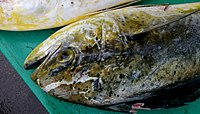 Closeup


Relation to humans[edit]
Fishing[edit]
Recreational fishing[edit]
 |
Mahi-mahi are highly sought for sport fishing and commercial purposes. Sport fishermen seek them due to their beauty, size, food quality, and healthy population. Mahi-mahi can be found in the Caribbean Sea, on the west coast of North and South America, the Pacific coast of Costa Rica, the Gulf of Mexico, the Atlantic coast of Florida and West Africa, Indian Ocean, Bay of Bengal, South China Sea and Southeast Asia, Hawaii, Tahiti, and many other places worldwide.
Fishing charters most often look for floating debris and frigatebirds near the edge of the reef in about 120 feet (37 m) of water. Mahi-mahi (and many other fish) often swim near debris such as floating wood, five-gallon bucket lids, palm trees and fronds, or sargasso weed lines and around fish buoys. Frigatebirds search for food accompanying the debris or sargasso. Experienced fishing guides can tell what species are likely around the debris by the birds' behavior.
30-to-50-pound (14 to 23 kg) gear is more than adequate when trolling for mahi-mahi. Fly-casters may especially seek frigatebirds to find big mahi-mahis, and then use a bait-and-switch technique. Ballyhoo or a net full of live sardines tossed into the water can excite the mahi-mahis into a feeding frenzy. Hookless teaser lures can have the same effect. After tossing the teasers or live chum, fishermen throw the fly to the feeding mahi-mahi. Once on a line, mahi-mahi are fast, flashy, and acrobatic, with beautiful blue, yellow, green, and even red dots of color.
Commercial fishing[edit]
The United States and the Caribbean countries are the primary consumers of this fish, but many European countries are increasing their consumption every year.[citation needed] It is a popular food fish in Australia, usually caught and sold as a byproduct by tuna and swordfish commercial fishing operators. Japan and Hawaii are significant consumers. The Arabian Sea, particularly the coast of Oman, also has mahi-mahi. At first, mahi-mahi were mostly bycatch in the tuna and swordfish longline fishery. Now, they are sought by commercial fishermen on their own merits.
In French Polynesia, fishermen use harpoons, using a specifically designed boat, the poti marara, to pursue it, because mahi-mahi do not dive. The poti marara is a powerful motorized V-shaped boat, optimized for high agility and speed, and driven with a stick so the pilot can hold his harpoon with his right hand. The method is also practiced by fishermen in the Philippines, especially in the northern province of Batanes, where the harpooning is called pagmamamataw.
Environmental and food safety concerns[edit]
Depending on how it is caught, mahi-mahi is classed differently by various sustainability rating systems:
- The Monterey Bay Aquarium classifies mahi-mahi, when caught in the US Atlantic, as a best choice, the top of its three environmental-impact categories. The aquarium advises to avoid imported mahi-mahi harvested by long line, but rates troll and pole-and-line caught as a good alternative.
- The Natural Resources Defense Council classifies mahi-mahi as a "moderate mercury" fish (its second-lowest of four categories), and suggests eating six servings or fewer per month.[9]
The mahi-mahi is also a common vector for ciguatera poisoning.[10] Although a very popular food dish in many parts of the world, there have been reports of ciguatera poisoning from human consumption of this fish. Ciguatera poisoning is caused by the accumulation of toxins (ciguatoxins and maitotoxin) in the flesh of the fish over time. These are produced by Gambierdiscus toxicus which grows together with marine algae, which causes fish like the mahi-mahi to consume them by accident.[11]
Mahi-mahi naturally have high levels of histidine, which is converted to histamine when bacterial growth occurs during improper storage or processing.[12] Subsequent cooking, smoking, or freezing does not eliminate the histamine. This leads to a foodborne illness known as scombroid food poisoning, which also affect other fish such as tuna, mackerel, sardine, anchovy, herring, bluefish, amberjack and marlin.[12] Symptoms are those of histamine intolerance and may include flushed skin, headache, itchiness, blurred vision, abdominal cramps, and diarrhea.,[12] and the onset of symptoms is typically 10 to 60 minutes after eating and can last for up to two days.[12] Rarely, breathing problems (like that of allergic asthma) or an irregular heartbeat may occur.[12] Diagnosis is typically based on the symptoms and may be supported by a normal blood tryptase.[13]
-
 Bull (male) mahi-mahi
 -
 Mahi-mahi are attracted to Sargassum, floating brown algae that serve as both a hiding place and source of food. Lines of this genus can stretch for miles along the ocean surface.
 -
 Grilled mahi-mahi


References[edit]
- ^ Collette, B.; Acero, A.; Amorim, A.F.; Boustany, A.; Canales Ramirez, C.; Cardenas, G.; Carpenter, K.E.; de Oliveira Leite Jr.; N.; Di Natale, A.; Fox, W.; Fredou, F.L.; Graves, J.; Viera Hazin, F.H.; Juan Jorda, M.; Minte Vera, C.; Miyabe, N.; Montano Cruz, R.; Nelson, R.; Oxenford, H.; Schaefer, K.; Serra, R.; Sun, C.; Teixeira Lessa, R.P.; Pires Ferreira Travassos, P.E.; Uozumi, Y.; Yanez, E. (2011). "Coryphaena hippurus". IUCN Red List of Threatened Species. 2011: e.T154712A4614989. doi:10.2305/IUCN.UK.2011-2.RLTS.T154712A4614989.en. Retrieved 19 November 2021.
- ^ a b c Froese, Rainer; Pauly, Daniel (eds.) (2019). "Coryphaena hippurus" in FishBase. August 2019 version.
- ^ "Dictionary.com: define Mahi-mahi".
- ^ Mary Kawena Pukui; Samuel Hoyt Elbert (2003). "lookup of dolphin". in Hawaiian Dictionary. Ulukau, the Hawaiian Electronic Library, University of Hawaii Press.
- ^ "mahimahi". Te Aka Māori Dictionary. Retrieved 2022-09-02.
- ^ "Fish detail". WWF SASSI. Retrieved 2018-05-31.
- ^ Dianne J. Bray, 2011, Mahi Mahi, Coryphaena hippurus, in Fishes of Australia, accessed 07 Oct 2014, http://www.fishesofaustralia.net.au/home/species/1730
- ^ Bostwick, Joshua (2000). "Coryphaena hippurus". Animal Diversity Web. Retrieved August 17, 2011.
- ^ "Consumer Guide to Mercury in Fish".
- ^ "Ciguatera Fish Poisoning (CFP)". Fish and Wildlife Research Institute. Archived from the original on 2006-11-25. Retrieved 2010-01-04.
- ^ "Dolphinfish". Florida Museum of Natural History. 2019. Retrieved June 2, 2019.
- ^ a b c d e "Food Poisoning from Marine Toxins - Chapter 2 - 2018 Yellow Book". CDC. 2017. Retrieved 1 June 2018.
 This article incorporates text from this source, which is in the public domain.
- ^ Ridolo, E; Martignago, I; Senna, G; Ricci, G (October 2016). "Scombroid syndrome: it seems to be fish allergy but... it isn't". Current Opinion in Allergy and Clinical Immunology. 16 (5): 516–21. doi:10.1097/ACI.0000000000000297. PMID 27466827. S2CID 21610715.

Further reading[edit]
- Atlantic Mahi Mahi NOAA FishWatch. Retrieved 11 November 2012.
- Pacific Mahi Mahi NOAA FishWatch. Retrieved 11 November 2012.
External links[edit]


- Froese, Rainer; Pauly, Daniel (eds.) (2004). "Coryphaena hippurus" in FishBase. October 2004 version.
- Dolphinfish Monterey Bay Aquarium
- Oceana's Sustainable Seafood Guide
- Dolphinfish Florida Museum
- Dolphinfishes from iNaturalist


