


Singapore Flyer
1°17′21.83″N 103°51′47.63″E / 1.2893972°N 103.8632306°E
| Singapore Flyer | |
|---|---|
 | |
 | |
 | |
| General information | |
| Type | Ferris wheel |
| Location | Singapore |
| Address | 30 Raffles Avenue, Singapore 039803 |
| Construction started | 2005[1] |
| Completed | 2008[1] |
| Opening | 11 February 2008 (restricted)[2] 1 March 2008 (soft) 15 April 2008 (official) |
| Cost | S$240 million |
| Owner | Straco Corporation Limited (90%), WTS Leisure Pte Ltd (10%)[4] |
| Height | 165 m (541 ft) |
| Dimensions | |
| Diameter | 150 metres (492 ft) |
| Technical details | |
| Floor area | 33,700 m2 (362,700 sq ft) |
| Design and construction | |
| Architect(s) | Kisho Kurokawa Architects & Associates, DP Architects |
| Developer | Melchers Singapore |
| Engineer | Arup |
| Main contractor | Mitsubishi – Takenaka Consortium[3] |
| Other information | |
| Seating capacity | 784 |
| Website | |
| singaporeflyer.com | |
The Singapore Flyer[a] is an observation wheel at the Downtown Core district of Singapore. Officially opened on 15 April 2008, it has 28 air-conditioned capsules, each able to accommodate 28 passengers, and incorporates a three-story terminal building.[5][6] The flyer has made numerous appearances in media and popular culture that features Singapore.
The Flyer has an overall height of 165 metres (541 ft) and was the world's tallest Ferris wheel until the 167.6 m (550 ft) High Roller, which is 2.6 m (9 ft) taller than the Flyer.[7][8]
Early history[edit]
The Singapore Flyer was first conceived in the early 2000s by Patrick MacMahon of Melchers Project Management, a subsidiary of German company Melchers. Formal planning commenced in 2002. A new company, Singapore Flyer Pte Ltd, was formed as the developer, with Melchers Project Management holding a 75% stake, and the remainder held by Orient & Pacific Management.[1][9]
The project was formally announced and endorsed on 27 June 2003 by the Singapore Tourism Board with the signing of a memorandum of understanding, formalising the understanding between the developer and tourism board with regard to the land-acquisition process.[1][9]
Under this agreement, the tourism board was to purchase the plot of land in Marina Centre from the Singapore Land Authority, and lease it to Singapore Flyer Pte Ltd for 30 years with an option to extend the lease by another 15 years. The land was to be rent-free during the construction phase of the project. In July 2003, Jones Lang LaSalle was appointed as the real estate advisor. Takenaka and Mitsubishi were selected as the main contractors, and Arup as the structural engineer.[1][9]
In August 2007, Florian Bollen, Singapore Flyer Pte Ltd chairman, raised his stake in the Singapore Flyer from 60% to 90% through acquisition of Melchers Project Management's 30% stake. The deal was done via AAA Equity Holdings, a private investment vehicle headed by Bollen. Orient & Pacific Management, which spearheaded the project development management, owns the remaining 10%.[1][9]
Construction[edit]
The groundbreaking ceremony was held on 27 September 2005, with Mah Bow Tan, then Minister for National Development, as guest of honour. The spindle was fitted on 13 December 2006, and the outer rim was completed on 9 April 2007. Installation of the passenger capsules began on 3 August 2007 and was completed on 2 October 2007.[10][1]
Opening[edit]
The Flyer opened in 2008. During Chinese New Year, corporate 'inaugural flights' were held from 11 to 13 February, and tickets for which sold out for S$8,888, an auspicious number in Eastern culture. The first public rides were on Valentine's Day, 14 February, the soft launch on 1 March,[2] and the official opening on 15 April, at which Prime Minister Lee Hsien Loong was the guest of honour.[1][11]
Design[edit]

The development has a gross building area of approximately 16,000 m2 (172,000 sq ft), built on a 33,700 m2 (362,700 sq ft) site along the Marina Promenade. Designed by Arup and Mitsubishi Heavy Industries with a capacity of up to 7.3 million passengers a year, the normally constant rotation of the wheel means that a complete trip lasts approximately 32 minutes.[12]
The Flyer's 28 air-conditioned capsules are mounted outboard of the rim of the wheel structure, providing continuously unobstructed views. Each capsule has a floor area of 26 m2 (280 sq ft) and is capable of holding 28 passengers, or up to five wheelchairs and 15 other visitors when booked in advance for use by disabled guests.[13]
The wheel initially rotated in a counter-clockwise direction when viewed from Marina Centre, but on 4 August 2008 this was reversed on the advice of Feng shui masters.[14]
Wheelchair ramps and lifts, handicapped toilets and a dedicated parking lot for the disabled are also provided.[15]
Acquisition[edit]
On 28 August 2014, Straco Leisure Pte. Ltd. announced the acquisition of Singapore Flyer after embezzlement and financial issues with the now defunct predecessor company, Great Wheel Corporation.[16] Straco Leisure Pte. Ltd. is 90% owned by Straco Corporation Limited, a Singaporean listed company that operates tourist attractions in China such as the Shanghai Ocean Aquarium and Underwater World Xiamen. The remaining 10% is owned by WTS Leisure Pte. Ltd., one of the largest private tour bus operators in Singapore.[4]
In media[edit]
- The Bloomberg Television series High Flyers is filmed in one of the Flyer's capsules.[17]
- The Flyer makes an appearance in the 2018 film, Crazy Rich Asians, based on the novel of the same name by Kevin Kwan.[citation needed]
- The Flyer was featured in a task on the sixteenth season of the American reality show The Amazing Race as well as during the finale of the first season of the Australian variant The Amazing Race Australia.[18][19]
- The Flyer was featured and visited by South Korean band Twice for their TWICE TV series (TWICE TV6) when they were in Singapore.[20]
- The Flyer was featured in two Detective Conan films, once in the 2016 film The Darkest Nightmare, and another time in the 2019 film The Fist of Blue Sapphire.[citation needed]
- The Flyer will appear in HBO series Euphoria, as part of the third season.[citation needed]
Gallery[edit]

-
 Exterior view inside a capsule
 -
 View within a capsule
 -
 Marina Bay in 2012, one of the many views from the Flyer's capsules
 -
![The site includes a tropical rainforest garden[21]](//upload.wikimedia.org/wikipedia/commons/thumb/a/a9/1_-_Yakult_Rainforest_Discovery.JPG/360px-1_-_Yakult_Rainforest_Discovery.JPG) The site includes a tropical rainforest garden[21]
The site includes a tropical rainforest garden[21] -
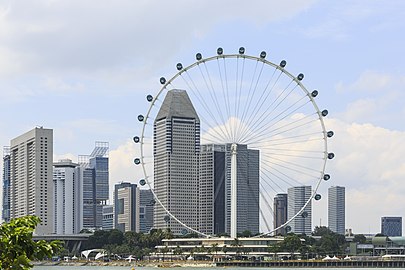 Singapore Flyer in the day
 -
 Singapore Skyline at Sunset from Gardens by the Bay
 -
 A view of Singapore Flyer at Dusk, 2012


![The site includes a tropical rainforest garden[21]](/wiki/File:1_-_Yakult_Rainforest_Discovery.JPG)


Notes and references[edit]
Notes[edit]
References[edit]
- ^ a b c d e f g h "History & Milestones". Singapore Flyer. Archived from the original on 24 March 2013. Retrieved 8 February 2013.
- ^ a b "Singapore Flyer opens to the public from Saturday". Channel NewsAsia. 1 March 2008. Archived from the original on 3 March 2008. Retrieved 2 March 2008.
- ^ "The Singapore Flyer – An Engineering Feat" (PDF). Singapore Flyer. Archived from the original (PDF) on 19 November 2012. Retrieved 8 June 2019.
- ^ a b "Straco Leisure Pte Ltd signs agreement to purchase the Singapore Flyer". Singapore Tourism Board. 28 August 2014. Archived from the original on 10 September 2014. Retrieved 10 September 2014.
- ^ "S'pore flyer set to spin on Monday night". Archived from the original on 28 October 2017. Retrieved 16 October 2018.
- ^ "5 things about Singapore Flyer and new owner Straco". 28 August 2014. Archived from the original on 26 March 2018. Retrieved 16 October 2018.
- ^ "High Roller: world's largest Ferris wheel hoisted into place in Las Vegas". Associated Press. 11 September 2013. Archived from the original on 15 September 2018. Retrieved 3 April 2018 – via www.telegraph.co.uk.
- ^ Santorelli, Tom. "'World's tallest' Ferris wheel opens in Las Vegas". BBC News. Archived from the original on 2 April 2014. Retrieved 2 April 2014.
- ^ a b c d "The Singapore Flyer – an engineering feat" (PDF). Archived (PDF) from the original on 5 May 2022. Retrieved 21 October 2021.
- ^ Singapore Flyer may open to public earlier than scheduled[permanent dead link]
- ^ "PM Lee officially opens Singapore Flyer". Channel NewsAsia. 15 April 2008. Archived from the original on 20 April 2008. Retrieved 16 April 2008.
- ^ "Fun Facts about the Flyer". Singapore Flyer. Archived from the original on 24 March 2013. Retrieved 28 May 2013.
- ^ "Design Concepts". Singapore Flyer. Archived from the original on 24 March 2013. Retrieved 28 May 2013.
- ^ "Feng Shui turns this wheel". The Straits Times. Archived from the original on 4 August 2010. Retrieved 14 September 2010.
- ^ "Wheelchair Access – Singapore Flyer". Singaporeflyer.com. 16 December 2007. Archived from the original on 9 September 2010. Retrieved 14 September 2010.
- ^ Tan, Weizhen (8 May 2014). "Singapore Flyer's woes takes a new spin after Merlin talks collapse – TODAYonline". TODAY. Archived from the original on 9 August 2014. Retrieved 7 August 2014.
- ^ "High Flyers for Bloomberg". 14 March 2014. Archived from the original on 4 March 2016. Retrieved 6 August 2015.
- ^ Shaw, Jessica (12 April 2010). "The Amazing Race recap: Singapore Sting". Entertainment Weekly. Archived from the original on 27 December 2019. Retrieved 27 December 2019.
- ^ "Tyler and Nathan Win the First Amazing Race Australia Series!". PopSugar. 2 August 2011. Archived from the original on 27 December 2019. Retrieved 27 December 2019.
- ^ "[V LIVE] TWICE TV6 -TWICE in SINGAPORE- EP.02". www.vlive.tv. Retrieved 21 October 2021.
- ^ "English Brochure" (PDF). Singapore Flyer. Archived from the original (PDF) on 8 October 2013.
External links[edit]

