


Whitney Museum
 | |
.jpg) The front of the museum (2019) | |
 Interactive fullscreen map | |
| Established | 1930 |
|---|---|
| Location | 99 Gansevoort Street, Lower Manhattan, New York City |
| Coordinates | 40°44′22.6″N 74°0′32.0″W / 40.739611°N 74.008889°W |
| Type | Art museum |
| Visitors | 768,000 (2023)[1] |
| Founder | Gertrude Vanderbilt Whitney |
| Director | Scott Rothkopf |
| Architect | Renzo Piano |
| Public transit access | Subway:     at 14th Street – Eighth Avenue at 14th Street – Eighth Avenue Bus: M11, M12, M14A, M14D |
| Website | whitney.org |
The Whitney Museum of American Art, known informally as "The Whitney", is a modern and contemporary American art museum located in the Meatpacking District and West Village neighborhoods of Manhattan in New York City. The institution was originally founded in 1930 by Gertrude Vanderbilt Whitney (1875–1942), a prominent American socialite, sculptor, and art patron after whom it is named.
The Whitney focuses on collecting and preserving 20th- and 21st-century American art. Its permanent collection, spanning the late-19th century to the present, comprises more than 25,000 paintings, sculptures, drawings, prints, photographs, films, videos, and artifacts of new media by more than 3,500 artists. It places particular emphasis on exhibiting the work of living artists as well as maintaining institutional archives of historical documents pertaining to modern and contemporary American art, including the Edward and Josephine Hopper Research Collection, the Sanborn Hopper Archive, and the Arshile Gorky Research Collection, among others.[2]
From 1966 to 2014, the Whitney was located at 945 Madison Avenue on Manhattan's Upper East Side in a building designed by Marcel Breuer and Hamilton P. Smith. The museum closed in October 2014 to relocate to its current building, which was designed by Renzo Piano at 99 Gansevoort Street and opened on May 1, 2015, expanding the museum exhibition space to 50,000 square feet.[3]
The museum organizes the Whitney Biennial, a bi-annual exhibition showcasing the work of emerging American artists, considered the longest-running and most important survey of contemporary art in the United States.[4][5][6] The museum also heads the Whitney Independent Study Program, which began in 1968, to support artists, critics and art historians by "encouraging the theoretical and critical study of the practices, institutions, and discourses that constitute the field of culture".[7][8] In 2023, with 768,000 visitors, the Whitney was the 26th most-visited museum in the United States and the 89th most-visited art museum in the world.[9]
History[edit]
Early years[edit]

Gertrude Vanderbilt Whitney, the museum's namesake and founder, was a well-regarded sculptor and serious art collector. As a patron of the arts, she began acquiring art in 1905, and had achieved some success with the Whitney Studio and Whitney Studio Club, New York–based exhibition spaces she operated from 1914 to 1928 to promote the works of avant garde and unrecognized American artists. Whitney favored the radical art of the American artists of the Ashcan School such as John French Sloan, George Luks, and Everett Shinn, as well as others such as Edward Hopper, Stuart Davis, Charles Demuth, Charles Sheeler, and Max Weber.[10][11]
With the aid of her assistant, Juliana R. Force, Whitney collected nearly 700 works of American art. In 1929, she offered to donate over 500 to the Metropolitan Museum of Art, but the museum declined the gift. This, along with the apparent preference for European modernism at the recently opened Museum of Modern Art, led Whitney to start her own museum, exclusively for American art, in 1929.[12][13]
Whitney Library archives from 1928 reveal that during this time, the Studio Club used the gallery space of Wilhelmina Weber Furlong of the Art Students League to exhibit traveling shows featuring modernist work.[14][15] The Whitney Museum of American Art was founded in 1930;[16] at this time architect Noel L. Miller was converting three row houses on West 8th Street in Greenwich Village—one of which, 8 West 8th Street had been the location of the Studio Club—to be the museum's home, as well as a residence for Whitney.[17] The new museum opened in 1931. Juliana Force became the museum's first director, and under her guidance, it concentrated on displaying the works of new and contemporary American artists. She declared at the opening, "There may be pictures here that you do not like, but they are here to stay, so you may as well get used to them."[18]
In 1954, the museum left its original location[17] and moved to a small structure on 54th Street connected to and behind the Museum of Modern Art on 53rd Street. On April 15, 1958, a fire on MOMA's second floor that killed one person forced the evacuation of paintings and staff on MOMA's upper floors to the Whitney. Among the paintings evacuated was A Sunday Afternoon on the Island of La Grande Jatte, which was on loan from the Art Institute of Chicago.[19]
Move to the Upper East Side[edit]

In 1961, the Whitney began seeking a site for a larger building. In 1966, it settled at the southeast corner of Madison Avenue and 75th Street on Manhattan's Upper East Side.[20] The building, planned and built 1963–1966 by Marcel Breuer and Hamilton P. Smith in a distinctively modern style, is easily distinguished from the neighboring townhouses by its staircase façade made of granite stones and its trapezoidal windows. In 1967, Mauricio Lasansky showed "The Nazi Drawings". The exhibition traveled to the Whitney, where it appeared with shows by Louise Nevelson and Andrew Wyeth as the first exhibits in the new museum.
The institution grappled with space problems for decades.[21] In 1967, the museum opened a satellite space called the Art Resources Center (ARC). Originally intended to be located in the South Bronx, the ARC opened on Cherry Street on the Lower East Side.[22] From 1973 to 1983, the Whitney operated a branch at 55 Water Street, a building owned by Harold Uris, who gave the museum a lease for $1 a year. In 1983, Philip Morris International installed a Whitney branch in the lobby of its Park Avenue headquarters. In 1981, the museum opened an exhibition space in Stamford, Connecticut, housed at Champion International.[23] In the late 1980s, the Whitney entered into arrangements with Park Tower Realty, IBM, and the Equitable Life Assurance Society of the United States, setting up satellite museums with rotating exhibitions in their buildings' lobbies.[24] Each museum had its own director, with all plans approved by a Whitney committee.[23]
The institution attempted to expand its landmark building in 1978, commissioning UK architects Derek Walker and Norman Foster to design a tall tower alongside it, the first of several proposals from leading architects, but each time, the effort was abandoned, because of the cost, the design, or both.[21] To secure additional space for the museum's collections, then-director Thomas N. Armstrong III developed plans for a 10-story, $37.5 million addition to the main building. The proposed addition, designed by Michael Graves and announced in 1985, drew immediate opposition. Graves had proposed demolishing the flanking brownstones down to the East 74th Street corner for a complementary addition. The project gradually lost the support of the museum's trustees, and the plans were dropped in 1989.[25] In 188, a sattellite branch was opened at 33 Maiden Lane.[26] Between 1995 and 1998, the building underwent a renovation and expansion by Richard Gluckman. In 2001, Rem Koolhaas was commissioned to submit two designs for a $200 million expansion. Those plans were dropped in 2003,[27] causing director Maxwell L. Anderson to resign.[28] New York restaurateur Danny Meyer opened Untitled, a restaurant in the museum, in March 2011. The space was designed by the Rockwell Group.[29]
Move downtown[edit]


The Whitney developed a new main building, designed by Renzo Piano, in the West Village and Meatpacking District in lower Manhattan. The new museum, at the intersection of Gansevoort and Washington Streets, was built on a previously city-owned site and marks the southern entrance to the High Line park.[21] Construction began in 2010 and was completed in 2015.[20] It cost $422 million.[30] Robert Silman Associates was the structural engineer; Jaros, Baum & Bolles provided MEP services; Ove Arup & Partners was the lighting/daylighting engineer; and Turner Construction LLC served as construction manager.[31]
The new structure spans 200,000 square feet (19,000 m2) and eight stories that include the city's largest column-free art gallery spaces, an education center, theater, a conservation laboratory, and a library and reading rooms. Two of the floors are fully devoted to the museum's permanent collection.[32] The only permanent artwork commissioned for the site—its four main elevators—were conceived by Richard Artschwager.[33] The new building's collection comprises over 600 works by over 400 artists.[34] Observation decks on the floors five through eight are linked by an outdoor staircase.
The new building is much more expansive and open than the old ones.[35] As one New York Times review described the building:
The Whitney ... has a series of events spaces at its margins: a flexible auditorium and four large terraces, three of which are linked by an outdoor staircase. ... It has timed tickets that are designed to control crowding, but people may linger longer than expected. After art they can retire to the eighth-floor cafe, the terraces or the lines of comfy leather couches facing glass walls overlooking the Hudson and Greenwich Village at either end of the fifth floor.[34]
The museum needed to raise $760 million for the building and its endowment. In May 2011, the Metropolitan Museum of Art announced it had entered into an agreement to occupy the Madison Avenue building for at least eight years starting in 2015, easing the Whitney's burden of having to finance two large museum spaces.[36] The occupation of the old space was later postponed to 2016.[37]
After an April 30, 2015, ceremonial ribbon-cutting attended by Michelle Obama and Bill de Blasio,[34] the new building opened on May 1, 2015.[38]
Collection[edit]

The museum displays paintings, drawings, prints, sculptures, installation art, video, and photography.
The original 600 works in the permanent collection grew to about 1,300 with the opening of the second building in 1954. This number grew to around 2,000 following its move to the Breuer building on Madison Avenue in 1966. It began collecting photography in 1991. Today, spanning the late 19th century to the present, the collection contains more than 25,000 artworks by upwards of 3,500 artists.[39] Artists represented include Josef Albers, Joe Andoe, Edmund Archer, Donald Baechler, Thomas Hart Benton, Lucile Blanch, Jonathan Borofsky, Louise Bourgeois, Frank Bowling, Sonia Gordon Brown, Charles Burchfield, Alexander Calder, Suzanne Caporael, Norman Carton, Carolina Caycedo, Ching Ho Cheng, Talia Chetrit, Ann Craven, Anna Craycroft, Dan Christensen, Greg Colson, Susan Crocker, Ronald Davis, Stuart Davis, Mira Dancy, Lindsey Decker, Martha Diamond, Richard Diebenkorn, Daniella Dooling, Arthur Dove, Loretta Dunkelman, William Eggleston, Helen Frankenthaler, Georgia O'Keeffe, Arshile Gorky, Keith Haring, Grace Hartigan, Marsden Hartley, Robert Henri, Carmen Herrera, Eva Hesse, Hans Hofmann, Edward Hopper, Richard Hunt, Jasper Johns, Corita Kent, Franz Kline, Terence Koh, Willem de Kooning, Lee Krasner, Ronnie Landfield, Roy Lichtenstein, John Marin, Knox Martin, John McCracken, John McLaughlin, Robert Motherwell, Bruce Nauman, Louise Nevelson, Barnett Newman, Kenneth Noland, Paul Pfeiffer, Jackson Pollock, Larry Poons, Maurice Prendergast, Kenneth Price, Robert Rauschenberg, Man Ray, Mark Rothko, Morgan Russell, Albert Pinkham Ryder, Cindy Sherman, John Sloan, Frank Stella, Andy Warhol, and hundreds of others.
Every two years, the museum hosts the Whitney Biennial, an international art show which displays many lesser-known artists new to the American art scene. It has displayed works by many notable artists, and has featured unconventional works, such as a 1976 exhibit of live body builders, featuring Arnold Schwarzenegger.[40]
In addition to its traditional collection, the Whitney has a website, Artport, that features "Net Art" that changes regularly. The Whitney will not sell any work by a living artist because it could damage that artist's career, but it will trade a living artist's work for another piece by the same artist.[41]
Gallery[edit]
-
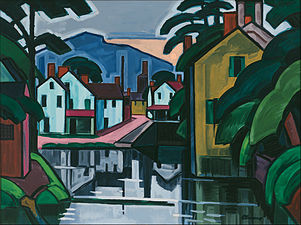 Oscar Florianus Bluemner, Old Canal Port, (1914)
 -
 Theodore Robinson, Etude, (1890)
 -
 Maurice Prendergast, Central Park, 1900, (1900)
 -
 George Luks, Armistice Night, (1918)
 -
 Edward Hopper, New York Interior, c. 1921
 -
 George Bellows, Dempsey and Firpo, (1924)
 -
 Charles Demuth, My Egypt, 1927
 -
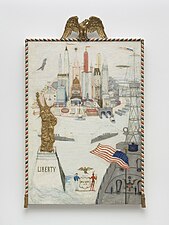 Florine Stettheimer, New York/Liberty, 1918-1919
 -

-
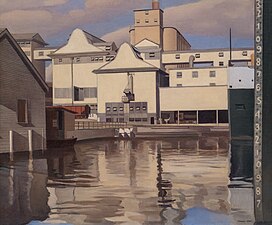 Charles Sheeler, River Rouge Plant, 1932
 -
 Edward Hopper, Early Sunday Morning, 1930
 -
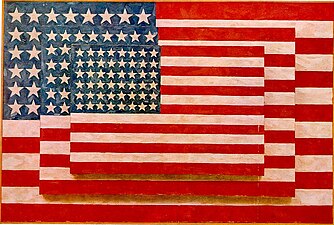 Jasper Johns, Three Flags, 1958
 -
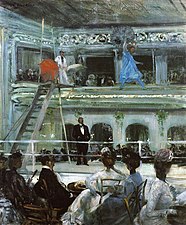 William Glackens, Hammerstein's Roof Garden, c. 1901
 -
 Georgia O'Keeffe, Summer Days, 1936

.jpg)


.jpg)


.jpg)
.jpg)


Library[edit]
The Frances Mulhall Achilles Library is a research library originally built on the collections of books and papers of founder Gertrude Vanderbilt Whitney, and the Whitney Museum's first director, Juliana Force. The library operates in the West Chelsea area of New York City.[42] It contains Special Collections and the Whitney Museum Archives. The archives[43] contain the Institutional Archives, Research Collections, and Manuscript Collections. The Special Collections consist of artists' books, portfolios, photographs, titles in the Whitney Fellows Artist and Writers Series (1982–2001), posters, and valuable ephemera that relate to the permanent collection. The Institutional Archives include exhibition records, photographs, curatorial research notes, artist's correspondence, audio and video recordings, and trustees' papers from 1912 to the present.
Highlights:
- Arshile Gorky research collection, 1920s–1990s
- Edward Hopper research collection, 1894–2000
Books and materials in the library can be accessed in the museum's database.[42]
Independent Study Program[edit]
The Whitney Independent Study Program (ISP) was founded in 1968 by Ron Clark.[44] The Whitney ISP has helped start the careers of artists, critics, and curators including Jenny Holzer, Andrea Fraser, Julian Schnabel, Kathryn Bigelow, Roberta Smith, and Félix González-Torres, as well as many other well-known cultural producers. The program includes both art history and studio programs. Each year, the ISP selects 14 students for the Studio Program (artists), four for the Curatorial Program (curators) and six for the Critical Studies Program (researchers). It is a one-year program that includes both visiting and hired artists, art historians, and critics, and involves the reading of theory. Clark retired in 2023; its incoming director is Gregg Bordowitz.
Notable alumni[edit]
1960s[edit]
|
1970s[edit]
|
|
|
1980s[edit]
|
|
|
1990s[edit]
|
|
|
2000s[edit]
|
|
|
2010s[edit]
|
|
Governance[edit]
Funding[edit]
As of March 2011, the Whitney's endowment was $207 million; the museum expected to raise $625 million from its capital campaign by 2015.[45] As of June 2016, the endowment had grown to $308 million.[46]
Historically, the operating performance has been essentially breakeven.[47] The museum restricts the use of its endowment fund for yearly operating expenses to 5% of the fund's value.[21] The Whitney has historically depended on private collectors and donors for acquisitions of new art.[48] In 2008, Leonard A. Lauder gave the museum $131 million, the biggest donation in the Whitney's history.[48][49] Donations for new purchases dropped to $1.3 million in 2010 from $2.7 million in 2006.[45]
Directors[edit]
The museum's director is Scott Rothkopf (since 2023).[2] Former directors include Adam D. Weinberg (2003–2023), Maxwell L. Anderson (1998–2003), David A. Ross (1991–1997), Thomas Armstrong III (1974–1990), and Juliana Force (1931–1948).[50]
Board of trustees[edit]
For years, Gertrude Vanderbilt Whitney supported the museum single-handedly, as did her daughter, Flora Whitney Miller, after her, and until 1961, its board was largely family-run. Flora Payne Whitney served as a museum trustee, then as vice president. From 1942 to 1974, she was the museum's president and chair, after which she served as honorary chair until her death in 1986. Her daughter Flora Miller Biddle served as president until 1995. Her book The Whitney Women and the Museum They Made was published in 1999.[51]
In 1961, the need for outside support finally forced the board to add outside trustees, including bankers Roy Neuberger and Arthur Altschul. David Solinger became the Whitney's first outside president in 1966.[24]
Controversies[edit]

The Board of Trustees has come under criticism since November 2018 by groups including Decolonize This Place, the Chinatown Art Brigade, and W.A.G.E., for vice chair Warren B. Kanders' ownership of the company Safariland, which manufactured tear gas used against the late-2018 migrant caravans;[52] 120 scholars and critics published an open letter to the Whitney Museum asking for the removal of Kanders from the museum board; additional signatories after the letter's initial posting included almost 50 artists who have been selected for the 2019 Whitney Biennial.[53] A series of nine weeks of protest by Decolonize This Place highlighted the use of Safariland weapons against protestors and others in Palestine and other places.[54]
On July 17, 2019, calls for Kanders's resignation were renewed following Artforum's publication of an essay, "The Tear Gas Biennial", by Hannah Black, Ciarán Finlayson, and Tobi Haslett.[55] On July 19, four artists (Korakrit Arunanondchai, Meriem Bennani, Nicole Eisenman, and Nicholas Galanin) published a letter, also in Artforum, asking their work to be withdrawn from the exhibition.[56] (The first artist to withdraw was Michael Rakowitz, who withdrew his work before the Biennial opened.) A day later, a second wave of artists (Eddie Arroyo, Christine Sun Kim, Agustina Woodgate, and Forensic Architecture) also withdrew.[57]
On July 25, 2019, Warren B. Kanders announced his resignation from the Board of Trustees of the Whitney Museum.[58] Kanders cited no wish to play a role in the museum's demise and urged fellow trustees to step up and assume leadership of the Whitney.[59]
See also[edit]
- Whitney Museum of American Art (original building)
- List of museums and cultural institutions in New York City
- List of Whitney Biennial artists
- Whitney Biennial
- The Catalog Committee
References[edit]
- Citations
- ^ Cheshire, Lee; da Silva, José; Research by Lillie Ellen Moller and Robert Palk (March 26, 2024). "The 100 most popular art museums in the world—blockbusters, bots and bounce-backs". The Art Newspaper. Retrieved March 26, 2024.
- ^ a b "Institutional Archives". Whitney Museum of American Art. Retrieved June 22, 2023.
- ^ Smith, Roberta (April 30, 2015). "New Whitney Museum Signifies a Changing New York Art Scene". The New York Times. ISSN 0362-4331. Retrieved June 19, 2023.
- ^ Reinhard, Scott; Watkins, Derek; DeSANTIS, ALICIA; Taylor, Rumsey; Mitter, Siddhartha (July 5, 2019). "Where Does Major American Art Come From? Mapping the Whitney Biennial". The New York Times. ISSN 0362-4331. Retrieved January 19, 2024.
the most prestigious American contemporary exhibition
- ^ Kelly, By Brian P. "Whitney Biennial 2024 Review: Reality Check". The Wall Street Journal. Retrieved March 14, 2024.
The most significant—and longest-running—survey of contemporary American art
- ^ Vartanian, Hrag; Haddad, Hrag Vartanian, Valentina Di Liscia, Natalie (March 14, 2024). "First Impressions From the 2024 Whitney Biennial". Hyperallergic. Retrieved March 14, 2024.
As the Whitney Museum's signature event, the Biennial is a highly anticipated exhibition that often acts as a barometer of trends and ideas percolating in global art communities, as told through an American lens.
{{cite web}}: CS1 maint: multiple names: authors list (link) - ^ Singerman, Howard (February 1, 2004). "IN THEORY & PRACTICE: A HISTORY OF THE WHITNEY INDEPENDENT STUDY PROGRAM". Artforum. Retrieved January 19, 2024.
- ^ "Independent Study Program (ISP)". Whitney Museum of American Art. Retrieved January 19, 2024.
- ^ Cheshire, Lee; da Silva, José; Research by Lillie Ellen Moller and Robert Palk (March 26, 2024). "The 100 most popular art museums in the world—blockbusters, bots and bounce-backs". The Art Newspaper. Retrieved March 26, 2024.
- ^ "Whitney Museum of American Art". The Saatchi Gallery. Retrieved April 17, 2016.
- ^ "Breuer's Whitney: An Anniversary Exhibition". Whitney Museum of American Art. 1996. p. 4. Retrieved March 12, 2021.
- ^ Dunlap, David W. (May 16, 2016). "Art Studios Where Whitney Museum Was Born Will Admit Visitors". New York Times. Retrieved July 12, 2016.
- ^ Scott, Andrea K. (March 12, 2016). "Inside the Breuer Building, After the Whitney and Before the MET". The New Yorker. Retrieved July 12, 2016.
- ^ The Biography of Wilhelmina Weber Furlong: The Treasured Collection of Golden Heart Farm by Clint B. Weber, ISBN 0-9851601-0-1, ISBN 978-0-9851601-0-4
- ^ The Whitney Museum Library archival items number 15405
- ^ "Whitney Museum of American Art | History, Collection, New York, & Facts | Britannica". October 25, 2023.
- ^ a b New York City Landmarks Preservation Commission; Dolkart, Andrew S.; Postal, Matthew A. (2009). Postal, Matthew A. (ed.). Guide to New York City Landmarks (4th ed.). New York: John Wiley & Sons. ISBN 978-0-470-28963-1., p.54
- ^ Berman, Avis (1990). Rebels on Eighth Street: Juliana Force and the Whitney Museum of American Art. New York: Atheneum. ISBN 9780689120862.
- ^ Allen, Greg (September 2, 2010). "MoMA On Fire". greg.org. Retrieved January 26, 2014.
- ^ a b Gray, Christopher (November 14, 2010). "The Controversial Whitney Museum". The New York Times.
- ^ a b c d Vogel, Carol; Taylor, Kate (April 11, 2010). "Rift in Family as Whitney Plans a Second Home". New York Times.
- ^ Anagnost, Adrian (2020). "Decentralize! Art, Power, and Space in the New York Art World". Konsthistorisk Tidskrift/Journal of Art History. 89 (2): 100–125. doi:10.1080/00233609.2020.1758205. S2CID 221065038.
- ^ a b Brenson, Michael (February 23, 1986). "Museum And Corporation – A Delicate Balance". New York Times.
- ^ a b Glück, Grace (December 4, 1988). "Mogul Power At The Whitney". New York Times.
- ^ William Grimes (June 22, 2011), Thomas N. Armstrong III, Museum Chief Who Once Led the Whitney, Dies at 78, New York Times.
- ^ https://www.nytimes.com/1988/04/16/arts/the-whitney-returns-to-downtown.html
- ^ Carol Vogel (April 15, 2003), Whitney Scraps Expansion Plans New York Times.
- ^ Carol Vogel (May 13, 2003), Director of the Whitney Resigns New York Times.
- ^ Hard, Ali (March 28, 2011). "Zagat Buzz Blog: Danny Meyer's Untitled Debuts in The Whitney, March 28, 2011". Zagat.com. Retrieved January 8, 2013.
- ^ "Whitney Museum building by Renzo Piano gets its design right". Boston Globe. May 2, 2015. Retrieved May 2, 2015.
- ^ "The Building". whitney.org. Retrieved December 6, 2022.
- ^ Ellie Stathaki (October 16, 2013), Under Construction: The Whitney Museum's new HQ by Renzo Piano in New York Wallpaper.
- ^ Vogel, Carol (June 6, 2013). "The Museum Elevator as Immersive Art". New York Times.
- ^ a b c Smith, Roberta (April 30, 2016). "New Whitney Museum Signifies a Changing New York Art Scene". New York Times. Retrieved May 1, 2015.
- ^ Brooks, Katherine (May 1, 2015). "12 Things To Search For At The Brand New Whitney Museum". Huffington Post. Retrieved May 2, 2015.
- ^ Vogel, Carol (May 11, 2011). "Met Plans to Occupy the Whitney's Uptown Site". New York Times.
- ^ Harris, Gareth (January 1, 2016), "The Year Ahead: museums opening in 2016", The Art Newspaper, retrieved January 5, 2016
- ^ "New Whitney Museum makes waves on social media". Wall Street Journal Blog. May 1, 2015. Retrieved May 1, 2015.
- ^ "Collection". whitney.org. Retrieved January 3, 2020.
- ^ Lowry, Katharine (June 7, 1976). "The Show Of Muscles At The Whitney Was Vitiated By – 06.07.76 – SI Vault". Sportsillustrated.cnn.com. Retrieved January 8, 2013.
- ^ Pogrebin, Robin (January 26, 2011). "The Permanent Collection May Not Be So Permanent". New York Times.
- ^ a b "library.whitney.org". library.whitney.org. Retrieved January 26, 2014.
- ^ "Whitney Museum of American Art: Archives". Whitney.org. Retrieved January 26, 2014.
- ^ "Independent Study Program". whitney.org.
- ^ a b Sarah Frier and Michelle Kaske (July 13, 2011), NYC’s Whitney Museum Pares Yield on Doubled Demand: Muni Credit Bloomberg.
- ^ 2016 Financial Statement Retrieved April 21, 2018
- ^ Fitch Rates the Whitney Museum of American Art, (NY) Revenue Bonds 'A'; Outlook Stable Reuters, June 23, 2011.
- ^ a b Pogrebin, Robin; O'Brien, Timothy L. (December 5, 2004). "ollectors as donors". New York Times.
- ^ Vogel, Carol (March 19, 2008). "Whitney Museum to Receive $131 Million Gift". New York Times.
- ^ Art: Whitney & Force Time magazine.
- ^ Arcade Publishing ISBN 978-1-55970-594-3
- ^ Greenberger, Alex (January 26, 2019). "'Whitney Museum, Shame on You': Decolonize This Place Holds Town Hall on Warren B. Kanders Controversy". ARTnews. Retrieved January 28, 2019.
- ^ "Almost 50 Whitney Biennal Artists Sign Letter Demanding Removal of Warren Kanders from Museum Board". Hyperallergic. April 29, 2019. Retrieved April 30, 2019.
- ^ "A Heated Fifth Week of Protest at the Whitney Museum Centers Palestinian Liberation". Hyperallergic. April 20, 2019. Retrieved April 30, 2019.
- ^ "The Tear Gas Biennial". www.artforum.com. July 17, 2019. Retrieved July 28, 2019.
- ^ "A Letter from Artists in the Whitney Biennial". www.artforum.com. July 19, 2019. Retrieved July 28, 2019.
- ^ "Warren Kanders Resigns From Whitney Museum Board After Months of Controversy and Protest [UPDATED]". Hyperallergic. July 26, 2019. Retrieved July 28, 2019.
- ^ "Marching right along". newcriterion.com. Retrieved October 7, 2019.
- ^ Pogrebin, Robin; Harris, Elizabeth A. (July 25, 2019). "Warren Kanders Resigns as Whitney Trustee After Protests Over Tear Gas". The New York Times. ISSN 0362-4331. Retrieved July 25, 2019.
External links[edit]
- Official website
- Whitney Museum Library
- Artport: The Whitney Museum Portal to Net Art
- Conservation Lab Interiors
- Whitney Museum within Google Arts & Culture
 Media related to Whitney Museum of American Art at Wikimedia Commons


- Whitney Museum of American Art
- Art museums and galleries established in 1931
- Buildings and structures completed in 1966
- Whitney family
- Museums of American art
- Art museums and galleries in New York City
- Museums in Manhattan
- Modern art museums in the United States
- Meatpacking District, Manhattan
- 1931 establishments in New York City
- Art museums and galleries established in 2015
- Renzo Piano buildings
- Modernist architecture in New York City
- Contemporary art galleries in the United States